5G technology is the fifth generation of cellular networking. Your phone sends and receives data over a carrier's radio network, which connects through network equipment to the internet or another service. The newer 5G radio can carry more traffic and support lower delay under the right conditions. But a 5G symbol doesn't tell you the band, whether the network uses a 5G core, or what speed you'll get inside your home.
This article is part of the consumer technology guide library.
What is 5G technology in plain language?
5G is a set of mobile-network standards for connecting compatible devices. Its radio interface is called New Radio, or NR. Think of NR as the wireless stretch between your phone and a nearby cell site; beyond that site, the operator's transport and core network handle the session and send your data onward. The term 5G covers more than a handset chip or a tower with extra antennas. It also describes how the network can be built and managed.
A new generation doesn't erase the old one overnight. Many 5G phones still use LTE, often called 4G, where 5G service is weak or unavailable. What matters to you is whether the particular device, SIM or eSIM, plan and local network can work together. The smartphone overview explains where the modem and SIM fit into the rest of the phone; this page stays with the cellular connection itself.
How does a 5G connection reach a website?
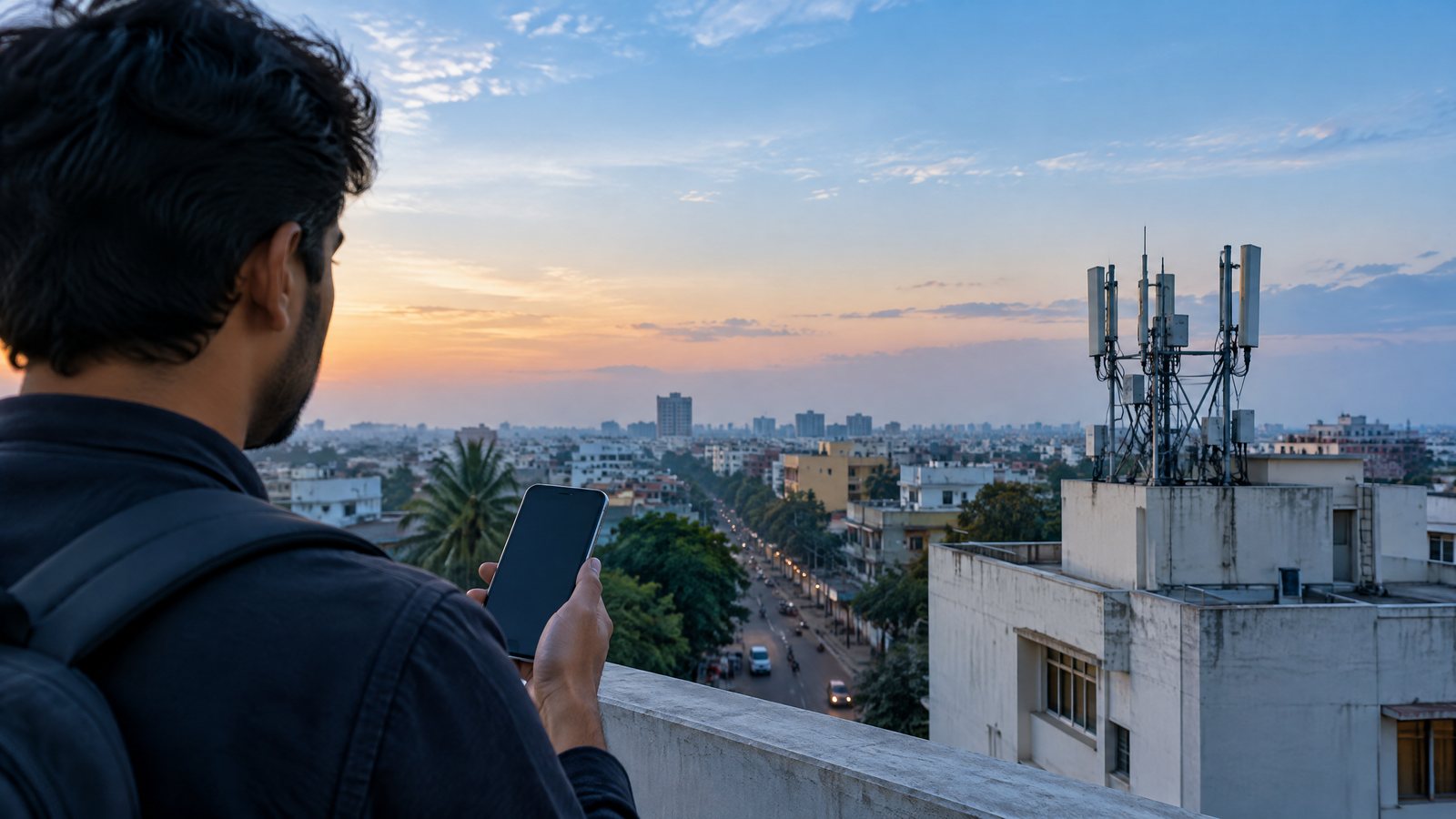
Imagine opening a page while waiting for a train. The browser asks for data; the phone's modem and antennas exchange radio signals with a suitable cell site. From there, traffic travels through the operator's transport network and core to the data network that hosts the site. The reply follows the route back. A SIM or eSIM identifies your subscription to the carrier, but it is not itself a source of radio coverage.
3GPP calls the 5G radio interface NR and names the standalone base station a gNB. Some connections use a 5G core; others pair 5G radio with existing 4G infrastructure. You don't need to memorize the abbreviations to diagnose a slow page. This journey makes one point clear: the radio is only one stretch. Congestion, an overloaded server, the operator's backhaul and your device can all affect the wait you notice.
- Your app requests data; the phone modem selects an available cellular connection.
- Phone and cell site exchange data over the relevant radio interface.
- Carrier transport and core networks route the session toward the data service.
- The response returns; your app still has to process and show it.
5G standalone vs non-standalone: what changes?
Non-standalone, or NSA, combines 5G New Radio with LTE radio and an existing 4G core. That let operators add a 5G radio path without replacing every part of their network first. Standalone, or SA, uses the 5G radio with a 5G core. 3GPP defines these as different deployment options. On an NSA connection, LTE can be the anchor, so a displayed 5G icon alone can't prove an end-to-end SA connection.
SA makes 5G-core features possible, including network-slicing arrangements and other service controls. Possible is doing work here: the operator must deploy and configure those capabilities, and the device and service must support them. Neither SA nor NSA promises a fixed browsing speed at your location. If your carrier offers a setting labelled 5G Standalone, treat it as a supported-network option, not a switch that creates local coverage.
| Network arrangement | 5G radio path | Network core | What the label cannot promise |
|---|---|---|---|
| Non-standalone (NSA) | NR alongside LTE; LTE may anchor the session | Existing 4G/EPC core | A particular download speed or access to 5G-core-only features |
| Standalone (SA) | NR connection to a standalone 5G system | 5G core | That a specific feature is enabled or that your indoor signal is strong |
What does 5G Advanced mean for a smartphone?
5G Advanced is the name 3GPP uses for the evolution of its 5G system starting with Release 18. That release includes work on energy efficiency, AI and machine learning, network slicing, satellite integration and other network capabilities. It is a standards release, not a new SIM card or a guarantee that your present phone or local tower supports every feature.
If a handset or operator advertises 5G Advanced, check which feature is supported on the exact model and network. A standards capability needs compatible equipment, configured network service and available coverage to affect your experience. It does not, by itself, make every 5G connection faster.
Low, mid and high band: why the same 5G logo can feel different
Radio frequency changes the trade-off. Low-band spectrum, often below 1 GHz, can travel farther and is useful for wider-area or indoor coverage. Mid-band can provide a useful balance of coverage and capacity across populated areas. Very-high-frequency millimetre-wave deployments can offer substantial bandwidth in a hotspot but usually require denser sites and have a harder time reaching through obstacles. The GSMA describes these as complementary layers, not three guaranteed speeds.
Picture moving from a street corner into a concrete building. Even with a 5G-capable phone, your signal, available spectrum and current load can change. One operator's band and another's band aren't identical in every city; a handset must support the relevant bands. Do not treat a nationwide coverage graphic as a promise for one room or assume that every 5G phone includes every country's high-band hardware.
| Common 5G layer | Useful strength | Common limit |
|---|---|---|
| Low band | Broader geographical or indoor reach | Less radio bandwidth may constrain capacity |
| Mid band | Balance of capacity and coverage | Real reach still depends on sites, terrain and buildings |
| High band / mmWave | High capacity in selected dense hotspots | Shorter practical reach; obstacles and site spacing matter |
Is 5G always faster than 4G?
No. 5G is designed to improve capacity and potentially reduce radio-network delay, but those are capabilities, not a personal speed contract. The ITU's IMT-2020 framework evaluates candidate radio technologies in defined conditions; a laboratory or standards target is not the result of a speed test on a crowded platform. A well-supported LTE connection may feel quicker than a weak or congested 5G one at a particular moment.
If a page loads slowly, first ask where the bottleneck might be. Is the cellular signal weak indoors? Are you sharing the cell with many people? Is the site itself responding slowly? A headline download number cannot answer those questions. Latency is the time a response takes to start travelling and return; throughput is how much data can be carried over time. A fast download doesn't guarantee low app delay, and low radio delay doesn't remove a slow distant server.
Why does my phone show 5G when the connection feels slow?
The status icon is a short carrier-and-device status label, not a live speed meter. Apple notes that its 5G icon depends on network configuration and, in rare cases, may appear without usable 5G coverage. Its 5G Auto setting can switch to LTE when 5G offers little noticeable advantage to save battery. Android icon behavior also varies by model and carrier; do not apply one iPhone menu to every handset.
For a practical check, compare the same phone and plan in the same place at different times, rather than trusting one screenshot. If your phone allows it, note whether LTE performs differently and whether indoor service changes near a window. A test uses mobile data, can be affected by background activity and is only a snapshot, not an official coverage audit. Check your device's supported bands and your plan's 5G eligibility before blaming the tower.
- Confirm the phone model supports your operator's local 5G bands and the plan is eligible.
- Separate indoor experience from the carrier's broad outdoor coverage map.
- Compare repeatable conditions; one peak reading is not representative coverage.
- If ordinary service is still poor, contact your own carrier through a channel you trust.
What does 5G mean for phone battery life and security?
It depends on the device, network and what you are doing. Apple says 5G On may reduce battery life and 5G Auto can switch to LTE when 5G isn't helping much. That does not make LTE universally more efficient in every place, and it does not mean a 5G connection damages your battery. Constant searching for usable service and long uploads can affect how a phone feels; measure your own routine before changing settings. Our separate battery guide covers cell capacity and ageing rather than claiming an exact 5G energy penalty.
5G standards include authentication and subscriber-identity privacy provisions. But the standard on the radio link is not a shield against a phishing message, a malicious app or an account takeover. An NSA setup and an SA setup also have different network security architecture. Keep phone updates, account protections and sensible app permissions in place regardless of which mobile icon appears.
Is 5G the same as 5 GHz Wi-Fi?
No. In 5G, the G means generation: fifth-generation cellular networking through a mobile operator. In 5 GHz Wi-Fi, GHz means gigahertz, a radio frequency band used by a local wireless network. A router showing a name such as MyHome-5G is not proof of cellular service. The FCC calls out this exact confusion in its consumer 5G FAQ.
Your phone may switch between mobile data and local Wi-Fi while you are using an app, but the network technologies, access points and service arrangements are different. An indoor Wi-Fi 7 connection also has its own router, channel and interference limits. If you want to diagnose a slow home connection, first check which network the phone is actually using.
How should someone in India check a 5G phone or plan?
India's Ministry of Communications reported in February 2026 that 5G service was available across most districts. A district figure says nothing certain about the signal in your building or on your street; the government also notes that expansion depends on operators' decisions. Do not mistake a national rollout statistic for a promise from a particular carrier today.
Before relying on 5G, check four practical things with information available for your own phone and area: supported handset frequency bands, an eligible SIM or eSIM and plan, the carrier's current local service, and the places where you actually use the phone. If you travel, check the separate roaming conditions. Do not buy a handset only for a large theoretical speed number or assume a 5G-enabled label guarantees SA, mmWave or coverage in every part of Gujarat.
Do you need a new 5G network SIM in India?
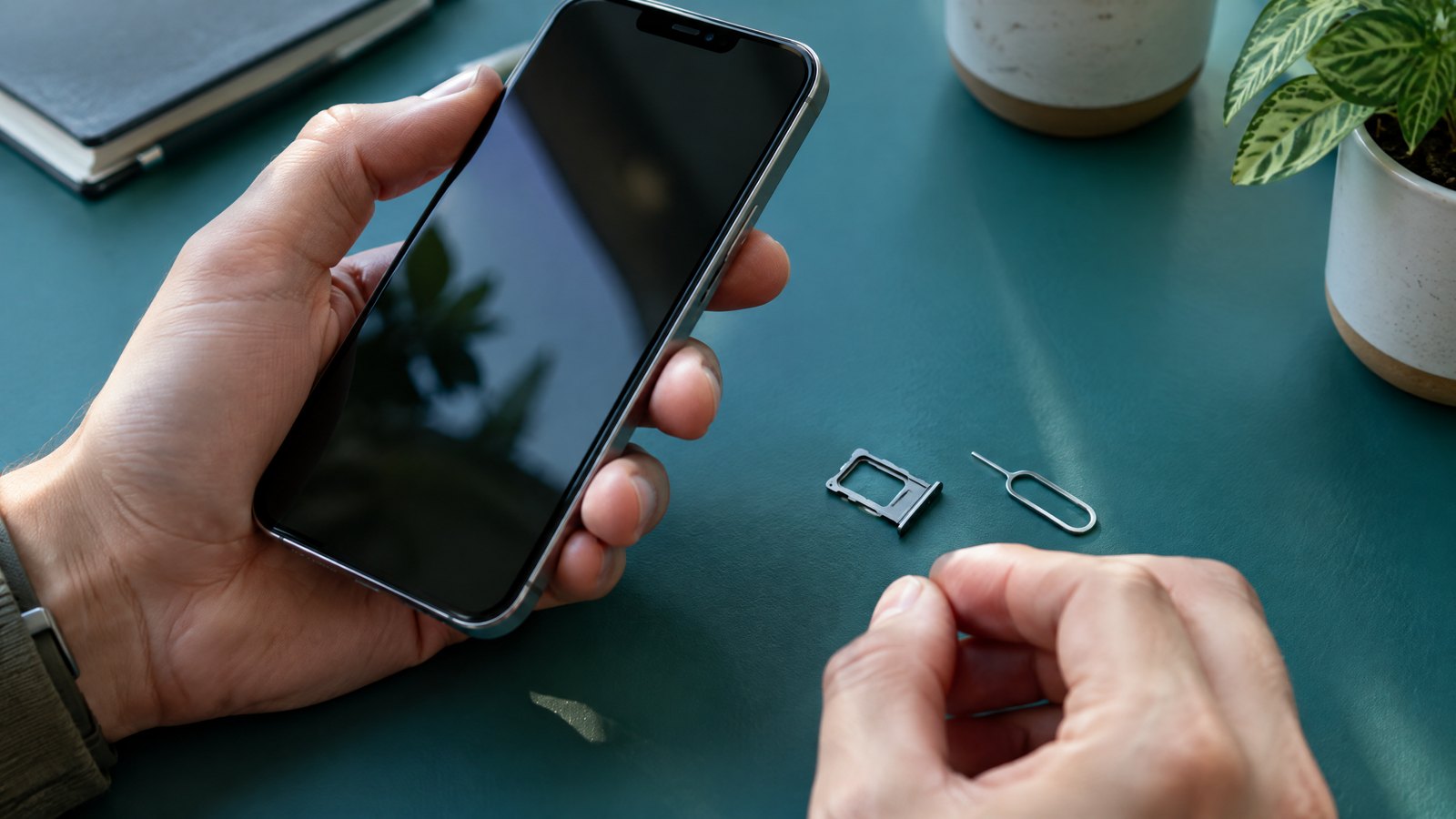
Usually you should check your current SIM before buying another. Jio says most existing Jio 4G SIMs can use its 5G service on a compatible phone with an eligible plan in a supported area. Airtel likewise says its existing 4G SIM is compatible with its 5G network. Neither statement proves that every old SIM, every plan or every device from every carrier will work. Apple's guidance says that in some cases a previous iPhone's SIM needs carrier setup. Treat the phrase '5 g network sim' as a question about service eligibility, not proof that a newly labelled card makes a phone 5G-capable.
If a 5G network icon never appears, check the phone's supported bands and software, your carrier's present service at your location, your plan, and the network setting for the active SIM or eSIM. Ask your own provider whether that specific subscription is provisioned for 5G before replacing a working SIM. A SIM identifies your subscription; the modem, network deployment and plan determine what radio service is actually available. This is a general checklist, not a promise about coverage or billing.
- Check the exact phone model's supported 5G bands and software updates.
- Confirm the current SIM or eSIM and mobile plan's 5G eligibility with your carrier.
- Check coverage where you use the phone, not only a district-wide map.
- Enable the supported 5G setting; replace the SIM only if the carrier specifically requires it.
5G technology explained: questions people actually ask
The answer often depends on your carrier, the device and the precise location, so these are general network explanations rather than a coverage or purchasing guarantee.
What is 5G technology?
5G is the fifth generation of cellular networking. A compatible phone uses 5G New Radio to reach a cell site, while the operator's transport and core network connect it to services. It can improve capacity and delay under suitable conditions; actual service varies.
How does a 5G network work?
Your phone exchanges data with a cell site over a supported radio band. The carrier's transport and core route the session to the destination and bring the response back. In non-standalone networks, 5G radio works alongside LTE and a 4G core; standalone networks use a 5G core.
Is a 5G phone always faster than a 4G phone?
No. Performance depends on available bands, signal quality, cell congestion, network backhaul, the phone and the app or server. A strong LTE connection can outperform weak or busy 5G in a specific place.
What is the difference between 5G SA and NSA?
NSA uses 5G NR radio with an LTE/4G anchor and core. SA connects 5G NR with a 5G core. SA enables different network capabilities, but it does not automatically guarantee a feature or speed for every user.
Does the 5G icon mean I have the fastest 5G band?
No. An icon is not a band, speed or standalone-core measurement. Its meaning can depend on the device and carrier; coverage, subscription and radio conditions must also line up.
Is 5G the same as my router's 5 GHz Wi-Fi?
No. 5G means fifth-generation cellular service. 5 GHz is a frequency band a local Wi-Fi router may use. They are different network technologies.
Do I need a 5G network SIM to use 5G in India?
Not necessarily. Jio and Airtel say their existing compatible 4G SIMs can access 5G when the phone, eligible plan and local coverage also support it. Other carriers or older cards may need specific provisioning; confirm your SIM or eSIM with your own provider rather than buying a replacement automatically.
Source notes
Reporting record
techduopulse stores source destinations privately. Public notes remain non-clickable so every visitor journey stays on this website.
5G architecture source note
Primary source · 5G standalone vs non-standalone: what changes?5G-Advanced Release 18 scope source note
Primary source · What does 5G Advanced mean for a smartphone?Radio-interface technical requirements and evaluation source note
Primary source · Is 5G always faster than 4G?Low-, mid- and high-band spectrum roles source note
Primary source · Low, mid and high band: why the same 5G logo can feel different5G device support and Wi-Fi name distinction source note
Primary source · Is 5G the same as 5 GHz Wi-Fi?5G status icon, eligibility and battery setting source note
Primary source · Do you need a new 5G network SIM in India?Release 15 network authentication and privacy source note
Primary source · What does 5G mean for phone battery life and security?February 2026 India district-level deployment statement source note
Primary source · How should someone in India check a 5G phone or plan?Industry analysis of ongoing SA deployment and integration source note
Context source · 5G standalone vs non-standalone: what changes?Jio existing SIM, compatible handset, plan and coverage source note
Primary source · Do you need a new 5G network SIM in India?Airtel 4G SIM compatibility source note
Primary source · Do you need a new 5G network SIM in India?Version 1: original Day 5 phone-first 5G explainer with standards-based network path, band and core distinctions, India context, practical coverage limits and private source provenance.