Smartphone battery technology stores energy in a rechargeable lithium-ion cell and uses electronics to charge it, protect it and estimate how much is left. The 5,000 mAh figure on a box describes electrical charge capacity, not a promise of two days of use. The controller, the phone's power demand and the condition of the cell all matter. If the percentage falls quickly, start by asking what that number measures before assuming the battery is faulty.
This article is part of the consumer technology guide library.
What is a smartphone battery system?
A smartphone battery system includes a rechargeable cell, electrical connections, charge and protection circuitry, and software that manages power. Inside the cell, lithium ions move between two electrodes as it charges and discharges. Electrons travel through the phone's external electrical circuit during use. A fuel gauge estimates the remaining charge; it does not look directly inside the cell. The details vary by phone.
Why include the whole system? Because the same cell can feel different depending on the display, radio signal, camera workload and software around it. A battery supplies energy; it does not decide on its own how long your screen will stay on. For that wider context, read the Smartphone Technology overview rather than treating the battery as a separate magic component.
Inside the cell: ions move, electrons power the phone
Think of the cell as two places that can hold lithium, separated by an electrolyte and a thin barrier. One electrode is the anode; the other is the cathode. The separator prevents their direct contact, while the electrolyte lets ions travel between them. When you use the phone, lithium ions generally travel from the anode to the cathode through the cell. Electrons take the outside route through the phone's circuits. Charging reverses the overall ion movement using energy from an external supply.
That description is a map, not a teardown of every handset. Argonne National Laboratory describes graphite as a common anode material and several metal oxides as possible cathode materials, but exact formulations differ. Over many cycles, cell reactions cannot be reversed perfectly; available capacity and peak-power ability eventually change. A battery is a consumable, even when you treat it carefully.
- The charging source supplies electrical energy through the phone's charging electronics.
- Lithium ions move inside the cell; electrons move through the external circuit.
- During phone use, the chemical process releases electrical energy for the phone's components.
- The cycle can be repeated, but the cell's condition changes gradually with age and use.
Why a slim phone often uses a pouch-shaped battery
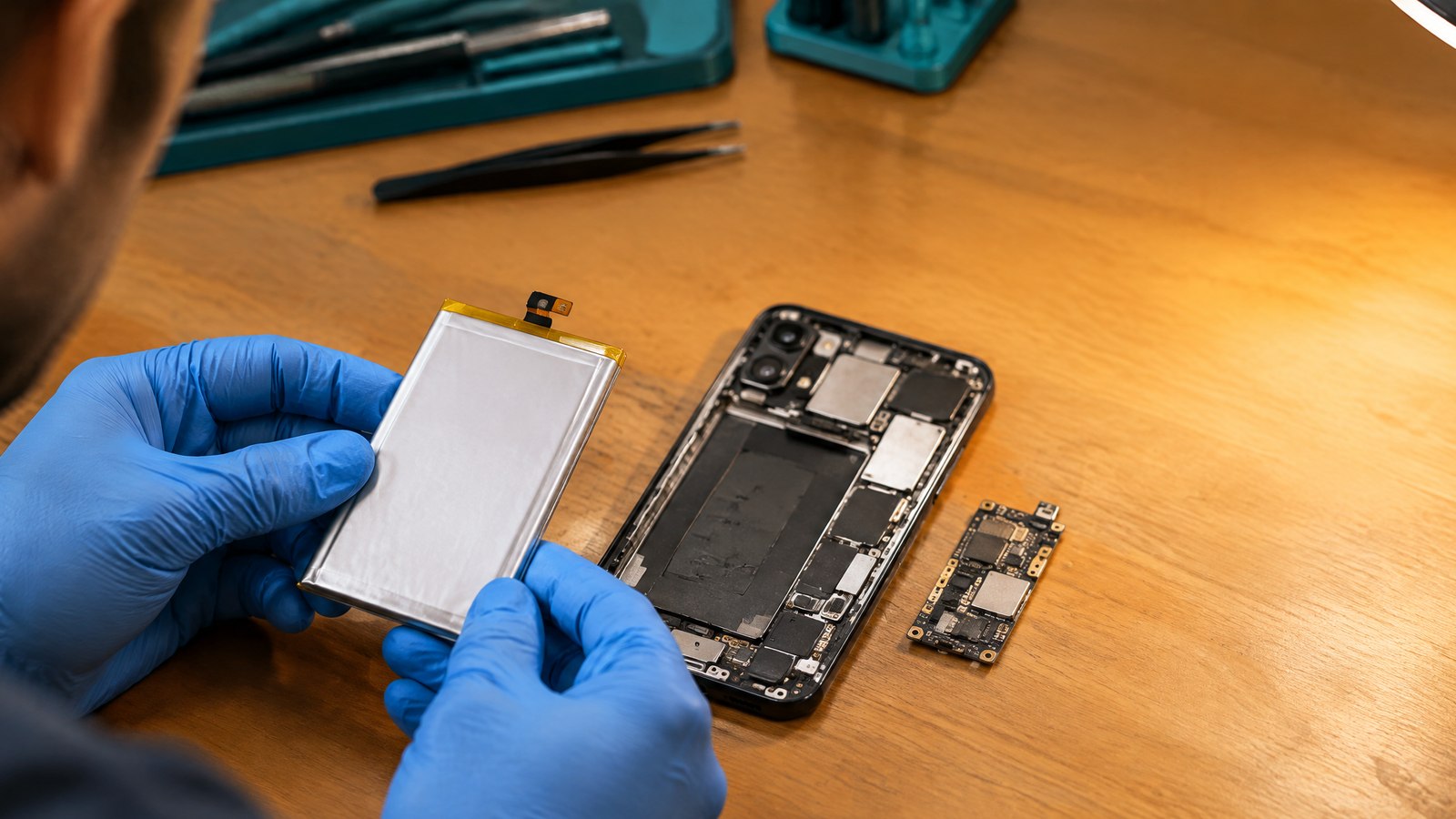
The flat silver pack a technician might see in an opened phone is often a pouch-format cell. Its flexible outer packaging fits thin spaces more easily than a rigid cylinder. Inside, electrode layers may be wound or stacked; Samsung SDI describes both manufacturing approaches. The pack is not a sealed box of liquid electricity. Its construction, electrical tabs, insulation and protective systems have to work as one product.
You may see 'Li-ion' and 'Li-polymer' used in phone specifications. Those labels alone do not prove one phone is safer, has more energy or charges faster. Chemistry, electrodes, pack design and testing differ. Treat a packaging label as a clue to construction, then look for actual capacity, energy, supported charging and service information. Do not open a phone or handle a cell as a way to check the label; repair is a trained-service job.
mAh versus Wh: what the capacity numbers really say
mAh, or milliampere-hours, measures electrical charge. Wh, or watt-hours, measures energy. To get an approximate energy number, multiply the rated mAh by the battery's nominal voltage in volts and divide by 1,000. For a purely illustrative 5,000 mAh cell rated at 3.85 V, that is about 19.25 Wh. It is arithmetic on label values, not a measurement of a named phone or the usable energy at your temperature and workload.
Voltage changes as a cell charges and discharges, and phone packs do not all have identical voltage or cell arrangements. If two devices quote 5,000 mAh at different nominal voltages, their stored energy is not necessarily equal. Wh makes a cleaner energy comparison when the specification is disclosed. Even then, battery energy is only part of runtime: your display, processor, modem, software and network conditions decide how quickly that energy is spent. Samsung SDI explains the mAh-to-Wh relationship; do not confuse watt-hours of stored energy with watts of instantaneous charging power.
| Number on a spec sheet | What it describes | What it cannot prove alone |
|---|---|---|
| 5,000 mAh | Rated charge capacity under stated test conditions. | Hours of runtime, energy across different nominal voltages, or long-term cell health. |
| 19.25 Wh (illustrative) | Approximate nominal energy for 5,000 mAh at 3.85 V. | Precisely usable energy in your phone or how quickly it will be consumed. |
| 65 W charger | A rated electrical power capability of a charger under supported conditions. | That every connected phone draws 65 W or reaches full charge in a set time. |
| 85% battery health | A device-specific estimate of retained maximum capacity compared with when new. | The present charge remaining, a safety verdict, or a universal replacement deadline. |
How charging power reaches the battery
Plugging in starts a negotiation, not a direct dump of a charger's maximum wattage into the cell. Under a compatible USB Power Delivery setup, the power source advertises capabilities and the device requests a supported level. The cable and the phone's charging hardware must also support that arrangement. Power electronics then manage voltage and current for the battery and the running phone. USB-IF documents the power-delivery protocol; it does not guarantee a particular phone's speed.
Picture a high-rated laptop adapter connected to a modest phone. The number printed on the adapter is its ceiling in certain modes, not the power the phone must draw. The phone can ask for less, or use another charging mode when protocols do not match. Its software can also reduce current because the battery is nearly full or the device is warm. That is why a timed charging claim needs a model, charger, cable, starting charge level and conditions, not a wattage headline alone.
Apple describes an iPhone charging process that is faster earlier and eases near a high charge level. Different manufacturers use different charge profiles, and Apple's example is not a universal 80% changeover rule. If you need the separate question of which USB-C cable carries which power and data modes, that has its own guide.
The controller, fuel gauge and protection circuits do different jobs
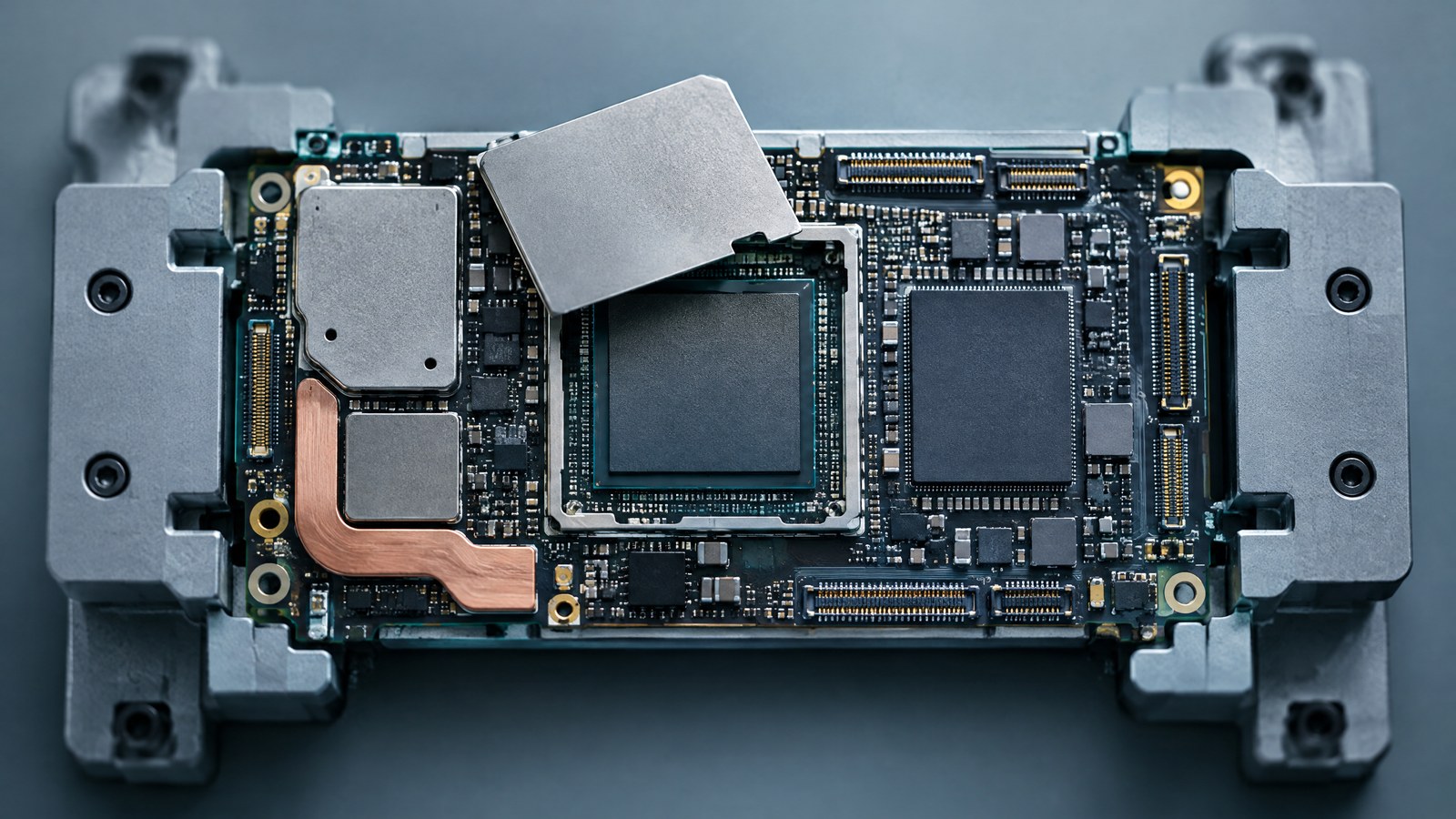
Several electronic jobs sit between the charging port, the cell and the phone. A charge controller regulates the charging process. A fuel gauge combines measurements and a cell model to estimate state of charge and, on supported devices, state of health. Protection circuitry checks for fault conditions such as excessive voltage or current. Texas Instruments lists chargers, gauges, monitors and protectors as separate design functions. A particular phone may integrate some in one chip or place them in different parts of the product.
That on-screen 42% is an estimate of the charge left under the device's algorithm, not a literal transparent window into battery chemistry. Load and temperature can change the estimate's accuracy or the phone's available power. A sudden shutdown on an ageing cell can involve its ability to supply peak power, not just its reported maximum capacity. Apple documents that relationship for iPhones; do not assume its exact software behavior applies to every Android model.
Battery percentage, battery health and charge cycles aren't interchangeable
Your status bar's percentage answers a short-term question: about how much usable charge does the phone think remains right now? Battery health answers a longer-term one: how much charge can this cell currently hold compared with when it was new, if the device offers that estimate? Charge cycles describe accumulated use equivalent to discharging a full battery's capacity. Two half-capacity discharges can add up to about one cycle; two trips to a charger do not automatically equal two cycles.
Google's Pixel documentation illustrates why a single rule is risky: some models show a health estimate or cycle count, while others do not, and model-rated cycle numbers differ. Apple's published cycle-retention conditions also vary by iPhone model. None of those product-specific numbers is a guarantee for your phone. If the device says battery health is reduced or repeated unexpected shutdowns interfere with use, check the manufacturer's service guidance rather than treating a screenshot as a diagnosis.
Why a bigger battery doesn't always mean a longer day
A 5,000 mAh sticker feels straightforward until you compare two phones at the end of a long train journey. One spends hours on a bright screen while searching for a weak signal. The other sits mostly idle on a steady connection. The first can drain sooner even if both batteries began at a similar charge. This is an illustrative situation, not a TechDuoPulse battery test or a claim about a named model.
Workload changes what the phone asks of its display, chips and radios. Battery energy is an input to runtime; software efficiency and conditions are the other side of the equation. In cold weather, a battery can also struggle to supply an instantaneous power demand even while the remaining-charge estimate looks plausible. If you are comparing phones, seek independent battery tests that disclose brightness, network, workload, temperature and age. One manufacturer's mAh figure is a capacity specification, not that test result.
A calmer way to read a phone's battery specifications
Start with the question you actually have. Need to compare stored energy across different pack designs? Ask for Wh or find both mAh and nominal voltage. Need to know whether charging works with your existing adapter? Check the phone's named protocol and cable requirements. Need to know whether it lasts through your routine? Look for repeatable real-world tests, not an adjective on a product page.
The same restraint helps with battery health. A displayed estimate is useful for tracking changes, but a daily one-point shift is not a forensic measurement. Model-specific support and a persistent, noticeable runtime or shutdown problem provide better context for a service decision. Keep the charging-habits discussion with our separate longevity article, where temperature and wear can be explained without turning this hardware guide into a second version of it.
- Compare energy with Wh when the phone publishes it; otherwise check the nominal voltage alongside mAh.
- Match the phone, adapter and cable's supported charging modes, rather than only the largest watt figure.
- Distinguish remaining charge (%) from estimated retained capacity (battery health).
- For runtime claims, demand a disclosed workload and test environment; for cell wear, follow model-specific support guidance.
What if the battery looks damaged or swollen?
This guide explains a power system, not how to open or repair one. A lifted screen, swollen pack, puncture, unusual smell or persistent overheating needs careful attention. Don't squeeze a bulging phone, pry out the cell or keep experimenting with chargers to see whether it settles down. Google's Pixel support specifically warns against pressing an exposed or swollen battery and advises contacting appropriate service or recycling channels. Follow the guidance for your exact model; do not put a damaged lithium-ion pack in ordinary household waste.
If your concern is simply shorter runtime, a professional battery check may be appropriate. If there are signs of physical damage, stop using and charging the device where safe and seek qualified support. None of the capacity calculations above can tell you that a compromised cell is safe.
Smartphone battery technology FAQs
These are general engineering explanations, not charging instructions for a particular handset.
How does a smartphone battery work?
A rechargeable lithium-ion cell stores energy chemically. Lithium ions move through the cell between electrodes while electrons travel through the external circuit to power the phone. Charging reverses the overall process; phone electronics manage charging, monitoring and protection.
Is a 5,000 mAh battery always better than a 4,500 mAh battery?
No. mAh is electrical charge capacity. Nominal voltage affects stored energy in Wh, and the display, radio, chip workload, software, temperature and age affect runtime. Compare disclosed energy and repeatable tests before drawing a conclusion.
What is the difference between mAh and Wh?
mAh expresses electrical charge. Wh expresses energy and accounts for nominal voltage: approximately mAh multiplied by nominal volts, divided by 1,000. Wh does not tell you the charging speed; watts (W) express power.
Does a 65 W charger make every phone charge at 65 W?
No. That rating is a charger capability under supported conditions. Actual charging depends on the device's supported protocol and limits, the cable, state of charge and temperature. Power often falls as charging progresses.
Does charging twice mean two battery cycles?
No. A cycle counts accumulated discharge equivalent to about one full battery capacity. Partial uses add up over time; a plug-in event alone is not a completed cycle.
Source notes
Reporting record
techduopulse stores source destinations privately. Public notes remain non-clickable so every visitor journey stays on this website.
USB Power Delivery overview
Primary source · How charging power reaches the batteryBattery electrodes, electrolyte and electron/ion paths source note
Primary source · Inside the cell: ions move, electrons power the phoneLithium-ion cell mechanism and separator source note
Primary source · Inside the cell: ions move, electrons power the phonePhone battery pouch-format construction source note
Primary source · Why a slim phone often uses a pouch-shaped batteryCapacity units and nominal energy conversion source note
Primary source · mAh versus Wh: what the capacity numbers really sayCharger, monitor and protection functions source note
Primary source · The controller, fuel gauge and protection circuits do different jobsState-of-charge and state-of-health estimate source note
Primary source · The controller, fuel gauge and protection circuits do different jobsiPhone charge-cycle and two-stage charging source note
Primary source · Battery percentage, battery health and charge cycles aren't interchangeableCapacity and peak-power ageing source note
Primary source · Battery percentage, battery health and charge cycles aren't interchangeableModel-specific health estimates and damaged-battery handling source note
Primary source · What if the battery looks damaged or swollen?Charging taper and temperature control source note
Primary source · How charging power reaches the batteryVersion 1: Day 4 hardware-first smartphone battery explainer with primary-source cell science, a worked nominal-energy example, controller/gauge distinctions and a strict boundary from the existing battery-care guide.