
Skip to content
techduopulse
Newsletter
HomeLatestAnalysisAI & MLHardwareSoftwareSecurityCloud

Intelligence

AI Technology & Machine Learning Guides

Independent guides to artificial intelligence technology, machine learning lifecycles, model evaluation, monitoring, deployment, and responsible AI.

30Stories in this field

Coverage areas

machine learning lifecyclemodel monitoringdata driftAI evaluation

Related systems

software engineering technologiescloud infrastructure technologycybersecurity technology
AI-generated editorial illustration of an unbranded laptop, phone, folders and a physical key in a small-business planning workspace; not a Claude Duet screenshot or real user photograph.Explainer
Artificial Intelligence22 Oct 2026

Claude Duet: What It Is, Who Can Use It and Is It Available in India?

Anthropic's new Claude Duet app works in the background and brings you tasks before you ask. Here is what Anthropic says it does, why it is not available to Indian accounts yet, and what to check before connecting work accounts.


By techduopulse Editorial Desk7 min
A researcher reviews blank paper drafts at a library table beside an unbranded laptop.Explainer
Artificial Intelligence8 Oct 2026

GPT Models Explained: What They Are and How They Differ From ChatGPT

A plain-English guide to the AI models behind GPT, how an app uses them, and why ChatGPT is not simply another name for the model.

By techduopulse Editorial Desk8 min
An analyst reflects on paper notes at a quiet cafe table in natural daylight.Explainer
Artificial Intelligence8 Oct 2026

Claude AI Models Explained: What They Are, Model Types and Coding Uses

Claude is a family of AI models, not one fixed product. Learn what the model lines mean, where coding fits, and what to check before relying on an answer.

By techduopulse Editorial Desk8 min
A creator reviews a camera and microphone on a bright studio desk.Explainer
Artificial Intelligence8 Oct 2026

Google Gemini Models Explained: What They Are and How They Differ From the App

Gemini is a family of Google AI models, not just the chat interface with the same name. Learn what a model does, how the app and API differ, why model labels change, and where Gemma fits.

By techduopulse Editorial Desk8 min
Four researchers work through unmarked cards around a shared table.Explainer
Artificial Intelligence8 Oct 2026

Llama AI Models Explained: Open Weights, Local Use and the App Difference

Llama is a family of Meta AI models, not one chatbot. Learn what open weights mean, how an app differs from a model, and what local running really involves.

By techduopulse Editorial Desk8 min
A researcher looks across a workspace toward a window above a closed laptop.Explainer
Artificial Intelligence8 Oct 2026

DeepSeek AI Models Explained: Reasoning Mode, App and API

DeepSeek can mean a chat app, an API or an underlying language model. Here is how those layers differ, what thinking mode actually changes and the limits to keep in mind.

By techduopulse Editorial Desk8 min
Two colleagues discuss blank documents beside a microphone and laptop.Explainer
Artificial Intelligence8 Oct 2026

Qwen AI Models Explained: Thinking, Instruct and Multilingual Use

Qwen is a family of Alibaba Group AI models, not one single chatbot. Learn how its thinking, instruct and multilingual capabilities differ, where the app fits, and what to verify before relying on an answer.

By techduopulse Editorial Desk7 min
A developer checks an unbranded small device by an overcast window.Explainer
Artificial Intelligence8 Oct 2026

Mistral AI Models Explained: General-Purpose, Specialist and Open-Weight Options

Mistral is a model family, not one chatbot. Learn how its general-purpose and specialist models differ, what open weight really means, and where an app or API fits in.

By techduopulse Editorial Desk8 min
A journalist reviews paper notes alone in a daylight newsroom.Explainer
Artificial Intelligence8 Oct 2026

Grok AI Models Explained: What the Model, Service and Search Tools Do

Grok can mean a response-generating model, a consumer AI service or a search-enabled workflow. This guide shows you how to tell those layers apart and when the difference matters.

By techduopulse Editorial Desk8 min
A developer assembles a small unbranded computer kit on a workbench.Explainer
Artificial Intelligence8 Oct 2026

Google Gemma Models Explained: Open Weights, Uses and Gemini Difference

Gemma is Google’s open-weight model family for builders, not a single chatbot. See what that changes, how it relates to Gemini, and where careful testing still matters.

By techduopulse Editorial Desk8 min
A researcher carries a compact computer through a sunlit makerspace.Explainer
Artificial Intelligence8 Oct 2026

Microsoft Phi Models Explained: Small AI for Focused, Local Tasks

Microsoft Phi is a family of small language models, not a single chatbot. Here is what that means for local AI, app builders, and anyone wondering whether Phi belongs on a phone.

By techduopulse Editorial Desk8 min
An engineer inspects cooling equipment in a brightly lit technical room.Explainer
Artificial Intelligence8 Oct 2026

NVIDIA Nemotron Models Explained: Open Models for AI Agents

NVIDIA Nemotron is a family of models for building AI systems. Here is what the models do, why agents use them, and where the limits begin.

By techduopulse Editorial Desk8 min
A language researcher arranges blank cards on a worktable.Explainer
Artificial Intelligence8 Oct 2026

GLM AI Models Explained: Text, Vision, and the Z.ai Platform

A plain-English guide to Z.ai’s GLM model family, including what a model is, what multimodal GLM models can take as input, and why you should test a feature in your own workflow.

By techduopulse Editorial Desk7 min
A researcher compares unmarked source documents under a library skylight.Explainer
Artificial Intelligence8 Oct 2026

What Is a Kimi AI Model? K3, Long Context and the Kimi Chatbot Explained

Kimi can mean a model family, a chat experience or a developer platform. Here is how the current Kimi models differ, what long context actually means, and where to be cautious.

By techduopulse Editorial Desk8 min
Two office colleagues review a blank form next to a filing cabinet.Explainer
Artificial Intelligence8 Oct 2026

IBM Granite AI Models Explained: Language, Embeddings and More

IBM Granite is a family of task-specific AI models, not one chatbot. Here is how its language, embedding, vision, speech and safety models fit into a practical workflow.

By techduopulse Editorial Desk8 min
Two information workers review a plain folder in a quiet records room.Explainer
Artificial Intelligence8 Oct 2026

Cohere Command Models Explained: Generation, Embed and Rerank

Cohere Command is a generation-model family for turning instructions and supplied context into text. Learn where it fits in an AI application, how it differs from Embed and Rerank, and what to verify before relying on its output.

By techduopulse Editorial Desk8 min
A small studio team plans with an unbranded camera and microphone.Explainer
Artificial Intelligence8 Oct 2026

Amazon Nova AI Explained: Models, Bedrock and What Each One Does

Amazon Nova is a family of AWS AI models, while Amazon Bedrock is the platform used to call them. Here is how the main model roles, inputs and limits fit together.

By techduopulse Editorial Desk8 min
An artist studies color swatches and a blank canvas in a daylight studio.Explainer
Artificial Intelligence8 Oct 2026

Stable Diffusion Models Explained: The Model, the App and the Images

Stable Diffusion is an AI image-model family, not one universal website. Learn how prompt-guided image generation works, why apps can feel different, and what to check before you trust or use an output.

By techduopulse Editorial Desk8 min
A photographer adjusts a reflector beside an unmarked studio backdrop.Explainer
Artificial Intelligence8 Oct 2026

FLUX AI Image Models Explained: Models, Apps, Licensing and Limits

FLUX is a Black Forest Labs model family, not one fixed image generator or every app that uses it. Learn what the image models do, how API and self-hosted routes differ, and what to check before using generated visuals.

By techduopulse Editorial Desk9 min
A film editor considers blank storyboards beside an inactive monitor.Explainer
Artificial Intelligence8 Oct 2026

Google Veo explained: the AI video model, Google Flow and its real limits

Google Veo is a generative video model, not the same thing as Google Flow. Here is what the model is documented to do, where product features fit and why you should still review every clip.

By techduopulse Editorial Desk7 min
A creative team considers plain colored-paper swatches around a studio table.Explainer
Artificial Intelligence8 Oct 2026

Adobe Firefly models explained: the creative AI family and the Firefly app

Adobe Firefly can mean Adobe’s creative AI model family or the workspace that lets you use it. Here is how to tell native models, partner choices and practical limits apart.

By techduopulse Editorial Desk7 min
Two people review blank planning notes at a kitchen table in morning light.Explainer
Artificial Intelligence8 Oct 2026

What Is ChatGPT? How the App Works, Its Limits and Its Link to GPT Models

ChatGPT is an AI application, not the name of one single model. Learn what happens when you ask it a question, when its tools matter, and why its answers still need checking.

By techduopulse Editorial Desk8 min
Two engineers examine printed document excerpts and a retrieval test workstation beside a softly lit server rack in a realistic evaluation lab.Explainer
Artificial Intelligence7 Sept 2026

Retrieval-augmented generation: the production failure modes teams must test

A retrieval-augmented generation system can fail before a model writes a word. A practical test program should inspect the corpus, retrieval step, context assembly, response, and monitoring loop.

By techduopulse Editorial Desk9 min
Two software operators review a printed AI action ledger and a physical permission-control board in a realistic, teal-lit operations room.Guide
Artificial Intelligence7 Sept 2026

AI agents need permission boundaries, audit logs, and reversible actions

An agent that can act on behalf of a person needs more than an instruction to be careful. Design boundaries around authorization, evidence, human review, and recovery before expanding its reach.

By techduopulse Editorial Desk9 min
Researchers assess a multimodal AI setup with a camera, microphone, document samples, and a small robotic workbench in a blue-lit lab.Analysis
Artificial Intelligence7 Sept 2026

How to evaluate multimodal AI beyond benchmark scores

A multimodal system can perform well on a benchmark yet fail when cameras, microphones, documents, timing, or human workflows interact. Evaluation should follow the real task and its consequences.

By techduopulse Editorial Desk8 min
Two data-centre engineers inspect a distributed AI compute cluster with visibly distinct accelerator modules under warm coral light.Explainer
Artificial Intelligence7 Sept 2026

Mixture-of-experts models: routing efficiency and its engineering trade-offs

Mixture-of-experts models activate only selected subnetworks for each input. That conditional computation can increase capacity, but routing, balance, communication, and operations determine the real engineering result.

By techduopulse Editorial Desk8 min
A machine-learning team compares simulated industrial images with carefully labelled real-world samples on a neutral studio table.Analysis
Artificial Intelligence7 Sept 2026

Synthetic data can expand AI training—but it can also preserve the wrong assumptions

Synthetic data can make rare, sensitive, or expensive scenarios easier to study. Its value depends on a specific validation purpose, because a realistic-looking simulation can still omit the variation that matters.

By techduopulse Editorial Desk8 min
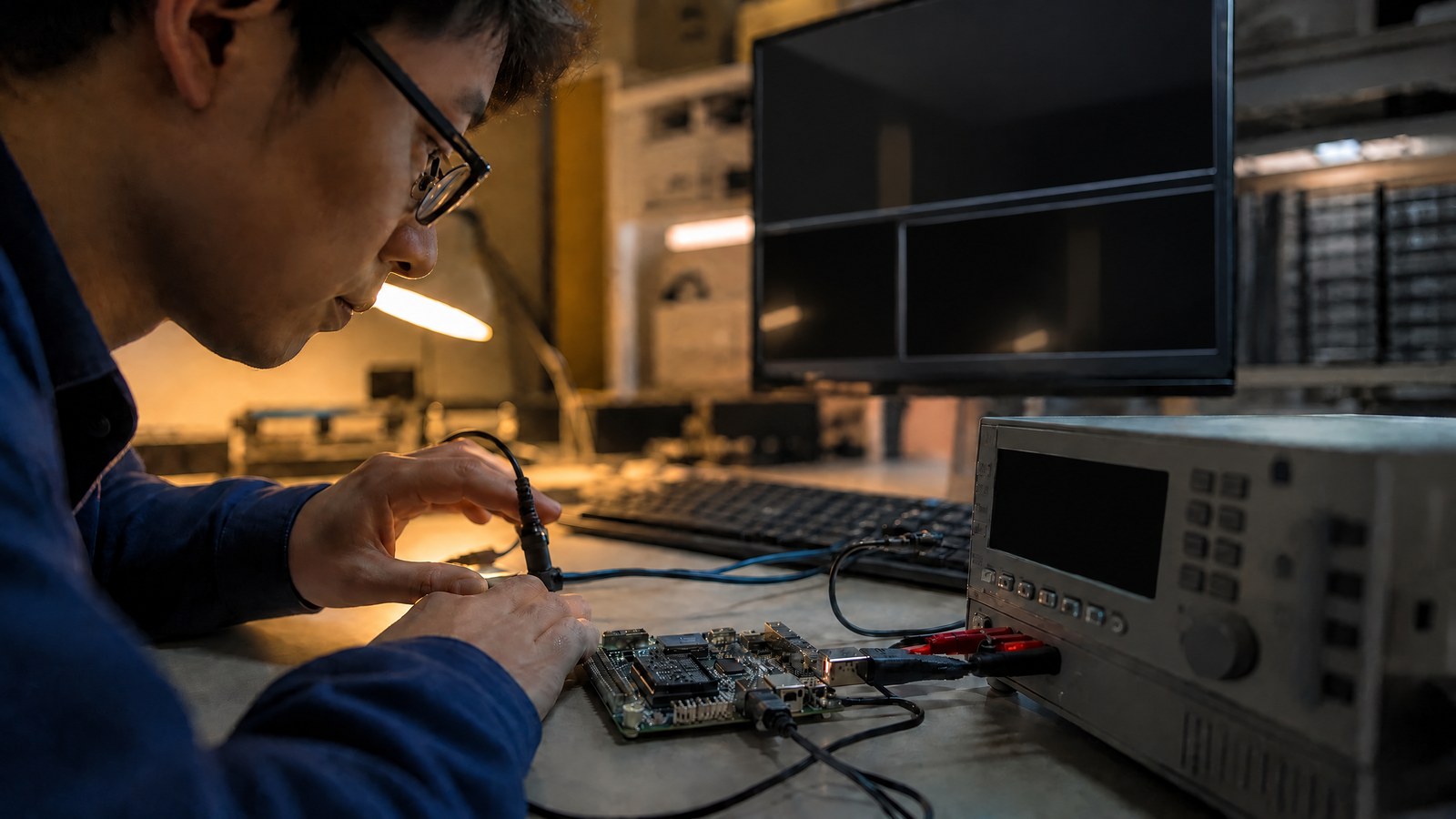
An engineer compares AI inference on a compact edge board and a workstation using measurement instruments in an amber-lit device lab.Guide
Artificial Intelligence7 Sept 2026

Model quantization: how teams trade precision for speed and smaller deployments

Quantization reduces numerical precision to make some models smaller and faster. The durable practice is to match the method, calibration data, hardware, and quality tests to the deployment target.

By techduopulse Editorial Desk8 min
Open AI accelerator server with dense memory stacks and copper cooling pipesAnalysis
Artificial Intelligence7 Sept 2026

Beyond the Transformer: How New AI Architectures Are Tackling the Memory Wall

State-space models, sparse attention, and hybrid memory systems are changing how engineers think about long-context artificial intelligence.

By Maya Rao11 min
Compact local language-model workstation with dedicated graphics hardwareGuide
Artificial Intelligence15 Aug 2026

A Practical Guide to Running Small Language Models Locally

Local inference can improve privacy and resilience, but model selection should begin with memory, task quality, and operational constraints.

By Maya Rao9 min

The Signal

One considered technology briefing.

The week’s important systems, products, and ideas—explained without the noise.

techduopulse

Technology explained clearly through news, analysis, practical guides, and research.

Explore

LatestAnalysisArtificial IntelligenceCybersecurity

Company

AboutContactEditorial StandardsPrivacyTerms

Stay informed

A concise first-party newsletter. No advertising links.

© 2026 techduopulse
Gujarat, India
Built for curious minds.