A tipping-bucket rain gauge turns individual bucket movements into a running record of rainfall at one location. Its appeal is simple mechanics and digital counts, but interpreting those counts well means separating accumulated depth from rain intensity, local exposure and the very different sensor that may operate a car’s windscreen wipers.
On this page 8 sections
- How a Tipping-Bucket Rain Gauge Turns Rain Into an Accumulation Record
- Why One Rain Gauge Cannot Describe Every Nearby Place
- Limits of Tipping Buckets: Heavy Rain, Light Rain and Frozen Precipitation
- A Weather Gauge Is Not a Rain-on-Windscreen Sensor
- An India-Focused Local Weather Context
- Important Points / Key Information
- Examples / Supporting Information
- Conclusion
Part of our emerging technology science guide library
How a Tipping-Bucket Rain Gauge Turns Rain Into an Accumulation Record
A tipping-bucket rain gauge is a catching rainfall sensor: a collector directs rain into one side of a balanced, two-compartment bucket. Once that side reaches its designed volume, the assembly tips, the other side moves under the flow, and the motion creates an electrical event. A logger treats each event as one nominal increment of rainfall depth, then adds the increments to form an accumulation record [1] [2].
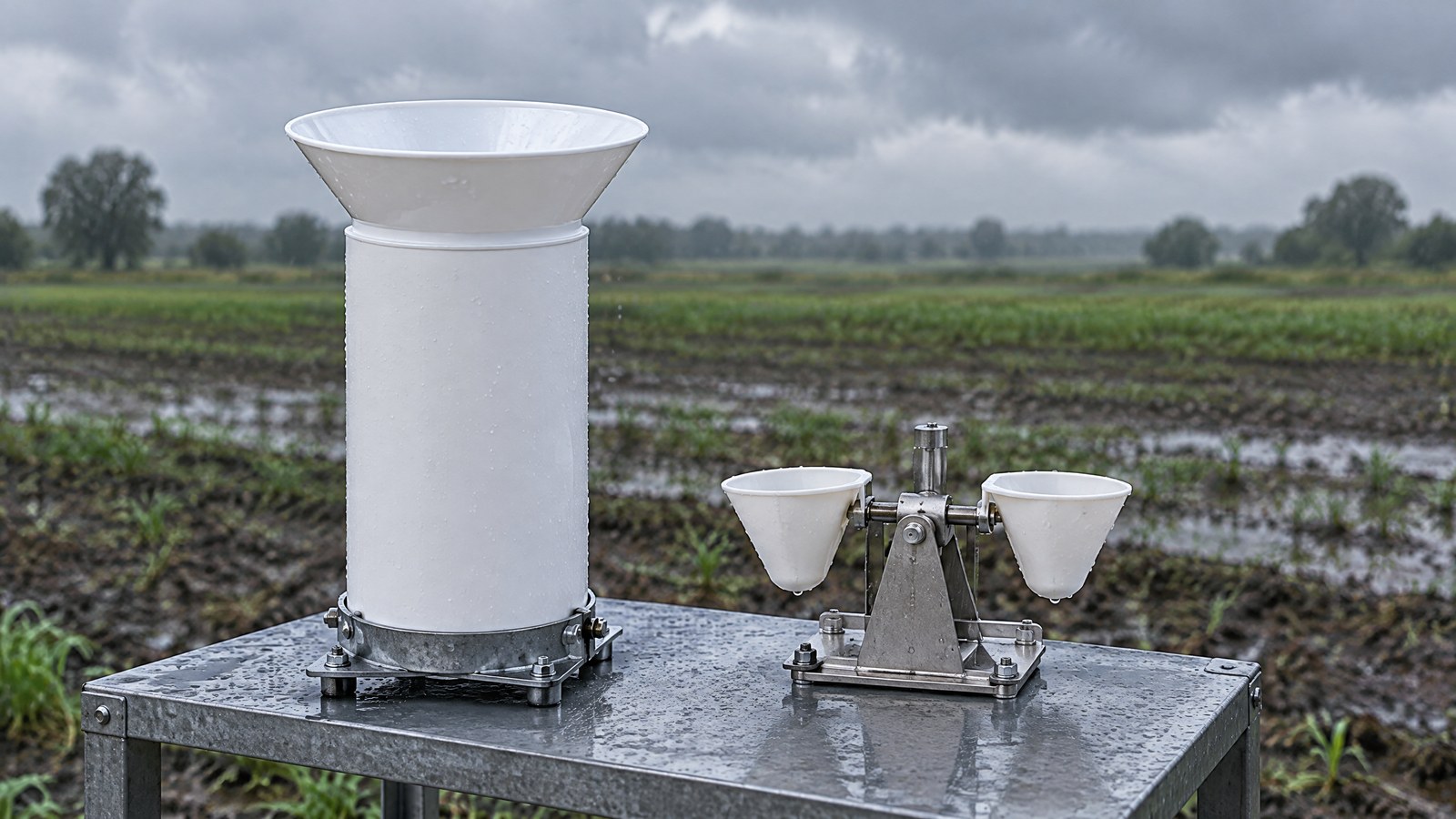
AI-generated editorial illustration of generic tipping-bucket rain-gauge hardware in an agricultural weather-station context, not a photograph of a tested product or an actual field measurement.
The word “nominal” matters. The depth represented by one tip is set by the gauge’s collector area and its tipping volume, so it belongs to that model and its calibration. The National Weather Service describes a typical 0.01-inch increment for one ASOS heated bucket, while UCAR’s educational documentation uses 0.2 mm as a calibration example [1] [5]. Those examples explain the principle; neither is a universal setting for every gauge.
From a funnel to a counted tip
Rain falls into a funnel or collector. The collected water fills the active cup of a pivoting bucket. At its set volume, the bucket rocks over, empties, and places the opposite cup under the outlet. A magnet-and-switch arrangement is one common way to turn that movement into a recorded pulse [2] [5]. The record is therefore a count of completed increments, rather than a continuous reading of the water level at every instant.
That design explains why a gauge can continue recording through a wet spell without storing all of the water. It also explains why a blocked funnel, an uneven mechanism or a missed pulse can alter the result. UCAR’s documentation specifically notes the role of a screen in keeping debris from interfering with the mechanism; the peer-reviewed review identifies contamination, levelling, friction and logging among the practical uncertainty sources [2] [5].
Accumulation is the natural output; intensity is a calculation
The most direct reading is accumulated rainfall: total nominal depth represented by all recorded tips over a stated period. Rainfall intensity is inferred from how many tips occur within a chosen interval, or from the time between tips. That extra calculation is useful, but it carries more assumptions because rain can begin, pause or vary within the reporting interval [2].
A quiet display immediately after rain begins does not prove that no water has entered the collector. Until the active bucket reaches a full tipping volume, no event is recorded. The same quantisation can shift some of a light shower’s apparent intensity from one time window to the next. For a time-critical decision, a data user should retain the tip timestamps and the stated aggregation method instead of reading a charted rate as a perfectly continuous measurement [2].
Why One Rain Gauge Cannot Describe Every Nearby Place
A rain gauge measures precipitation caught at its own collector, at its own height and exposure. It is a point observation, not a map of a village, farm, road corridor or catchment. The reviewed hydrology literature stresses that rainfall varies in space and time and that a single rain-gauge record cannot capture that spatial variability [2].
This is especially important when comparing a local gauge with a satellite precipitation product or weather radar. They observe or estimate rainfall over areas in different ways; the apparent mismatch may reflect spatial sampling as well as instrument error. A ground gauge can be valuable context for a local site without being treated as a verdict on rainfall everywhere around it.
Exposure changes what reaches the collector
Wind does more than make a rain gauge look untidy. Airflow around the gauge body and nearby objects can deflect drops away from the opening. The National Weather Service says exposure is central to precipitation accuracy because turbulence and eddy currents near a gauge can carry precipitation away; it notes that loss tends to increase with wind speed and orifice height [3].
Trees, roofs, walls, crop canopies and terrain can also make a record highly local. Splashing into or out of the collector, evaporation, wetting of surfaces and dirt or insects can affect a catch or the moving mechanism [2]. These are reasons to document the location and maintain the instrument under its manufacturer’s procedures, not reasons to apply a universal correction to every reading. A correction that may suit one model and exposure may be wrong for another.
Limits of Tipping Buckets: Heavy Rain, Light Rain and Frozen Precipitation
Tipping buckets are practical automatic gauges, but the mechanism has measurement limits. During intense liquid rain, water can arrive while the bucket is moving; the scientific review describes this as a source of mechanical underestimation that depends on rainfall intensity and the gauge design [2]. Wind can also cause undercatch before rain reaches the funnel. Neither limitation can be judged from a tip count alone.
At the other end, light or intermittent rain exposes the threshold nature of the measurement. A partial fill produces no tip yet, so the timing of a small event can be less precise than a reader expects. For snow, freezing rain or hail, a basic unheated tipping bucket is not the same thing as an all-weather precipitation instrument. The National Weather Service’s heated ASOS example melts frozen precipitation so it can be measured as liquid equivalent, but research on heated buckets still identifies response delay, wind undercatch and solid-precipitation challenges [1] [2].
Relevant Rainfall-Gauge Variants
An unheated tipping bucket is commonly used for liquid-rain accumulation at a local station. A heated tipping bucket adds heat so frozen precipitation can melt before the bucket measures it; that broadens the conditions it can address but does not erase the physical limits of catching precipitation [1] [2]. Tip size, collector geometry, drainage and data handling vary by design, so a product specification is the right source for a particular instrument’s increment or operating range.
A weighing precipitation gauge is a different automatic approach: it follows the changing weight of collected precipitation rather than waiting for discrete bucket tips. The reviewed literature discusses weighing gauges alongside tipping buckets because both are used for automated records, while their timing and frozen-precipitation behaviour can differ [2]. The choice is a monitoring-design question for qualified operators, not a basis for treating one sensor reading as self-validating.
A Weather Gauge Is Not a Rain-on-Windscreen Sensor
The phrase “rain sensor” can describe two very different jobs. A tipping-bucket gauge is fixed in one place and produces an accumulated precipitation record from counted increments. A vehicle’s rain-sensing wiper system responds to moisture on the windscreen so that wiper action can change. Lincoln’s owner support describes equipped rain-sensing autowipers as adjusting their speed according to how wet the windshield gets [4].
That makes the vehicle sensor useful for visibility-related automation in that vehicle. It does not turn the car into a calibrated weather station, establish rainfall depth at a location or replace a fixed gauge’s timestamped accumulation record. Conversely, a gauge can report local rainfall totals without telling a driver whether the windscreen has enough water to need a wipe. Keeping those purposes separate avoids a common category error.
An India-Focused Local Weather Context
In an India-focused farm, water-monitoring or residential weather-station context, a tipping bucket can help build a local history of when accumulated rain crossed the gauge’s own increments. Paired with time, site notes and perhaps other local observations, that history can support conversations about irrigation records, drainage observations or the local weather context of a water-level change. It does not, by itself, forecast a monsoon event, determine crop treatment, verify flood safety or describe rainfall across a district.
The practical question is always “rainfall where, over what interval, and measured by which gauge?” A station log that retains the gauge model, nominal tip increment, time basis, maintenance history and changes to its surroundings is easier to interpret later. If the record will inform a safety-sensitive, agricultural, engineering or water-management decision, qualified human review and the relevant local data sources are needed.
Important Points / Key Information
Key Takeaways
A tipping-bucket gauge records completed, calibrated increments of precipitation at one collector. It is strongest when its accumulation, time basis, site exposure and maintenance context stay together.
- A tip count becomes rainfall depth only through that gauge’s stated nominal increment; do not transfer a number from one model to another.
- A rainfall rate is calculated from tips and time. It can be less certain than a longer accumulation during light, intermittent or rapidly changing rain.
- Wind, nearby obstructions, splash, debris and mechanical condition can alter what is caught or recorded.
- A windscreen rain sensor responds to glass wetness for wipers; it is not an accumulation rain gauge.
Examples / Supporting Information
These examples illustrate interpretation only. They are not product tests, installation instructions, agricultural prescriptions or evidence from a real local event.
Hypothetical: two gauges, one short shower
Imagine two comparable local stations during the same brief shower. One collector is in an exposed open area; the other is beside a roof edge where airflow is disturbed. Their logged totals might differ. That difference would not, by itself, prove that either mechanism failed or that rain fell uniformly across the neighbourhood. It would be a prompt to examine exposure, timestamps, maintenance and any other available observations. This scenario is hypothetical, not a field result.
A sourced operational example: discrete increments
The National Weather Service describes ASOS using a heated tipping bucket for liquid precipitation accumulation, with a precisely balanced bucket that typically tips at 0.01 inch and records each tip electronically [1]. The value of this example is not the number itself: it shows how a defined physical increment becomes a time-stamped cumulative record. A different gauge may have a different nominal increment, which is why the instrument documentation belongs with the data.
Conclusion
A tipping-bucket rain gauge is a clear example of a sensor whose simple output conceals important context. Each counted movement represents a calibrated rainfall increment at one collector, so the resulting accumulation can be useful when its model, timing, exposure and upkeep are known. The more demanding interpretation questions concern intensity, low-rate timing, high-intensity mechanical loss, wind undercatch and spatial representativeness.
It is also worth keeping the name straight: a fixed tipping bucket records rainfall accumulation, while a vehicle rain-on-windscreen sensor supports wiper behaviour. Treating both as “rain sensors” without their purpose and limits can lead to bad comparisons. Use in a safety-sensitive decision requires qualified professional assessment.
How we checked thisSources (5)
We keep source links private so your reading stays on techduopulse. Each note names the publisher and document we checked.
ASOS tipping-bucket accumulation example
Primary source · Tipping counts and gauge typesPeer-reviewed review of tipping-bucket measurement uncertainty
Secondary source · Intensity, point sampling and undercatch limitationsRecording rain-gauge exposure and data context
Primary source · Exposure and operational contextVehicle rain-sensing wiper function
Primary source · Weather gauge versus windscreen sensorDigital tip recording and debris-screen context
Primary source · Mechanism and maintenance contextOwner-approved educational sensor explainer; obsolete private-draft status removed without changing source-backed facts or professional safety boundaries. Original generic AI editorial illustration, not a product or field-test photograph.