SEO title: Soil Moisture Sensor: How It Works in India Meta description: Learn how soil moisture sensors measure water, compare sensor types, and support smarter irrigation and farming decisions in India.
This article is part of the software engineering technologies guide library.
What is a soil moisture sensor?
Soil moisture is the water held in the pores between soil particles. A soil moisture sensor is a device that makes an indirect electrical or physical measurement and relates it to the soil’s water condition. It is not necessarily measuring the same quantity as every other soil sensor. [1] [2]
Two measurements are especially important:
Volumetric water content (VWC): the volume of liquid water divided by the total volume of soil, commonly expressed as a percentage. A VWC sensor estimates how much water is present in a defined volume of soil.
Soil matric potential, or tension: an indication of how tightly soil holds water. Tensiometers measure this tension-related condition, while granular-matrix sensors infer it from electrical resistance. A tension reading is not interchangeable with a VWC percentage. [1] [2]
That distinction helps avoid a common misunderstanding. A display that says “moisture” may be useful, but the value needs a unit, a sensor type and a context before it becomes an irrigation decision.
Soil moisture sensor working principle
Most soil moisture sensor working principles rely on the fact that water, air and soil minerals behave differently electrically. As the balance of water and air in the soil changes, the property sensed by the probe changes too. Electronics then convert that change into an analogue voltage, a digital value, VWC estimate or tension-related reading. [1] [2]
For capacitance or frequency-domain reflectometry (FDR) sensors, the probe responds to the soil’s dielectric properties. Because water has very different dielectric behaviour from air and soil particles, a wetter or drier surrounding changes the sensor response. A calibration is used to relate that response to water content. [1] [2]
Time-domain reflectometry (TDR) works differently: a probe sends an electromagnetic pulse along rods or waveguides in the soil. The pulse travel and reflection behaviour changes with the soil’s dielectric constant, allowing the system to estimate moisture. [1] [2]
A basic resistive probe sends current through exposed conductive paths. Wet soil may conduct more readily than dry soil, but dissolved ions and salinity also affect conduction. That means a resistive probe can be useful for a rough wet/dry indication or a learning project; it should not automatically be treated as an accurate VWC instrument. [3]
Main soil moisture sensor types
The “best” type depends on whether you need a simple indication, an estimate of water content, or an understanding of how hard plants must pull water from the soil. The following comparison is a guide to the measurement principle, not a promise of equivalent accuracy.
| Sensor type | What it responds to | What the reading is useful for | Important caution |
|---|---|---|---|
| Capacitance / FDR | Changes in soil dielectric or electrical properties | Estimating water content when appropriately calibrated | Texture, bulk density, salinity, temperature and installation can influence the response. [1] [2] |
| TDR | Travel and reflection of an electromagnetic pulse in a probe | Estimating moisture from dielectric behaviour | It still needs sound installation and interpretation for the soil and crop. [1] [2] |
| Resistive probe | Electrical resistance or conductivity through soil | Basic wet/dry indication and beginner experiments | Ions and salinity can change output even when water content does not. [3] |
| Tensiometer / granular-matrix sensor | Soil water tension, directly or through resistance | Irrigation decisions based on how available water is to the crop | The output is tension-related, not the same as a VWC reading. [1] [2] |
Using a soil moisture sensor for irrigation
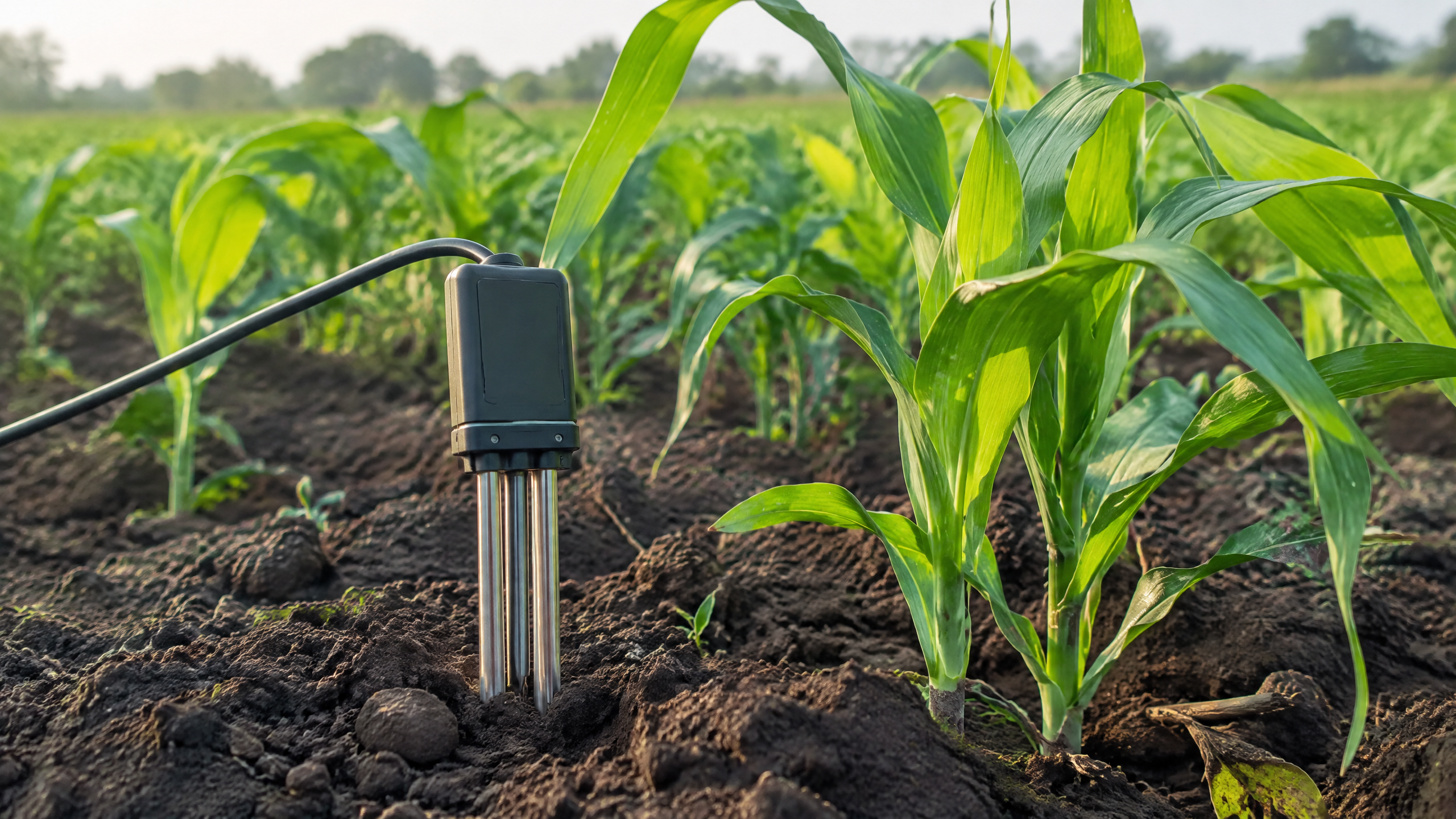
A sensor supports irrigation scheduling when it represents the part of the soil from which the crop is drawing water. It should not be placed wherever it is easiest to push in. A useful installation aims for the crop root zone, avoids wheel tracks and unusually wet or dry areas, and may use more than one depth. [1] [2]
For a deeper-rooted crop, a sensor nearer the lower part of the active root zone can help indicate whether water is moving beyond where roots can use it. A shallower sensor can show conditions where many roots are actively taking up water. Looking at both readings over time is generally more informative than reacting to one isolated value. [2]
Before deciding to irrigate, interpret the reading alongside:
the soil’s field capacity, permanent wilting point and available water range;
crop type and growth stage;
expected rain, evapotranspiration and recent irrigation;
the irrigation system’s capacity and wetting pattern; and
whether the probe has been placed, installed and calibrated appropriately. [1] [2]
So a sensor is an input to a decision, not an automatic instruction to start or stop a pump. Thresholds copied from another crop, soil or field can be misleading.
Soil moisture monitoring in agriculture and India
For soil moisture monitoring in agriculture, field probes give local, in-soil information at the selected location and depth. They are especially relevant where irrigation timing needs to account for the crop root zone. A probe in a pot or field observes a small area; it does not describe every part of a farm.
India also has a different kind of soil-moisture information source: ISRO describes an open operational satellite-derived surface soil-moisture product from EOS-04 C-band SAR, with 500 m spatial resolution and a 17-day repeat cycle. ISRO lists applications including irrigation scheduling, crop-water management, yield forecasting, drought detection and flood monitoring. This is useful regional context, but it is not a replacement for a probe reading at a chosen root-zone depth in a particular field. [5]
For a practical farm workflow, the two ideas answer different questions: a field sensor can show local conditions around roots, while a satellite-derived surface product can provide a broader-area view. Neither removes the need to observe the crop and irrigation system.
Accuracy, calibration and placement: why numbers vary
A soil moisture sensor does not read water in a vacuum. The same instrument can respond differently when soil texture, clay content, bulk density, salinity, electrical conductivity or temperature changes. Gravel, roots, macropores, cracks and the exact position relative to an irrigation wetting pattern can also affect a field reading. [1] [3] [4]
This is why a low-cost probe showing a stable-looking number should not be assumed to be measuring a universal percentage of water. Research on low-cost capacitance systems notes that a sensor can be repeatable in laboratory conditions while field variability rises because it samples only a small soil volume and encounters real field differences. [4]
For a meaningful setup:
Choose a representative location. Avoid an atypical patch, wheel track, leak or edge unless that is the condition you specifically want to investigate.
Install at a purposeful depth. Match the probe position to the root-zone question you want answered; consider multiple depths when appropriate. [2]
Maintain close soil contact. Gaps, cracks and disturbed soil around a probe can make the sample unrepresentative.
Calibrate for the site where possible. A soil-specific relationship is preferable to assuming a factory or generic conversion is exact for every field. [1] [4]
Look for trends and corroborate them. Compare changes after irrigation or rain with field observations, crop condition and the irrigation pattern.
Calibration is not a single universal trick. It is the process of relating a particular sensor’s output to the water condition of the soil in which it will be used. The effort is most valuable when a reading will influence recurring irrigation decisions.
Can a soil moisture sensor work with Arduino?
Yes. An Arduino can read the analogue or digital signal supplied by a compatible sensor interface, record changes over time and trigger an alert or a simple control experiment. This makes a soil moisture sensor Arduino project a useful way to learn about sensor inputs, thresholds and data logging.
The learning value comes from treating the number as evidence to question. Test the probe in the same soil as it dries and is watered; observe whether soil contact, depth or fertilizer-treated water changes the output. With a resistive probe in particular, do not assume that a changing value represents water content alone, because dissolved ions influence electrical conduction. [3]
For projects that could control irrigation equipment, add appropriate electrical design, isolation and supervision. A sensor reading alone is not a safety guarantee or a substitute for checking the system, crop and water flow.
Frequently asked questions
What is a soil moisture sensor for agriculture in India?
It is a device used to estimate soil water content or a tension-related soil-water condition near crop roots. In India, its usefulness depends on local soil, crop, depth, irrigation method and weather—not simply on the device name. [1] [2]
What is the soil moisture sensor working principle in simple terms, including for learners searching in Hindi?
The sensor observes an electrical or physical property that changes as the amount of water in soil pores changes. Capacitance/FDR and TDR use dielectric behaviour; resistive probes use electrical conduction; tensiometers and granular-matrix sensors focus on tension-related conditions. [1] [2] [3]
Can I use a soil moisture sensor with Arduino?
Yes. An Arduino can read a sensor signal and help you log wet-to-dry changes for an educational project. Treat the output as a sensor-specific signal that needs testing in the relevant soil, rather than as a guaranteed universal moisture percentage.
How should I use a soil moisture sensor for irrigation?
Place it to represent the crop root zone, then interpret its trend with crop stage, soil water-holding condition, rain outlook, evapotranspiration and irrigation capacity. Do not copy a fixed threshold from another soil or crop without validation. [1] [2]
What is a good soil moisture sensor project for beginners?
A simple project is to log readings from one probe in a pot through a watering and drying cycle, while recording depth and soil condition. Compare the pattern with direct observations rather than relying only on an LED or a single “dry” threshold. A resistive probe is particularly useful for demonstrating why conductivity and water content are not identical. [3]
Does soil moisture monitoring in India only mean placing a probe in a field?
No. In-field probes offer local root-zone information, while satellite-derived products can give a wider-area surface-soil perspective. ISRO’s operational soil-moisture product is one India-specific example, but it should not be confused with a sensor installed at a selected field depth. [5]
Related reading
/article/humidity-sensor-types-working
/article/temperature-sensor-types-working-principle
/article/level-sensor-types-working-uses
/article/flow-sensor-working-principle
Source notes
Reporting record
techduopulse stores source destinations privately. Public notes remain non-clickable so every visitor journey stays on this website.
https://extension.umn.edu/natural-resources/conservation/agricultural-soil-and-water/irrigation/soil-moisture-sensors-for-irrigation-scheduling
Primary source · Research source 1https://www.canr.msu.edu/resources/utilizing-soil-moisture-sensors-for-efficient-irrigation-management
Primary source · Research source 2https://metergroup.com/measurement-insights/soil-moisture-sensors-how-they-work-why-some-are-not-research-grade/
Primary source · Research source 3https://pmc.ncbi.nlm.nih.gov/articles/PMC12528689/
Primary source · Research source 4https://www.isro.gov.in/High-Resolution_Operational_Soil_Moisture_Product.html
Primary source · Research source 5New India-focused sensor explainer covering soil moisture sensor, working principles, uses and limitations.