SEO Title: Temperature Sensor: Types, Working Principle and Uses Meta Description: Learn how temperature sensors work, compare thermistors, RTDs and thermocouples, and choose the right type for Indian electronics projects.
This article is part of the software engineering technologies guide library.
What is a temperature sensor?
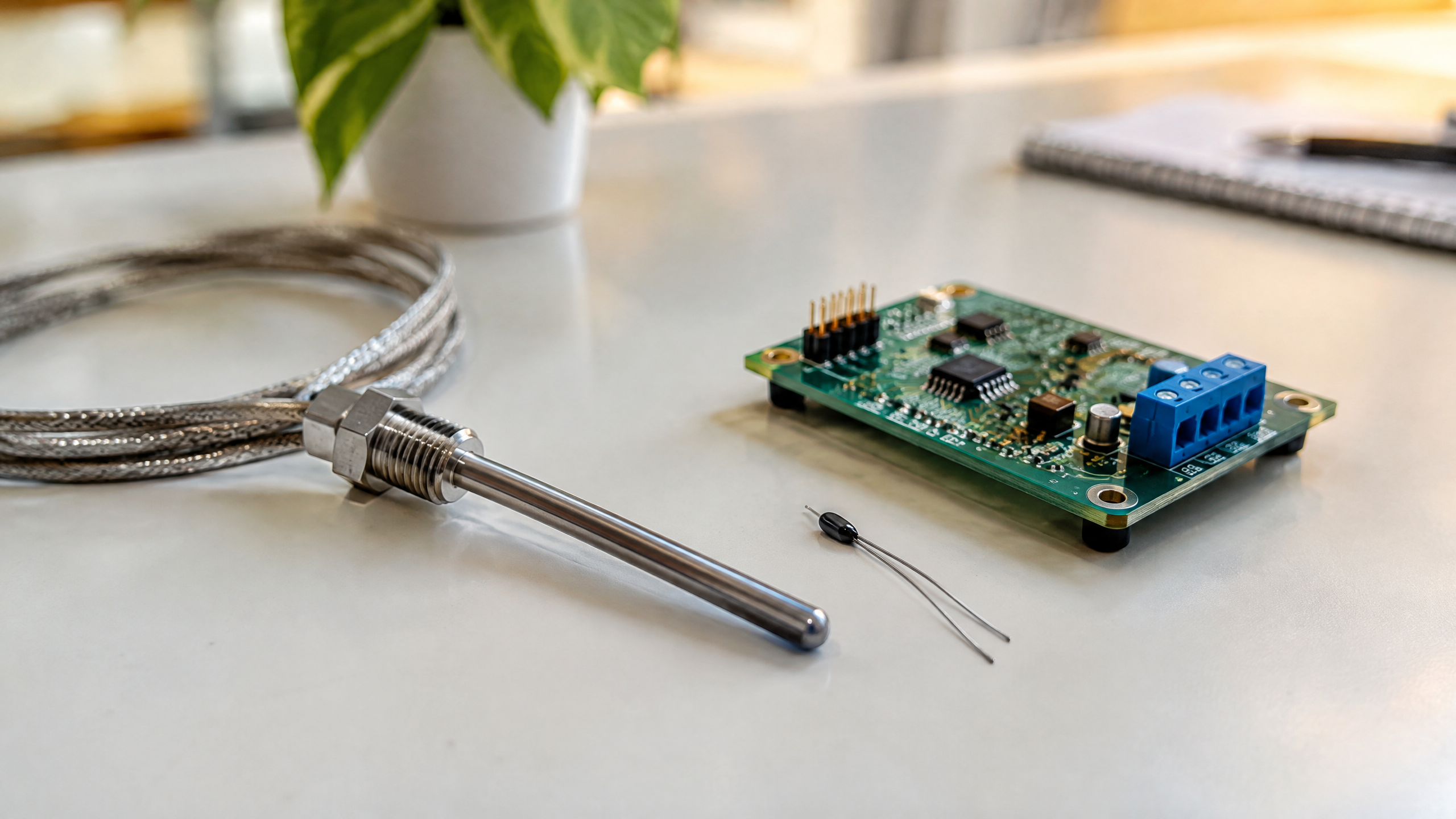
A temperature sensor is a device that infers temperature from a physical property that changes predictably as temperature changes. Depending on the sensor family, that property may appear as a change in resistance, a small voltage, an electrical current or already-converted digital data. Common families include thermocouples, resistance temperature detectors (RTDs), negative-temperature-coefficient (NTC) thermistors and semiconductor or IC sensors. [1] [2]
It helps to separate four things that are often bundled together in casual discussion:
Sensor element: the part that responds to temperature, such as an NTC bead or platinum RTD.
Probe or package: the housing, cable, metal sheath or chip package that lets the element be placed in an environment.
Signal conditioning: circuitry that supplies excitation, amplifies, filters, linearises or digitises the signal.
Instrument or controller: the display, microcontroller, data logger or control system that turns the signal into a usable decision.
A bare element is not automatically a ready-to-use thermometer. Its placement, electrical interface and calibration approach all shape the final result.
Temperature is commonly displayed in degrees Celsius (°C). The SI base unit for thermodynamic temperature is kelvin (K): 0 °C equals 273.15 K, while a change of 1 °C is the same size as a change of 1 K. [5]
How does a temperature sensor work?
The temperature sensor working principle follows a simple signal chain:
Heat reaches the sensing element. The element needs time and good thermal contact to come close to the temperature of the air, surface, liquid or object being measured.
A temperature-dependent property changes. A metal’s resistance may rise, a thermistor’s resistance may fall, or two dissimilar metals may generate a thermoelectric voltage.
Electronics interpret the change. A circuit may measure resistance, compensate a reference junction, apply a mathematical conversion or send digital data to a controller.
The system presents or uses the reading. This might be a display, a logged value, an alert threshold or a control input.
This is why “how does a temperature sensor work?” has no one-line answer. The basic idea is shared, but the property being measured and the supporting electronics differ by sensor type. Complete-system quality can be influenced by excitation current, amplification, analogue-to-digital conversion, filtering, lead resistance, thermal contact, response time, calibration and electrical isolation. [1]
### A practical note on placement
If a sensor is close to a heat-producing regulator, motor, display backlight or microcontroller, it may describe that local hot spot rather than the room. Likewise, a probe pressed loosely against a surface can lag behind the surface temperature. Before changing code or buying another module, check what the sensor is physically coupled to and whether it has had time to settle.
Main temperature sensor types
### Thermocouple temperature sensor
A thermocouple uses two dissimilar metals. Their junction produces a thermoelectric voltage through the Seebeck effect. Critically, the voltage reflects the temperature difference between the measuring junction and a reference junction; an absolute temperature reading therefore needs a known reference or cold-junction compensation. [1] [2] [3]
Thermocouples are valued where a broad operating range and rugged construction matter. They are not a universal shortcut to accuracy: the wire type, junction construction, extension wiring, reference compensation, installation and calibration all matter to the measurement.
### RTD temperature sensor
An RTD measures the predictable change in a metal’s electrical resistance with temperature. Platinum RTDs are widely used because they offer useful linearity, repeatability and long-term stability. [1] [2]
The wire connecting the RTD is part of the measurement challenge. Its own resistance can add to the reading, particularly with longer leads. Three-wire and four-wire arrangements are used to reduce the influence of lead-wire resistance, depending on the measurement circuit and required performance. [1]
### NTC thermistor temperature sensor
An NTC thermistor is usually a semiconductor or metal-oxide device whose resistance generally decreases as temperature rises. It can be highly sensitive, which is helpful for detecting relatively small changes around its intended operating region. But its response is nonlinear, and its useful range is generally narrower than that of a thermocouple. [1] [2]
Measurement current also matters. Excessive current can warm the thermistor itself, producing self-heating and a reading that is not representative of the target. The circuit design, mounting and conversion method should therefore be considered along with the thermistor element. [1]
### Semiconductor or digital temperature sensor
Semiconductor/IC temperature sensors contain an integrated sensing element and may provide a relatively linear analogue signal or a digital output. A digital temperature sensor can simplify the interface between a board and a microcontroller because conversion may happen inside the IC. Its actual limits, resolution, communication method and accuracy conditions must still come from that specific component’s datasheet. IC sensors generally have narrower operating ranges than thermocouples. [2]
| Sensor family | What is measured electrically? | Useful when | Important caution |
|---|---|---|---|
| Thermocouple | Thermoelectric voltage from two dissimilar metals | A rugged probe and broad temperature capability are needed | Requires correct reference/cold-junction compensation |
| RTD | Change in metal resistance | Stability, repeatability and a relatively linear response are priorities | Lead-wire resistance and wiring arrangement can affect results |
| NTC thermistor | Resistance that generally falls as temperature rises | High sensitivity over an intended, limited range is useful | Nonlinearity and self-heating need attention |
| IC/digital sensor | Integrated analogue or digital temperature signal | Compact electronics and direct controller interfacing are useful | Use the chosen part’s datasheet; the chip measures its local thermal environment |
Temperature sensor applications: from projects to systems
Temperature sensing appears in many familiar settings. In an Indian classroom or maker lab, it can support an Arduino exercise that reads an analogue divider or digital bus and logs a changing temperature. In homes and offices, it can contribute to appliance, HVAC or environmental monitoring. In agriculture, storage and process settings, a properly selected probe can help observe equipment or product conditions. Factories may use temperature data in process control, machinery monitoring or thermal protection schemes.
These examples do not make every low-cost module suitable for every setting. A sensor chosen for an indoor learning project may not withstand vibration, moisture, electrical noise, immersion, high heat or a long cable run. When a reading influences people, equipment protection, regulated work or a critical process, use appropriate engineering review, specified components and calibration practices rather than relying only on a hobby display.
### Arduino and room-temperature projects
For a temperature sensor Arduino project, start by deciding whether the task needs a bare analogue element, an RTD interface, a thermocouple interface or a digital IC. An NTC-based circuit typically requires a known resistor, a stable reference and a conversion from measured voltage to estimated temperature. A digital sensor still needs correct power, wiring, code and placement.
A “room temperature sensor for Arduino” should be kept away from direct sunlight, the board’s warm power circuitry and forced hot airflow if the intention is to approximate room conditions. Allow time for the sensor and its enclosure to settle. The reading should be treated as an observation of the sensor’s local environment, not an automatic statement about every part of a room.
Accuracy, calibration and limits to understand
A temperature sensor’s quoted specification is not a blanket promise for the assembled project. The final measurement can be affected by the sensor element, its tolerance, selected range, reference circuitry, wiring, thermal path, airflow, electrical noise, software conversion and the comparison method used for calibration. [1]
Calibration means comparing an instrument or system against a suitable reference under defined conditions and documenting or applying any needed correction. It is not simply typing an offset into code once. A one-point adjustment may improve agreement near that point but may not correct nonlinearity or errors elsewhere. For a thermocouple, reference-junction compensation deserves specific attention; for an RTD, lead resistance and the chosen wiring method matter; for an NTC thermistor, self-heating and the conversion curve matter. [1] [2] [3]
Response time is also distinct from accuracy. A sensor enclosed in a protective housing may be more durable but respond more slowly than an exposed element. Equally, an apparently fast-changing display may reflect electronic filtering or local airflow rather than the true temperature of a larger object.
Finally, temperature sensing has practical safety boundaries. Do not improvise mains-connected measurement circuits, use a non-rated sensor in a hazardous environment, or assume a hobby module provides protective control. Work involving high voltage, extreme heat, pressurised equipment, food safety, clinical use or critical protection should follow the applicable equipment instructions, standards and qualified professional guidance.
How to choose a temperature sensor without chasing a “best” one
Use the application to narrow the options:
Define the target. Is it air, a surface, a liquid, an enclosure or the sensor chip itself?
Set the required operating conditions. Consider expected temperatures, moisture, vibration, cable length, electrical noise and mechanical installation.
Choose the family based on trade-offs. Thermocouples favour broad range and ruggedness; RTDs favour stability, linearity and repeatability; NTC thermistors offer sensitivity at lower cost over a more limited range; IC sensors can ease compact electronic integration. [1] [2]
Design the whole measurement path. Include wiring, excitation or reference, signal conditioning, data conversion, mounting and software.
Verify under representative conditions. Compare with an appropriate reference and record the conditions before trusting the value for decisions.
That approach is more durable than selecting an element only because it is common in a tutorial or because one number in a listing looks impressive.
Frequently asked questions
What is a temperature sensor in India used for?
A temperature sensor in India is used for the same broad purposes as elsewhere: electronics projects, appliances, building systems, environmental monitoring, machinery and process measurement. The appropriate type depends on the local environment, installation and required confidence in the reading, not on location alone.
What is the temperature sensor working principle in Hindi?
In simple Hindi, तापमान सेंसर तापमान बदलने पर किसी भौतिक गुण—जैसे resistance या voltage—में होने वाले बदलाव को मापकर reading देता है. The exact mechanism depends on whether it is a thermistor, RTD, thermocouple or IC sensor. [1] [2]
What are temperature sensor types and applications in India?
Common types are thermocouples, RTDs, NTC thermistors and semiconductor/IC sensors. Applications can include education, embedded electronics, appliances, building controls, agriculture-related monitoring and industrial systems. Selection should be based on range, environment, wiring, response needs and calibration requirements rather than an assumed one-size-fits-all accuracy. [1] [2]
Can I use a temperature sensor with Arduino?
Yes. Arduino projects can read analogue or digital temperature sensors, but the method must match the sensor. A thermistor needs a suitable analogue circuit and conversion; thermocouples and RTDs typically need the appropriate measurement interface; a digital IC needs compatible power, communication and code. Check the selected part’s datasheet and the module’s documentation before wiring it.
What should I know about an NTC thermistor temperature sensor?
An NTC thermistor generally becomes less resistive as it gets warmer. It can be sensitive but nonlinear, and excessive measurement current can cause self-heating. Its mounting and conversion method matter just as much as the nominal sensor type. [1] [2]
RTD vs thermocouple: which should I choose?
Choose based on the job. An RTD is often chosen when stability, repeatability and a relatively linear response are important; a thermocouple is often chosen where wide temperature capability and ruggedness are needed. RTD lead resistance and thermocouple reference-junction compensation are key design considerations. Neither is automatically superior in every application. [1] [2] [3]
Related reading
/article/humidity-sensor-types-working
/article/pressure-sensor-working-principle-types
/article/light-sensor-working-principle-types
/article/soil-moisture-sensor-working-india
Source notes
Reporting record
techduopulse stores source destinations privately. Public notes remain non-clickable so every visitor journey stays on this website.
https://support.google.com/trends/answer/4365533?hl=en
Primary source · Research source 4https://www.ni.com/en/shop/data-acquisition/sensor-fundamentals/measuring-temperature-with-thermocouples-rtds-and-thermistors.html
Primary source · Research source 1https://www.ti.com/lit/pdf/slyb211
Primary source · Research source 2https://data.nist.gov/pdr/lps/ECBCC1C1302A2ED9E04306570681B10748
Primary source · Research source 3https://www.nist.gov/pml/owm/si-units-temperature
Primary source · Research source 5New India-focused sensor explainer covering temperature sensor, working principles, uses and limitations.