SEO Title: Humidity Sensor: Types, Working and Applications Meta Description: Learn what a humidity sensor measures, how capacitive and resistive types work, and why calibration, temperature and condensation affect readings.
This article is part of the software engineering technologies guide library.
What is a humidity sensor?
A humidity sensor is an instrument that detects moisture in air and turns that change into a usable electrical signal. In everyday environmental monitoring, it commonly reports relative humidity (RH) as a percentage.
Relative humidity is the ratio of water-vapour partial pressure to the saturation vapour pressure at the same temperature. At 100% RH, the air is saturated at that temperature. Because saturation vapour pressure changes with temperature, RH can rise or fall even if the actual amount of water vapour in a space has not changed. [1] [3]
That distinction helps make sense of a familiar situation: air that feels different when a room is cooled, or when the weather changes before and during the monsoon. It also explains why RH is not the same measurement as absolute humidity, which expresses water-vapour mass per volume, or dew point, the temperature at which saturation and condensation begin. A cold surface may collect condensation even while the surrounding air reading is below 100% RH. [2] [3]
How does a humidity sensor work?
The basic job is to expose a sensing material to water vapour, observe a predictable electrical change, and use electronics to translate that change into an RH reading. The sensor is measuring its local air environment, not a universal property of an entire building or outdoor area.
A common approach is the capacitive humidity sensor. It uses a moisture-absorbing (hygroscopic) polymer as part of a capacitor. As the polymer takes up water vapour, its dielectric properties change; that changes capacitance. The accompanying electronics then convert the capacitance change into an analogue or digital humidity value. [2] [3]
A resistive or impedance humidity sensor uses a different route. Adsorbed water changes the sensing material's electrical conduction or impedance. Depending on the material and conditions, the mechanism can involve electronic as well as ionic or proton conduction. In other words, not every humidity sensor is simply a capacitor with a percentage display. [2]
Many practical packages also measure temperature or apply temperature compensation. That is important because the RH calculation depends on temperature. A module that offers temperature and humidity data can therefore be more useful for interpreting the humidity number, but the stated performance of the sensing component should not be mistaken for the accuracy of every finished device built around it. [3]
Main humidity sensor types
Humidity sensing technologies are often grouped by the electrical property that moisture changes. The following is a high-level comparison; individual designs can differ substantially.
| Type | What moisture changes | Practical takeaway |
|---|---|---|
| Capacitive humidity sensor | The dielectric behaviour of a hygroscopic layer, changing capacitance | Common for RH measurement; electronics convert the capacitance change to a reading. [2] [3] |
| Resistive / impedance humidity sensor | Electrical conduction or impedance in the sensing material | Uses humidity-dependent conduction mechanisms rather than capacitance. [2] |
The type alone does not decide whether a sensor is right for a project. The operating environment, temperature range, exposure to moisture, enclosure, airflow, required response behaviour, calibration process and interface all influence the eventual measurement.
Where humidity sensors are used
Humidity data becomes meaningful when paired with a clear question. Some common applications include:
Weather and indoor monitoring: Tracking the local RH around a room, classroom, workshop or outdoor station.
HVAC and building systems: Helping systems observe conditions in ducts, rooms or equipment spaces. Sensor location matters: a reading near a vent, warm appliance or damp wall may not represent the rest of the space. [3]
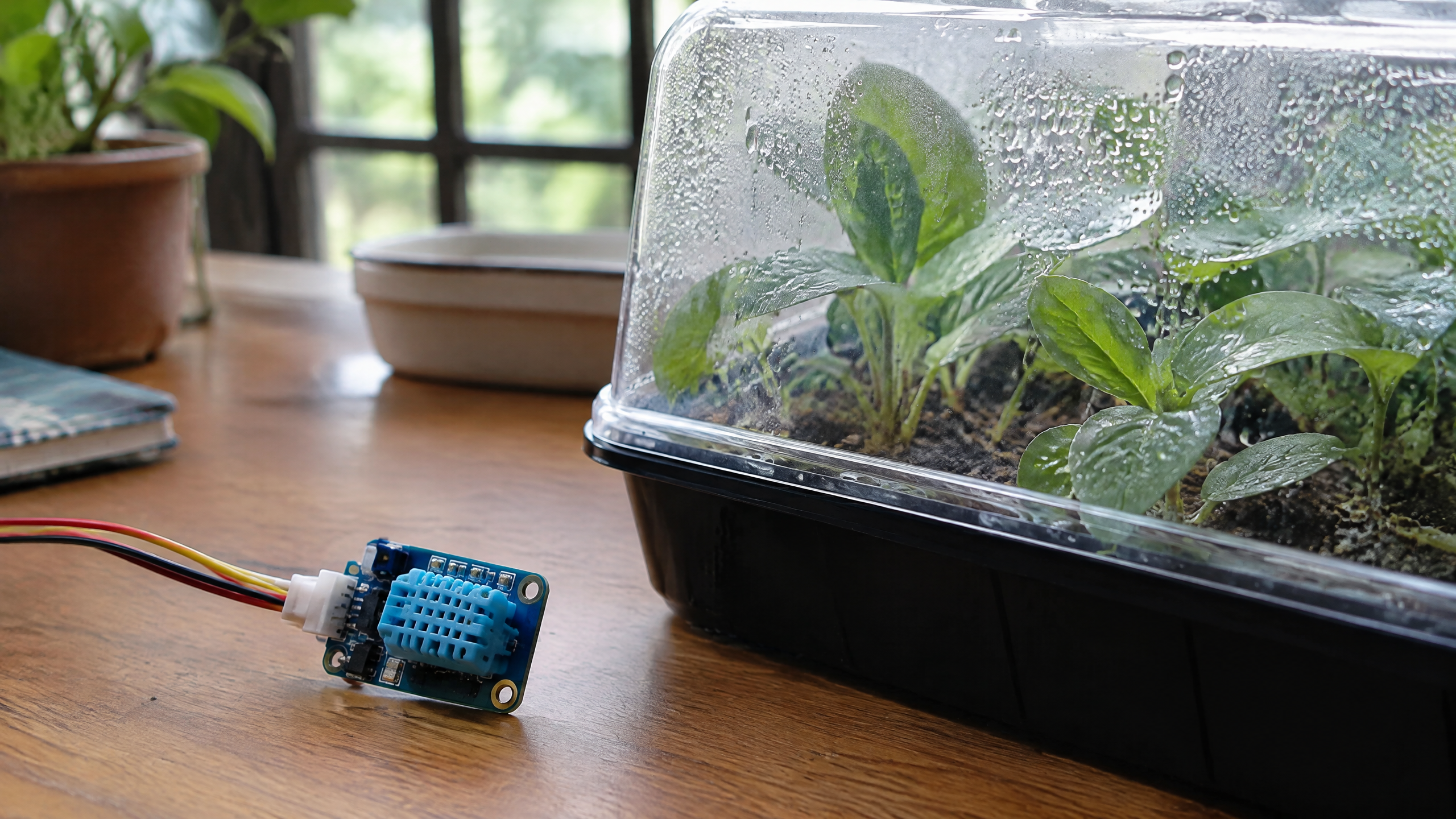
Agriculture and greenhouses: Observing air conditions around plants or protected cultivation. This is different from measuring moisture in soil, which calls for a soil-moisture sensing approach.
Storage and electronics enclosures: Monitoring the microclimate around instruments, cabinets or materials that may be affected by moisture and condensation.
IoT, maker and education projects: Logging temperature and RH, testing airflow or learning how sensors communicate with a microcontroller. A low-cost Arduino project can be useful for learning, but its number should be treated as a measurement to check, not an unquestionable reference.
Laboratory and research settings: Humidity is also a metrology topic. India's Department of Science and Technology has highlighted CeNS work on rapid relative-humidity measurement for laboratory and human-breath-analysis contexts; that is research context, not a consumer-performance guarantee. [4]
Why a humidity reading can be misleading
A sensor can be operating normally while its reading is still unhelpful for the decision a reader wants to make. The key is that it measures a local microclimate.
### Temperature changes the meaning of RH
Since RH depends on temperature, compare temperature alongside humidity whenever possible. A percentage on its own does not tell the full moisture story. If condensation risk matters, dew point and surface temperature may be more relevant concepts than a single ambient RH value. [2] [3]
### Placement and airflow matter
Keep the sensing element away from direct heat sources, direct moisture sources and locations that do not represent the area being monitored. Enclosure design and airflow influence how quickly and how faithfully vapour reaches the element. A sensor beside a warm circuit board, in stagnant air, or immediately beside an air-conditioner outlet may describe that spot rather than the room. [3]
### Condensation, drift and response behaviour matter
Humidity does not necessarily change instantly at the sensing element. Response is governed by vapour exchange between the environment and the element; response time is commonly described as the time to reach 63% of a step change (τ63). Depending on the design, condensation, sustained high-humidity exposure, hysteresis, creep and drift can affect a reading or its recovery. [2] [3]
These are reasons to read a device's documentation for its intended conditions rather than assume one accuracy figure or response time applies to all humidity sensors.
Humidity sensor accuracy and calibration
Accuracy is a system question, not just a line on a module's label. The sensor element, temperature measurement or compensation, analogue or digital electronics, power conditions, placement, airflow and the way the data is interpreted can all matter. No single accuracy value is universal across sensor types, devices or environments.
Calibration is also more than pressing a reset button. For traceable relative-humidity calibration, NIST uses a controlled chamber supplied with humidified air of accurately known moisture content while temperature and pressure are kept stable. [1] That laboratory process illustrates the principle: a meaningful check compares a sensor against a known, controlled reference under stated conditions.
For a classroom, maker or monitoring project, a sensible approach is to document where the sensor is placed, record temperature with RH, allow conditions to stabilise, and follow the device documentation for any calibration or maintenance guidance. If a measurement will support a consequential engineering, quality or safety decision, use an appropriate calibrated instrument and process rather than relying on an unverified hobby module.
FAQs
What is a humidity sensor in Hindi?
Humidity is commonly called आर्द्रता in Hindi, so a humidity sensor may be described as an आर्द्रता सेंसर. The measurement principle is unchanged: it detects water vapour in its local air environment and commonly reports relative humidity.
How does a temperature and humidity sensor work?
It combines humidity sensing with temperature measurement or temperature compensation. This is useful because relative humidity depends on temperature; interpreting both values together is generally more informative than treating the RH percentage alone as a complete moisture measurement. [3]
How do I measure humidity with a sensor?
Place the sensor where it represents the air you want to observe, away from obvious heat and moisture sources, ensure airflow is appropriate for its enclosure, and let conditions settle before interpreting the data. Record temperature with RH and compare the result with a known reference when confidence in the measurement matters. [1] [3]
Is a humidity sensor for Arduino suitable for learning projects?
It can be a practical way to learn data logging, sensor interfaces and the relationship between temperature and RH. Its reading still reflects the sensor's placement, environment and calibration state, so it should not automatically be treated as laboratory-grade or as a substitute for a validated measurement process.
What is a DHT11 temperature humidity sensor?
“DHT11 temperature humidity sensor” is common educational and project wording for a combined temperature-and-humidity module. Before using any such module, consult the exact datasheet and documentation for its interface, intended operating conditions, stated performance and calibration guidance; module names alone do not establish how accurate a finished project will be.
DHT11 vs DHT22 sensor explained: what should I compare?
Compare the exact documentation for the particular modules: their stated operating conditions, temperature and humidity specifications, response behaviour, interface requirements, calibration information and enclosure needs. More broadly, assess where and how the sensor will be installed, because heat, airflow, moisture exposure and condensation can affect the system-level result. [3]
What are relative humidity sensor applications in India?
Examples include local weather logging, classrooms and maker projects, greenhouses, building or HVAC monitoring, storage areas and electronics enclosures. The best application is one where the sensor location and measurement objective are clearly defined; a monsoon-season outdoor reading and an air-conditioned indoor reading answer different questions.
Related reading
[Temperature sensor](/article/temperature-sensor-types-working-principle)
[Pressure sensor](/article/pressure-sensor-working-principle-types)
[Light sensor](/article/light-sensor-working-principle-types)
[Soil moisture sensor](/article/soil-moisture-sensor-working-india)
Source notes
Reporting record
techduopulse stores source destinations privately. Public notes remain non-clickable so every visitor journey stays on this website.
https://support.google.com/trends/answer/4365533?hl=en
Primary source · Research source 5https://www.nist.gov/pml/sensor-science/thermodynamic-metrology/hygrometers
Primary source · Research source 1https://pmc.ncbi.nlm.nih.gov/articles/PMC4063076/
Primary source · Research source 2https://sensirion.com/media/documents/FC5BED84/662B494D/Sensirion_Humidity_Temperature_Design_Guide.pdf
Primary source · Research source 3https://dst.gov.in/cens-develops-humidity-sensor-rapid-measurement-relative-humidity-labs-human-breath-analysis
Primary source · Research source 4https://developers.google.com/search/docs/monitor-debug/trends-start
Primary source · Research source 6New India-focused sensor explainer covering humidity sensor, working principles, uses and limitations.