Embodied AI helps a robot connect what it observes with what it physically does. A polyfunctional, or multi-purpose, robot can perform a supported range of tasks, but changing a job requires more than a new instruction. Its tools, trained skills and operating conditions must also suit the work. Conventional industrial robots are already reprogrammable and multi-purpose in the robotics federation’s ISO-based vocabulary. [1] [2]
This guide focuses on that task change: how perception and action models interact with hardware, what simulation and digital twins can help with, and where reliability and safety limits remain. It uses documented research and clearly labelled examples rather than assuming a robot can do everything shown in a demo. The 2027 section describes directions to watch, not guaranteed adoption or productivity gains.
Show less
On this page 16 sections
- Key Takeaways
- What is embodied AI in robotics?
- What are polyfunctional robots?
- Task flexibility starts with the hardware
- How perception, planning and control work together
- What RT-2 demonstrates—and what it does not
- How simulation and digital twins help train robots
- Task-specific automation versus multi-task deployment
- Applications: separate the task from the promise
- Benefits depend on reliable task changes
- Safety and learning updates must remain controlled
- Embodied AI directions to watch in 2027
- Frequently asked questions
- Important Points / Key Information
- Examples / Supporting Information
- Conclusion
Part of our artificial intelligence technology guide library
Key Takeaways
- Embodied AI connects observations and trained actions; multi-purpose capability still depends on the machine and task.
- Conventional industrial robots are already reprogrammable, so flexibility is not an entirely new category.
- Vision-language-action research can broaden task interpretation without teaching arbitrary physical motions.
- Simulation supports development; real performance, task changes and safety functions need appropriate validation.
What is embodied AI in robotics?
In robotics, embodied AI means AI that uses a machine’s observations to help it act through a physical body. Perception, decisions and movement are connected by feedback: what the robot does changes the situation it observes next. A camera-equipped arm that interprets an instruction and performs a trained manipulation task is one example. [2]
The term describes a connection between intelligence and physical action, not a guaranteed level of competence. A robot may use learned perception while the rest of its task remains tightly constrained. Others use models that predict actions from images and instructions. Different architectures can support different capabilities. [2]
Software errors can also have serious consequences. Robotics adds physical constraints such as reach, payload, friction and collision hazards. A convincing plan on a screen is therefore not enough; the machine must be able to execute it within a suitable, validated application. [5]
What are polyfunctional robots?
Here, polyfunctional means multi-purpose: a robot can perform more than one task within the limits of its hardware, tools and validated capabilities. It might handle several item types, switch between handling and inspection, or combine transport with manipulation. The word is descriptive here, not a claim of a separate safety certification. [1]
Multi-purpose robots are not an entirely new invention. The International Federation of Robotics uses ISO vocabulary that already describes industrial robots as reprogrammable, multi-purpose manipulators. An industrial robot is not defined as a machine that can only repeat one motion forever. [1]
The useful distinction is between the robot and its deployment. A flexible arm can be installed in a cell dedicated to one job. Moving it to another task may require a new tool, revised fixtures, different programming, training data or a fresh safety review. AI may help with parts of that change, but it does not remove the engineering work. [1] [2] [5]
Task flexibility starts with the hardware
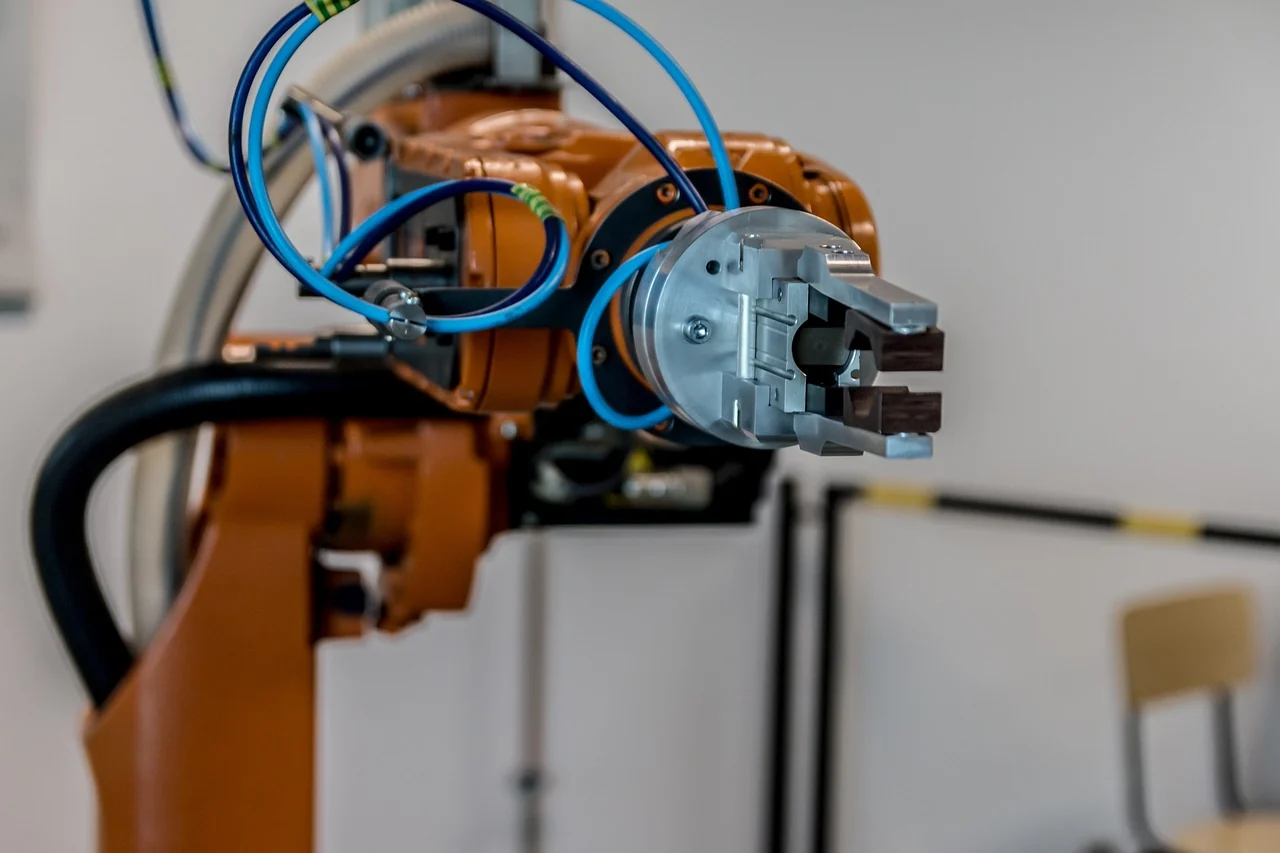
Software cannot give an arm more reach or make an unsuitable end tool hold every object. A robot’s joints and attached tool determine the physical actions available to it. The end effector is the device at the working end of the arm, such as a gripper or another task-specific tool.
A multi-task installation needs a supported range of tasks. Carrying a tote, gripping a small component and manipulating a fragile item can require different contact surfaces, payload limits and control strategies. Tool changes can also introduce different hazards, so flexibility is not the same as permission to change the application without review. [5]
A humanoid shape is not necessary for every multi-purpose task. The federation’s definitions allow a mobile robot to be a platform with or without manipulators. A mobile base with an arm is a different physical design from a fixed arm, but neither shape proves that a learned model can handle arbitrary work. [1] [2]
How perception, planning and control work together
A practical loop is observe, choose a supported action, execute it through the control system and check the result. The components do not always sit in separate software modules. RT-2, for example, studies a model that directly predicts robot actions from camera images and an instruction. The physical machine and its controls still have to carry out those actions. [2]
Perception estimates the scene and the robot’s state
Images can help identify an object and estimate where it is. Other sensing can provide distance or information about the robot’s own movement. An estimate is not perfect knowledge: unfamiliar objects, clutter and unusual dynamics can expose weaknesses that a familiar test does not show. [2]
It helps to separate sensing the world from sensing the body. A distance measurement concerns the surroundings; an encoder provides information about position or movement in a mechanism. Combining the available information supports control, but it does not establish that a robot sees every obstacle or recognises every person.
A task instruction must become a supported action
“Move these parts to the tray” contains a goal, but the robot still needs to locate suitable objects and produce executable actions. A vision-language-action model, or VLA, connects visual and language input with action output. RT-2 represents actions in a form the learned model can predict after training on both web and robot demonstration data. [2]
The language interface is only one part of the capability. Describing a new task does not prove that the robot has the required physical skill or can perform it reliably in the current workspace. An instruction also needs to remain within the application’s permitted actions and safety constraints. [2] [5]
Feedback checks what actually happened
Movement control and the relevant feedback connect a selected action to the mechanism. The intended grip or position can differ from the result when an object moves, a component behaves differently or a measurement is inaccurate. A task needs a way to recognise an unsuccessful result rather than silently continue as though the plan worked. [2] [5]
Smooth-looking motion is not proof of safety. OSHA’s industrial-robot guidance discusses component faults, unexpected movement and the need to check actual stopping functions. Detection and stopping depend on the equipment, configuration and protective measures; no generic AI model guarantees that every unexpected contact will be detected safely. [5]
What RT-2 demonstrates—and what it does not
The 2023 RT-2 paper is a useful documented example of broader task interpretation. Its authors combined robot demonstration data with knowledge from pre-trained vision-language models. They showed that learned manipulation skills could be applied to some new objects and semantically varied instructions. These are research results from specified evaluations, not a 2027 deployment guarantee. [2]
The limitation is as important as the result. The paper says web-scale experience did not give the robot new physical motions beyond the skills represented in its robot data. It helped deploy those skills in new ways. Understanding the words “fold this towel” therefore does not establish that a robot trained for a different manipulation task can fold it. [2]
The authors also describe failure cases involving precise or dexterous motions, grasping particular object parts and tasks requiring more extended reasoning. High computation cost can become a bottleneck when an application needs high-frequency control. These limits are specific to that research, but they show why semantic generalisation and physical competence need separate evidence. [2]
How simulation and digital twins help train robots
Simulation lets developers evaluate virtual robots and scenes before using physical hardware for every trial. NVIDIA’s Isaac Sim documentation describes imported robot and scene assets, synthetic-data generation, and software testing before hardware deployment. A digital-twin example represents an identified real robot, workspace or installation rather than merely an arbitrary training scene. [3]
The label does not make the virtual world an exact mirror. The reviewed NVIDIA material distinguishes approximate simulated physics from the real world. Nor should a generic simulated room be described as continuously synchronised with a factory unless that particular data connection has been established. [3] [4]
The value is being able to explore a defined task and its assumptions. Virtual trials can vary object positions, lighting or other conditions without wear on the simulated machine. Some physical trials may be avoided, but neither a universal cost saving nor a fixed number of training attempts follows from using simulation. [3] [4]
Synthetic data creates controlled variation
Synthetic data is generated rather than captured from a physical trial. Isaac Sim supports labelled scene and sensor outputs that can be used in robotics development. Labels and varied scenes can help a model encounter conditions that would be difficult to collect repeatedly with hardware. [3]
The generated material still depends on the scene and modelled conditions. A useful training set does not emerge simply by creating more images. If important objects, contact behaviour or sensor effects are missing, a model can perform well in the virtual setup and still struggle outside it. [4]
Why sim-to-real transfer remains difficult
Sim-to-real transfer means moving a policy developed in simulation to a physical robot. Domain randomisation varies training conditions instead of assuming one perfect match. NVIDIA describes visual variation and changes to parameters such as friction, mass, actuator delays and sensor noise. [4]
Those variations are a strategy, not a guarantee. The same material describes trade-offs and difficulty with highly dynamic tasks. Parameter ranges need to fit the problem, and a simulation-trained policy still needs appropriate validation on the real system. A successful virtual run cannot establish that real stopping distances, protection or task performance are acceptable. [4] [5]
Task-specific automation versus multi-task deployment
Compare the way a cell is used, not an imaginary divide in which all conventional robots lack sensors or flexibility. A conventional reprogrammable robot can support more than one application; an AI-equipped robot can still be deployed for just one tightly defined task. [1] [2]
The choices below describe deployment approaches. They are not claims that every multi-task robot is faster, cheaper or easier to change.
| Question | Task-specific deployment | Multi-task deployment |
|---|---|---|
| What is validated? | A defined task with specified parts, tools and conditions. | A supported set of tasks and the transitions between them. |
| Can the hardware change jobs? | It may be reprogrammable or retoolable. | It also depends on reach, tools, payload and controls. |
| What role can AI play? | Perception or another limited function may already use AI. | Models may help interpret varied input and select supported actions. |
| Is changeover automatic? | Not necessarily; integration and review may be needed. | Not necessarily; new tools or policies can require renewed review. |
| How is success judged? | Reliable performance in the defined application. | Reliable performance across each supported task, not versatility claims alone. |
Applications: separate the task from the promise
Manufacturing, logistics and agriculture contain physical tasks that benefit from perception and controlled action. Their requirements differ, so evidence for one task should not be treated as proof of competence across an entire industry. [2] [5] [6]
Manufacturing: a defined set of jobs
A possible multi-task cell could handle parts for one operation and inspect another item with a supported sensor or tool. That is an illustrative use of reprogrammable equipment, not evidence that a single robot can perform every assembly step. Tooling, fixtures and the task’s precision still matter. [1] [5]
Production claims should identify what the robot did, where and under what constraints. The existing car-factory guide covers specific manufacturer examples; this article does not turn those pilots into a claim that robots autonomously build whole vehicles.
Logistics: transport is not the same as picking
A mobile platform can travel under its own control, while a manipulator acts on objects. Combining the two can support tasks involving both transport and handling, but the federation’s definitions do not promise that any mobile robot can also grasp an item. [1]
A hypothetical warehouse robot might move a supported container and manipulate specified objects at a workstation. Irregular packaging, difficult grips and unfamiliar dynamics can challenge a learned manipulation policy. A demonstration with a few known items does not show reliable picking of every object in a warehouse. [2]
Agriculture: a specialist perception-and-action example
John Deere describes See & Spray as using camera vision and machine learning to distinguish crops from weeds for targeted spraying. That is a concrete manufacturer-described example of perception affecting a physical action. It is not an independent test or an assertion about availability in India. [6]
It also illustrates a useful distinction: an AI-enabled specialist task is not automatically multi-purpose robotics. A system designed to classify and target weeds does not thereby acquire the tools or trained skills needed to harvest delicate fruit. The machine, task and evidence must stay specific. [2] [6]
The supplied outline also lists medical uses. This explainer does not infer surgical, rehabilitation or patient-handling capability from industrial robotics research. Those claims would need separate device-specific clinical and safety evidence.
Benefits depend on reliable task changes
The attraction of a multi-purpose robot is that supported tasks can share some equipment and learning infrastructure. Vision-language-action research shows one way to broaden interpretation of objects or instructions. But that benefit has to survive real physical execution, not just language understanding. [2]
Switching tasks may reduce the need for entirely separate equipment in a suitable application. It may also introduce tool changes, more complex validation and additional maintenance. OSHA’s guidance highlights the hazards of different end effectors, paths and tasks. “More versatile” is therefore not a substitute for a task-specific assessment. [5]
Reliability also includes what happens after an unsuccessful action. Downtime, recovery and supervision can affect the usefulness of a system even when most familiar demonstrations look successful. This article does not assign invented productivity, safety or financial-return figures.
Safety and learning updates must remain controlled
OSHA’s industrial-robot guidance calls for task-based risk assessment, appropriate risk reduction, and verification and validation of actual safety functions. It states that risk assessment alone is insufficient. A sensible generated plan or collision-free simulated motion does not certify physical safety. [5]
Deployment also differs from training. Running a trained policy does not mean the robot continually changes its model weights during normal operation. Developers can improve a model through further data and training, but the reviewed material does not establish safe, automatic learning from every public interaction. [3]
Changes to tasks, poses, paths or end tools can introduce different hazards. OSHA says risk-assessment documentation should be reviewed when the application changes. Applying that principle to an AI policy change means considering the safety impact and appropriate renewed validation; this is an application of the general guidance, not an OSHA quotation specifically about language models. [5]
This is an explanation of engineering considerations, not installation, maintenance or safeguard-modification instructions. Workplace guidance also cannot establish that an unrelated consumer or medical robot is safe. [5]
Embodied AI directions to watch in 2027
Better use of robot demonstrations, more suitable action models and improved transfer from simulation are plausible directions to watch. RT-2 provides evidence of one research approach; Isaac Sim and related training material describe tools for developing and testing others. Neither establishes when a particular capability will become dependable in a specific workplace. [2] [3] [4]
Multi-task arms, mobile manipulators and humanoids are different design possibilities. The useful evidence will be validated task range, reliability after changes, protective measures and maintenance requirements. A new body shape or model announcement is not a demonstration of those qualities. [1] [5]
The supplied sources do not prove a universal 2027 growth wave, shorter changeovers or wider adoption across every sector. Keep research results, pilots, product plans and routine deployment separate.
Frequently asked questions
Do polyfunctional robots have to be humanoid?
No. Multi-purpose capability concerns supported tasks, not a required human-like shape. Fixed arms or mobile platforms with manipulators can support different applications; their actual abilities still depend on hardware, tools and control. [1]
Can a language instruction teach any new physical skill?
No. RT-2’s authors explicitly say web knowledge did not supply new motions outside the skills represented in its robot data. An understandable instruction is not proof that the machine has the necessary reach, tool or trained control skill. [2]
Does a digital twin remove the need for real testing?
No. Simulation uses approximations, and domain randomisation does not guarantee transfer. Real-system validation and verification of relevant safety functions remain necessary. A virtual success is not physical-safety certification. [3] [4] [5]
Does the robot learn automatically while it works?
Not necessarily. Running a trained policy and collecting data are different from updating that policy. Further training or changes to the application need controlled evaluation and appropriate safety-impact review, rather than assuming every interaction safely improves the robot. [3] [5]
Important Points / Key Information
Embodied AI connects observations with physical action. Polyfunctional describes a supported range of tasks; neither term guarantees general-purpose competence. [1] [2]
- Conventional industrial robots are already reprogrammable and multi-purpose in the federation’s ISO-based vocabulary.
- Task range is bounded by hardware, end tools, trained skills and the operating conditions.
- RT-2 demonstrates semantic generalisation, not arbitrary new physical motions from web data.
- Simulation can support development, but simulated success is not real-world safety certification.
- Validate relevant changes and keep research, deployment evidence and conditional 2027 directions distinct.
Examples / Supporting Information
Hypothetical task change: an arm is validated to pick specified rigid parts and place them in a tray. The next proposed job is handling a delicate item. A language model might recognise the new object, but that does not establish that the old gripper and motion policy are appropriate.
The new job needs a supported tool and suitable control behaviour, followed by evaluation in its intended conditions. Simulation can help explore candidate motions, but physical performance and the relevant protective measures still need appropriate review. These are considerations, not a procedure for reprogramming or bypassing a robot’s safeguards. [2] [3] [5]
This example separates knowing what an object is, having a physical skill and being cleared for a specific task. It is not a hands-on test, a product recommendation or proof of shorter changeover time.
Conclusion
Embodied AI can help a robot interpret observations and use trained actions in more varied situations. Multi-purpose capability depends on more than the model: suitable hardware, end tools and a supported task range remain essential. Conventional reprogrammable robots and newer AI approaches are not mutually exclusive categories. [1] [2]
Look for evidence of what the machine can reliably do after a task change. Simulation and digital-twin work can help development, but they do not erase physical limits or replace validation. That is the practical basis for judging adaptable robots, whether a demonstration happens today or a product is proposed for 2027. [3] [4] [5]
How we checked thisSources (6)
We keep source links private so your reading stays on techduopulse. Each note names the publisher and document we checked.
[1] International Federation of Robotics — Standardization — robot definitions at ISO — Undated; retrieved 6 Nov 2026
Primary source · ISO-based robot definitions as reported by IFR; no claim to certify a particular machine[2] Brohan and colleagues / RT-2 research team — RT-2: Vision-Language-Action Models Transfer Web Knowledge to Robotic Control — 2023
Primary source · Original research; physical-skill, computation and evaluation limitations retained[3] NVIDIA — What Is Isaac Sim? — Updated 14 October 2026
Primary source · Simulation, synthetic data and separation of training/evaluation; not physical-safety certification[4] NVIDIA — Sim-to-Real Strategy 1: Domain Randomization — Undated; retrieved 6 Nov 2026
Primary source · Conceptual variation and sim-to-real limits; no hands-on control instructions copied[5] OSHA — Industrial Robot Systems and Industrial Robot System Safety — Technical Manual Section IV, Chapter 4 — Undated; retrieved 6 Nov 2026
Primary source · Industrial workplace risk assessment and validation; not latest-edition or universal safety certification[6] John Deere — See & Spray Gen 2 — Undated; retrieved 6 Nov 2026
Primary source · Manufacturer-described targeted-spraying mechanism only; no savings, clinical, regional-availability or promotional claimsInitial source-backed owner-authorized manual publication. Original reviewed article facts, metadata and licensed real photograph preserved. Schema-only body and citation projections are recorded privately; no hands-on test or qualified human certification claimed.