Physical AI is the part of artificial intelligence that has to cope with the real world. Instead of only producing a response, image or recommendation on a screen, a physical-AI system observes its surroundings, chooses an action and causes a machine to move or change something. That can describe a warehouse robot choosing a route, a drone holding position while it captures an inspection image, or a smart machine stopping when a sensor reports an unsafe condition. The label is broad, and it is not a guarantee of human-like understanding or full autonomy. The useful question is simpler: what can the machine sense, decide and safely do in its actual operating environment? Key Takeaways
This article is part of the software engineering technologies guide library.
What is physical AI?
Physical AI is AI that helps a machine perceive, reason about and act in the physical world. Gartner listed physical AI among its 2026 strategic technology trends and described it as bringing intelligence into the real world through robots, drones and smart equipment. That is trend framing rather than evidence that every such system is mature or widely deployed. [1]
A useful working definition comes from NVIDIA, which describes physical AI as enabling autonomous systems such as cameras, robots and self-driving cars to perceive, understand, reason and perform or orchestrate complex physical-world actions. This is a vendor definition, so it is best read as a practical description of the systems category, not as a formal standard. [2]
The important distinction is action with consequences. A chatbot can give instructions for picking up a box. A robot arm must identify the box, estimate its location, select a grip, regulate force, avoid people and equipment, and respond if the box slips. In the latter case, poor perception or a bad decision can damage goods, interrupt work or injure someone.
Physical AI overlaps with embodied AI, robotics, computer vision, control systems and autonomous systems. The terms are not always used consistently:
Traditional automation commonly follows predefined logic in a controlled sequence.
Robotics combines mechanisms, electronics, software and control to sense or act in the world.
Embodied AI emphasises intelligence situated in a body that interacts with its environment.
Physical AI is a broad current label for AI-enabled systems that connect perception and decisions to real-world action.
A machine does not become physical AI simply because it has a camera or because its maker calls it “AI”. The meaningful test is whether it can use inputs to adapt an action within a defined operating boundary.
How physical AI works: sense, estimate, decide, act
A physical-AI system is usually a loop, not a one-time prediction. NIST describes robotic systems as needing to perceive the world and their own state through sensors and algorithms, plan and adapt actions from that estimate, then execute through locomotion, grasping or other actuation. [3]
### 1. Sense the environment and the machine’s state
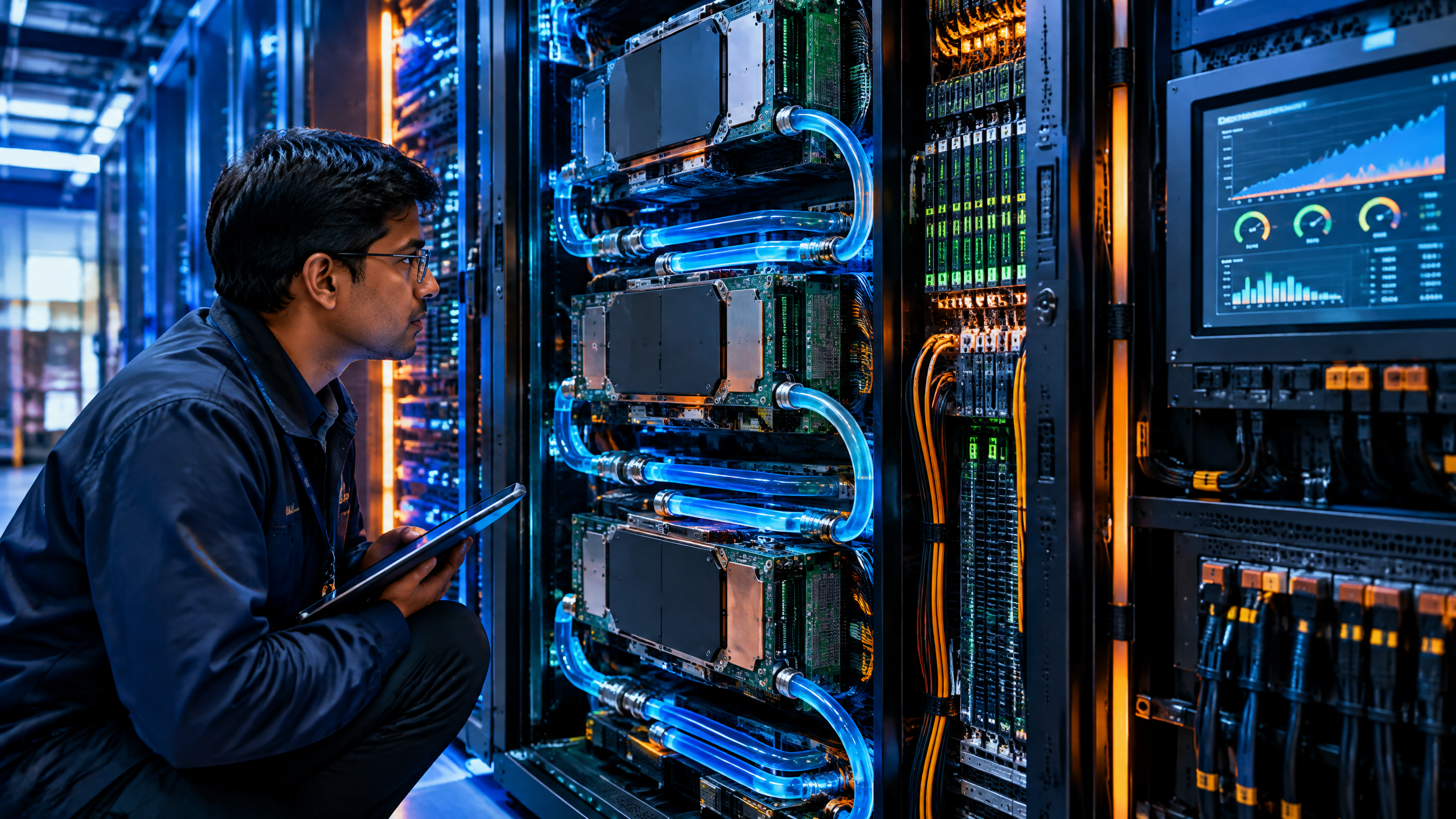
Sensors convert parts of the environment or machine condition into data. A system may use one sensor, but real deployments often combine several because each signal has limits.
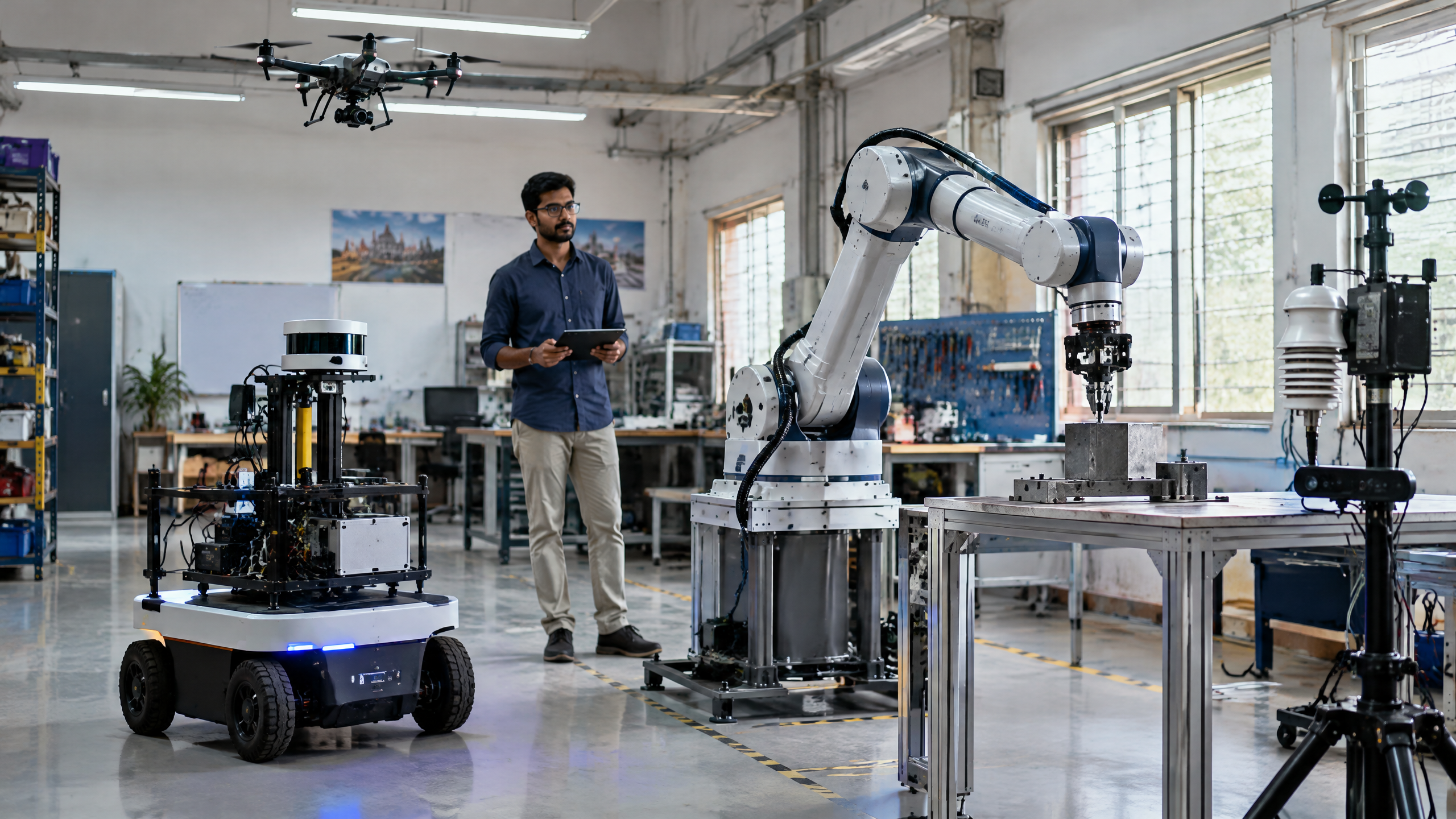
A mobile robot, for example, may use cameras to recognise visual features, wheel encoders to estimate travel, an inertial measurement unit (IMU) to detect acceleration and rotation, and depth or ranging sensors to estimate obstacles. A robot arm may add force or torque sensing to detect contact. A drone may combine cameras, an IMU, barometric sensing and satellite-navigation signals.
Sensor fusion means combining those inputs into a more useful estimate. It does not make a system infallible. Cameras can be affected by lighting, reflections or occlusion. Satellite navigation can be degraded or unavailable in some places. Motion sensors drift, and a depth sensor may struggle with particular materials or weather conditions. The machine must account for uncertainty rather than treat every measurement as ground truth.
For a primer on parts of that sensor layer, the existing TechDuoPulse explainers on /article/accelerometer-explained, /article/gyroscope-explained and /article/ultrasonic-sensor-working-uses are natural supporting reads.
### 2. Build an estimate of what is happening
Raw data is not yet understanding. The software turns it into an estimate of the scene and the machine’s position, movement and possible hazards. This may include identifying an object, mapping a room, estimating an object’s pose, tracking a person or predicting where a moving vehicle might be next.
Some tasks use machine-learning models, including computer-vision models. Others rely mainly on geometry, rules, filtering and conventional control. Most practical systems blend methods because a learned model can be useful for perception while a constrained controller is better suited to a safety-critical movement.
A model can be uncertain or wrong even when its answer sounds confident. Good system design therefore separates a tentative perception result from the decision to move a motor, release a gripper or change direction.
### 3. Decide within constraints
The decision layer chooses an action from the current estimate. It may plan a route, select a grasp, adjust speed or request human help. The system should also apply constraints such as speed limits, keep-out zones, joint limits, battery reserve, collision margins and permissions.
This is where autonomy needs careful wording. A machine can be autonomous for a narrow task—such as following a mapped route in a warehouse—without being generally intelligent or safe in every unfamiliar environment. A remote operator, supervisor or emergency stop may remain part of the design.
### 4. Act, observe the result, and correct
Actuators are components that make physical change: motors turn wheels, servo mechanisms move joints and pumps or valves change fluid flow. The control system compares the intended result with new sensor readings and makes small corrections. This feedback loop is why a robot can hold a position or a drone can adjust to a disturbance instead of executing one fixed movement and hoping it worked.
NIST’s robotics programme treats performance as a property of the integrated system, not only of an individual sensor or AI model. That matters because a strong vision model cannot compensate for a poorly calibrated actuator, unreliable communications or an unsafe workcell design. [3]
Where physical AI appears in the real world
Physical AI is best understood through bounded jobs, where designers can define the environment, inputs, task and safety controls.
### Robot arms and mobile robots
In factories, labs and warehouses, systems may sort items, inspect surfaces, move materials or perform repetitive handling. A robot arm’s challenge is not merely recognising an object. It must account for object variation, placement, grip force, reach, obstacles and recovery when the expected action fails.
A mobile robot has another layer of difficulty: it must move through a space shared with people, equipment and changing obstructions. NIST’s work specifically calls for measurement methods for perception, mobility, human-robot interaction, dexterity and safe operation in dynamic and unstructured environments. [3]
### Drones and remotely operated systems
Drones are a clear example of physical intelligence because they combine sensing, flight control, navigation, communications and a payload such as a camera. They can support inspection, mapping or observation, but the fact that a drone has automated features does not remove the need for a defined mission, operator procedures and current regulatory checks.
Date-sensitive India note (checked 13 October 2026): India’s Ministry of Civil Aviation maintains an official entry for the Drone Rules, 2021, while the DGCA portal lists Drone Rules, amendments and the Digital Sky platform. Requirements vary with the operation and can change. This article is not operational or legal advice; check current DGCA and Digital Sky material before flying or deploying a drone. [4] [5]
### Smart equipment and inspection systems
The term can also include fixed equipment that observes and responds: a vision system that identifies a defect, a machine that adjusts to a measured condition, or a monitored facility that raises an alert and changes a process state. Here, “physical” does not require a humanoid robot. It requires a reliable connection between an observation, a decision and a real-world action.
The practical value is usually task-specific: fewer manual measurements, more repeatable inspection or operation in places that are difficult to access. Whether it is a good fit depends on the error cost, the variability of the environment and the quality of the fallback process.
Robots, drones and sensors: the pieces that have to work together
A useful mental model is a chain: sensor → state estimate → decision → controller → actuator → feedback. Weakness at any point limits the whole machine.
Consider a drone inspecting a structure. A camera may detect an area worth reviewing. The navigation stack estimates position. A planner sets a safe path and speed. The flight controller turns those targets into motor commands. The communication link shares telemetry or video. A human may review the result or take over. If wind, connection quality, lighting or position estimates fall outside the design envelope, the correct behaviour may be to slow down, return, hover, stop or hand control back—not to keep improvising.
This systems view prevents a common misunderstanding: a larger AI model is not automatically a better physical-AI system. The best model still needs suitable sensors, timely computing, accurate calibration, dependable controls and an environment where its performance has been assessed.
That is also why metrics must match the job. Image-classification accuracy is not enough for a robot that handles fragile parts. Relevant measures might include the rate of successful picks, force-control error, time to stop, false obstacle detections, recovery behaviour and safe performance under expected variations. NIST notes that contextual performance requirements and verification methods are needed to assess whether robotic systems meet the needs of intended applications and environments. [3]
Training and testing: why simulation helps but cannot finish the job
Physical-AI teams need examples of ordinary and difficult situations: different objects, surfaces, lighting, routes, contact forces and failures. Capturing every scenario on real machinery can be slow, expensive or unsafe.
Simulation and digital twins can help create repeatable scenarios, test controllers and generate synthetic training data. NVIDIA describes physics-based simulation and synthetic data as tools for developing physical-AI systems; this explains one development approach, not a guarantee that a simulated model will transfer cleanly to a deployed machine. [2]
The gap between simulation and reality matters. Sensor noise, worn wheels, flexing parts, dust, vibration, weather, people and imperfect maps can affect a real machine in ways a model misses. NIST’s automated-vehicle measurement work explicitly combines simulation with a physical research vehicle to validate that simulation-derived metrics are meaningful on real systems. [6]
A responsible development cycle therefore includes:
defining the job and the operating boundary;
testing expected and failure cases in controlled conditions;
validating on the actual hardware and environment;
setting intervention, stop and recovery rules; and
monitoring performance after changes to models, sensors, software or the site.
This is not bureaucracy around the AI. It is how a system that can move, lift, fly or control equipment earns confidence.
Physical AI in India: what the current signals do—and do not—show
Observed facts, date-sensitive: India Mobile Congress 2026 listed industrial automation/robotics among its “Fuelling Growth” themes. Its programme also named AI-native telecom, edge and cloud, autonomous networks, satcom and responsible AI. This is evidence that these topics are part of a major 2026 industry agenda; it does not prove nationwide deployment, demand or commercial availability of any particular technology. [7]
MeitY’s Draft National Strategy for Robotics, published in February 2024, identifies manufacturing, agriculture, healthcare and national security as priority sectors. It proposes work on research, demonstration, testing, validation and certification. Because the document is explicitly a draft, it should not be described as an enacted national robotics policy. [8]
India also has a relevant navigation building block. ISRO states that NavIC’s civilian Standard Position Service covers India and a region up to 1,500 km beyond the national boundary, and it is interoperable with other global navigation satellite system signals. Positioning is only one input to a physical-AI system, however; local sensing, maps, controls and operating conditions still determine whether a machine can carry out a task safely. [9]
Interpretation: These official and industry signals make India a useful context for explaining physical AI through practical needs—industrial automation, field monitoring, mobility, agriculture and inspection—rather than through generic claims that robots will replace whole occupations or that drones can operate without constraints. The stronger question for any deployment is whether the system has been tested for its exact environment, user workflow, connectivity and safety requirements.
Limits and trade-offs to understand before trusting a physical-AI system
Physical AI adds capability, but it also adds exposure to real-world uncertainty. The trade-offs should be visible before a system is put near people, vehicles, crops, machinery or critical processes.
### Reliability and the “long tail” of unusual situations
A system trained on common conditions may fail on rare but important ones. Objects can be moved, labels can be obscured, surfaces can change, and people can behave in unexpected ways. A demo in a tidy, prepared environment is not enough evidence for broad operational claims.
### Safety is a system property
Safety involves mechanical design, sensors, control logic, guarding, emergency stops, worksite procedures, training and maintenance. ISO says robotics standards support safe integration and human-robot interaction; its sector page lists updated 2025 industrial-robot safety standards. The existence of a standard does not certify a particular product or installation, so compliance should be assessed by the responsible organisation and applicable authorities. [10]
### Data, privacy and cybersecurity
Cameras, microphones and location signals can collect sensitive information. Connected robots and drones also add software, accounts, networks and update paths that must be secured. Data minimisation, access control, retention rules and secure update practices are design choices, not automatic consequences of using AI.
### Cost, maintenance and integration
The bill is not limited to a robot or a drone. It can include sensors, charging, spare parts, connectivity, maps, calibration, integration with existing processes, operator training and downtime. A narrow, repeatable task may justify that work; a highly variable task may need more human oversight or a different approach.
### Human responsibility remains essential
A system may classify, plan or control, but people still set its purpose, operating boundary and escalation path. High-consequence uses need clear accountability for monitoring, intervention and incident review.
How to evaluate a physical-AI claim
When you encounter a robot, drone or “smart” machine described as physical AI, ask these questions:
What exact task does it perform, and in what environment?
Which sensors does it rely on, and what conditions degrade them?
What does it do when it is uncertain, disconnected or unable to complete the task?
What prevents unsafe movement or a bad command from becoming a physical action?
Has the complete system been tested on the relevant hardware and site, not only in simulation?
Who can pause, override or inspect it, and what is the recovery procedure?
What data does it collect, where is it processed and who can access it?
Clear answers are more useful than broad claims about intelligence. They reveal whether the system is a credible, bounded automation tool or simply a concept demonstration.
Frequently asked questions
### Is physical AI the same as robotics?
Not exactly. Robotics is the broader field of designing and operating machines that sense or act. Physical AI is a current term for AI-enabled systems that connect perception and decision-making to physical action. A robot can be largely rule-based; a physical-AI system may combine learned models, conventional software and control systems.
### What is embodied AI?
Embodied AI usually refers to intelligence that is situated in and interacts through a physical body, such as a robot. It substantially overlaps with physical AI. In everyday technology writing, the terms are often used for related systems, but they do not have one universal industry definition.
### Do all physical-AI systems use generative AI?
No. A physical system may use computer vision, control algorithms, mapping, optimisation, rules, machine learning or a combination. Generative AI can be useful for some interfaces or planning research, but safe physical action still depends on sensing, constraints and controls.
### Why do physical-AI systems need several sensors?
Different sensors observe different aspects of a task and fail in different ways. Combining inputs can improve the system’s state estimate, but it also increases integration, calibration and testing work. More sensors do not automatically make a system safe.
### Can a drone be fully autonomous?
Autonomy is task- and environment-specific. A drone may automate parts of a carefully defined mission, but its use is still constrained by sensing limits, weather, communications, procedures and applicable requirements. In India, verify the current official DGCA and Digital Sky information for the intended operation. [4] [5]
### Does NavIC make a robot or drone accurate enough by itself?
No. NavIC is a navigation service that can contribute positioning and timing information. ISRO publishes an accuracy design figure for its civilian service, but real task performance depends on the receiver, signal conditions, integration with other sensors, maps, controls and the required safety margin. [9]
### Can simulation prove that a robot is safe in the real world?
No. Simulation is valuable for repeatable training and test scenarios, but real hardware and sites introduce differences. NIST’s work combines simulated scenarios with physical-vehicle validation rather than treating simulation as a final proof. [6]
### Will physical AI replace human workers?
It may automate parts of some bounded tasks, but it does not by itself determine employment outcomes. Real deployments also create work in supervision, maintenance, integration, safety, operations and exception handling. Effects vary by job, organisation and local conditions; blanket replacement claims are not supported by this explainer.
Suggested same-site internal links
These are editorial recommendations for this private draft. They use existing, plausible TechDuoPulse /article/ paths and should be added only where the surrounding copy remains useful.
Anchor: “how accelerometers measure movement” → /article/accelerometer-explained — place in the sensing section.
Anchor: “how a gyroscope measures orientation” → /article/gyroscope-explained — place in the drone or state-estimation discussion.
Anchor: “ultrasonic sensors for distance detection” → /article/ultrasonic-sensor-working-uses — place in the obstacle-sensing explanation.
Anchor: “proximity sensor types and working” → /article/proximity-sensor-types-working — place in the machine-safety or robot-perception discussion.
Anchor: “force sensors in contact tasks” → /article/force-sensor-working-principle — place in the robot-arm section.
Anchor: “soil-moisture sensors in India” → /article/soil-moisture-sensor-working-india — optional contextual link for an agriculture example, not a deployment claim.
Anchor: “AI infrastructure explained” → /article/ai-infrastructure-gpus-tpus-npus-inference-energy — place in the section on local versus cloud computing for robots and cameras.
Anchor: “5G technology explained” → /article/5g-technology-explained — use only if that page exists at publication; otherwise omit rather than substitute an unverified path.
Frequently asked questions about Physical AI Explained: Robots, Drones, Sensors and Real-World Intelligence
These answers summarise the scope of this explainer. Availability, standards and implementation details can change, so check current official guidance before acting.
What is Physical AI Explained: Robots, Drones, Sensors and Real-World Intelligence?
Physical AI Explained: Robots, Drones, Sensors and Real-World Intelligence explains the main ideas, practical uses and limitations in plain English.
Why does this technology matter?
Its value depends on the problem, implementation, evidence, cost, security and the people responsible for using it.
What should readers verify?
Verify current availability, compatibility, security, privacy and regulatory details with the relevant official source.
Is this article professional or legal advice?
No. It is general technology information and does not replace professional, legal, regulatory or security advice.
Source notes
Reporting record
techduopulse stores source destinations privately. Public notes remain non-clickable so every visitor journey stays on this website.
Gartner Top 10 Strategic Technology Trends for 2026
Primary source · Research source 1What is Physical AI?
Primary source · Research source 2Measurement Science for Robotics and Autonomous Systems Program
Primary source · Research source 3Drones Rules, 2021 dated 25 August 2021
Primary source · Research source 4DGCA drone rules and Digital Sky portal
Primary source · Research source 5Measurement Science for Automated Vehicles
Primary source · Research source 6India Mobile Congress 2026 — Scale Without Boundaries
Primary source · Research source 7Draft National Strategy for Robotics
Primary source · Research source 8ISRO Satellite Navigation Services
Primary source · Research source 9ISO Robotics
Primary source · Research source 10New India-focused explainer covering physical AI explained, practical context, limitations and verified sources.