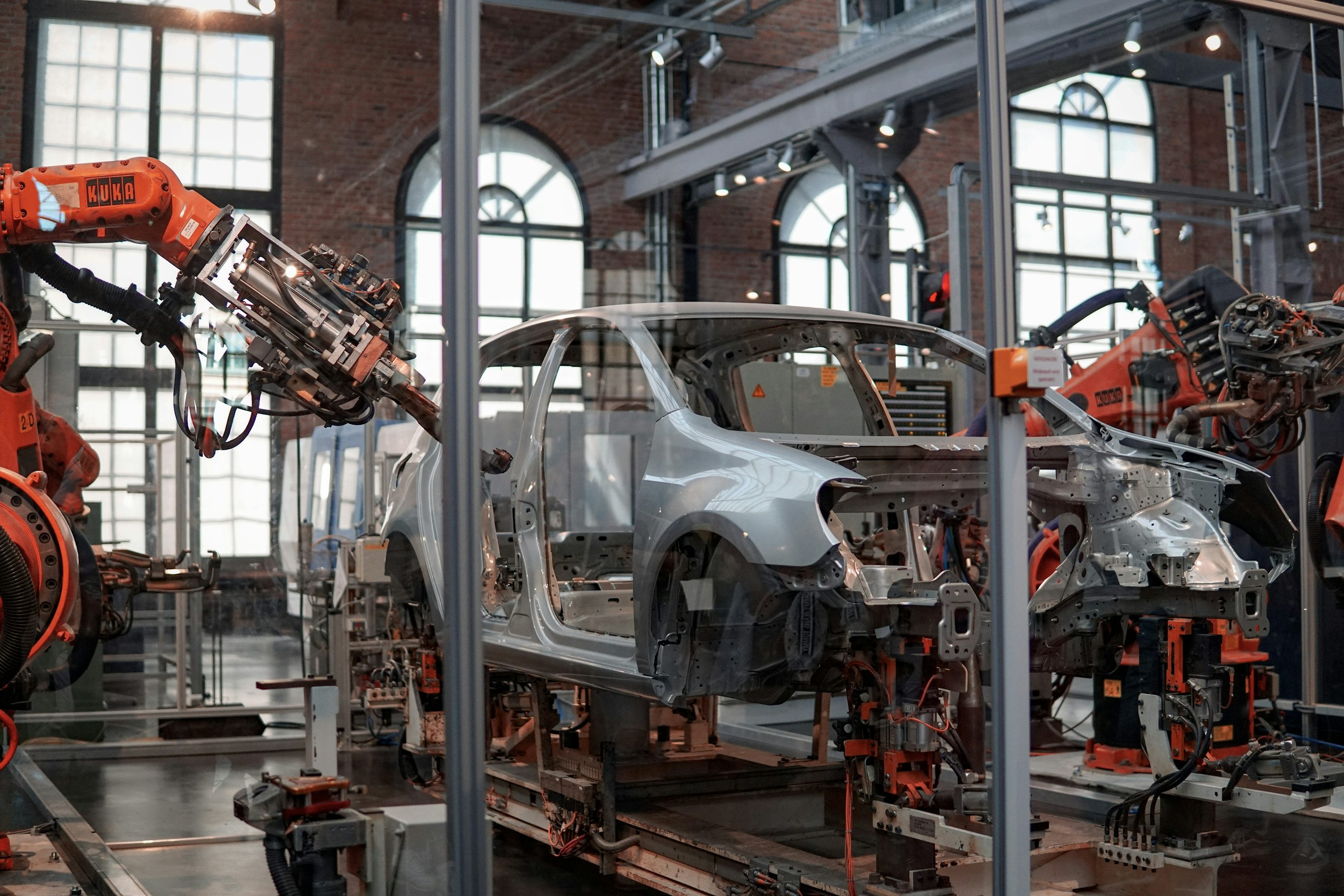
AI robots in car factories are taking on carefully defined tasks, from positioning sheet-metal parts to learning how to move and sequence components for assembly. BMW's production pilot, Hyundai's robot training centre and Mercedes-Benz's earlier tests show useful progress, but they do not describe robots independently building entire cars or vehicles driving themselves.
On this page 11 sections
- Key Takeaways
- What do AI robots do in automobile manufacturing?
- BMW: what the Figure 02 pilot actually achieved
- Hyundai: Atlas training moves into a production setting
- Mercedes-Benz: earlier Apollo tests provide context
- Real-world limits: reliability, safety and integration
- What Indian readers can learn from these factory pilots
- Frequently Asked Questions
- Important Points / Key Information
- Examples / Supporting Information
- Conclusion
Part of our artificial intelligence technology guide library
Key Takeaways
- Factory robot arms, mobile robots and humanoids describe different physical designs; none automatically proves AI capability.
- BMW says Figure 02 supported production of more than 30,000 X3 vehicles within ten months in its 2025 pilot; it positioned parts before welding. [1]
- Hyundai's operational RMAC trains Atlas for logistics and parts sequencing; component assembly by 2030 remains a future plan. [2]
- Reliability, safety and integration matter more than a human-like appearance; the cited foreign pilots do not establish deployment in India.
What do AI robots do in automobile manufacturing?
Manufacturing robotics concerns the factory process: handling materials, preparing parts, moving components and carrying out defined production tasks. Self-driving technology concerns how a vehicle perceives roads and controls its movement. Both may use sensors and AI, but evidence about one does not prove capability in the other.
Robot arms, mobile robots and humanoids are different designs
A conventional industrial arm typically performs a repeatable operation with a task-specific tool. A mobile robot moves materials through a facility. A humanoid adds a body and manipulators resembling parts of human anatomy, potentially allowing it to work with equipment arranged for people. These categories can overlap: a mobile platform can carry arms.
Shape alone does not tell us how a robot is controlled. An arm can use AI-assisted vision, while a humanoid can follow tightly constrained instructions or a human operator. Walking is not a requirement for every humanoid design: the AEON robot in BMW's Leipzig plans uses wheels. [1]
Physical AI must connect perception to controlled action
BMW describes physical AI as digital AI combined with real machines and robots. [1] In practical terms, software must relate sensor information to physical actions: identify a part, estimate its position and guide a suitable movement. The machines also need control systems that keep those movements within the task's operating limits.
This is not simply a chatbot issuing instructions to machinery. A plausible text answer cannot establish that a gripper has secured a component or that a path is clear. A useful robot needs feedback from the physical process, and its permitted actions must remain bounded.
BMW: what the Figure 02 pilot actually achieved
BMW's release of 27 February 2026 reports results from a Figure 02 pilot conducted at Spartanburg in the United States during 2025. According to BMW, within ten months the robot supported production of more than 30,000 BMW X3 vehicles and handled more than 90,000 components. These are manufacturer-reported pilot totals, not independent performance benchmarks. [1]
The task was precise removal and positioning of sheet-metal parts for the welding process. That wording matters: Figure 02 prepared components before welding; it was not reported as welding the cars itself. Supporting production of an X3 is also not the same as building that vehicle alone. [1]
The result demonstrates work on a defined production operation rather than a general-purpose car-building machine. It does not establish performance on every part shape, shift pattern or factory layout. The totals also cannot, by themselves, reveal the number of human interventions, the full cost of operation or how another plant would perform.
Leipzig's AEON schedule is a plan, not a confirmed outcome
The same February release describes an initial AEON test in Leipzig in December 2025. BMW then planned another test for April 2026 and a production pilot starting in summer 2026, exploring high-voltage battery assembly and component manufacture. AEON's wheeled body is distinct from a walking humanoid. [1]
Those later stages remain plans in the evidence used here. A scheduled date passing does not confirm completion, so this article does not claim that the Leipzig pilot is now running. BMW also described evaluating Figure 03 use cases, which is not evidence of a completed Figure 03 rollout. [1]
Hyundai: Atlas training moves into a production setting
Boston Dynamics announced on 21 September 2026 that the first phase of its Robotics Metaplant Application Center, or RMAC, was operational inside Hyundai Motor Group Metaplant America outside Savannah, Georgia. This is an operational training-centre milestone, not a statement that every Hyundai factory now uses autonomous humanoids. [2]
Atlas is being trained in real production environments for logistics and sequencing automotive parts: arranging components in the correct order for assembly. Sequencing is preparation for assembly, not evidence that Atlas already completes the entire assembly process. Boston Dynamics describes component assembly by 2030 as future scope. [2]
A larger RMAC facility and training for wider industrial sectors were planned for 2027. These dates identify intended next steps; they do not establish completed facilities or achieved production results. Keeping training, deployed tasks and future targets separate makes the announcement more informative. [2]
Teleoperation is not autonomous operation
In its 5 January 2026 announcement of the fully electric product version of Atlas, Boston Dynamics listed autonomous, teleoperated and tablet-steered modes. The September RMAC source also shows a teleoperated trainer. A human-like robot in a factory therefore should not automatically be described as making all decisions independently. [2] [3]
Teleoperation means a person directs the robot remotely. Autonomous control means the system carries out a defined task without continuous human steering, within its configured limits. Training can help develop that capability, but a training demonstration is not proof of unattended operation through every exception.
Mercedes-Benz: earlier Apollo tests provide context
Mercedes-Benz's 18 March 2025 account of AI and humanoid robots describes testing Apptronik's Apollo, with an initial focus on repetitive internal logistics. Component and module transport, along with initial component quality checks, were among the explored uses. This is historical context, not a new November 2026 announcement or proof of broad production deployment. [4]
The company described transferring employee know-how through teleoperation and augmented reality as a step toward developing autonomous operation. That makes human task knowledge part of the development process, rather than something automatically replaced by the machine. [4]
The account also discusses AI production chatbots and data support. Those software tools can assist people with information, but they are not equivalent to a robot's physical control or safety system. One factory may use several forms of AI without all of them moving machinery. [4]
Real-world limits: reliability, safety and integration
The useful question is not only whether a robot can complete a movement. It is whether the operation can be repeated, checked and recovered safely as part of the wider line. The reported pilots address selected tasks; they do not supply a universal guarantee of factory readiness.
Repeated performance and accepted quality
A part may arrive rotated, a container may be misplaced or a grip may fail. Engineers need to understand how the system detects these conditions and when it requests help. Reliability includes recovering from exceptions, not just succeeding when the scene matches a demonstration.
The downstream process must also accept the result. Positioning a sheet-metal component is useful only if its placement meets the next operation's requirements. Pilot totals do not reveal every quality check or rejected attempt, so this article makes no zero-defect or guaranteed-throughput claim.
Human proximity does not prove safety
A human-shaped machine still moves mass and may carry heavy or awkward components. Its operating area, tools, movement limits and interaction with people need task-specific assessment. Controlled access, protective systems, stop procedures and trained supervision remain relevant; a humanoid label is not a blanket safety certification.
BMW says production IT, occupational safety, process management and shop-floor logistics were involved early in its work. That cross-functional approach is significant because risks can arise from the whole operation, not merely the robot's body. [1]
The robot must fit the process
A factory needs to know which component is required, whether the station is ready and whether the previous step succeeded. BMW's reference to standardised interfaces highlights this integration work. A capable machine cannot solve mismatched production information simply by having hands. [1]
For readers assessing announcements, the questions are practical: what task was demonstrated, who controlled it, what period was measured and how were exceptions handled? If these details are missing, avoid turning a promising pilot into a claim about an entire plant.
What Indian readers can learn from these factory pilots
India's industrial-robot growth provides useful context without proving local humanoid adoption. In its 24 September 2026 World Robotics release, the International Federation of Robotics reports that India installed almost 10,500 new industrial robots in 2025. This is an annual installation count across industries, not the total operating stock, an automotive-only count or an AI-only or humanoid count. [5]
The BMW and Hyundai examples discussed here concern facilities in the United States and a German plan. They do not establish that these humanoids have been installed in an Indian car factory. The transferable lesson is how to evaluate a production task, not to assume identical deployment everywhere.
Skills extend beyond AI models
Students can study sensor interpretation, mechanical handling, control software, production-data integration and quality measurement as connected disciplines. A distance sensor may help estimate proximity, but the control system still needs to decide what that measurement means for a particular movement.
A supervised learning project can define one task, record attempts and examine failure cases without making claims about industrial readiness. Understanding documentation and testing is valuable alongside model development. The cited announcements do not establish guaranteed employment outcomes or a fixed number of jobs removed.
Frequently Asked Questions
Are humanoid robots building complete cars alone?
Not in the evidence cited here. BMW's Figure 02 positioned sheet-metal parts before welding, while Hyundai's RMAC trains Atlas for logistics and parts sequencing. These are defined contributions to manufacturing, not complete independent vehicle production. [1] [2]
Does every factory robot use AI?
No. Robot describes a physical machine; AI describes software methods that may support functions such as perception or task planning. Conventional programmed automation remains distinct from AI-assisted operation, and a humanoid may also be directed by a person.
Do these announcements confirm humanoid use in Indian car factories?
No. The cited factory examples do not verify an Indian installation. IFR's almost 10,500 new industrial robots installed in India in 2025 is a broader cross-industry statistic and cannot be used as a count of automotive humanoids. [5]
Important Points / Key Information
Read the task and date together. BMW's February 2026 figures describe a 2025 pilot; Mercedes-Benz's account is from March 2025; Hyundai's September 2026 milestone is an operational training centre. Future assembly and facility targets remain plans. [1] [2] [4]
Manufacturer-reported totals show the scope of reported activity, not independent proof of universal autonomy, measured savings or guaranteed reliability. Keep robot design, control mode and production responsibility separate.
Examples / Supporting Information
Hypothetical process example: a robot identifies a component in a tray, confirms its grip, moves it to a fixture and signals that placement is complete. A separate process checks acceptance before the next operation begins. If the part is unclear or placement cannot be confirmed, the system stops or requests human help.
This example illustrates perception, handling, checking and supervision; it is not a description of a verified BMW, Hyundai or Mercedes-Benz sequence. Real implementation would require task-specific engineering and safety assessment.
Conclusion
AI robots in car factories are most usefully understood through the operations they perform, not their resemblance to people. BMW's documented positioning pilot and Hyundai's operational training centre show concrete but bounded progress. Earlier Mercedes-Benz tests add context, while Indian industrial-robot figures describe a different, broader category.
The next meaningful evidence is repeatable task performance, accepted quality, safe recovery and clear integration into production. Until those details are demonstrated for a particular application, a humanoid's appearance or a future schedule should not stand in for proof.
How we checked thisSources (5)
We keep source links private so your reading stays on techduopulse. Each note names the publisher and document we checked.
[1] BMW Group — 27 February 2026
Primary source · Source-backed article facts and limitations[2] Boston Dynamics — 21 September 2026
Primary source · Source-backed article facts and limitations[3] Boston Dynamics — 5 January 2026
Primary source · Source-backed article facts and limitations[4] Mercedes-Benz — 18 March 2025
Primary source · Source-backed article facts and limitations[5] International Federation of Robotics — 24 September 2026
Primary source · Source-backed article facts and limitationsInitial source-backed manual publication. Reviewed article facts and citations preserved through the production adapter. Original hero bytes retained with accurate attribution and illustration disclosure.