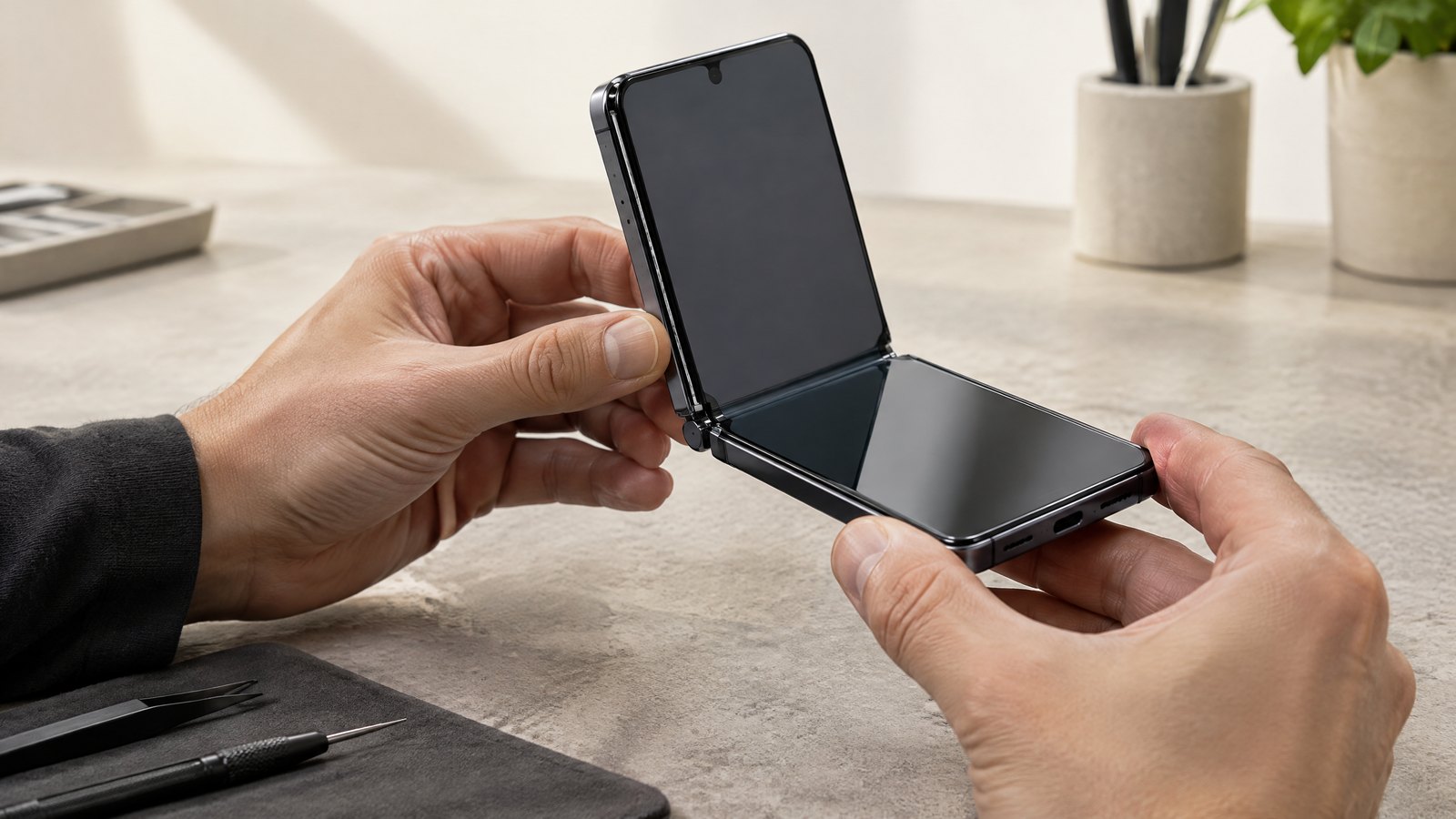
A foldable phone is not simply a normal smartphone with a larger screen. Its inner display bends repeatedly around a hinge, its body has moving parts, and its protection claims must be read more carefully than a familiar slab phone's. That can make a book-style phone useful for reading, documents and split-screen work, or a flip-style phone easier to carry. It also changes what to inspect before paying: the feel of the crease, the way the hinge moves, the exact ingress rating, the screen-protector policy and the local repair route. This guide explains the trade-offs without treating a showroom impression or a fold-count headline as a guarantee.
This article is part of the consumer technology guide library.
How a flexible display becomes a foldable phone
Most current foldables use a flexible OLED inner panel. Instead of keeping all display layers on a rigid sheet of glass, the screen assembly is designed to bend through a controlled radius at the centre. A cover layer, touch layer, display layers, adhesive and supporting structure must move together while still showing an image and accepting touch. The hinge supplies the geometry that stops the device from simply creasing at a random sharp point.
That construction is why the inner panel should not be judged by the same assumptions as the outside screen. The outer display usually behaves more like a conventional phone screen; the inner one is a moving surface intended for taps and swipes, not a place to press hard with a fingernail, pen or object trapped between the halves. A factory-applied film may be part of the system rather than ordinary packaging film. Before fitting an accessory, identify whether it is intended for the outer display, the inner display or the specific model.
A flexible screen does not make every task better. The principal advantage is usable area when open: a map beside messages, a document at a larger size, or two apps visible at once. The compromise can be more thickness when shut, a narrower cover screen on some designs, and software that may need to resize an app as the phone changes shape. The wider smartphone overview explains how display, software and other components work together; folding changes the physical package, not the need to judge each part of the phone.
What the hinge does, and what the crease tells you
The hinge is more than the piece that opens and closes the body. It controls the bend of the display, aligns the two halves, resists unwanted movement and provides enough stability for the phone to stay partly open where a model supports that use. A well-designed hinge can feel deliberate without being a promise that it will feel identical after years of use. Its feel is a purchasing observation, while its long-term behaviour depends on design, wear, care and the particular unit.
The visible or touchable line in the middle is the crease: the area where the display repeatedly bends. It is a physical consequence of making a screen fold, not automatically evidence of a defect. What matters is whether it interrupts the way you read, scroll or type. Look at a bright screen from several viewing angles, then run a finger lightly across the centre. If the crease distracts you in the apps you use most, that is a valid reason to prefer another form factor; there is no universal threshold for what feels acceptable.
Do not mistake a small gap when closed, a faint hinge sound or a different resistance near the end of travel for proof of either quality or failure. The relevant question at purchase is whether the demonstrator unit behaves as the maker documents and whether the retailer will record a concern found on delivery. Do not force a foldable past its intended opening direction or use the hinge to crush an object; a moving mechanism has limits that a rigid phone body does not share.
Durability claims: turn a fold count into useful questions
A headline such as a large number of folding cycles can show that a maker has run a repeat-motion test. It cannot predict the exact life of one phone in one person's pocket. Test results depend on a stated or unstated setup: the model tested, opening angle, speed, temperature, humidity, whether the phone was powered, and the definition of a completed cycle. A cycle number also says little by itself about accidental drops, grit in a bag, a delaminating protector, battery ageing or repair availability.
Use a durability claim as a prompt for documentation, not as a lifetime calculation. Ask the brand or authorised seller for the model-specific test statement, the written warranty duration, exclusions for the inner display and hinge, and the process if the installed protector lifts. If a salesperson quotes a cycle figure but cannot point to a model-specific written source, treat it as unverified sales talk rather than a reason to pay more.
Practical durability is also about the use pattern. Someone who opens the main screen many times during a workday, carries keys in the same pocket, or uses the phone outdoors in dusty conditions faces different risks from someone who mostly opens it at home. A protective case may reduce some bump damage but can add bulk or interfere with a hinge if it is not designed for that exact device. Check its fit opened and closed instead of assuming every case protects every moving part.
- Read the model's warranty text, not only a product-card durability slogan.
- Ask whether an authorised Indian service route handles inner-screen, hinge and protector work for that exact model.
- Keep the invoice, serial or IMEI record and written exchange terms in case a delivery-time issue needs documenting.
- Treat a laboratory cycle claim as one data point, not a personal lifespan guarantee.
Water, dust and an IP rating: read the two digits separately
An IP rating is an ingress-protection classification, not a blanket word such as waterproof. The International Electrotechnical Commission explains that the first numeral concerns protection against solid objects and runs from 0 to 6, while the second concerns liquids and runs from 0 to 9. The test conditions behind a rating matter. A device rated for a particular water exposure is not automatically suitable for a beach, a shower, salt water, every dust environment or a damaged seal.
For India, the Bureau of Indian Standards lists IS/IEC 60529:2001 as the standard for degrees of protection provided by enclosures, reviewed in 2025. That record helps identify the standard behind the IP vocabulary; it does not certify every foldable on a shop shelf. Read the exact IP code in the precise phone's official specification, and do not transfer it to a different generation, storage variant or rival model.
An example such as IP48 should be read digit by digit, not as a single durability score. The first digit is the relevant solids-protection class and the second is the liquid-protection class. It does not say that the hinge is invulnerable to all small particles, nor that a wet phone can be charged immediately. If the specification omits an IP rating, do not infer one from a similar-looking model or a video demonstration.
| Claim to inspect | What it can establish | What it cannot establish |
|---|---|---|
| Exact published IP code | A defined enclosure rating under its stated test conditions | Universal protection from every liquid, dust setting or later physical damage |
| Hinge cycle statement | That the maker describes a repeat-fold test for a model | How one unit will age in your conditions or survive drops |
| Pre-installed protector policy | Whether the maker treats the film as a supported component | That any third-party film, repair or removal has the same outcome |
| Warranty and service wording | The documented route and terms available at purchase | A guarantee that all accidental damage will be free to repair |
A purchase check that fits real life in India
Start with your routine rather than the open-screen novelty. A book-style foldable may suit someone who reads PDFs, compares spreadsheets or uses split screen on local trains and at a desk. A flip-style design may prioritise pocketability and quick outer-screen actions. Neither category automatically has the better camera, battery life or processor; compare those model by model. The processor guide is useful when you need to separate a form-factor decision from performance and thermal behaviour.
At a shop, make a short repeatable check instead of trying to simulate weeks of use. Open and close the display normally; confirm that the main and cover screens respond across the areas you can reach; read a page on a light background and a dark background; and check whether the phone sits or opens in the way you expect. Then stop. Pressing on the centre, bending the device backwards or putting foreign objects into the closing path is not a meaningful test and may harm a demonstrator.
Before checkout, record the exact model number, local warranty, exchange window and the name of the authorised support channel. Ask a focused repair question: if the inner protector begins to lift or the hinge develops unusual play, who assesses it, and does the written policy distinguish wear from accidental damage? Ask the retailer to put any included plan or promised accessory on the invoice. This is more useful than a vague assurance that the phone is 'durable'.
- Choose the closed and open size you will actually use, including one-handed use on the cover screen.
- Confirm the exact Indian variant, storage option, warranty terms and authorised repair contact before payment.
- Check the listed IP rating and its limitations in the official specification for the chosen model.
- Read the maker's wording on the inner-screen protector, compatible cases and repair work.
- Compare normal-phone alternatives if your priority is camera reach, very long battery runtime or the lowest repair-risk cost.
Care that respects the moving parts
Care guidance should come from the exact maker and model, because protection and materials change across generations. As one documented manufacturer example, Samsung's foldable-care support page advises users to clear objects from between the screens before folding, clean a dirty hinge gently with a soft dry cloth, avoid hard or sharp pressure on the main screen, and avoid user removal of the main-screen protector. The same page distinguishes protection ratings across its own foldable models. Those instructions are not evidence that every foldable from every brand has identical limits.
The useful general principle is modest: keep the fold area clear, follow the model's documented cleaning advice, and avoid improvised repairs. Do not use a hard tool to investigate a crease, apply a random adhesive film to the inner display, or assume a generic cleaning liquid is safe around a hinge. If the screen surface changes, a protector lifts, the display flickers or the hinge movement changes noticeably, photograph the condition and contact the authorised channel before attempting a fix.
A foldable also carries the usual phone responsibilities. Use a screen lock and account protections, install updates, and be cautious with accessories that claim magnetic or hinge protection without a model-specific compatibility statement. The security checklist covers those wider digital safeguards; an IP rating and a robust-looking hinge do not defend an account from phishing or an unsafe app.
When a conventional phone may be the calmer choice
A foldable is most compelling when the open display changes a task you do often. If your phone use is mainly calls, payments, quick messaging and photos, a conventional phone can offer the same essential services with fewer moving-part questions. It may also offer a simpler choice of cases, screen protectors and local repair options. That is not a verdict against folding; it is a way to avoid paying for a capability that will remain closed most of the time.
Price comparison should include the cost and uncertainty of ownership, not only the launch price. Compare the written support terms, possible downtime if a special display part is needed, and whether you are comfortable using a device with a more sensitive inner surface. Do not invent a resale value or assume a new hinge generation will make previous risks disappear. The evidence available at purchase is the specification, the warranty and repair documentation, and the unit you are allowed to inspect normally.
The sound decision is specific: choose a foldable when its extra workspace or compact folding shape is valuable enough for you to accept the added care and to follow the model's conditions. Choose a slab phone when a rigid screen, lower complexity or a familiar repair path matters more. Neither outcome needs a dramatic durability prediction.
Foldable smartphone technology: common questions
These answers explain the technology and the evidence checks to make. They do not replace the precise specifications, warranty and service terms for a particular phone sold in India.
Does a crease mean a foldable phone is damaged?
Not by itself. The crease is the area designed to bend, so a visible or tactile line can be normal. Check for a new surface change, display fault, abnormal behaviour or a concern covered by the model's support guidance instead of using the crease alone as a diagnosis.
Are foldable phones waterproof and dustproof?
Do not use those broad labels. Check the exact IP code for the chosen model and read the maker's conditions. IP digits classify stated protection against solids and liquids under defined tests; they do not make a phone safe from every wet or dusty situation.
Can I replace a foldable phone's inner screen protector myself?
Follow the exact manufacturer's instructions. Some makers treat the pre-installed inner protector as a specially designed component and direct owners to authorised service for replacement. A generic film or self-removal can have different consequences for fit, support or warranty.
What is the best way to judge foldable durability before buying?
Use written, model-specific evidence: the official IP rating, warranty wording, authorised repair route, protector policy and any stated test method. Inspect a phone normally for your real tasks, but do not turn a showroom check into a destructive stress test or treat a fold-count claim as a personal lifetime guarantee.
Source notes
Reporting record
techduopulse stores source destinations privately. Public notes remain non-clickable so every visitor journey stays on this website.
Manufacturer foldable-care and protector guidance source note
Primary source · Care that respects the moving partsIP-code digit and terminology source note
Primary source · Water, dust and an IP rating: read the two digits separatelyIndian regulator record for the IP Code source note
Primary source · Water, dust and an IP rating: read the two digits separatelyVersion 1: original India-focused guide to flexible displays, hinges, creases, IP-code interpretation and evidence-based foldable purchase checks; claims are bounded by model-specific documentation and no first-person testing.