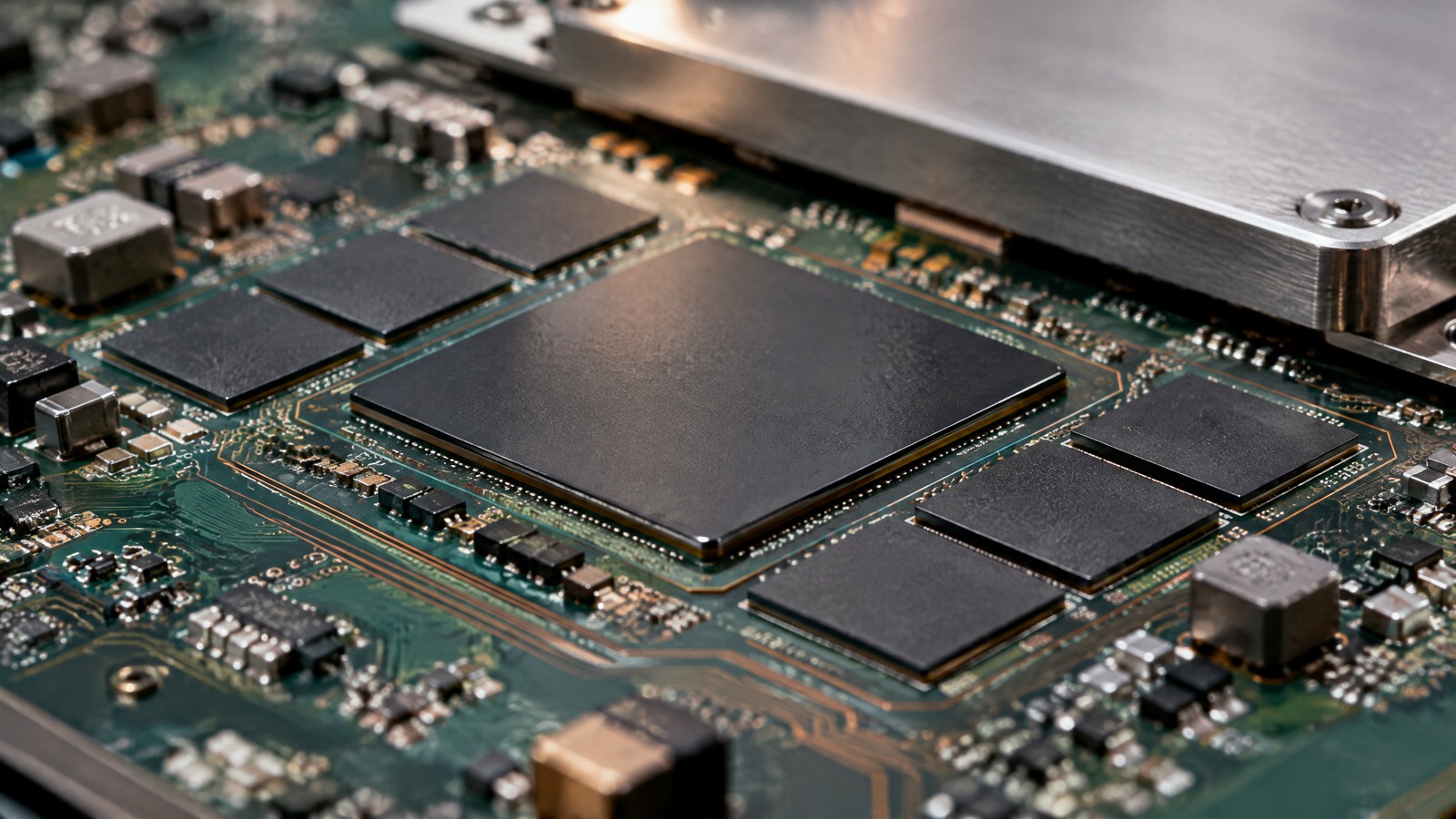
Qualcomm says its first-generation High Bandwidth Compute, or HBC, silicon has successfully run the full memory read-write path and near-memory computations in its San Diego lab. [1] The result is a meaningful hardware milestone for AI inference, but understanding its significance means separating a working memory architecture from a finished accelerator’s speed, power use and commercial availability.
On this page 8 sections
Part of our computer hardware technology guide library
Key Takeaways
- Qualcomm says first-generation HBC silicon exercised the complete memory read-write path and near-memory computations in its lab.
- HBC moves selected data-intensive operations closer to memory to reduce the traffic sent to a separate processor.
- Memory bandwidth, memory capacity and end-to-end token generation speed are different measures; improving one does not guarantee an equal improvement in another.
- Dragonfly AI250 sampling is expected in the first half of 2027, not confirmed general availability or an India launch.
- The announcement’s normalized performance estimates are not independent, like-for-like production-system benchmarks.
What Qualcomm actually validated
In its 2 November announcement, Qualcomm described tests using industry-standard automated test equipment to exercise physical HBC silicon. The tests covered reading and writing memory, as well as near-memory computations using randomized weights and activations at production-representative dimensions. Weights are the model’s learned parameters; activations are intermediate values produced as it processes information. [1]
That scope matters because the work goes beyond a proposed architecture or a computer simulation. Qualcomm reports that real data paths operated in hardware. However, testing those paths with randomized inputs does not by itself establish how a complete language model will perform inside a customer’s serving system.
The company also says a data-centre product has taped out and that early bring-up of a logic base with bonded DRAM tiers is yielding. Tape-out is a design-to-fabrication milestone; it should not be read as confirmation that finished systems are already available in volume. [1]
Why a working chip is only one development stage
A complete inference platform must combine memory with processing, software and system connections. The November announcement therefore needs to be read at two levels: Qualcomm reports working component-level technology, while product integration remains the next stage. The company describes this as a staged programme that includes process development, test vehicles, silicon validation and integration. [1]
It also describes redundancy, remapping and testing intended to address memory defects and relevant electrical, thermal and interface failure modes. These are useful engineering details, but the announcement does not provide an independent production-system reliability assessment. The reasonable conclusion is progress towards a deployable platform, rather than proof that every commercial requirement has been settled. [1]
Why AI inference can hit a memory bottleneck
Inference is the work a trained model does when it answers a request. Its speed depends on more than the processor’s maximum arithmetic performance: the necessary data must reach the computing units quickly enough to keep them busy. When data delivery is the limiting factor, adding more arithmetic capacity alone cannot remove the delay. [2]
This is the problem Qualcomm is targeting with HBC. The aim is to reduce costly data movement and improve the effective bandwidth available for selected inference operations. That is particularly relevant to the output-generation stage of language models, although the bottleneck still depends on the workload and serving configuration. [1] [2]
Prefill and decode put different pressure on hardware
A typical decoder-style language model first processes the input prompt in a stage called prefill. Because the input is already known, much of this work can run in parallel. It then generates the response through decode, where new output tokens are produced sequentially. Tokens are the units into which a model divides text; they are not necessarily whole words. [2]
Decode repeatedly needs model data and information about the existing context. At low batch sizes, this can leave substantial arithmetic capacity waiting for data from memory. NVIDIA’s technical explanation identifies this data-transfer pressure as a central decode constraint. That helps explain why Qualcomm is pursuing memory-side changes rather than relying only on more peak compute. [2]
Batching changes the balance. Processing several requests together can spread the cost of reading shared model weights across more work, improving hardware use. But each request also needs its own context storage. A result measured with one request therefore cannot automatically predict the throughput or responsiveness of a busy service. [2]
Bandwidth is not the same as memory capacity
Memory capacity describes how much data can be held, usually stated in gigabytes or terabytes. Memory bandwidth describes how much data can be accessed or transferred per second. A system can have enough space for a model yet struggle to feed its processing units quickly enough. It can also have fast memory access but insufficient space for the required workload. [2] [3]
The model’s weights are only part of that space requirement. A key-value cache, usually shortened to KV cache, stores intermediate attention information so the model need not recompute it at every generation step. Longer contexts and more concurrent requests increase this cache demand. Faster bandwidth does not, by itself, create more installed memory capacity. [2]
Tokens per second is a separate, application-level outcome. It reflects the model and its numerical precision, the serving software, batch size, context length and hardware together. A memory-bandwidth multiplier should never be copied directly into a claim that a chatbot will generate answers by the same multiplier.
How Qualcomm HBC changes where computation happens
HBC stands for High Bandwidth Compute. Qualcomm’s architectural explanation describes moving selected data-intensive operations close to the memory holding the model data. Instead of sending all the operands for those operations to a separate processor, the design performs work near memory and sends more compact results outward. The purpose is to reduce traffic across that external connection. [3]
This also explains the word ‘effective’ in effective memory bandwidth. Work can draw on bandwidth inside the memory arrangement without requiring an equivalent stream of raw data to leave it. A headline for internal or effective bandwidth therefore needs its measurement boundary explained before it is compared with an external memory-interface specification. [3]
HBC is not another spelling of HBM, or High Bandwidth Memory. Conventional HBM-based accelerators use closely packaged memory stacks to supply a processor with data. Qualcomm’s HBC proposition changes where some of the computation takes place, not merely the width or speed of the connection. That architectural distinction is more useful than treating the names as interchangeable. [3]
There are still limits to what can be concluded. Near-memory computing does not mean every operation happens inside memory, that all data movement disappears, or that ordinary processing and system connections no longer matter. Qualcomm’s efficiency case is plausible for work constrained by data movement, but its advantage on a particular service must be demonstrated on that service’s workload.
What comes next for Dragonfly AI250
Qualcomm says Dragonfly AI250 will integrate HBC into a complete AI inference accelerator platform, with sampling expected in the first half of 2027. Sampling is a development and evaluation stage; it is not a promise of general availability during that period. The wording also does not establish an India launch date. [1]
For Indian developers and enterprises, the potential relevance is the economics of running AI services. Reducing energy spent moving data could help an operator serve a workload more efficiently. Whether that produces a cheaper cloud offering depends on the complete system, deployment costs and the provider’s pricing decisions, not just the memory technology.
The checked announcement provides no guaranteed rupee saving, India cloud price or local deployment commitment. Nor does a data-centre memory milestone imply that an existing Snapdragon phone will receive HBC through a software update. This news concerns the foundation of Qualcomm’s planned inference infrastructure, not a newly available consumer feature. [1]
Important Points / Key Information
The most important qualification is in Qualcomm’s performance footnote. Its estimates use measured first-generation HBC silicon results normalized to target operating conditions, compared with published competing product specifications. Qualcomm says final performance may vary with implementation, workload and system configuration. This is different from independently testing finished competing servers under identical conditions. [1]
When fuller product results arrive, four questions will make them more useful than a standalone bandwidth headline:
- Was the same work compared? The model, numerical precision, input length and output length should be disclosed, alongside the serving software and batch size. Otherwise, the systems may be solving materially different problems.
- Which part became faster? Time to begin an answer and the pace of generating the remaining answer affect users differently. Aggregate output across many requests is also different from the speed experienced by one person.
- What did the power measurement include? An accelerator-only reading and a whole-system reading have different boundaries. A fair efficiency claim should state what equipment and workload were included.
- What does the cost claim cover? A useful comparison needs a clear system scope and pricing basis. A component-level efficiency result is not itself evidence of lower cloud bills or a lower total deployment cost.
Examples / Supporting Information
The following examples are hypothetical illustrations, not Qualcomm measurements or hands-on tests. They show why an architecture can address a real bottleneck without producing the same benefit for every AI service.
A conversational assistant with short prompts
Consider an assistant handling short questions while generating relatively long replies. If decode is constrained by repeated memory access, reducing data movement could improve the pace of generation. That is a workload where HBC’s design goal is directly relevant. It still takes a complete-system test to establish the size of any gain. [2] [3]
Now increase the number of simultaneous users. Batching can improve use of shared weights, but the service must also accommodate more KV-cache data. The operator needs to examine both total output and response times under load. A fast single-request demonstration cannot answer that capacity-planning question on its own. [2]
A service answering questions about long documents
A document assistant may spend substantial work processing a long input before generating a short reply. Faster decode would address only part of that request. Input processing and the memory needed to retain context can remain important, so a decode-focused result should not be presented as the whole service’s speedup. [2]
For an Indian-language deployment, evaluation should also use the intended model and representative language inputs. NVIDIA cautions that tokens from different tokenizers are not automatically equivalent. Comparing raw token rates across unlike models can therefore obscure how much useful text each system actually produces. That is a benchmarking caution, not a claim that HBC has been tested on particular Indian languages. [2]
Conclusion
Qualcomm’s HBC announcement is meaningful because the company reports that its near-memory approach has operated on physical silicon across complete read-write paths and relevant computations. It provides evidence of engineering progress towards Dragonfly AI250, whose sampling remains expected in the first half of 2027. [1]
The larger lesson is that AI inference performance depends on feeding compute efficiently, not just adding more arithmetic units. HBC targets that problem by changing where selected work happens. Its eventual value will depend on complete-system results with clear workload, power and cost boundaries; the current milestone should neither be dismissed as a design slide nor mistaken for a shipping-product victory.
How we checked thisSources (3)
We keep source links private so your reading stays on techduopulse. Each note names the publisher and document we checked.
Qualcomm OnQ — Qualcomm HBC demonstrates AI inference leadership with validated silicon — 2 November 2026
Primary source · Supporting informationNVIDIA Technical Blog — Mastering LLM Techniques: Inference Optimization — 17 November 2023
Primary source · Supporting informationQualcomm OnQ — HBC vs HBM vs SRAM: Part 1 - Comparing each approach's ability to scale the memory wall — 30 July 2026
Primary source · Supporting informationInitial source-backed news-analysis edition. Vendor findings and reported details are attributed; generic AI editorial illustration, not product photography or a hands-on test.