A NOx sensor is less a general exhaust “pollution meter” than a feedback component that helps an SCR-equipped vehicle judge what is happening before and after its nitrogen-oxide treatment stage. Understanding its two measurement positions and its limits makes it easier to see why a warning can point to a system investigation, not an automatic verdict on one part.
On this page 6 sections
Part of our computer hardware technology guide library
What a NOx Sensor Measures in an SCR-Equipped Vehicle
A NOx sensor measures nitrogen oxides in exhaust gas, usually in a vehicle whose aftertreatment system is designed to reduce those gases. In this context, NOx is a collective label for nitrogen monoxide and nitrogen dioxide. The sensor’s reading becomes information for the vehicle’s emissions-control logic; it is not, by itself, a legal compliance certificate, a direct measure of engine health, or a reading of ambient air around the vehicle. [1] [2]
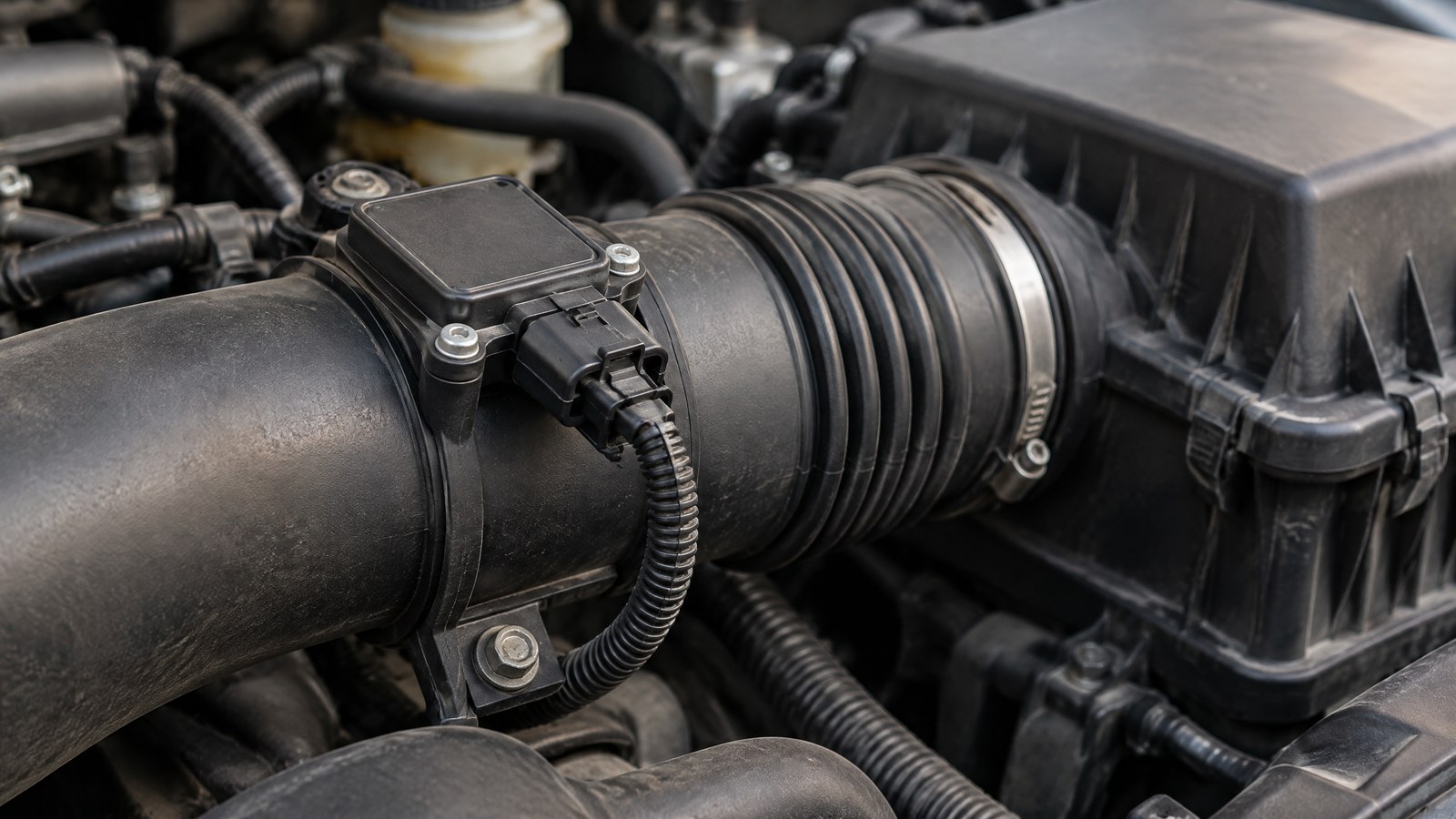
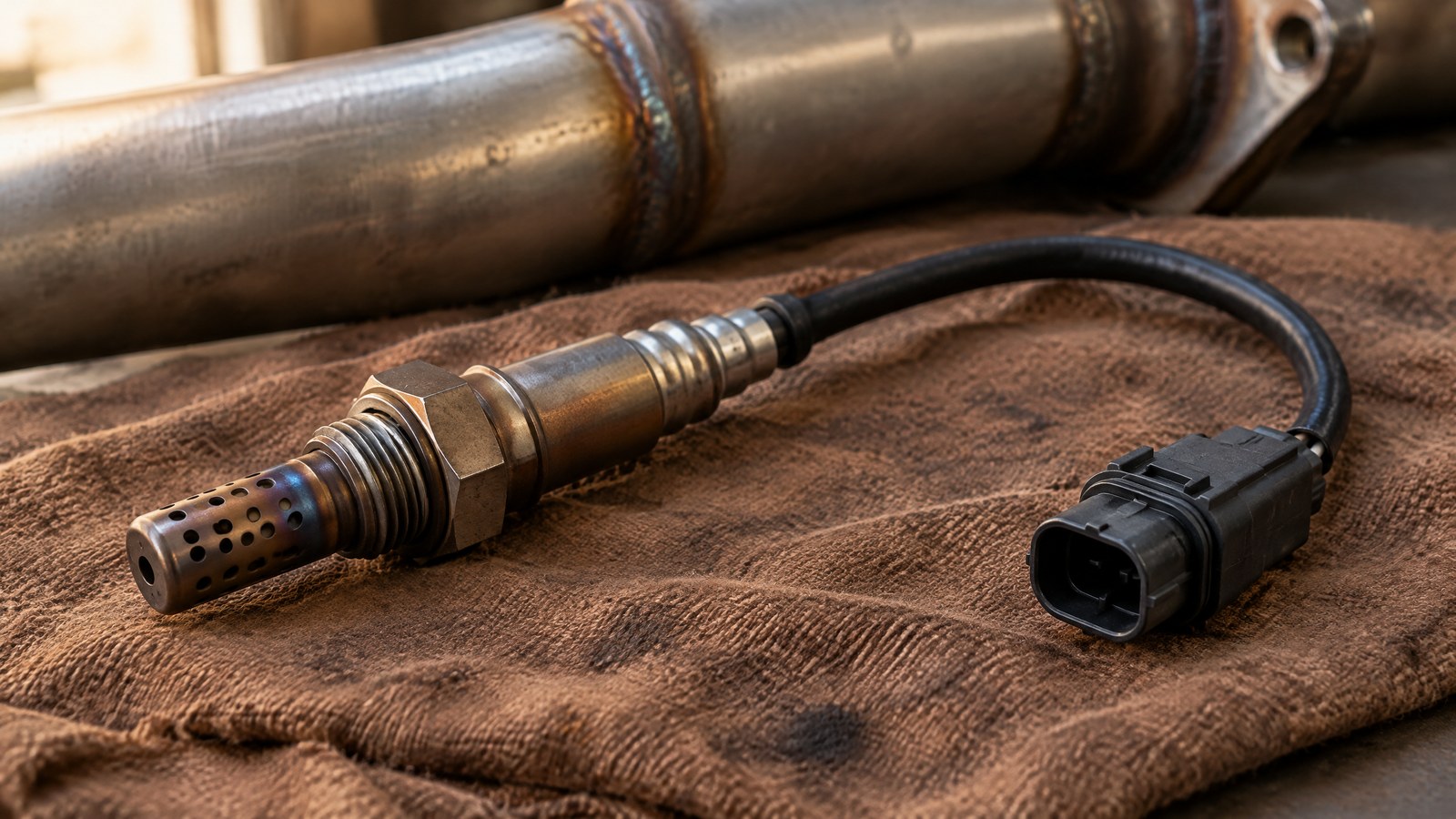
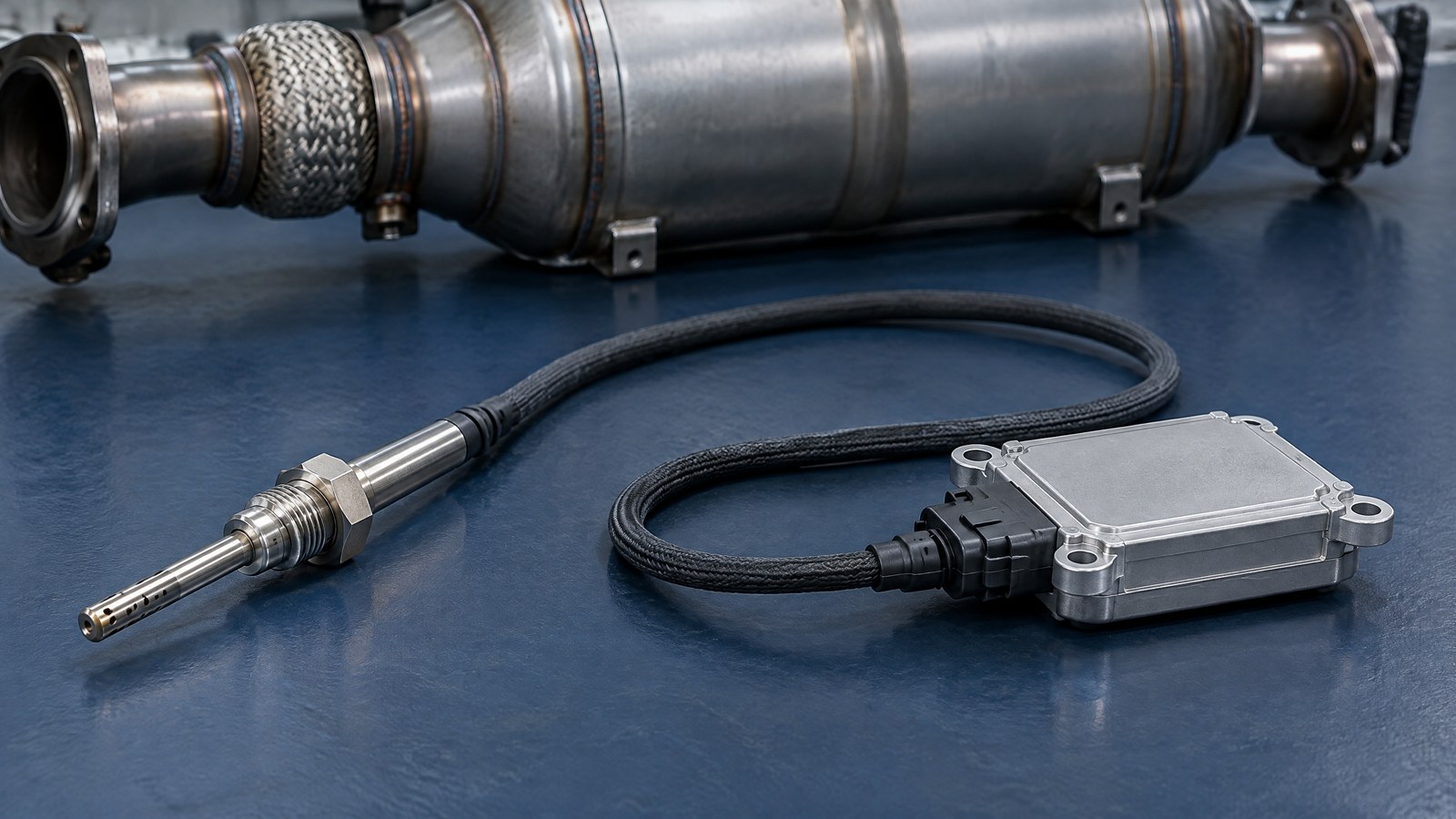
AI-generated editorial illustration of generic exhaust aftertreatment hardware on a road vehicle, not a photograph of a tested product or an actual field measurement.
This matters most in the SCR discussion because selective catalytic reduction is an exhaust aftertreatment process. EPA describes diesel exhaust fluid as part of SCR systems used to reduce nitrogen oxides in diesel exhaust. The sensor helps the system observe the exhaust stream around that process, while the catalyst, exhaust temperature, fluid quality and dosing hardware all remain separate parts of the larger picture. [4]
Why the Reading Is More Than a Single Number
A reported NOx value is useful only with its location and operating context. Exhaust composition changes with load, temperature and the state of the aftertreatment system. A sensor can provide a concentration signal, but it does not explain on its own why that signal changed. That distinction keeps a reader from treating an exhaust reading as a simple pass-or-fail label.
It is also different from an oxygen or lambda sensor. Although related electrochemical technologies may be used, a NOx sensor is designed to support nitrogen-oxide measurement in an exhaust-aftertreatment context. Conflating the two can lead to the wrong question: oxygen information and nitrogen-oxide feedback serve different roles in a vehicle system. [1]
How a NOx Sensor Supports SCR Feedback
In a common road-vehicle arrangement, an upstream NOx sensor observes exhaust entering the SCR catalyst and a downstream NOx sensor observes exhaust leaving it. The difference is informative because it gives the control and diagnostic system a way to assess the treatment stage rather than merely to see one location. DieselNet notes that, when two sensors are installed, the SCR catalyst’s conversion rate can be determined from their relationship. [1]
Inside the probe: controlled electrochemistry, not a simple detector
Automotive NOx sensors are commonly amperometric electrochemical devices built with two or three cells in adjacent chambers. In the high-level mechanism described by DieselNet, an initial cell removes oxygen from the sample so oxygen does not overwhelm the NOx measurement; a later cell processes the remaining sample, and the required pumping current relates to the measurement. [1]
The practical result is a sensing assembly that needs more than a bare probe. Delphi describes a controller near the sensor that calculates the nitrogen-oxide level and sends data to the SCR controller. That division helps explain why a communication, heating, connector or controller issue can matter to a reported sensor fault without proving that the sensing ceramic itself is the cause. [2]
What NOx Sensor Readings Can and Cannot Tell You
A NOx sensor can contribute evidence that an exhaust-aftertreatment system is not behaving as expected. It cannot isolate a root cause by itself. The displayed or stored information may reflect the sensor, its controller or communications, exhaust conditions, the SCR catalyst, diesel exhaust fluid supply, or an upstream engine and aftertreatment condition. That is why a sensor-related warning is best treated as a prompt for a qualified, vehicle-specific assessment rather than a do-it-yourself repair plan. [2] [3]
Cross-sensitivity and exhaust conditions set real limits
The measurement environment is chemically demanding. DieselNet notes that automotive NOx sensors can be sensitive to ammonia as well as NOx at the SCR outlet. It also explains that hydrocarbon and carbon-monoxide interference must be controlled before the sensing cell, and that nitrogen dioxide may need conversion before measurement. Those details are a reminder that the sensor signal comes from a designed sampling-and-processing process, not from an all-knowing chemical label. [1]
Heat, contamination and ageing can affect an exhaust-mounted sensing system, but a generic article cannot assign a cause, a replacement interval or a safe cleaning method for a particular vehicle. Such conclusions need the model-specific service information, compatible diagnostic equipment and a trained person who can assess the full system.
A code or warning is system context, not a parts verdict
Manufacturer material illustrates the boundary clearly. Volvo’s guide says the SCR is susceptible to upstream failures and directs that upstream components be diagnosed and corrected before SCR assessment. Its procedure is specific to named heavy-duty vehicles, but the underlying lesson is broadly useful: a downstream symptom can be influenced by earlier parts of the exhaust, engine or fluid system. [3]
For owners and fleet teams, the safe decision boundary is simple: preserve the vehicle information, avoid defeating emissions controls, and use the manufacturer’s documentation and a qualified workshop for interpretation. This article does not provide wiring, programming, calibration, dosing or bypass instructions.
Important Points / Key Information
The most useful way to think about a NOx sensor is as one evidence source in a linked aftertreatment system. Its value is in the feedback relationship—especially when readings are considered by location and alongside other vehicle information—not in a single isolated number.
Key Takeaways
- A NOx sensor measures nitrogen oxides in exhaust and supplies feedback to vehicle emissions-control logic; it is not an ambient-air monitor or a stand-alone compliance certificate. [1] [2]
- Where fitted, upstream and downstream sensors provide different context around an SCR catalyst, so their roles should not be swapped in a general explanation. [1] [3]
- Ammonia sensitivity and changing exhaust conditions mean the signal requires system-aware interpretation. [1]
- A warning, code or performance restriction can involve several components. Qualified, model-specific assessment is safer than assuming the sensor alone has failed. [2] [3]
Examples / Supporting Information
The following examples explain the evidence without turning it into a repair recipe. They are intended to show why position, system dependencies and scope of manufacturer documentation matter.
Documented heavy-duty example: two positions around the SCR
Volvo’s published heavy-duty guide identifies NOx sensors at both the SCR inlet and outlet and describes their use in evaluating SCR performance. It also warns that the final SCR component is susceptible to upstream failures. This supports a reader-first conclusion: two readings can help locate a system question, but they do not eliminate the need to examine the conditions that feed the SCR. [3]
The example is supporting information from a specific manufacturer guide, not a universal procedure for passenger cars, Indian commercial vehicles or another make. It should not be used to select parts or make a diagnosis.
Hypothetical India-use scenario: a fleet warning needs context
Hypothetical: a diesel goods vehicle operating on intercity routes in India records an emissions-related warning. It would be tempting to call the NOx sensor the problem because the message names it. A more careful interpretation is that the vehicle has detected a condition relevant to the monitored aftertreatment system; the cause may still involve sensor operation, exhaust conditions or another linked component.
The appropriate next step is not a bypass, a fluid-dosing adjustment or an internet-derived threshold. The operator can keep the vehicle details and fault information available and seek a qualified workshop using the correct manufacturer material. This protects people, equipment and emissions-control integrity while avoiding a false certainty from a generic explanation.
Conclusion
A NOx sensor earns its place in modern vehicle aftertreatment by translating a difficult exhaust-gas condition into feedback that the SCR and onboard systems can use. Its inlet or outlet location, electrochemical design and interaction with the controller explain why it is more specialised than a generic gas sensor. [1] [2]
The right takeaway is measured confidence: a sensor-related message is useful evidence, but not a stand-alone diagnosis. For any real vehicle concern, retain the system context, do not disable or bypass emissions equipment, and rely on qualified, model-specific review.
How we checked thisSources (4)
We keep source links private so your reading stays on techduopulse. Each note names the publisher and document we checked.
DieselNet technical guide on automotive NOx sensor operation
Secondary source · How NOx sensors work as part of SCR feedbackDelphi explanation of NOx sensor and SCR-controller roles
Primary source · How NOx sensors work as part of SCR feedbackVolvo guide on upstream and downstream SCR sensor assessment
Primary source · What readings can and cannot tell youEPA background on DEF, SCR and NOx control
Primary source · NOx sensing in vehicle aftertreatment contextOwner-approved educational sensor explainer; obsolete private-draft status removed without changing source-backed facts or professional safety boundaries. Original generic AI editorial illustration, not a product or field-test photograph.