SEO title: Gas Sensor: Types, Working Principle and Uses Meta description: Learn how gas sensors detect gases, compare electrochemical, semiconductor and NDIR types, and understand calibration, limits and real-world uses.
This article is part of the software engineering technologies guide library.
What is a gas sensor?
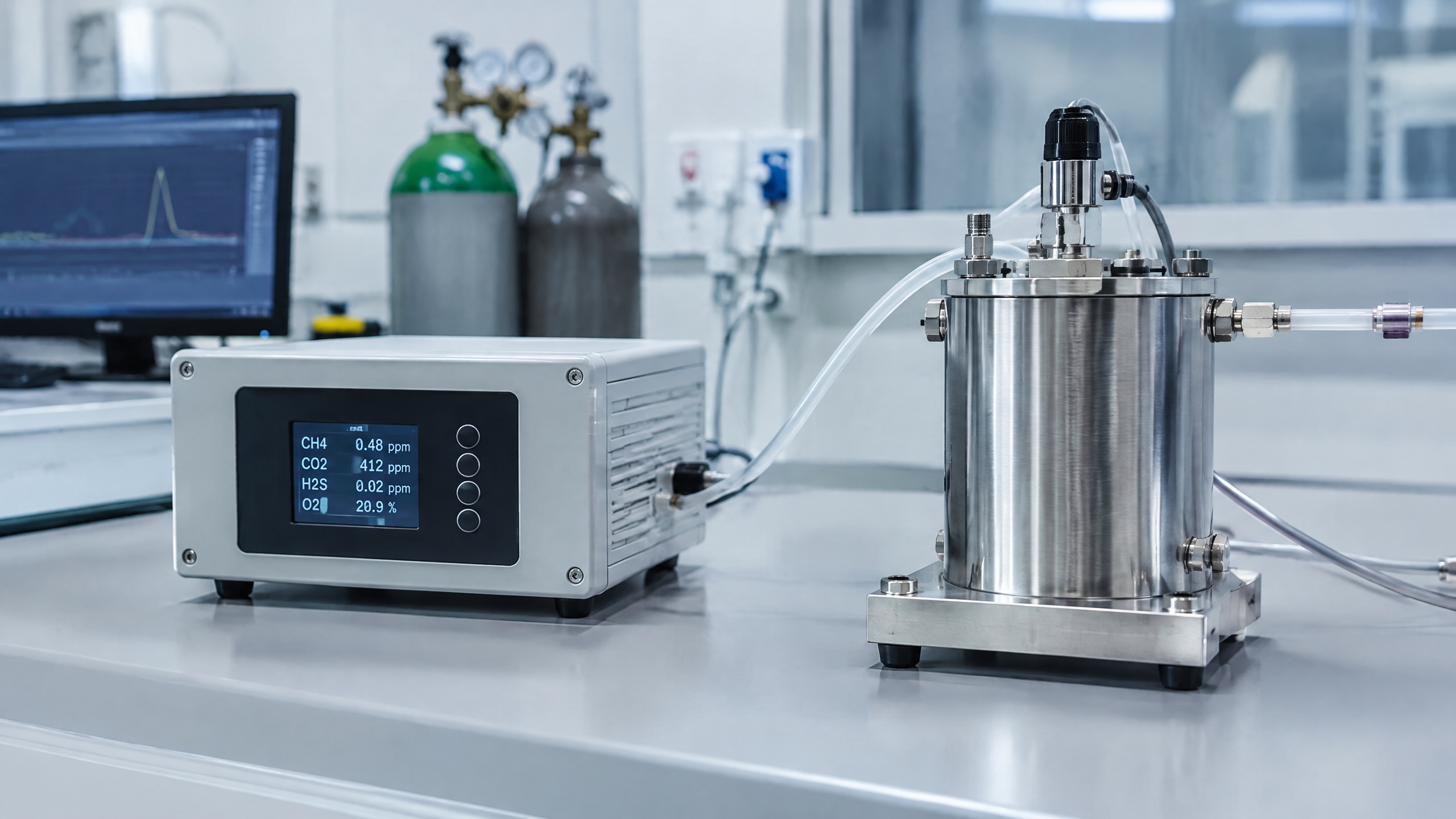
A gas sensor is the sensing element in a system designed to detect or estimate the amount of one or more gases. Its output may be a change in resistance, current, voltage or a processed digital value. The sensor by itself is different from a gas detector: a detector is a finished instrument or system that may add signal processing, a display, alarms, power management, enclosure and maintenance requirements.
Different gas-sensor families work because gases have different physical or chemical properties. Some absorb infrared light at characteristic wavelengths; some react at electrodes; and some alter the electrical behaviour of a semiconductor surface. Consequently, a sensor suitable for one target gas or environment may be unsuitable for another. Sensitivity, selectivity, stability and response/recovery speed are practical considerations alongside size and power consumption. [2]
Gas sensor working principle: from gas to reading
The basic signal path is easy to picture:
Gas reaches the sensing element. It may diffuse through an opening, membrane or optical chamber.
A measurable interaction occurs. Depending on the design, the gas absorbs light, reacts electrochemically or changes a material’s electrical resistance.
Electronics measure the change. Signal-conditioning circuitry turns the raw response into a usable electrical or digital output.
The instrument interprets it. Firmware or electronics can display a reading, log data, compare it with configured settings or activate an alarm in a suitable finished system.
The final value is not magic. It depends on the sensor’s intended target gas, its calibration, the operating environment and the instrument design. An electrical response to a gas mixture does not necessarily mean that a module can identify every gas separately or quantify it accurately.
Main types of gas sensors
### Semiconductor or metal-oxide gas sensors
Semiconductor gas sensors, often called metal-oxide sensors, use a heated oxide surface. When gases interact with that surface, the sensor’s resistance changes. Tin oxide and zinc oxide are common materials discussed for this family. [1] [2]
This principle helps explain why many hobby and learning modules need warm-up time and can draw more power than a passive component: many metal-oxide devices operate at elevated temperature. Their response can also have limited selectivity, so a change in output should not be treated as proof of one specific gas without supporting information from the manufacturer and the test conditions. [2]
### Electrochemical gas sensors
An electrochemical gas sensor admits gas through a porous membrane or capillary into a cell containing electrodes and an electrolyte. A reaction associated with the gas produces an electrical signal related to concentration. [3]
This approach is widely relevant to targeted gas measurement, but readings can be affected by cross-sensitivity and environmental conditions. The sensor, its electronics, its calibration gas and the particular application should therefore be considered together—not as interchangeable parts. [3]
### NDIR gas sensors
An NDIR gas sensor uses non-dispersive infrared sensing. It shines infrared energy through an optical path and observes absorption at wavelengths associated with the target gas. For example, carbon dioxide has a commonly used absorption region near 4.3 micrometres. [1]
A typical arrangement includes an infrared source, an optical path or chamber, filtering and a detector. The idea is selective optical measurement, but real-world performance still depends on the optical design, the gas mixture, the environment and the instrument’s calibration. [1]
| Sensor type | What changes | Useful way to think about it | Important limits to check |
|---|---|---|---|
| Semiconductor / metal-oxide | Electrical resistance at a heated oxide surface | A gas-responsive material changes its conductivity | Heating, power use and limited selectivity can matter |
| Electrochemical | Reaction-related electrical signal in an electrolyte cell | Target gas diffuses into a small chemical cell | Cross-sensitivity and environmental effects need attention |
| NDIR | Infrared absorption through an optical path | The instrument looks for a gas’s light-absorption signature | Optical design, target gas and calibration still govern performance |
Where gas sensors are used
Gas sensing supports many application-specific systems, including hazardous flammable or toxic-gas detection, industrial processes, environmental monitoring, agriculture and some medical contexts. [2] The important word is application-specific: the required sensor, range, alarm behaviour, housing and maintenance plan can differ greatly between a laboratory setup, a greenhouse, an industrial workplace and a domestic appliance.
For learners, phrases such as “gas sensor project using Arduino,” “MQ-2 gas sensor Arduino,” “LPG gas leakage detector project” and “gas sensor experiment” often refer to the same educational goal: observe a sensor response, read an analogue or digital output and build basic signal logic. Treat these as experiments unless the complete setup has been designed, tested and maintained for its intended safety use. An affordable MQ-style module can illustrate sensing behaviour; it does not, on its own, establish gas identity, concentration accuracy or safety certification.
Accuracy, selectivity and calibration: what can affect a reading?
A headline accuracy number—if a manufacturer provides one—does not describe every real installation. Temperature, humidity, pressure, particulates, sensor ageing, interfering substances and exposure to very high gas concentrations can change a response or contribute to calibration drift. [3] [4] Placement, airflow and the quality of the surrounding electronics can matter too.
Selectivity asks whether a sensor responds mainly to the target gas rather than to other gases. Sensitivity describes how much the output changes for a change in gas level. Stability concerns whether the response remains dependable over time, while response and recovery describe how quickly the signal changes when conditions change. These characteristics are related but not interchangeable. [2]
### Calibration is not the same as a bump test
For applicable direct-reading monitors, OSHA distinguishes between two common maintenance ideas:
A bump test is a qualitative functional check: it confirms that test gas reaches the sensor and that alarms operate.
Calibration uses a known gas concentration to verify the reading and, where needed, adjust the instrument.
A successful bump test is not a substitute for calibration. Follow the finished instrument manufacturer’s procedure, schedule and specified test gas; where relevant, use suitable traceable test gas. [4] A sensor module connected to an Arduino does not become calibrated merely because its output changes when exposed to something.
Safety and standards context
If a gas-sensing system is intended to warn people about hazardous conditions, it deserves more scrutiny than a classroom demonstration. Incorrectly maintained or inaccurate direct-reading monitors can miss a hazardous condition. [4] Do not rely on an unverified DIY module, a generic threshold value or this article as a safety plan. For a workplace or other risk-sensitive setting, use equipment and procedures appropriate to the application, and consult the applicable manufacturer instructions and local professional requirements.
Standards also have defined scopes. IEC 62990-1:2019 addresses performance requirements and test methods for certain toxic-gas detectors in workplace and industrial/commercial contexts, and distinguishes occupational-exposure measurement from safety-monitoring and alarm use. Its scope does not automatically cover domestic devices, oxygen measurement, explosion-risk gas measurement or environmental air-pollution monitoring. [5] In other words, the presence of a standard number should not be read as blanket approval for every gas detector or use case.
Frequently asked questions
What is the gas sensor working principle in Hindi or simple terms?
In simple terms, gas reaches a sensing part and changes something measurable—such as resistance, an electrochemical current or absorbed infrared light. Electronics convert that change into a signal or reading. The exact principle depends on the sensor type and target gas.
Can I make a gas sensor project using Arduino?
Yes, an Arduino can read many sensor-module outputs and help demonstrate logging, thresholds and response behaviour. It is best treated as an educational project unless the complete system has appropriate design, testing, calibration and maintenance for a specific application.
How does an MQ-2 gas sensor Arduino project work?
MQ-style learning modules commonly use a heated metal-oxide sensing element whose resistance changes in the presence of gases. An Arduino can read the conditioned output. The observed change alone does not confirm a particular gas or provide a universally accurate concentration value; warm-up, environment and calibration affect interpretation. [2]
Is an LPG gas leakage detector project the same as a gas leakage sensor for home?
Not necessarily. A student project may demonstrate a sensing response and basic alarm logic, while a home-use detector is a finished product intended for a stated purpose. Whether a device is suitable for a home depends on its documented target gas, installation instructions, limitations, testing and maintenance requirements. Do not assume a project module provides equivalent protection.
What are the most common gas sensor types and applications?
Three widely discussed families are semiconductor/metal-oxide, electrochemical and NDIR sensors. They are used in application-specific systems for areas such as hazardous-gas detection, industrial processes, environmental monitoring, agriculture and research. [1] [2] The right choice depends on the gas, measurement goal, environment, power constraints and required maintenance.
Why is gas sensor calibration important?
Sensors can drift with age, environmental conditions, interfering gases and high exposure. Calibration checks a reading against a known concentration and may adjust the instrument; it is different from a bump test that simply checks gas delivery and alarm function. [4]
Related reading
/article/smoke-sensor-working-principle
/article/humidity-sensor-types-working
/article/pressure-sensor-working-principle-types
/article/flow-sensor-working-principle
Source notes
Reporting record
techduopulse stores source destinations privately. Public notes remain non-clickable so every visitor journey stays on this website.
https://www.akm.com/us/en/products/gas-sensor/sensor-components/tutorial/types-mechanism/
Primary source · Research source 1https://pmc.ncbi.nlm.nih.gov/articles/PMC7700484/
Primary source · Research source 2https://www.cdc.gov/niosh/docs/2003-154/pdfs/chapter-h.pdf
Primary source · Research source 3https://www.osha.gov/publications/shib093013
Primary source · Research source 4https://www.iso.org/standard/68020.html
Primary source · Research source 5New India-focused sensor explainer covering gas sensor, working principles, uses and limitations.