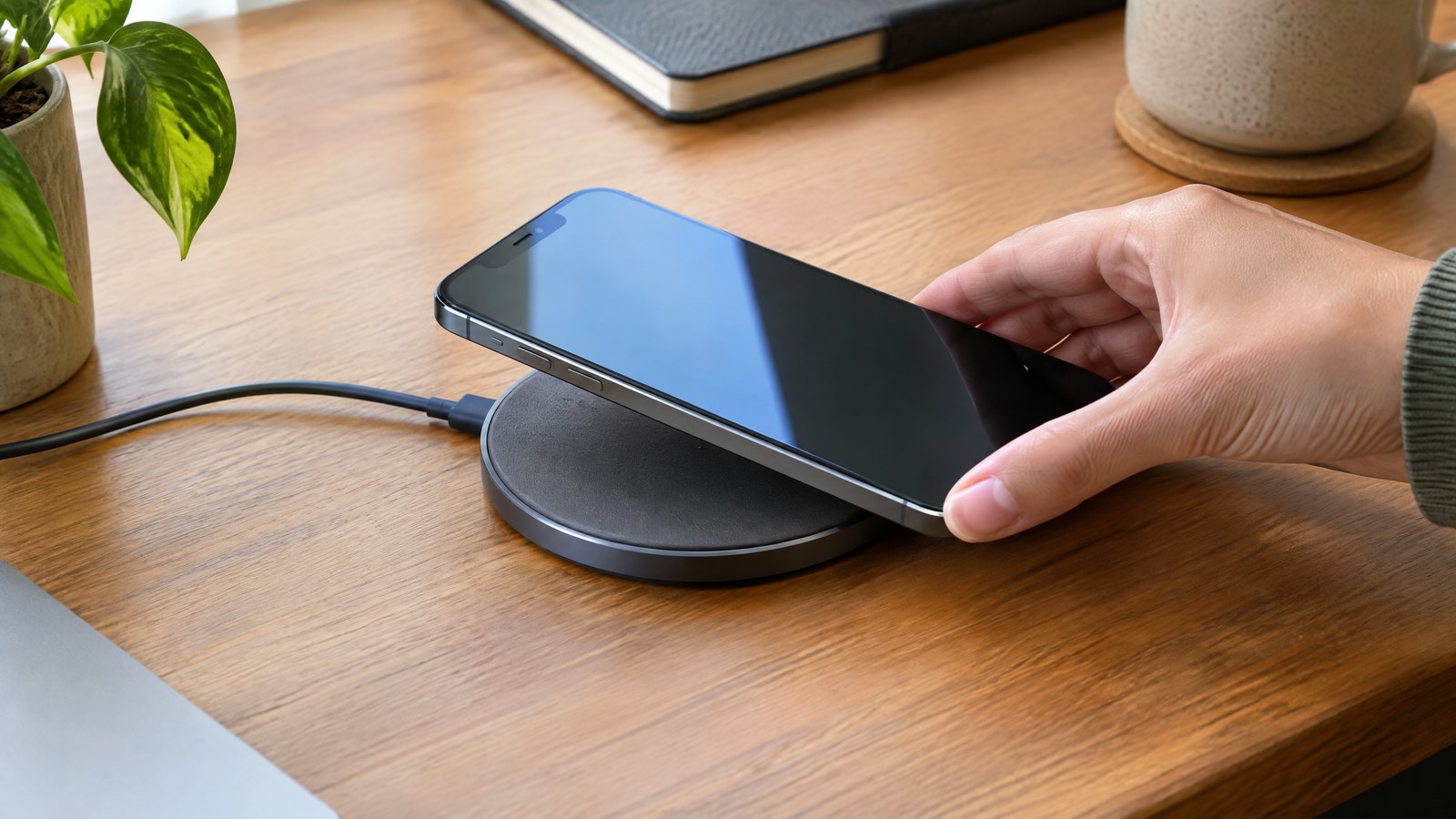
Qi2 wireless charging smartphones use a newer generation of the Qi wireless-power standard from the Wireless Power Consortium (WPC). Its headline feature is magnetic attachment: a compatible phone and charger are designed to line up their charging areas instead of relying entirely on careful placement on a flat pad. That can make a bedside stand or desk charger less fussy, but it does not turn every magnetic case into a Qi2 product or make every advertised wattage available to every phone. For a reliable purchase decision in India, treat the phone, its case, the charging pad or stand, and the wall adapter as one charging chain.
This article is part of the consumer technology guide library.
Qi2 wireless charging smartphones: the short answer
Qi is a family of inductive wireless-charging specifications, not a single guaranteed speed. Qi2 is the newer, magnetically aligned branch. The WPC says Qi v2.0 introduced Qi2 in 2023, with magnetic attachment intended to align the transmitter in the charger and the receiver in the device. That alignment addresses a practical problem with ordinary pads: a phone can look as if it is resting on the pad while its charging coils are offset enough to charge slowly, pause or not begin at all.
The useful distinction is between a standard, a certified product and a marketing description. A phone may support ordinary Qi charging without being a Qi2 receiver. A charger may have magnets without being Qi2 Certified. A Qi2 Certified transmitter and a compatible receiver still negotiate power within their own limits, so a figure printed on the box is an upper capability of a particular setup, not the charge rate you should expect in every room or with every case.
For everyday use, Qi2 is most valuable when you repeatedly place the phone on a stand, travel with a compact magnetic pad, or want a charger that also holds the phone in a consistent position. It is not automatically the best choice for a long gaming session, a hot car, or the fastest possible top-up. A cable can remain the more direct option when speed, low heat or uninterrupted use matters most.
Qi2 generations: why 15W and 25W labels are not interchangeable
Version numbers and retail names are easy to mix up. The WPC’s history records Qi 1.2 as adding the option for up to 15W power transfer, while Qi v2.0 added the Magnetic Power Profile, or MPP, that underpins magnetic attachment and alignment. The WPC describes Qi2 as delivering 15W charging for certified mobile devices. That history matters because an older 15W Qi claim, a Qi2 15W claim and a magnetic-looking accessory are not identical statements about design or certification.
The WPC says Qi v2.2 added support for up to 25W power transfer and brands Qi v2.2.1 as Qi2 25W. “Up to” is the essential phrase. The phone receiver must support the relevant profile and power level; the pad or stand must support it; and the input adapter and cable must supply what that accessory requires. Battery temperature, charge level and device software can reduce power along the way. A 25W-capable pad is not evidence that a specific phone will receive 25W.
Use the exact product documentation rather than guessing from the generation alone. A retailer may shorten a name to “Qi2 charger”, while a manufacturer’s technical page separates a 15W model from a Qi2 25W model. If those documents do not identify the model number and supported power profile, the safer assumption is that the maximum rate is unverified for your phone.
| Specification milestone | What changed | What it does not prove for one purchase |
|---|---|---|
| Qi 1.2 | An option for power transfer up to 15W | That a particular phone, pad and adapter will charge at 15W |
| Qi v2.0 / Qi2 | Magnetic Power Profile for attachment and alignment; Qi2 described by WPC as 15W | That any magnetic case or older Qi phone is Qi2 Certified |
| Qi v2.2 / Qi2 25W branding | Support for transfer up to 25W | That a 25W accessory will deliver 25W to every receiver or in all temperatures |
What magnetic alignment fixes — and what it cannot fix
Inductive charging works best when the charging areas are positioned as intended. With a non-magnetic pad, you often have to centre the phone manually; a notification vibration can shift it, and a small camera bump or a bulky wallet case can change how the back sits. Qi2’s magnetic attachment is designed to put compatible charging areas into the correct relationship more consistently. It is an alignment convenience and can support better energy transfer, not a magic solution for every obstruction.
The WPC’s Qi 2.1 history is a useful clue to the real-world complication: it introduced a requirement and test for mechanical obstructions such as protruding cameras near a phone’s charging area. That does not promise that every camera island, case or ring accessory will work with every stand. It means the standard has considered such a class of fit problem. A case can still create distance, a hinged stand can place the phone at a poor angle, and a metal plate or cards in a wallet case can be inappropriate between phone and charger.
A simple example is a phone in a thick decorative case. It might attach magnetically and look neatly centred, yet the phone maker may advise removing that case if charging is slow. Conversely, a bare phone on an ordinary Qi pad may charge normally when carefully centred even though it lacks Qi2 magnetic attachment. Do not confuse a satisfying magnetic snap with proof of a particular charging speed, thermal result or certification status.
- Place the charger on a stable, level surface and follow its position markings if it has them.
- Check that the charging indicator appears after the phone is attached; attachment alone is not confirmation of charging.
- Remove a thick, metal, battery or wallet-style case if charging is intermittent or unusually warm, subject to the phone maker’s advice.
- Keep cards, badges, key fobs and other items out from between the phone and pad; magnets and heat are poor companions for unknown accessories.
Compatibility is a chain, not a logo on one box
Start with the exact phone model and region, then read its manufacturer charging documentation. Do not infer Qi2 support merely because the phone has a circular magnetic accessory system or because a review calls it “MagSafe-style”. Apple’s current guidance says an iPhone 8 or later can charge with Qi-certified accessories, and notes that many Qi-certified chargers charge iPhone at up to 7.5W. That is a useful baseline for ordinary Qi, not a blanket claim that every such iPhone receives a Qi2 rate.
The same caution applies on Android. Google’s Pixel support page says wireless charging is available on Pixel 3 and later but lists several exceptions. That illustrates the central purchasing rule: “wireless charging” is a feature family, not a complete compatibility answer. A manufacturer’s page for the precise handset is the authority for whether it supports Qi, Qi2, a particular wattage, a proprietary stand, or only a named accessory.
Then inspect the accessory chain. The charging pad or stand needs an appropriate certified transmitter; the case needs to permit the intended contact and alignment; and the USB power adapter needs the input rating specified by the accessory maker. Apple explicitly advises using the adapter supplied with the accessory or one recommended by its manufacturer. Swapping in a low-output adapter, an unsuitable cable, or an unknown multi-port charger can leave a capable pad with less input power than its headline scenario assumes.
| Part to verify | Question to ask | Practical limit |
|---|---|---|
| Phone | Does the exact model’s manufacturer page name Qi, Qi2 or a maximum wireless rate? | A general family name or a magnetic back does not settle it |
| Case | Is it intended for this phone and for wireless charging? | Magnetic attachment can still coexist with excess spacing or obstruction |
| Pad or stand | Is the exact model Qi or Qi2 Certified in the WPC database? | A logo-like graphic, a marketplace title or a similar SKU is not a database match |
| Adapter and cable | Do they meet the charger maker’s required input? | The pad cannot create more input power than its supply can provide |
WPC certification and India compliance answer different questions
Qi certification is about the WPC charging standard. The WPC says products carrying the Qi or Qi2 logo have undergone independent laboratory testing for safety and interoperability, and its certification information also refers to energy-efficiency testing. It provides a certified-products database, which is the most useful first check when a listing uses a Qi2 label. Search the exact brand and model number, not just a product family or a seller’s headline.
That certification does not replace every other check a buyer in India should make. The Bureau of Indian Standards (BIS) Compulsory Registration Scheme page lists both mobile phones and power adapters for IT equipment among product categories under its scheme. That is a different compliance framework from WPC interoperability certification. A WPC listing is not, by itself, a statement about Indian sale, importer details, warranty support or the registration status of a particular bundled adapter.
There is also an important limit to this evidence: the BIS page consulted for this guide lists categories and standards, but it does not let us verify the registration of a specific wireless charging pad. Check the physical product information, official Indian seller documentation and the exact model before treating an accessory as locally compliant. Treat unusually vague labels, missing model numbers and a promised power level with no adapter requirement as reasons to pause, not as an invitation to guess.
Heat, charging speed and the habits that matter
Wireless charging is not heat-free. Energy crosses a small air gap by magnetic induction, and both the charger and phone manage that transfer. Better alignment can reduce wasted energy relative to a poor placement, but it cannot remove the heat from charging electronics, battery chemistry, a warm room, a case that traps heat or a phone that is simultaneously running navigation, video calls or a demanding game. A cooler, ventilated place is a more realistic goal than expecting a pad to remain cold.
Apple says an iPhone may become slightly warmer while charging and that its software can limit charging above 80 percent if the battery becomes too warm, then resume when the temperature drops. That is iPhone-specific guidance, not a universal promise for Android phones, but the practical response travels well: do not repeatedly detach and reattach a hot phone in an attempt to force full speed. Let the phone and charger cool, check that the surface is firm and uncovered, and remove an unsuitable case if the manufacturer recommends it.
Apple also warns that thick, metal or battery cases can cause slow or failed charging and that objects placed between an iPhone and charger can affect performance. Apply the same conservative logic to any phone: do not sandwich unknown metal accessories between receiver and pad, and do not rely on an advertised maximum when the phone is already hot. If a charger gives persistent error lights, unusual smell, deformation, or excessive heat beyond normal warmth, stop using it and contact the manufacturer or seller rather than continuing a test at home.
- Start charging on a hard, open surface rather than under bedding, inside a bag or in direct sun.
- Use the adapter and cable specification stated for that pad or stand; higher wattage printed elsewhere is not a substitute.
- Check the on-screen charging indication after placement, especially with a case attached.
- If the phone is already warm from use, choose a cooler location or a cable instead of assuming wireless charging will keep its maximum rate.
- Stop and seek product support if behaviour appears abnormal; this guide cannot diagnose a battery, pad or adapter fault.
A practical Qi2 buying checklist for India
A useful way to shop is to begin with the phone you already own, not a charger’s largest number. Open the phone manufacturer’s India-facing specifications or support guide and record the exact wireless-charging wording. Next, find the exact charger model in the WPC certified-products database and compare the accessory maker’s required input adapter. This avoids the common mismatch where a legitimate pad is paired with an adapter that cannot provide its required input, or where a product name is shared by a non-certified lookalike.
Consider the job as well as the standard. A compact flat pad is usually enough for an overnight desk or bedside routine if you can place the phone correctly. A magnetic stand can be more convenient for glanceable notifications or video calls, but inspect whether your camera bump and case sit flat. A power bank, car mount or multi-device station adds more variables: its own input, its thermal design, its intended phone position and potentially different rates for each position. Certification narrows compatibility uncertainty; it does not turn every accessory category into the same product.
Finally, retain the invoice, model number and packaging. Those mundane details help with warranty questions and make it possible to check a later product-database entry or a manufacturer support notice. They are more useful than a seller’s broad claim that a charger works with “all Qi2 phones”.
- Confirm the phone’s exact model, software support notes and stated wireless-charging capability.
- Match the pad or stand’s exact model number against the WPC certified-products database.
- Separate ordinary Qi, Qi2 15W and Qi2 25W claims rather than treating them as one label.
- Read the accessory’s adapter and cable requirement before reusing an old charger.
- Check fit with your case, camera bump and intended orientation before relying on a stand.
- For an India purchase, review the product’s local seller, invoice, warranty and relevant BIS information in addition to WPC status.
- Keep expectations conditional: actual rate may change with phone state, temperature, alignment and the negotiated power limit.
Qi2 wireless charging smartphones: frequently asked questions
These answers explain the standard and a careful compatibility process. They are not a substitute for a phone or accessory maker’s model-specific manual, nor do they guarantee a charging rate in a particular home, car or climate.
Is Qi2 the same as ordinary Qi wireless charging?
No. Qi is the broader WPC wireless-power family. Qi2 is the newer generation associated with the Magnetic Power Profile for attachment and alignment. A phone can support ordinary Qi charging without being a Qi2 receiver, so verify the exact model rather than assuming that wireless charging means Qi2.
Will a Qi2 charger make my older Qi phone charge at 15W or 25W?
Not necessarily. The phone receiver, charger profile, case and input adapter must all support the relevant power level. A Qi2 25W accessory has an upper capability; it does not upgrade an older phone’s receiver or override the phone’s thermal and software limits.
Is a magnetic case enough to prove Qi2 compatibility?
No. Magnets may help a case attach, but they do not by themselves prove that the phone and case meet Qi2 certification requirements or that the charging coils and spacing are suitable. Check the phone maker’s case guidance and the charger’s exact certified model listing.
Why does a wirelessly charging phone become warm or slow down?
Charging electronics and the battery produce heat, and wireless transfer can be affected by alignment, a case, ambient temperature and phone activity. On iPhone, Apple says software can limit charging above 80 percent when the battery is too warm. Other phones have their own controls, so cool the setup and consult the relevant manufacturer guidance.
Does WPC Qi2 certification replace BIS checks for accessories sold in India?
No. WPC certification addresses conformance to the Qi charging standard, including interoperability testing. BIS is an Indian regulatory framework with different product categories and requirements. Use the WPC database for Qi status, and check exact local product, seller and compliance information separately.
Source notes
Reporting record
techduopulse stores source destinations privately. Public notes remain non-clickable so every visitor journey stays on this website.
Qi2 alignment, certification and power-profile source note
Primary source · Qi2 wireless charging smartphones: the short answerQi specification versions and magnetic-profile source note
Primary source · Qi2 generations: why 15W and 25W labels are not interchangeableQi certification and certified-product database source note
Primary source · WPC certification and India compliance answer different questionsiPhone Qi placement, case, adapter and temperature source note
Primary source · Heat, charging speed and the habits that matteriPhone centre-placement and Qi-certified charger source note
Primary source · Compatibility is a chain, not a logo on one boxPixel wireless-charging availability and exception source note
Primary source · Compatibility is a chain, not a logo on one boxIndia compulsory-registration category source note
Primary source · WPC certification and India compliance answer different questionsVersion 1: original India-first Qi2 explainer focused on WPC certification, magnetic alignment, Qi2 15W versus Qi2 25W, model-and-accessory compatibility, heat limits and separate BIS context. Claims are constrained to verified primary sources and model-specific checks.