A chlorophyll fluorescence sensor gives water-monitoring teams a fast, repeatable view of how an algal-pigment signal changes at one location over time. It is useful for spotting patterns that deserve attention, but it is not a direct count of algae, a laboratory chlorophyll-a result, or proof that water is safe.
On this page 5 sections
Part of our emerging technology science guide library
How a Chlorophyll Fluorescence Sensor Reads Aquatic Algae
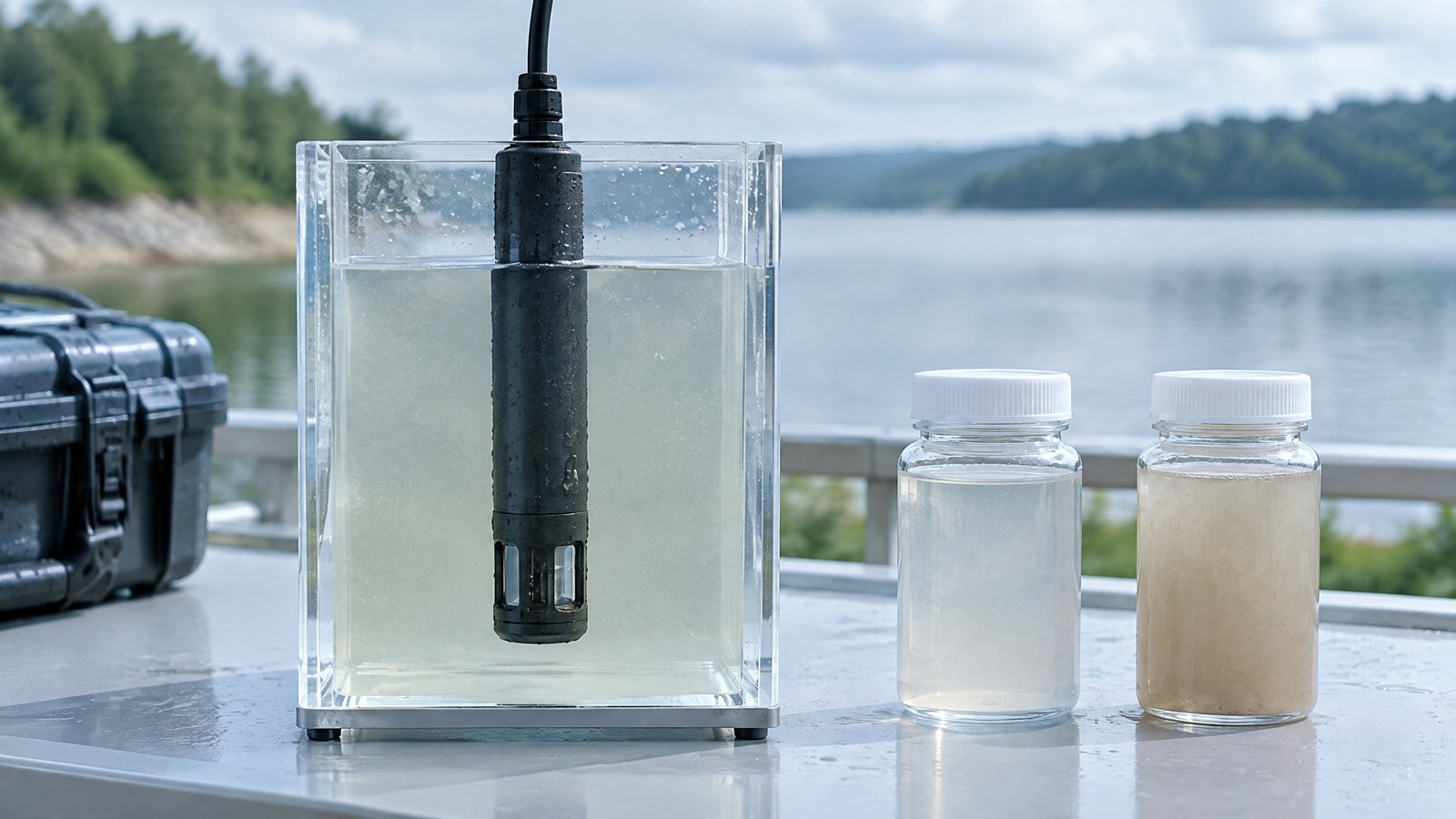
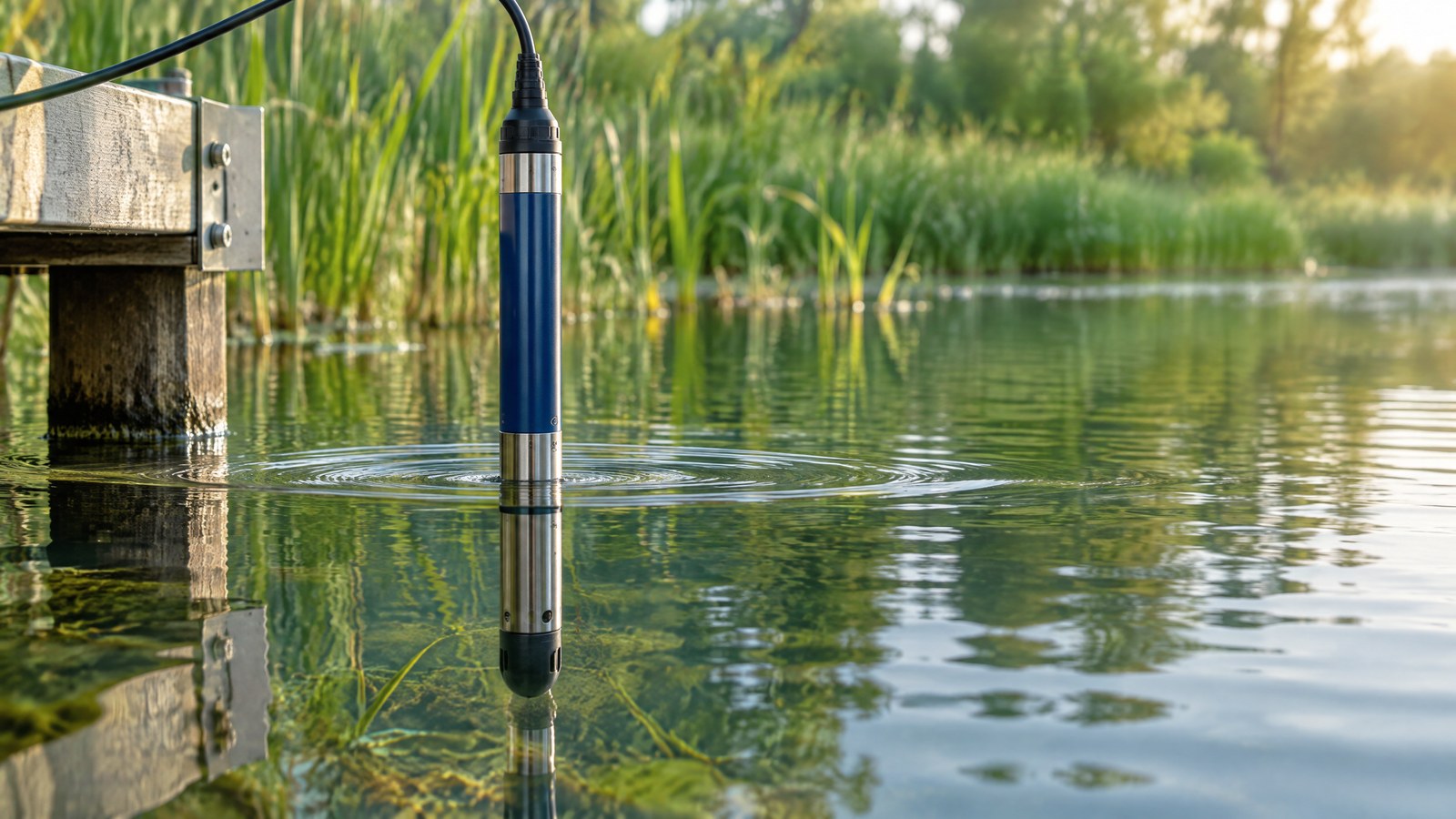
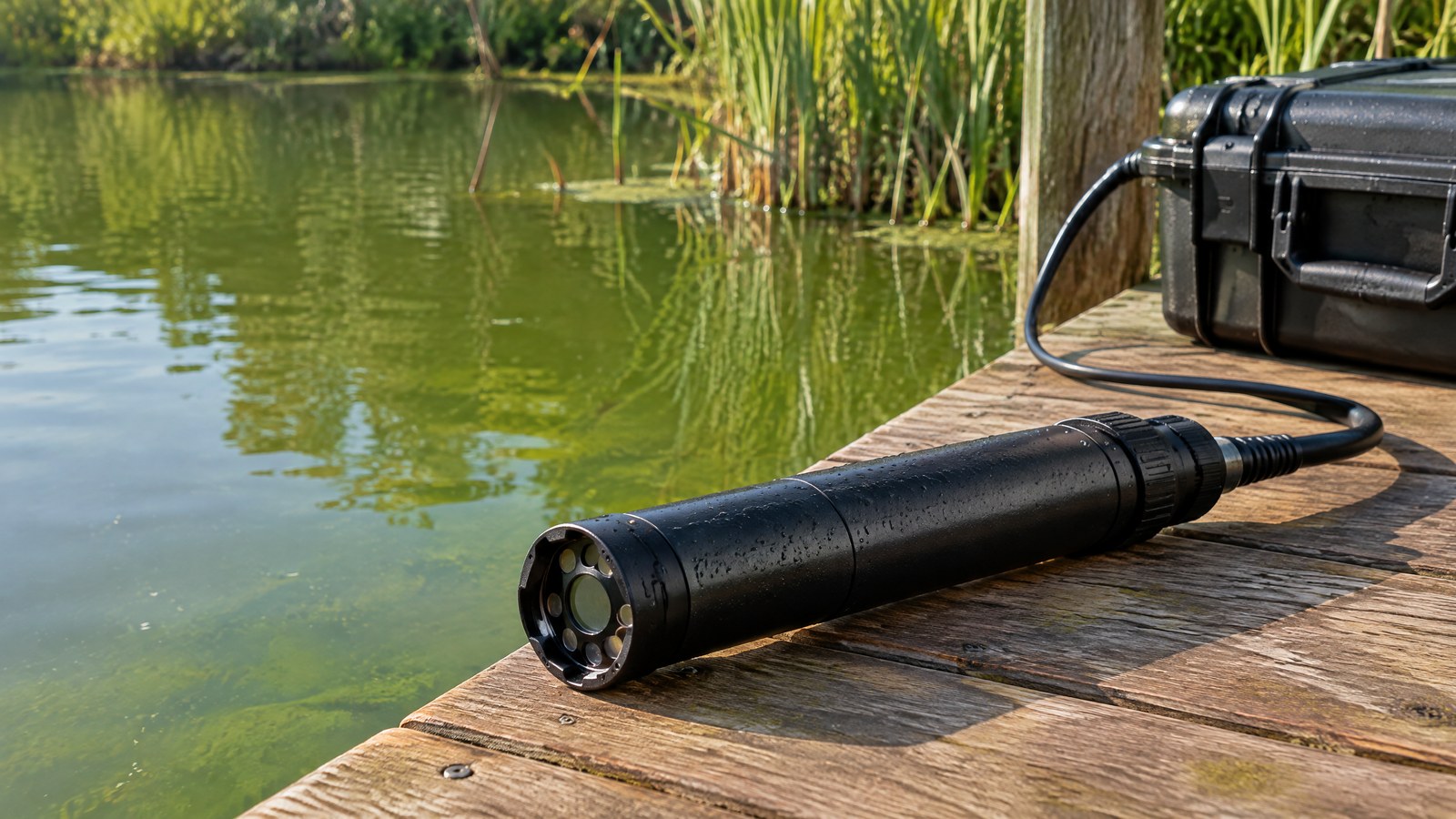
AI-generated editorial illustration of generic in-situ aquatic fluorescence-probe hardware in a lake-monitoring context, not a photograph of a tested product or an actual field measurement.
An in-situ chlorophyll fluorescence sensor is an optical probe placed in water, often as one channel in a multiparameter instrument. It shines light selected to excite chlorophyll-related pigments in the water volume immediately around the probe, then detects a small part of the light emitted back as fluorescence. The recorded response is a practical proxy signal for phytoplankton pigment, not a direct measurement of every organism in the water. USGS guidance describes these instruments as tools for determining the presence and relative abundance of algal pigments and for making qualitative estimates in environmental waters. [1]
A pigment response, not an algal headcount
Chlorophyll-a is a widely used pigment indicator because algae and cyanobacteria contain it, but the fluorescence response per unit of pigment is not fixed. Species composition, cell shape, physiological condition, temperature, ambient light and photoinhibition can all change the response. That means a rising trace may be a valuable indication of changing conditions, yet it does not automatically show how many cells are present or how much total algal biomass has changed. [1] [2]
This distinction is particularly important for readers who have encountered leaf-fluorescence equipment in agriculture. Aquatic pigment probes are designed to track fluorescence from suspended material in water. They are not pulse-amplitude-modulated instruments for calculating leaf or algal photosynthetic efficiency. [5]
Why a time series is often the useful result
A fixed probe can sample frequently enough to reveal when a pigment signal rises, falls or follows a repeated daily or seasonal pattern. In that role, it complements discrete water samples: the sensor supplies continuity between samples, while laboratory analysis and biological identification supply the reference needed to interpret the optical signal. A recent USGS river evaluation concludes that fluorescence is especially suited to relative change and temporal dynamics rather than exact chlorophyll magnitude at every moment. [2]
The signal should therefore be read as one layer of evidence. A change is a reason to check context, not a diagnosis by itself. Temperature, turbidity, depth, light, dissolved oxygen and other observations may help explain whether a shift is likely linked to algae, mixing, sediment or another local condition. [3]
Calibration and Context Determine Whether the Signal Travels Well
A display that reports a chlorophyll-like concentration can look more definite than the underlying measurement is. Many instruments start with a factory relationship between relative fluorescence and a reference material or a reference culture. That relationship can be useful for setup and comparison within an instrument’s documented use, but it is not an automatic laboratory result for every lake, river, pond or reservoir. [1]
Local comparison turns a proxy into a better-informed estimate
Where a programme needs to relate fluorescence to laboratory chlorophyll-a, the relationship should be checked with paired, discrete samples from the same site and relevant conditions. USGS notes that such relations need site-specific data and may change as seasonal conditions or species composition change. [1]
The Illinois River study gives a clear supporting example. It compared continuous fluorescence observations with laboratory chlorophyll-a at several sensor locations and found that location, individual sensor, or both could materially affect the relationship. Its practical conclusion was not that fluorescence is unhelpful; it was that a local relation may need to be developed per location and potentially per sensor when a more precise estimate is required. [2]
Optical interference and maintenance are part of the measurement
Water is not an empty optical path. Suspended particles can scatter or block the probe’s excitation light and the returning fluorescence, while coloured dissolved organic matter can absorb or contribute light in ways that affect a chlorophyll channel. The direction and size of those effects depend on the water and the optical design, so a single correction should not be assumed to work everywhere. [1] [5]
Biofouling, drift, placement and changes in the water column also matter. In a USGS lake-monitoring study, routine field records faced practical challenges including fouling, drift and data loss, and sensor-to-laboratory agreement varied by lake and sensor. [3] For that reason, a credible monitoring programme records maintenance, checks instrument behaviour against suitable references, and retains discrete samples when they are needed for interpretation. These are professional quality-assurance activities, not a do-it-yourself recipe.
Important Points / Key Information
The most responsible plain-English interpretation is: ‘the pigment-related fluorescence at this monitoring point has changed.’ That statement can support a decision to examine the site using an established monitoring plan. It cannot be stretched into ‘the water is safe,’ ‘the bloom is toxic,’ or ‘there are exactly this many algae.’ EPA similarly notes that chlorophyll-a can estimate algae and cyanobacteria in a waterbody but does not tell researchers whether the algae are harmful. [4]
For drinking-water, swimming, livestock, aquaculture or ecosystem decisions, an optical pigment proxy does not certify the absence of cyanotoxins, pathogens, chemical contamination, or risks to fish and other organisms. Qualified professionals should interpret the sensor alongside the appropriate sampling, laboratory methods and local procedures.
- Key Takeaways
- A chlorophyll fluorescence sensor tracks a relative optical response from algal pigments in water; it does not directly count algae or measure biomass. [1] [2]
- Local paired sampling and ongoing context are important when a programme wants to estimate laboratory chlorophyll-a from the sensor signal. [1] [2]
- Turbidity, coloured dissolved organic matter, light conditions, species composition and fouling can complicate interpretation. [1] [3] [5]
- A chlorophyll signal cannot identify the organism present, confirm a cyanobacterial bloom, or establish whether cyanotoxins are absent. [4]
Examples / Supporting Information
Supporting example: continuous monitoring compared with laboratory samples
USGS researchers in the Illinois River Basin used instream sensors to collect frequent chlorophyll fluorescence observations and paired them with discrete laboratory chlorophyll-a samples. The work supports using the sensor to understand whether chlorophyll conditions are relatively higher or lower and when changes occur. It also shows why a site should not borrow a conversion from somewhere else without validation: agreement changed across monitoring locations. [2]
A separate USGS study of lake platforms reached a similarly cautious result. Fluorometer chlorophyll measurements correlated moderately with laboratory chlorophyll-a, while their relationship with total phytoplankton biovolume was weaker. The study also found that interpretation benefited from other measurements such as temperature, turbidity, pH and light. [3]
Hypothetical India-use scenario: a reservoir trend check
Hypothetical example: A reservoir-monitoring team in India keeps an in-situ fluorescence probe at a consistent depth and notices that its pigment signal rises after a period of changing inflow and water clarity. The team should treat the rise as a pattern worth reviewing, not as proof of a harmful bloom or a toxin result. Comparing the observation with local discrete samples and contextual water-quality records can help qualified staff determine whether the pattern reflects algae, suspended material, changing light, or a mixture of causes.
This is where an in-situ probe can add value: it makes a developing pattern visible between manual sampling visits. Its value is strongest when it is embedded in a documented monitoring and quality-assurance programme, rather than used as a stand-alone safety verdict.
Conclusion
Chlorophyll fluorescence sensors are best understood as trend instruments for algal pigment in water. They can make changes in an aquatic system visible at useful time intervals, but their readings depend on biology, optics, location, maintenance and local calibration. Use the trace to ask a better question about the water, then rely on qualified interpretation and suitable sampling or laboratory analysis for questions about exact chlorophyll, species, toxins or water safety.
How we checked thisSources (5)
We keep source links private so your reading stays on techduopulse. Each note names the publisher and document we checked.
USGS field guidance on algal fluorescence interpretation
Primary source · How a Chlorophyll Fluorescence Sensor Reads Aquatic AlgaeUSGS field evaluation of fluorescence as a chlorophyll proxy
Primary source · Calibration and Context Determine Whether the Signal Travels WellUSGS continuous lake-monitoring sensor evaluation
Primary source · Optical interference and maintenance are part of the measurementEPA explanation of chlorophyll as a proxy, not a harmfulness test
Primary source · Important Points / Key InformationTechnical explanation of optical interference in total-algae sensing
Secondary source · Optical interference and maintenance are part of the measurementOwner-approved educational sensor explainer; obsolete private-draft status removed without changing source-backed facts or professional safety boundaries. Original generic AI editorial illustration, not a product or field-test photograph.