Ambient intelligence describes a space that uses sensing and context to respond with less repeated input from people. A room might combine occupancy information, daylight and a chosen lighting preference rather than wait for another app command. Sensors supply the signals, connectivity carries messages, and a rule or model helps determine an allowed response. [1] [2]
This guide explains that loop and the difference between a connected gadget and a coordinated environment. It looks at homes, offices, retail and care, then separates useful possibilities from assumptions about privacy, offline operation and perfect prediction. The 2027 outlook is conditional: the concept and some applications already exist, but the sources do not prove a universal transformation next year. [1] [3] [4] [6]
Show less
On this page 12 sections
- Key Takeaways
- What is ambient intelligence?
- How ambient intelligence works: sensing to feedback
- Ambient intelligence versus ordinary smart technology
- Examples in homes, offices, retail and care
- When can ambient intelligence be useful?
- Privacy and security do not disappear with the interface
- Ambient intelligence possibilities to watch in 2027
- Frequently asked questions
- Important Points / Key Information
- Examples / Supporting Information
- Conclusion
Part of our artificial intelligence technology guide library
Key Takeaways
- Ambient intelligence coordinates context and allowed responses; the concept predates 2027.
- Ordinary smart devices already support rules and automation, so this is not a strict old-versus-new product divide.
- Local processing and non-camera sensing can change data flows without guaranteeing privacy or offline operation.
- Care monitoring needs appropriate validation and human review; users should retain understandable controls.
What is ambient intelligence?
Ambient intelligence is a design approach in which computing is embedded in a space and responds to its context. Sensors provide information about the surroundings, software interprets that information, and connected equipment carries out an appropriate response. The aim is to reduce repeated manual interaction while keeping the environment useful to the people in it. [1]
The concept is not new to 2027. Sanders and Gegov’s 2006 academic paper describes an idea developed in the late 1990s around embedded, context-aware and adaptive systems. Today’s sensors and local processing provide ways to implement parts of that idea; they do not establish that every connected room is fully autonomous. [1]
“Invisible technology” means that routine operation demands less attention. It should not mean hidden surveillance, an unexplained decision or controls that occupants cannot find. A good design makes its sensing and automatic actions understandable, even when people rarely need to operate them. [1] [6]
How ambient intelligence works: sensing to feedback
The basic loop is sense, interpret, apply a policy, act and check the result. Connectivity helps components exchange information, but the network alone does not decide what the room should do. A connected sensor can report a reading without having any AI capability. [1] [2]
Consider a lighting system that combines occupancy information with a daylight reading and an occupant’s chosen preference. Those inputs give it more context than a single button press. However, detecting presence is not the same as knowing a person’s identity, activity or intention. A system must limit what it concludes from the information it actually has. [1] [6]
Sensors measure conditions, not complete understanding
A room may use motion or presence sensors, light measurements, temperature readings or door-state information. A more detailed setup might include radar, depth sensing or cameras. Each provides a different signal; choosing a sensor starts with deciding what the system needs to know, rather than collecting everything available. [1] [3] [4]
Motion and presence are particularly easy to confuse. A person can be present while sitting quietly. TI describes mmWave radar applications that detect very small movements, including breathing, and use position or motion information for occupancy sensing. Actual performance still depends on the sensor, placement, software and environment. This is not a guarantee that a particular device will detect every occupant. [3]
Combining signals can help a system handle uncertainty, but it does not turn uncertainty into proof. Conflicting readings, lost messages or an obstructed sensor need a defined fallback. For an ordinary room-control task, that might mean preserving a usable manual setting rather than taking an unexpected action.
Connectivity carries messages between devices
Sensors and actuators need a way to exchange readings and commands. Matter is one example of a smart-home connectivity standard. The Connectivity Standards Alliance describes Bluetooth Low Energy for setup, with Wi-Fi, Thread and Ethernet used for device connections. Matter’s role is compatible local communication, not learning an occupant’s habits. [2]
Do not treat Matter, Thread and Zigbee as interchangeable names. Matter and Zigbee are different protocols and do not communicate natively with one another. Supported bridges can expose compatible devices to a Matter ecosystem, but the available functions still depend on the products and platform. [2]
An existing device is not guaranteed to receive a Matter upgrade. The Alliance says this depends on its technical capabilities and whether the manufacturer supplies an update. A standards badge helps identify a supported technology; it does not establish that every advanced feature works through every app. [2]
Rules and learned models can both use context
Context-aware software relates readings to a situation. For lighting, the relevant context might be occupancy, available daylight and a chosen brightness level. The earlier ambient-intelligence literature includes both rules and intelligent responses; a context-aware action does not necessarily require a large language model. [1]
A fixed rule can be appropriate for a clear task. A learned model may help classify a signal or estimate a pattern when there is a reason to use it. The important question is whether the method works for the intended setting and can handle mistakes, not whether every decision is described as AI.
Preferences should remain explicit where guessing would be intrusive. A user-selected reading mode is different from a system claiming to know that someone is reading. In a shared room, different occupants can have conflicting preferences; a design needs a way to resolve them rather than treating one predicted preference as everyone’s choice.
What local processing changes—and what it does not
Local or edge processing runs a computation on a device or nearby gateway instead of sending that particular job to a remote service. It can avoid some network round trips and reduce transfers of the raw input. That is a benefit of a specified data flow, not an automatic guarantee about everything the installation does. [6]
Other functions may still use the internet: remote access, notifications, cloud analysis, updates or backups. The Matter FAQ describes local connectivity but explains that control away from home needs an internet-connected controller or another supported internet connection. An on-site lighting action and a remote caregiver alert therefore have different dependencies. [2]
If outage resilience matters, verify the whole path: the sensor, controller, actuator, local network and available power. Local AI does not help if the equipment needed to act has lost power. Nor does keeping an inference local prove that logs, records or account services remain local. [6]
Automatic actions need limits and feedback
An actuator turns a software decision into a physical change, such as adjusting a light or sending an allowed control request. The system then needs feedback about whether the request succeeded. A command that was sent is not proof that the room reached the intended condition.
Lighting preferences are not the same risk as a door-lock decision or a care alert. Presence alone should not be treated as permission to unlock a door or as proof that an occupant is safe. Important actions need appropriate constraints, dependable controls and a response path if the system is uncertain.
Manual override is a feature to require and verify, not something every product automatically provides. People should be able to see why a routine action happened and change it when appropriate. Automatic behaviour that repeatedly conflicts with an occupant’s choice is not useful merely because it runs without a screen. [1] [6]
Ambient intelligence versus ordinary smart technology
The difference is a design focus, not a strict division between “old gadgets” and “intelligent rooms.” Ordinary smart devices can already use sensors, schedules, local rules and coordinated scenes. Ambient intelligence describes making those capabilities work around the context of a space, with less repeated interaction. [1] [2]
The comparison below describes possible design choices, not guaranteed capabilities of two product categories. A simple rule can be part of an ambient system, and a sophisticated smart device can already respond automatically.
| Question | Device-level control | Coordinated ambient design |
|---|---|---|
| What is controlled? | A device or a user-configured scene. | Several components respond to a shared room context. |
| How does an action start? | A button, app, schedule or sensor rule. | Relevant inputs and preferences determine an allowed response. |
| Does it require learned AI? | Not necessarily. | Not necessarily; rules and learned models can coexist. |
| Must it use the cloud? | Depends on the product and feature. | Also depends on the whole system and feature. |
| What should the user retain? | Usable settings and controls. | Usable settings, clear sensing choices and appropriate overrides. |
Examples in homes, offices, retail and care
Useful applications are task-specific. Adjusting lights to occupancy is easier to define than asking a room to anticipate everything a person wants. Start by identifying the signal, the action and what happens when the signal is wrong. [1]
A home: comfort without repeated commands
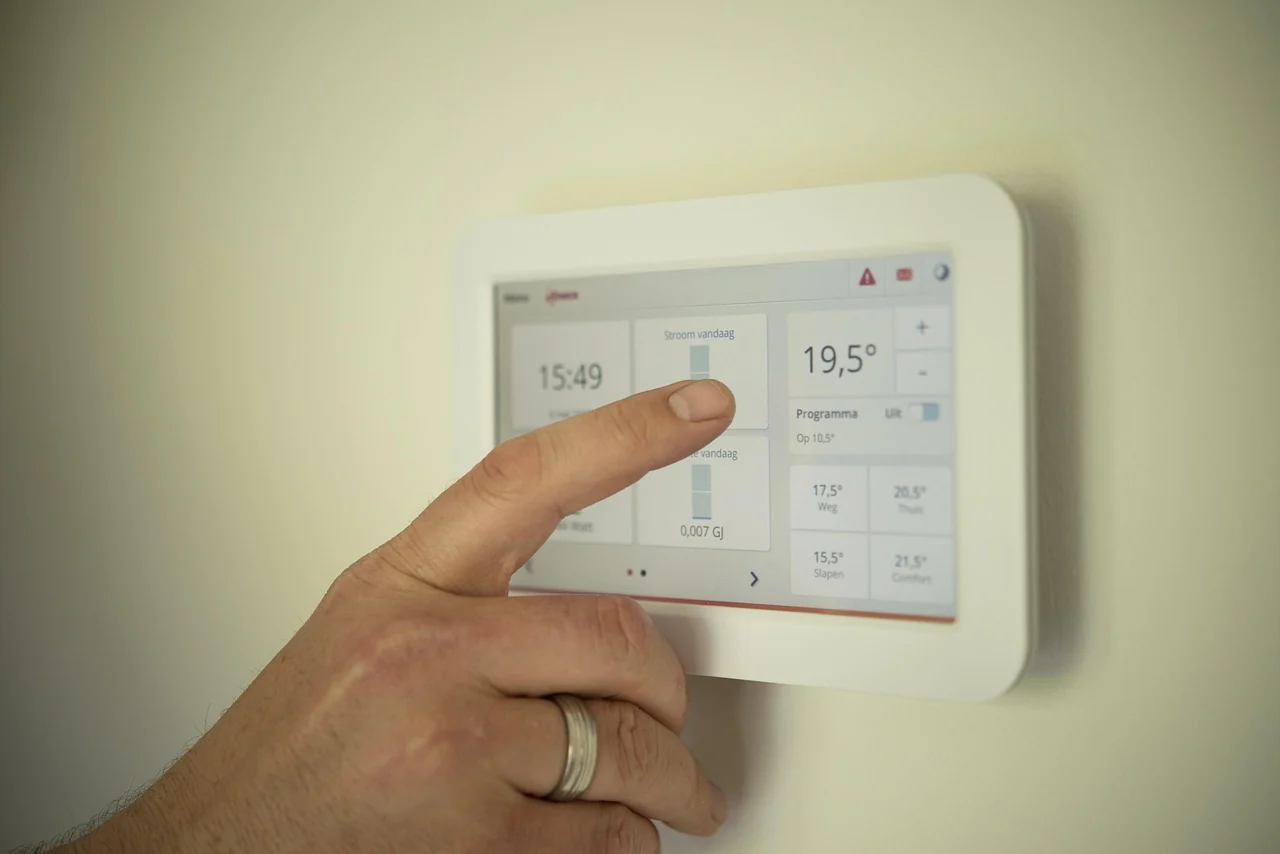
A possible home setup could combine a daylight sensor, occupancy information and chosen lighting preferences. The room would adjust a permitted setting without a separate app command each time. This is an illustrative design, not a claim that the photographed controller or any particular product has been tested by us.
Shared households need understandable controls. A child, visitor or housemate may not want a learned routine applied to them. Keeping a manual switch and making sensing choices clear can be more valuable than adding more predictions. Collection of presence or activity information also needs appropriate privacy controls. [6]
An office: an attributed occupancy-control example
TI describes Framery office pods using its IWR6843AOP radar sensor to detect occupancy and adjust lighting and ventilation when someone enters or leaves. This is a vendor-described example of occupancy-driven room control already in use, not a promised 2027 launch or an independent hands-on evaluation. [3]
The example also shows why a system should be described precisely. Detecting an occupied pod does not mean the system knows the participants, understands the meeting or can infer every comfort preference. Those would be separate capabilities requiring their own evidence.
A shop: defined signals rather than presumed intent
An illustrative retail design might use a shelf-state signal to flag a replenishment check, or occupancy information to inform an allowed lighting setting. Those are defined tasks. A person standing near a shelf does not automatically reveal what they intend to buy.
Calling footfall data anonymous simply because it lacks ordinary video is unsafe. NIST warns that aggregated sensor information can reveal additional information or help re-identify people. Describe what is collected and retained, restrict access, and avoid treating context sensing as blanket permission for personalised tracking. [6]
A care setting: monitoring support, not diagnosis
Haque, Milstein and Li Fei-Fei’s 2020 Nature review discusses contactless sensing and ambient-intelligence possibilities in healthcare and daily living. Its accessible figures illustrate activity categorisation and movement monitoring. This supports discussing suitably designed monitoring systems, not claiming that every consumer sensor can diagnose illness or detect every fall. [4]
A system may flag a possible fall or unusual inactivity for a caregiver to review. A warning is not confirmation of a fall or illness, and an absence of a warning is not proof of safety. Appropriate validation for the intended setting, human oversight and a defined response protocol are necessary. The review identifies clinical validation as a hurdle to deployment at scale. [4]
These systems should not be presented as a substitute for human care or as a guaranteed way to extend independence. Our sources do not establish universal clinical benefit, flawless alert delivery or a timetable for mass adoption in 2027. [4]
When can ambient intelligence be useful?
Its most direct benefit is reducing a repeated interaction when the system has enough reliable information to make an allowed adjustment. Occupancy-driven room control illustrates that purpose. It is useful when the automatic response fits the actual situation and the occupant can correct it. [1] [3]
Energy savings are possible, but not automatic. Reducing unnecessary lighting or ventilation can be a goal of a configured occupancy-control system. A saving claim still needs a measured comparison, suitable operating conditions and attention to the power and maintenance required by the new equipment. We do not attach an invented savings percentage or promise lower bills. [3]
The best result may be a simple, predictable rule rather than constant personalisation. If automatic adjustments make a room uncomfortable or difficult to control, less manual interaction has not produced a better experience.
Privacy and security do not disappear with the interface
Camera-free sensing can avoid collecting conventional images, but occupancy, radar, depth or activity records can still reveal patterns of daily life. NIST’s IoT risk report highlights unwanted information from sensor aggregation and challenges around collection notice, retention and re-identification. “No camera” is not the same as “no sensitive data.” [6]
People need clear information about what is sensed, why it is used and who can access it. Appropriate notice and consent where required, collection limited to the purpose, defined retention/deletion and usable sensing controls are practical safeguards. Their presence must be checked; neither consent alone nor a local processor proves legal compliance. [6]
Security also includes maintenance. NISTIR 8259A identifies baseline capabilities for device identification, configuration, data protection, restricted interface access, software updates and cybersecurity-state awareness. These are a starting point for context-specific risk management, not a certification that an installation cannot be compromised. Device identification here means identifying the device, not recognising every person in the room. [5]
Matter likewise includes security mechanisms but says complete privacy protection depends on device makers and service providers too. A compatible network can carry protected messages while the surrounding application still handles data poorly. Treat communication, application permissions and data governance as separate things to check. [2]
Ambient intelligence possibilities to watch in 2027
More coordinated room control and more local classification are plausible directions to watch, because parts of the sensing and connectivity stack already exist. The important evidence will be specific features working reliably in actual homes or buildings, not a general announcement that technology has become invisible. [2] [3]
Other useful developments could include clearer reasons for automatic actions, easier overrides and better ways to manage data collection. These are design priorities, not confirmed product launches or predictions that every office, shop or care setting will adopt them next year. [1] [6]
The verified sources do not prove that 2027 is a turning point. They establish an older concept, current enabling technologies and unresolved practical issues. A claim about adoption, cost reductions or universal energy benefits would need different evidence.
Frequently asked questions
How is ambient intelligence different from IoT?
IoT connects devices so they can exchange information and commands. Ambient intelligence describes how a space uses context to provide an appropriate response. Networking is part of the foundation; it does not by itself understand needs or learn routines. [1] [2]
Does an ambient system need an AI model?
Not for every decision. A context-aware rule can coordinate a defined task, and learned models may help with classification or patterns where they are suitable. The design should match the task, rather than adding a model solely to make an ordinary automation sound more advanced. [1]
Can it work without cameras?
Some tasks can use light, motion, radar or other non-camera signals. Which sensor is suitable depends on the task and setting. Non-camera sensing can still reveal occupancy or activity patterns, so privacy requirements do not disappear. [3] [4] [6]
Will it still work if the internet goes down?
Only if the required sensing, decision and control path remains available locally with adequate power. Remote access or alerts may still depend on internet services. Check the intended feature, not just whether the product advertises edge AI or Matter. [2] [6]
Important Points / Key Information
Ambient intelligence is coordinated, context-aware operation around a space. It is not a guarantee of identity recognition, perfect prediction or completely hands-free control. [1] [6]
- Select the minimum signals needed for the task; presence is not identity or intent.
- Distinguish compatible communication from the software policy that decides an action.
- Check local and remote dependencies separately; edge processing is not a universal privacy or outage guarantee.
- Require usable controls, updates, data-handling safeguards and sensible fallbacks.
- Use care alerts only with appropriate validation and human response pathways; keep 2027 claims conditional.
Examples / Supporting Information
Hypothetical reading-room example: an occupant has enabled a reading-light preference. A daylight sensor reports that natural light is low, while a suitable occupancy sensor indicates that someone is present. The controller applies the chosen brightness to an allowed light, then checks whether the command succeeded.
This is context-based coordination, not a claim that the room inferred an unspoken desire or knew the occupant’s identity. If another person wants a different setting, a usable manual control lets them change it. If the presence reading is uncertain, the configured fallback should avoid an abrupt, unsuitable response.
The example is an explanatory workflow, not a tested installation, product recommendation or measured energy saving. It separates the sensor input, user preference, permitted action and result check so each can be evaluated on its own. [1] [3] [6]
Conclusion
Ambient intelligence brings sensing, contextual decisions and connected equipment together so a space can handle a defined task with less repeated input. The concept has a long history, and practical occupancy-control examples already exist. That does not mean a room understands everything its occupants need. [1] [3]
Judge the design by its actual inputs, dependable actions, privacy choices and available controls. The useful version of invisible technology is one that demands less effort while remaining understandable—not one that quietly removes the user’s ability to decide. [1] [6]
How we checked thisSources (6)
We keep source links private so your reading stays on techduopulse. Each note names the publisher and document we checked.
[1] D. A. Sanders and A. Gegov — Ambient Intelligence — 2006
Primary source · Established ambient/context-aware definition; historical forecasts not adopted[2] Connectivity Standards Alliance — Matter FAQ — Undated; retrieved 6 Nov 2026
Primary source · Matter transport, bridging, local/remote control and privacy boundaries[3] Texas Instruments — Industrial mmWave radar sensors — Undated; retrieved 6 Nov 2026
Primary source · Radar sensing and attributed Framery office-pod example; promotional absolute-care claims excluded[4] Haque, Milstein and Li Fei-Fei / Nature — Illuminating the dark spaces of healthcare with ambient intelligence — 9 September 2020
Primary source · Accessible abstract and original figures only; clinical-validation limits and monitoring rather than diagnosis[5] NIST — IoT Device Cybersecurity Capability Core Baseline — NISTIR 8259A — 29 May 2020
Primary source · Six context-specific device security capabilities; not a guarantee or person-identification scheme[6] NIST — Considerations for Managing Internet of Things Cybersecurity and Privacy Risks — NISTIR 8228 — June 2019
Primary source · Sensor aggregation, privacy risks, notice, retention and device/external-service dependenciesInitial source-backed owner-authorized manual publication. Original reviewed article facts, metadata and licensed real photograph preserved. Schema-only body and citation projections are recorded privately; no hands-on test or qualified human certification claimed.