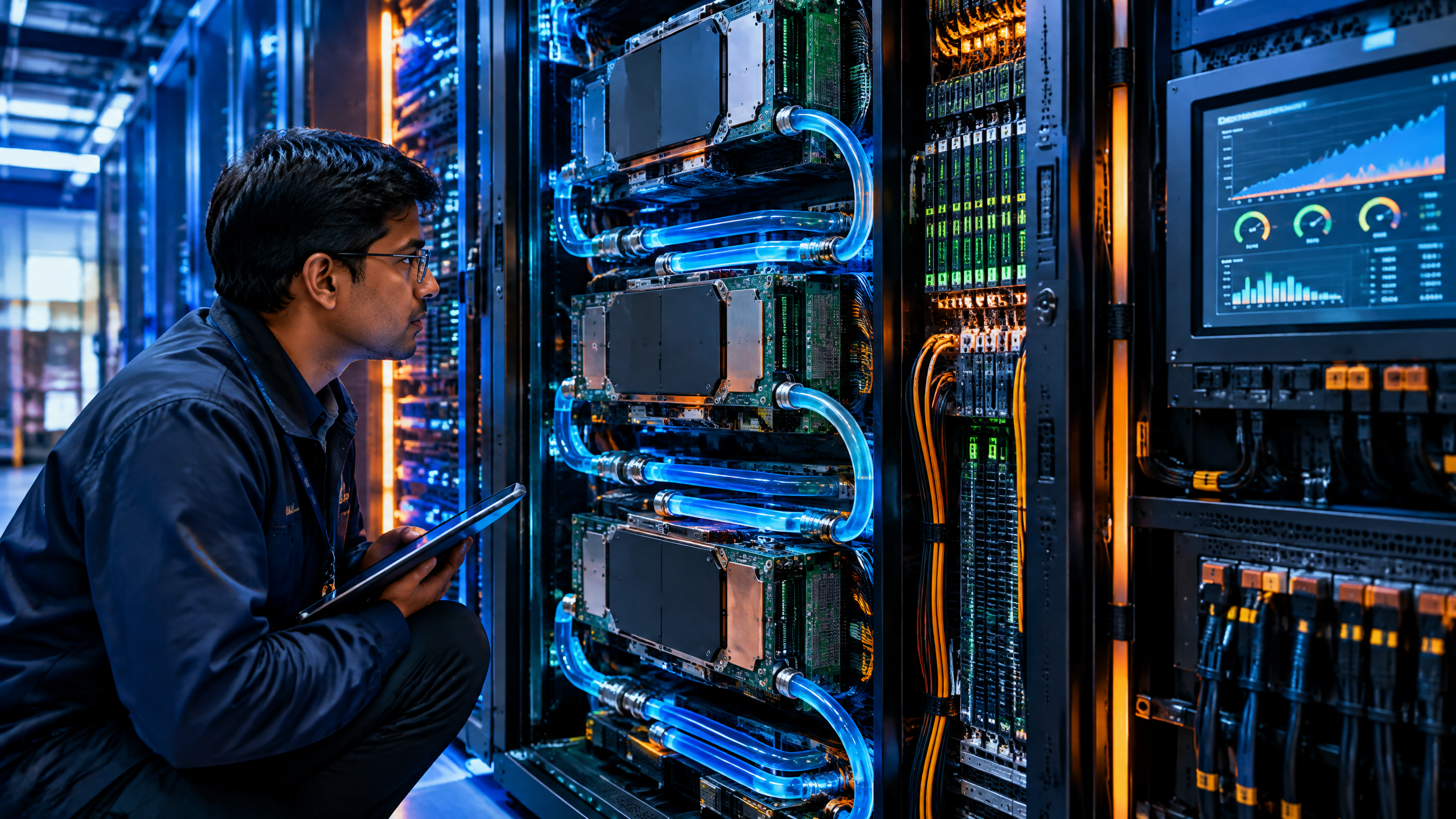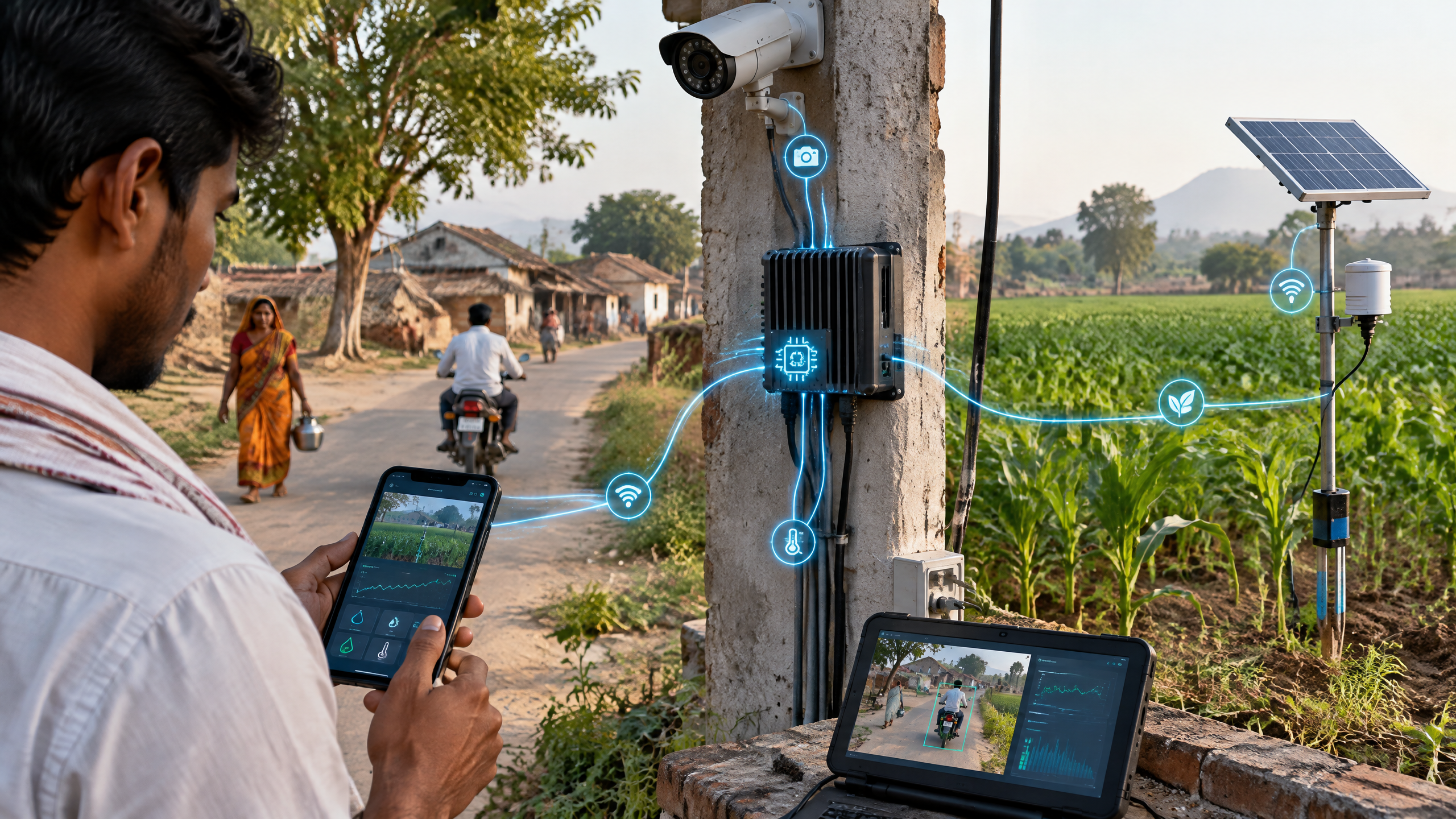
When your phone recognises speech without waiting for a server, a camera flags motion as it happens, or a sensor notices an unusual vibration, some or all of the AI work may be happening where the data is created. That is the basic idea behind edge AI. This does not mean the cloud is obsolete. Most practical systems divide work between devices, nearby computing equipment and cloud services. The useful question is not “edge or cloud?” It is which task should run where, and why?
This article is part of the software engineering technologies guide library.
Key takeaways
Edge AI runs inference close to the data source. A phone can analyse audio, a camera can classify a frame, and a small sensor can detect a pattern without sending every raw input away first.
It can improve response time and keep working through poor connectivity. It can also reduce how much raw data needs to cross a network, but local processing alone is not a guarantee of privacy, security or accuracy. [1] [2]
Cloud AI remains important. It is often used for model training, storing and aggregating data, deeper analysis, monitoring, and sending updated models to devices.
Hardware limits shape the result. Battery capacity, heat, memory, model size, supported operations and chip capabilities determine what a device can do well. [2] [3]
In India, edge computing is a current infrastructure discussion, not proof of universal deployment. As of 13 October 2026, India Mobile Congress lists cloud, edge computing and connected devices among its technology discussion areas; a February 2026 government release described edge computing as a focus for low-latency applications. [5] [6]
What is edge AI, in plain English?
A normal AI workflow has two stages. In training, developers expose a model to data and adjust it so that it can learn a pattern. This often uses powerful, centralised computing because it can require large datasets and repeated calculations. In inference, the trained model receives a new input and produces an output: “person detected,” “wake word heard,” “this image probably contains a document,” or “this sensor reading is unusual.” [1]
Edge AI puts that second stage on the device itself or on computing equipment close to it. An edge device might be a phone, a camera, a wearable, a gateway attached to factory machinery, or a microcontroller inside an appliance. “Edge” describes the location in the computing system: close to the source of data, at the network’s edge, rather than only in a central cloud.
Important distinction: edge AI is a deployment choice, not a claim that a model is smarter. It changes where computation takes place and therefore changes trade-offs around delay, connectivity, power, data transfer and system design.
How an edge AI system works
A simple edge AI flow has four parts:
A device captures an input, such as a camera frame, microphone sample or vibration reading.
A local model processes that input and returns a result.
The device or application acts on the result—for example, showing a suggestion, recording an event or raising an alert.
The system may send selected results, diagnostics, opted-in data or uncertain cases to another system. Developers can then monitor performance, retrain a model elsewhere and distribute an updated version to devices. [1]
The last step is why edge AI and cloud AI frequently work together. A camera may decide locally whether a frame contains movement, while a central service stores only an event record or receives a short clip for a rule that requires further review. The exact split should be designed around the use case, not assumed from the label “edge.”
### On-device AI, edge AI and cloud AI are related—but not identical
On-device AI is a specific kind of edge AI: the inference runs on the user’s own phone, tablet, computer or other endpoint. Apple, for example, documents on-device machine-learning capabilities for image and video analysis, speech and other features across its devices. [4]
Edge AI is broader. A networked camera, an industrial gateway or a local server in a building can also be an edge location, even though it is not a personal device.
Cloud AI runs in remote, centralised infrastructure reached over a network. It can be the sensible choice when a task needs a larger model, substantial storage, a shared view of data from many devices or more powerful computing resources.
Edge AI vs cloud AI: what changes?
| Question | Edge AI | Cloud AI |
|---|---|---|
| Where does inference run? | On the endpoint or equipment near the data source | In remote, centralised computing infrastructure |
| Does every input need a network trip first? | Not necessarily | Usually yes |
| Can it work when connectivity is absent or unreliable? | Often for the local task, if the model and required data are on the device | Usually not for the cloud-dependent part |
| What can be sent over the network? | A result, event or selected data instead of every raw input | Inputs are typically sent for processing, subject to system design |
| Main practical constraints | Device compute, memory, storage, heat and battery | Network availability, transfer delay, service capacity and operating cost |
| Common role in a hybrid system | Fast filtering, immediate feedback or local control | Training, fleet management, storage, aggregation and heavier analysis |
These are patterns, not laws. An edge device can still upload data, and a cloud system can return a fast response on a good connection. A privacy-sensitive application also needs careful choices about permissions, encryption, access controls, retention and logging. Keeping a particular input on a device reduces one transfer path; it does not by itself establish that the complete system is private or secure.
Why run AI on a phone, camera or sensor?
### Faster response when a network round trip is not acceptable
A device can make a local decision without first waiting to upload input and receive a response. Android’s developer documentation identifies this as a benefit of on-device inference, particularly for video applications that process successive camera frames. [2]
This is most useful where the response itself is time-sensitive: showing a live camera guide, triggering a machine alert, recognising a simple spoken command or filtering a stream before any upload. The appropriate response time depends on the task; edge AI does not promise a particular millisecond result.
### Operation through patchy or unavailable connectivity
Local inference can continue when a device has no connection, provided it has the model, necessary data and enough power to run the task. That can matter for a device in transit, a remote sensor or an app being used in an area with inconsistent coverage. Android lists offline availability as one benefit of on-device inference, while Google’s microcontroller documentation explains that embedded ML can avoid dependence on reliable internet connections. [2] [3]
Offline operation does not mean a system needs no connectivity at all. Updates, backups, remote assistance, records or enhanced analysis may still rely on a network at another time.
### Less raw data sent away
A local model can turn a large stream into a smaller outcome: for example, “abnormal vibration detected at 14:03” rather than a continuous raw signal feed. That can reduce bandwidth use and central processing demand. It may also lower unnecessary exposure of raw audio, image or sensor data, depending on what the system retains and transmits. [1] [3]
The benefit is an engineering option, not an automatic outcome. A design that uploads every camera frame after analysing it locally would not obtain the same data-transfer benefit.
### Hardware that can execute AI workloads locally
Phones and other modern devices may distribute machine-learning calculations across CPUs, graphics processors, digital signal processors and dedicated accelerators. Android documents that its runtime can distribute supported work across available on-device processors; it also notes that this varies by device and model support. [2]
At the smaller end, embedded AI can run on modest hardware for narrow tasks. Google’s LiteRT for Microcontrollers is designed for devices with only a few kilobytes of memory; its documentation gives examples including simple speech and person detection. Those examples illustrate a key limit: small devices are suited to compact, targeted models, not every type of AI workload. [3]
What edge AI looks like in everyday technology
A useful way to understand edge AI is to focus on the input, local decision and next action.
### Phones and wearables
A phone can process text, speech, images or device signals locally to provide immediate features. An app might classify an image, identify speech, improve accessibility or make a suggestion from data already on the device. Whether a given feature is truly local depends on that product’s design; users should not assume all “AI” functions run on-device.
### Cameras
A camera can use a compact vision model to distinguish a person from general movement, count objects or identify a condition that merits recording. A local result can help avoid treating every frame as equally important. The system still needs safeguards: poor lighting, unusual angles, camera placement and biased or incomplete evaluation data can affect results.
### Sensors and industrial equipment
A sensor can collect vibration, temperature, sound or other readings, and an embedded model can look for a pattern that differs from normal operation. Google’s microcontroller guidance uses intelligent industrial sensors as one possible setting for this approach. [3]
An alert is not a diagnosis. In higher-consequence settings, a local classification should fit within a process that includes calibrated sensors, clear escalation rules and appropriate human review.
### Vehicles and physical systems
Systems that interact with the physical world often need a response near the device because waiting for remote processing could be unsuitable. But local AI does not remove safety engineering requirements. Sensor reliability, fallback behaviour, testing, cybersecurity and human responsibility remain central to any consequential deployment.
The limits and trade-offs of edge AI
The appeal of edge AI can make it sound like a universal upgrade. It is not. Choosing local inference shifts constraints rather than making them disappear.
### Smaller models may be necessary
Devices have finite memory, storage and computing power. A model may need to be compressed, quantised or redesigned to fit a target device, which can affect accuracy, supported features or the range of inputs it handles well. Google’s microcontroller documentation explicitly limits supported operations and devices, and does not support on-device training. [3]
### Battery, heat and device variation matter
Running a model consumes energy and can add heat. Android’s documentation cautions that neural-network computation can increase battery use and that models can occupy multiple megabytes of app space. The same app can therefore behave differently across hardware generations and device configurations. [2]
### Updates and monitoring are still required
Models can become less useful when conditions change: a different camera angle, new background noise, a software update or a population the model was not evaluated on. A responsible edge deployment needs a way to test versions, monitor failures within appropriate privacy boundaries and roll back a flawed update. Cloud-connected tooling can help here, which is another reason hybrid systems are common.
### Local data can still be sensitive
An on-device pipeline may reduce transmission, but sensitive data can still exist in device storage, logs, backups or diagnostic reports. Threats can also include compromised hardware, insecure update paths and unauthorised access. The right controls depend on the data and setting; this article is not legal, security or compliance advice.
### A model can be confidently wrong
An inference result is a probability-based output or rule-driven classification, not a fact simply because it ran locally. Edge AI should be evaluated against the conditions it will actually encounter. When an error could affect a person’s safety, access, money or rights, the system needs stronger testing, meaningful oversight and a safe fallback—not just faster inference.
Edge AI in India: useful context without overclaiming
Observed, date-sensitive context (checked 13 October 2026): India Mobile Congress’s conference page includes cloud, edge computing and connected devices among the technology areas it discusses. This shows that edge and cloud are on a prominent Indian technology forum’s agenda; it does not establish nationwide adoption, a market ranking or the availability of any specific service. [5]
Observed, date-sensitive context (17 February 2026): A Ministry of Communications press release reported that the Minister of State described a focus on high-capacity fibre backhaul, edge computing for low-latency applications, cloud infrastructure expansion and affordable access. This is a government statement of focus and direction, rather than an independent measurement of deployment outcomes. [6]
Interpretation: For India’s varied connectivity, device and infrastructure conditions, it is reasonable to examine whether a task must send all raw data to a central service. Local processing may be especially useful where immediate feedback or tolerance of intermittent connections is important. It is not automatically the best design: a cloud service may be more appropriate when the task requires a larger model, a shared dataset or central coordination. Actual suitability depends on the device, connection, model, operational risk and cost.
How to decide what should run at the edge
Ask five practical questions before treating edge AI as the answer:
What is the local decision? Define a narrow outcome such as detecting a wake word or flagging a possible anomaly.
What happens if the connection fails? Decide which functions must continue and which can wait.
What raw data must leave the device? Send only what the service genuinely needs, and document why.
Can the device run the model reliably? Test battery effect, heat, memory use, latency, supported hardware and behaviour on lower-capability devices.
What is the fallback when the model is uncertain or wrong? Build a clear route for retry, human review, safe shutdown or a cloud-assisted check.
That framework makes the choice concrete. Edge AI is strongest when it solves a real location or timing constraint—not when it is added as a label.
Frequently asked questions
### What is edge AI?
Edge AI is the use of AI models on or close to the device that produces the input data, such as a smartphone, camera or sensor. It most often refers to local inference using a trained model. [1]
### Is edge AI the same as on-device AI?
On-device AI is a subset of edge AI. It means the model runs on the endpoint itself, such as a phone or laptop. Edge AI can also run on nearby equipment, such as a camera gateway or local server.
### Is edge AI better than cloud AI?
Neither is always better. Edge AI can suit fast, offline-capable or data-minimising tasks. Cloud AI can suit larger models, central storage, shared analysis and model training. Many systems use both.
### Does edge AI work without the internet?
A local feature can work without an active connection if its model and necessary data are already on the device. Updates, syncing or additional cloud features may still need connectivity. [2] [3]
### Does edge AI protect privacy?
It can reduce the need to transmit raw data, which can be a privacy benefit. It does not guarantee privacy: device storage, permissions, logs, update systems and transmitted results still need appropriate controls.
### Why can’t every AI model run on a phone or sensor?
Models may be too large or require more memory, computing power or energy than the device can provide. Hardware capabilities also differ. Small embedded platforms may support only a limited set of model operations. [2] [3]
### Does a phone’s AI chip mean every AI feature is local?
No. Dedicated hardware can help with supported local workloads, but an application may still use remote services for some or all processing. Check the feature’s documentation and privacy information rather than relying on chip marketing alone.
### Can edge AI learn on the device?
Some systems can adapt locally, but edge AI more commonly runs inference with a model trained elsewhere. For example, LiteRT for Microcontrollers does not support on-device training. [3]
Suggested same-site internal links
Use these only where the referenced article exists or is published under the stated path:
AI infrastructure explained — /article/ai-infrastructure-gpus-tpus-npus-inference-energy — for the difference between training, inference and AI hardware.
AI chips explained — /article/ai-chips-chiplets-hbm-inference-hardware — for accelerators, memory and inference hardware.
Physical AI explained — /article/physical-ai-robots-drones-sensors — for the relationship between local intelligence, robots and sensor-rich systems.
5G technology explained — /article/5g-technology-explained — for network capabilities that may complement, rather than replace, local processing.
AI security platforms explained — /article/ai-security-platforms-model-prompt-agent-protection — for model, data and deployment security considerations.
Confidential computing explained — /article/confidential-computing-data-in-use-security — for a separate approach to protecting data while it is processed.
Frequently asked questions about Edge AI Explained: Why Some AI Runs on Phones, Cameras and Sensors
These answers summarise the scope of this explainer. Availability, standards and implementation details can change, so check current official guidance before acting.
What is Edge AI Explained: Why Some AI Runs on Phones, Cameras and Sensors?
Edge AI Explained: Why Some AI Runs on Phones, Cameras and Sensors explains the main ideas, practical uses and limitations in plain English.
Why does this technology matter?
Its value depends on the problem, implementation, evidence, cost, security and the people responsible for using it.
What should readers verify?
Verify current availability, compatibility, security, privacy and regulatory details with the relevant official source.
Is this article professional or legal advice?
No. It is general technology information and does not replace professional, legal, regulatory or security advice.
Source notes
Reporting record
techduopulse stores source destinations privately. Public notes remain non-clickable so every visitor journey stays on this website.
Arm — What is Edge AI?
Primary source · Research source 1Android Developers — Neural Networks API
Primary source · Research source 2Google AI Edge — LiteRT for Microcontrollers
Primary source · Research source 3Apple Developer — AI & Machine Learning
Primary source · Research source 4India Mobile Congress — Conference
Primary source · Research source 5Ministry of Communications — Telecom Infrastructure to Anchor India’s AI Growth
Primary source · Research source 6New India-focused explainer covering edge AI explained, practical context, limitations and verified sources.