A wind-direction sensor does more than show which way a vane is pointing: it describes where the moving air at one measured spot is coming from. For a local weather station, that small distinction helps make sense of wind shifts around crops, water bodies and built structures without mistaking a single reading for the weather of an entire area.
On this page 7 sections
Part of our emerging technology science guide library
What a Wind-Direction Sensor Measures
A wind-direction sensor measures the horizontal direction from which air is arriving at its location. In meteorology, a north wind comes from the north and moves southward; the National Weather Service defines wind direction as the true direction from which the wind blows. It commonly uses compass points or degrees around the horizon, with north represented as 360 degrees in that convention [2].
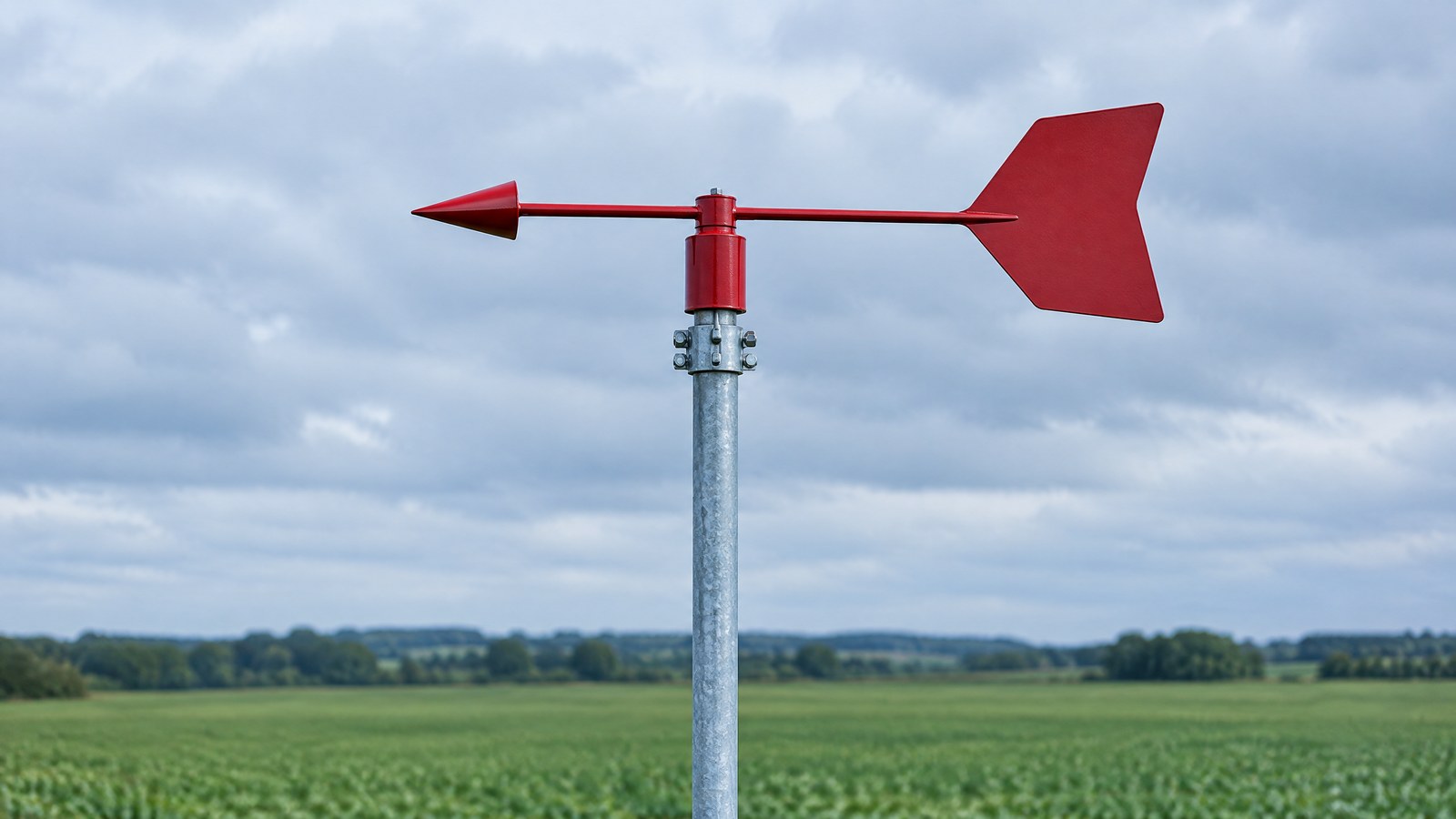
AI-generated editorial illustration of generic weather-vane hardware above an agricultural weather-station context, not a photograph of a tested product or an actual field measurement.
This is different from merely saying where an object is pointing. A useful record also needs a reference orientation—normally true north—and a stated time basis. Without those details, two readings that look similar on a display can mean different things when compared with a forecast, another station or a longer local record.
The direction-from convention prevents a common reversal
Wind reports use a “from” convention, not a “toward” convention. A reading of east therefore means air is arriving from the east, even though leaves, smoke or a wind sock may visibly stream westward. The National Weather Service glossary makes the same distinction explicitly: wind blowing from north to south is a north wind [2].
A compass reference also matters. North can be geographic, or true, north rather than the direction a magnetic compass happens to show at the site. A station’s documentation should identify its reference so that a directional change is not confused with a reference mismatch.
Calm and variable wind are different kinds of uncertainty
At very low wind speed, a direction can be physically uninformative. A vane may settle according to friction, balance, vibration or a tiny eddy rather than a sustained flow; an electronic instrument may still output a number, but that does not make the number a dependable prevailing direction. For that reason, observing systems can assign a calm state instead of treating every displayed angle as a wind direction.
The ASOS system, for example, reports winds measured at two knots or less as calm. That is an ASOS reporting rule, not a threshold to copy into every station. Its value is conceptual: a calm condition should not be converted into a confident arrow merely because the interface expects an angle [1]. Variable wind is another case: the National Weather Service distinguishes direction that fluctuates materially during an evaluation period from a stable directional observation [2].
How Weather-Vane and Ultrasonic Sensors Derive Direction
The two common approaches are a moving weather vane and a fixed ultrasonic instrument. Both seek the horizontal airflow direction at the sensor, but they obtain it differently. The choice affects maintenance and signal behavior, yet neither design can correct for a poorly representative location.
A weather vane follows the airflow
A conventional wind vane is shaped so that airflow turns the larger tail downwind and leaves the pointer facing into the wind. The rotating shaft’s angle is then converted to a record by a position-sensing mechanism. In the R.M. Young Model 05103 manual, vane position is transmitted through a conductive-plastic potentiometer, producing an output proportional to wind-direction angle [3]. Other instruments may use different position encoders, so the signal details should be taken from the instrument’s own documentation.
The practical strength of this design is that the motion is easy to understand. Its limits are equally physical: a mechanical vane has bearings, a balance and a response to changes in airflow. It may lag rapidly changing flow or be disturbed by contamination, wear or vibration. The cited manual also describes a small electrical open region for that model, a reminder that a full mechanical rotation does not guarantee identical reporting behavior at every angle [3].
An ultrasonic sensor calculates airflow components
An ultrasonic wind sensor has no rotating vane. It sends sound pulses between transducers; air moving along an acoustic path changes the pulse travel time. By comparing the relative velocities along more than one path, the instrument derives horizontal wind components and then expresses them as speed and direction. This transit-time principle is described in the R.M. Young 85000 ultrasonic-anemometer manual [4].
Because the sensing head has no moving parts, ultrasonic designs avoid vane-bearing wear. That does not make them universally better: geometry, processing choices, environmental exposure and maintenance requirements still depend on the specific model. The key reader takeaway is that a vane measures its orientation in airflow, while an ultrasonic sensor estimates the airflow vector from changed acoustic travel times.
Why Siting Can Matter More Than the Sensor Type
A wind-direction sensor reports the wind where it sits, not automatically the wind over a field, pond, road or district. Roof edges, walls, trees, crop rows and nearby terrain can bend, block or churn air before it reaches the sensing point. The result may be a genuine local observation but a poor answer to a broader question.
Obstructions create local flow that can look like a regional wind
The R.M. Young manual warns that eddies from trees, buildings and other structures can greatly influence wind speed and wind-direction observations [3]. In a separate personal weather-station guide, the National Weather Service illustrates how a sensor mounted too low near a roof can have its direction heavily influenced by the roof peak [5]. This is why moving a sensor a short distance can change its directional record even when the surrounding weather has not changed.
Complex terrain adds another layer. EPA guidance notes that a station at the bottom of a well-defined valley may measure flow shaped by channeling or slope-driven effects, and that one measurement site may not always define the relevant transport direction [6]. For agriculture and local water monitoring, that is not a defect in the sensor; it is a question of whether the station is intended to describe the sheltered site itself or a wider exposure.
Time averaging must respect a circular scale
Direction is circular: 359 degrees and 1 degree are both close to north, although ordinary arithmetic would place their average near south. A weather system therefore needs a circular or vector-aware method when it summarizes changing directions. It also needs the accompanying wind speed, because an average direction during nearly calm conditions can hide the fact that there was no strong prevailing flow.
ASOS provides one transparent example of a defined reporting window: it uses a two-minute average of five-second average directions and updates the report once a minute [1]. A farm or research station may use another interval and data-quality approach. The important practice is to retain the interval and calm or variable flags alongside the direction rather than comparing unlabeled arrows as if they came from the same method.
Wind Direction in an India-Focused Local Weather Context
For an India-focused local weather station, wind direction can add context to temperature, rainfall, humidity and wind-speed observations. A direction change at a crop site may indicate that airflow at that sensor has shifted; it does not, by itself, identify a cause, forecast rain or establish conditions elsewhere. Nearby irrigation, tree belts, sheds, village buildings, reservoirs and uneven ground can all make the station’s exposure highly local.
A useful description of the station therefore records the sensor type, reference north, height and obvious nearby obstructions, together with the direction and speed averaging method. Those notes make it easier for a qualified reviewer to decide whether a pattern is likely to be local exposure, a repeatable site feature or a broader weather change. They also keep historical comparisons honest when a mast, crop canopy or surrounding construction changes.
Important Points / Key Information
**Key Takeaways**
A wind-direction sensor reports the direction the wind comes from at the sensing point, usually relative to true north—not the direction an arrow, smoke plume or wind sock travels.
A calm or variable condition deserves its own label. An angle recorded in weak or swirling air is not automatically a meaningful prevailing direction.
A weather vane senses its alignment with airflow; an ultrasonic sensor derives a wind vector from sound-pulse transit times. Both remain dependent on representative exposure.
For local agricultural weather, record the site context and averaging method with the data.
- Use direction together with wind speed and an explicit averaging interval.
- Treat the sensor’s compass reference as part of the measurement, not as a cosmetic display setting.
- Interpret a site beside an obstruction or in complex terrain as a local observation unless its representativeness has been assessed.
Examples / Supporting Information
The following examples explain interpretation, not product selection, installation, field testing or operational instructions.
Hypothetical: a sheltered farm weather station
Imagine a station beside a shed and a line of mature trees. A midday reading may consistently show air arriving along the gap between them. That could be useful for understanding airflow at that sheltered point, but it should not be labelled the prevailing direction for the entire farm without comparing it with the station’s exposure and purpose. The scenario is hypothetical; it is not a measured result or a recommendation for station placement.
A sourced siting example: why the roofline matters
The National Weather Service personal-station guide offers a concrete exposure benchmark: it describes an anemometer ideally at 10 metres above ground and at a horizontal distance of ten times the nearest obstruction’s height. The same guide cautions that a roof peak can heavily influence the observed wind direction [5]. These are ideal-scenario guidelines for personal stations, not a universal certification rule, but they show why a technically sound sensor can still yield a site-specific direction.
Conclusion
A wind-direction sensor is best understood as an instrument for describing where air is arriving at one defined place and over one defined reporting interval. Reading it well means using the direction-from convention, recognising when calm or variable flow makes an angle weak evidence, and knowing whether the station’s exposure matches the question being asked.
Weather vanes and ultrasonic instruments take different routes to that answer, but neither turns a local airflow signal into a universal weather statement. Keeping the sensor type, true-north reference, wind speed, averaging method and site context together produces a more useful and more honest local weather record.
How we checked thisSources (6)
We keep source links private so your reading stays on techduopulse. Each note names the publisher and document we checked.
ASOS wind direction reporting and calm-wind treatment
Primary source · Direction, calm and time averagingMeteorological direction-from convention and calm notation
Primary source · Direction-from conventionMechanical vane position sensing and obstruction effects
Primary source · Weather-vane design and exposureUltrasonic transit-time measurement of wind direction
Primary source · Ultrasonic designPersonal weather-station anemometer exposure guidance
Primary source · Local weather-station sitingComplex-terrain representativeness of wind-direction measurements
Primary source · Terrain limitationsOwner-approved educational sensor explainer; obsolete private-draft status removed without changing source-backed facts or professional safety boundaries. Original generic AI editorial illustration, not a product or field-test photograph.