
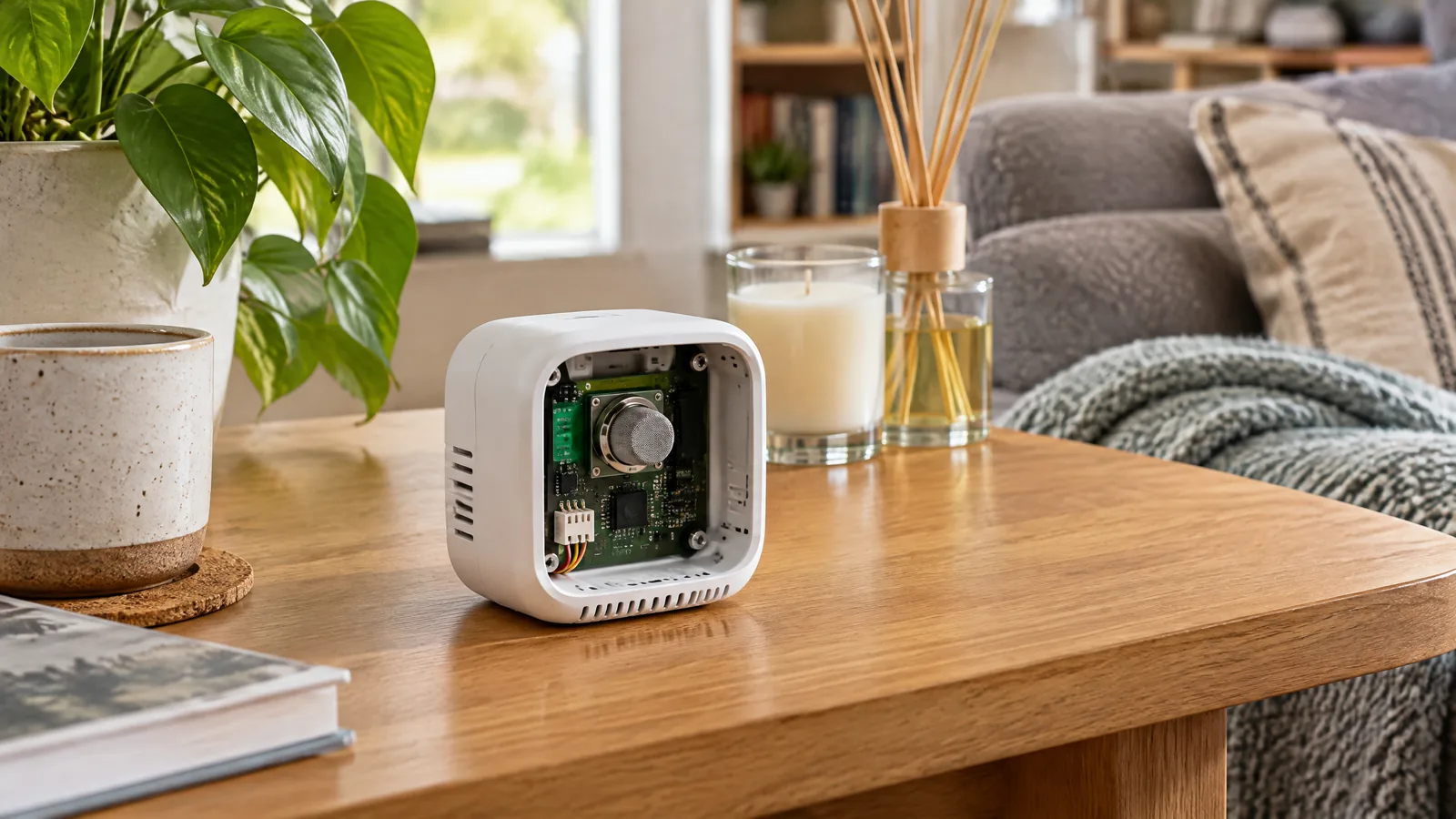
A room can smell stale after cooking, cleaning or closing the windows, yet a small display may show only one changing IAQ number. A VOC/indoor-air-quality gas sensor responds to gases and vapours in the air so an embedded project can track odour or air-quality trends, but its IAQ, bVOC or CO2-equivalent output may be a model-derived indicator rather than a direct measurement of one gas.
This article is part of the computer hardware technology guide library.
What does a VOC/indoor-air-quality gas sensor measure?
A VOC/indoor-air-quality gas sensor detects changes in a gas-sensitive material or sensing system when vapours reach it. VOC means volatile organic compound: a broad group of carbon-based compounds that can evaporate into indoor air. A sensor may react to a mixture of vapours from cooking, cleaning products, paints, fragrances, furniture or human activity rather than identifying each compound separately.
The useful output for a smart-home or environmental project is often a trend. For example, a reading may rise after a room is painted or while a strong cleaning product is being used, then move back towards its earlier baseline after ventilation. That pattern can help a project record events or prompt a person to inspect the room. It does not, by itself, prove which chemical caused the change or that the air is safe.
Some modern parts combine a gas-sensitive element with humidity, temperature and pressure sensing. A product such as Bosch's BME690 lists IAQ, bVOC-equivalent and CO2-equivalent outputs. The word equivalent matters: these are processed indicators produced by the sensor's software model, not a promise that the device is a laboratory VOC analyser or a direct CO2 instrument.
- Physical sensing element: the part that changes its electrical behaviour when exposed to gases or vapours.
- Module or breakout board: an optional carrier that may add a connector, regulator, heater control and interface wiring.
- Microcontroller and code: optional external electronics that read, store, display or transmit the sensor output.
- Algorithm or library: optional model-based processing that can turn raw gas response and environmental data into an IAQ or equivalent index.
How the sensing principle works
Many embedded VOC modules use a heated semiconductor or metal-oxide sensing layer. Gas molecules interact with the surface, changing its electrical resistance. The electronics measure that change, while firmware can combine it with temperature, humidity and a baseline to produce a more convenient output. Metal-oxide sensors are small and practical, but technical reviews identify cross-selectivity, resistance drift, high operating temperature and power use as important limitations.
This is different from an NDIR carbon-dioxide sensor. NDIR uses infrared absorption in an optical path designed around a gas's absorption behaviour. It is also different from an electrochemical sensor, where a chemical reaction at electrodes creates a current related to the target gas in a particular design. These sensor families should not be treated as interchangeable simply because all of them are called gas sensors.
A VOC sensor's response is therefore best understood as a combination of gas mixture, sensor surface, temperature profile, electronics and software interpretation. A change in the number is evidence that the system saw a change in its input conditions; it is not automatically a chemical identification.
A sensible VOC sensor Arduino project for indoor trends
For a beginner project, connect a compatible breakout or development board to a microcontroller through the interface documented for that board. Read the manufacturer's raw or processed output, record the time and note simple context such as cooking, cleaning, a closed room or an open window. The goal is to compare the sensor with its own recent baseline, not to invent a universal safe or unsafe threshold.
Give the part the warm-up and operating conditions specified by its manufacturer. A heated sensing element may need time before its baseline becomes useful. Keep the placement consistent: a sensor beside a window, exhaust fan, perfume bottle or warm power supply will experience a different air stream from one on a shelf in the middle of a room.
A useful dashboard can show the current value, a smoothed trend, temperature and humidity, plus a note when the device has not completed its startup period. Logging the context makes the graph easier to interpret than a single colour or buzzer. If the project sends a notification, label it as a change detected or ventilation reminder rather than a hazardous-gas alarm.
- Check the exact sensor and board documentation before choosing voltage, pins, interface mode and library.
- Allow the specified startup or warm-up period and record when the baseline was established.
- Log temperature and humidity with the gas output because environmental conditions can affect interpretation.
- Compare repeated trends in the same location instead of comparing an uncalibrated number with another person's device.
- Use a certified, purpose-built detector for any life-safety function; do not substitute a hobby IAQ module.
Why humidity, temperature and warm-up change the reading
Humidity and temperature are not background details. They can change how vapours reach or interact with a sensing surface, and they can change the electronics' response. This is why some integrated devices include environmental sensors and software compensation. Bosch lists full-accuracy operating ranges and separate humidity and temperature specifications for the BME690, but those model-specific figures should not be copied to another module.
Warm-up is also part of the measurement process for a heated semiconductor sensor. Immediately after power-up, the heater and sensing layer may not be at their normal operating state. A project that treats the first value as a stable room baseline can create a false trend. Baseline drift over time, cross-sensitive vapours and very different airflow can produce similar-looking changes.
Place the sensor where room air can reach it without exposing the sensing opening to water droplets, dust or a concentrated chemical source. Follow the manufacturer's mounting and condensation guidance. A trend monitor can be useful, but it should not hide the uncertainty behind a precise-looking number.
What this sensor cannot tell you
A general VOC/IAQ sensor cannot automatically identify every gas in a room. A rise in response may be caused by several vapours, and a model trained for one classification task may not perform the same way in another room or with another mixture. Selectivity depends on the sensing element, temperature settings, algorithm, calibration data and application conditions.
Do not read a CO2-equivalent value as a direct carbon-dioxide concentration unless the particular instrument documents a true CO2 measurement method. Do not use a VOC index to make a medical diagnosis, certify compliance with an indoor-air standard or decide that a room has no dangerous gas. A consumer or hobby module is not automatically a life-safety detector, fire alarm or certified toxic-gas monitor.
Calibration is also more than seeing a number change when perfume, alcohol vapour or another strong source is nearby. For a serious measurement task, use the sensor maker's procedure, a suitable reference and the complete instrument's documented maintenance plan. Otherwise, describe the output honestly as an embedded trend or model-based indicator.
Key takeaways
A VOC/indoor-air-quality gas sensor is most useful in a beginner project for observing relative changes in indoor vapours and odour-related conditions over time.
IAQ, bVOC and CO2-equivalent values can be software-derived outputs; they are not automatically direct measurements of a single gas.
Warm-up, humidity, temperature, placement, cross-sensitivity and baseline drift can all affect the result.
A module, microcontroller, library and physical sensing element have different roles. Check each datasheet instead of treating the complete project as one calibrated instrument.
Use certified equipment for safety-critical gas detection, and treat a hobby IAQ project as an educational or environmental trend monitor.
Frequently asked questions
Can I use a VOC air quality sensor with Arduino?
Yes, if the sensor board and library support the Arduino board's voltage and interface. Use the manufacturer's wiring and startup guidance, then log trends rather than treating an uncalibrated output as a universal concentration or safety threshold.
Does a VOC sensor measure CO2 directly?
Not necessarily. Some products provide a CO2-equivalent estimate from a gas response and software model. Direct CO2 measurement normally requires a sensor architecture and documentation intended for that gas, such as an appropriate NDIR design.
Why does my indoor-air-quality sensor change after cooking or cleaning?
Cooking and cleaning can add vapours that interact with a gas-sensitive element. Airflow, humidity, temperature and the product mixture also affect the response, so the change is a useful event in a trend log but does not identify one chemical on its own.
How long should a VOC sensor warm up?
The required startup period is model-specific. Follow the datasheet or library guidance and ignore or label early readings until the sensor has reached its intended operating state. Do not borrow a warm-up time from a different module.
Can a hobby IAQ module replace a gas-leak detector?
No. A hobby module may demonstrate a response to gases, but a life-safety detector is a finished system with a documented target, installation method, alarm behaviour, testing and maintenance requirements. Use equipment designed and certified for the hazard you need to monitor.
About the image
AI-generated editorial illustration; not an actual product or mission photograph.
Source notes
Reporting record
techduopulse stores source destinations privately. Public notes remain non-clickable so every visitor journey stays on this website.
Source note: Bosch Sensortec BME690 product documentation
Primary source · Indoor-air-quality applications, IAQ/bVOC/CO2-equivalent outputs, environmental sensing, operating modes and model-specific gas-classification featuresSource note: AKM gas-sensor technical tutorial
Primary source · Semiconductor, NDIR and electrochemical principles; VOC scope and limits of different gas-sensor architecturesSource note: Sensors review on metal-oxide semiconductor gas sensors
Secondary source · Metal-oxide sensing mechanism, cross-selectivity, drift, operating temperature, power and indoor total-VOC application contextNew India-focused application article distinct from the existing broad gas-sensor guide. Explains VOC and IAQ trend monitoring for Arduino or smart-home projects, separates the physical sensor from modules and software-derived outputs, and qualifies warm-up, environmental effects, selectivity, CO2-equivalent readings and life-safety limitations without invented testing or statistics.


