
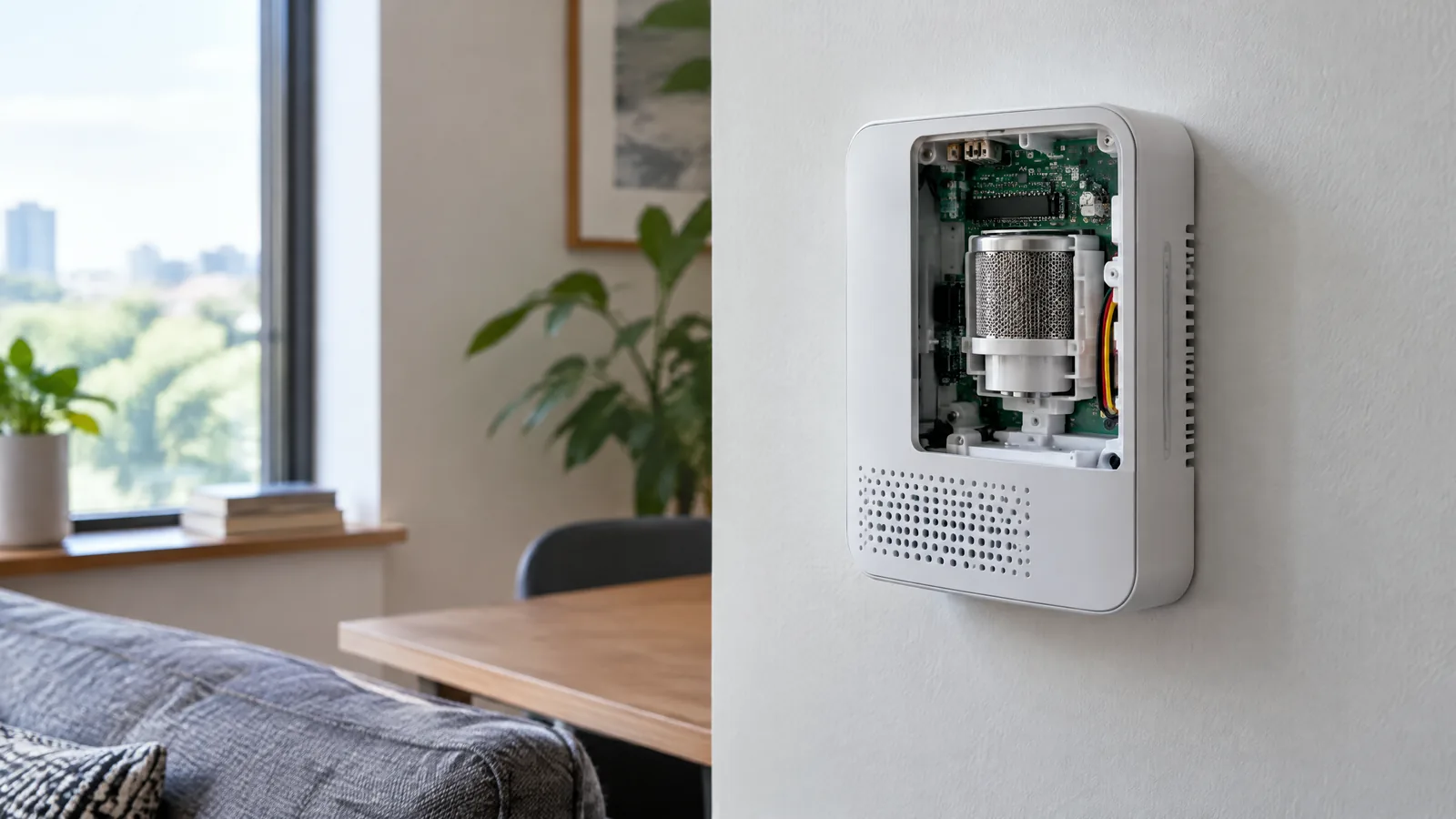
A room can show a sudden air-quality change after painting, using strong cleaning products or bringing in new furniture, yet a single number may not tell you what caused it. A total volatile-organic-compound (TVOC) sensor measures a broad gas response or derived index associated with volatile organic compounds, so it is useful for tracking changes but not for naming every chemical in the air.
This article is part of the computer hardware technology guide library.
Key takeaways
TVOC is best treated as a trend or change signal. It can help compare a building space before and after an activity, but it is not a complete indoor-air-quality measurement.
- A TVOC sensor responds to a broad group of volatile compounds or produces a model-specific index; it does not provide a complete chemical inventory.
- Use changes alongside the activity log, ventilation information and other instruments rather than reading one value as a health limit.
- Temperature, humidity, placement, airflow, contaminants and the sensor’s processing can affect the result.
- A TVOC monitor is not a substitute for a smoke alarm, carbon-monoxide alarm, targeted test or professional building assessment.
What does a TVOC sensor measure?
Volatile organic compounds are a broad class of chemicals that can enter indoor air from products and materials. Paints, cleaning supplies, insecticides, furnishings and building materials are examples of possible sources. A TVOC sensor does not normally separate that mixture into a named list of compounds. Instead, its sensing element produces a response that electronics may convert into a concentration estimate, an equivalent-gas value or a proprietary index, depending on the model.
That distinction matters. Two instruments can show different numbers in the same room because they use different sensing elements, calibration references, algorithms or display scales. Unless the manufacturer documents a specific measurement method and target, do not present a displayed TVOC value as laboratory identification or as a universally comparable concentration.
How a TVOC sensor fits into a building-monitoring system
The physical sensor is only one part of a monitoring system. A finished indoor-air-quality monitor may add a sampling opening, signal conditioning, temperature and humidity readings, firmware, a display, data logging, wireless connectivity and an alert rule. Some systems also include separate particulate-matter, carbon-dioxide or carbon-monoxide instruments. Those are optional or model-specific components, not automatic features of every TVOC sensor.
In a building, the most useful question is often comparative: did the signal change when an activity began, and did it move back after ventilation or source removal? For example, a facilities team might record a baseline in a meeting room, note cleaning or furnishing work, and compare readings before and after the room is ventilated. This helps investigate patterns without pretending that the sensor has identified the source.
| Part of the setup | What it can contribute | What not to assume |
|---|---|---|
| TVOC sensing element | A broad response associated with some volatile compounds | A complete chemical list or exact identification |
| Temperature and humidity sensor | Context for interpreting environmental changes or compensation | That every TVOC device includes compensation |
| Data logger or dashboard | Trends, event notes and comparisons over time | That a smooth chart proves accurate concentration |
| Alert rule | A user-defined prompt when a value changes | A universal indoor health or emergency threshold |
Useful applications for VOC sensors in buildings
A VOC sensor for buildings is most useful when it supports a specific observation. It can help a team compare rooms, check whether an activity coincides with a change, or see whether ventilation changes the broad signal. Possible examples include tracking a new-materials or furnishing period, comparing a classroom before and after cleaning, and observing a workshop or office during a scheduled process. The result is evidence for follow-up, not a final diagnosis.
Keep an activity log with the time, room, doors or windows, ventilation state and relevant products or work. Without that context, a spike is easy to misread. A sensor may respond to an indoor source, outdoor air entering through ventilation, or a mixture of compounds. A change in airflow can alter the reading even when the source has not changed.
- Establish a baseline during ordinary occupancy rather than using a single start-up reading.
- Compare before, during and after a known activity when practical.
- Record ventilation, temperature, humidity, occupancy and nearby sources with the reading.
- Use other appropriate measurements when the question concerns a particular pollutant.
Placement and interpretation limits
Placement can change what a monitor sees. The U.S. Environmental Protection Agency advises following the manufacturer’s instructions, keeping airflow into the monitor unobstructed, and generally placing it in the occupants’ breathing zone. A device immediately beside a cleaning bottle, stove, open window or air-conditioning vent may measure a local plume or draft rather than the room’s usual condition.
A TVOC reading is also affected by the sensor’s environment and processing. Temperature, relative humidity, time in use, multiple contaminants, placement and data-processing methods can influence accuracy and precision. A rising value is therefore a prompt to investigate the room and its activities, not proof that a particular chemical is present at a particular concentration.
There are no widely accepted indoor concentration limits for most pollutants covered by low-cost monitors. A manufacturer’s colour band or alert threshold is a product setting, not automatically a regulatory or medical limit. Low-cost monitor alerts are not designed to provide the immediate-danger warning supplied by certified smoke or carbon-monoxide alarms.
What a TVOC sensor cannot tell you
A TVOC sensor cannot, by itself, identify which VOC caused a response, measure every indoor pollutant, prove that a building is safe, or diagnose symptoms. Indoor air quality includes particles, combustion products, biological agents, radon, moisture-related concerns and other factors. The EPA notes that monitors detect only the contaminants and environmental factors for which they are designed, so one device cannot represent the whole indoor environment.
If a persistent pattern matters, use the signal to define a better question: which room, activity or material needs investigation? Targeted sampling, a qualified indoor-air professional or a product-specific instrument may be appropriate depending on that question. Do not change building operation or make health claims from an unexplained number alone.
Frequently asked questions
These answers describe the general role of a TVOC sensor; the model’s documentation remains the source for its specific sensing method and display units.
Is a TVOC sensor the same as a VOC detector?
Not always. TVOC sensor is commonly used for a broad response or derived index, while a detector may mean a complete instrument with electronics, display, logging or alerts. Check what the particular product measures and how it reports the result.
Can a TVOC sensor identify formaldehyde or a specific chemical?
A general TVOC response should not be treated as proof of a specific chemical. Identifying or quantifying one compound requires a method and instrument designed for that target, with the relevant calibration and limitations.
Where should I place an indoor air quality VOC monitor?
Follow the manufacturer’s instructions. In general, keep airflow clear and place it in the occupants’ breathing zone rather than directly beside a source, draft, open window or ventilation outlet.
Does a high TVOC reading mean the building is unsafe?
Not by itself. The reading may indicate a change worth investigating, but it does not identify the pollutant, represent complete indoor air quality or establish a universal health threshold. Use context and, when needed, targeted professional assessment.
Can a TVOC monitor replace a carbon-monoxide or smoke alarm?
No. A low-cost TVOC or indoor-air monitor is not an emergency warning device equivalent to a certified smoke alarm or carbon-monoxide alarm. Use the safety device intended for that hazard.
About the image
AI-generated editorial illustration; not an actual product or mission photograph.
Source notes
Reporting record
techduopulse stores source destinations privately. Public notes remain non-clickable so every visitor journey stays on this website.
Source note: U.S. Environmental Protection Agency — Low-Cost Air Pollution Monitors and Indoor Air Quality
Context source · VOC monitor scope, placement, accuracy and precision limits, alerts and interpretationSource note: U.S. Environmental Protection Agency — Report on the Environment: Indoor Air Quality
Context source · VOC sources, building materials, ventilation and the broader scope of indoor air qualityNew India-focused building application explainer distinguishing a TVOC sensor’s broad gas response or derived index from chemical identification, complete IAQ monitoring and emergency detection. Adds practical room-use examples, component boundaries, placement guidance, interpretation limits and five reader FAQs using EPA evidence.


