
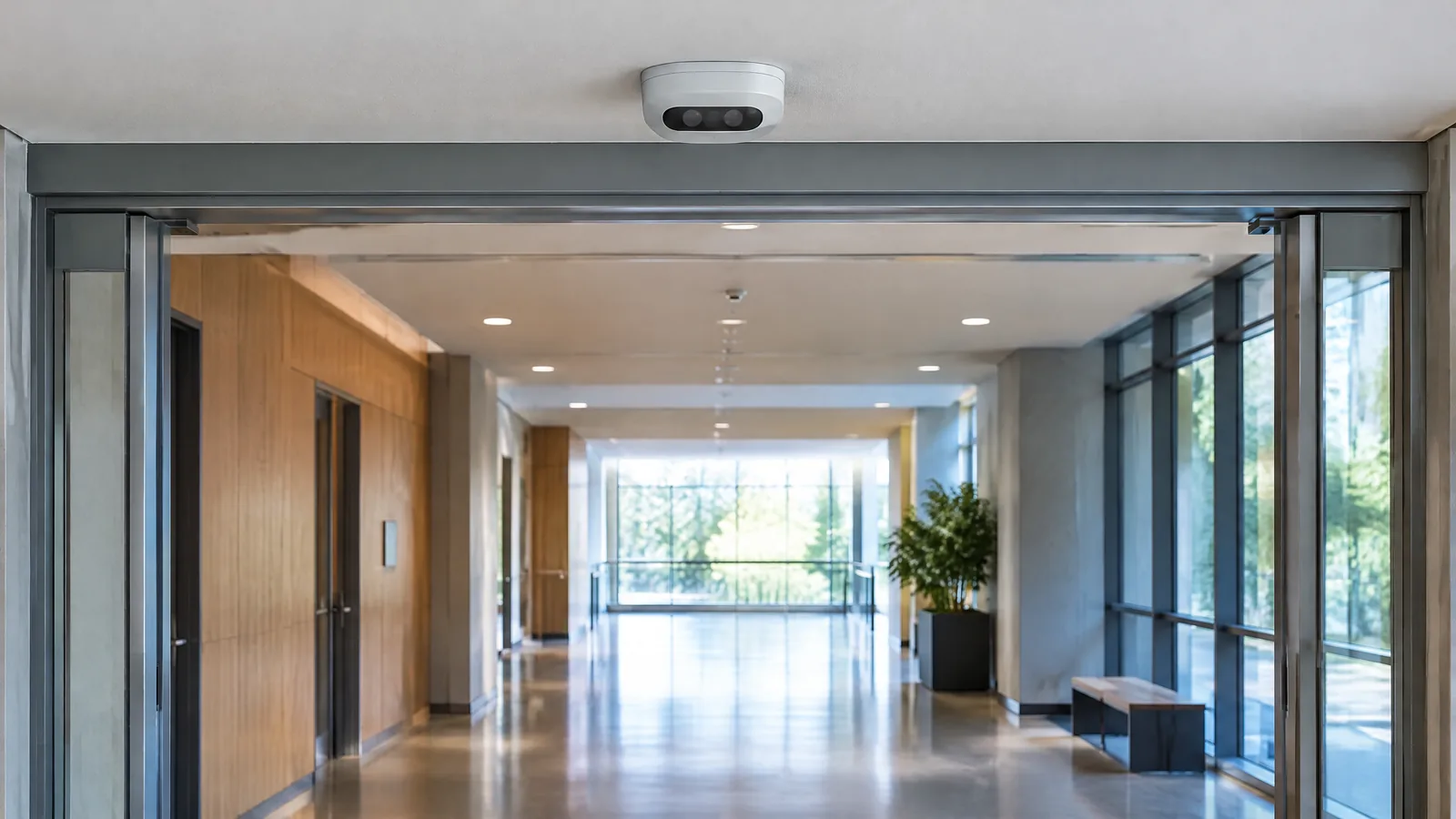
An empty meeting room may still receive full lighting and ventilation, while a busy corridor may be missed by a simple motion detector. A thermal-infrared people-counting sensor estimates how many people pass through or occupy a defined building area by sensing infrared energy or infrared depth, without treating the output as an identity record.
This article is part of the computer hardware technology guide library.
Key takeaways
A thermal-infrared people-counting sensor reports an estimate for a defined zone or passage, not a perfect headcount for an entire building.
Some products use active infrared time-of-flight (ToF) depth sensing; a passive thermal imager is a different instrument and should not be described as the same device.
Camera-free designs can reduce image collection, but privacy still depends on the data fields, retention, access rules, notices and local review.
Coverage, mounting position, doorway geometry, lighting, temperature and people flow can all affect the result.
- Define the operational decision first: space-use reporting, lighting scheduling or ventilation demand estimation.
- Confirm whether the selected system outputs counts, occupancy estimates, events or raw sensor data.
- Pilot the exact doorway or zone and compare readings with a documented manual check before connecting consequential automation.
What does this sensor measure?
In a building context, the phrase describes a sensing system that uses infrared information to estimate presence, movement or people flow in a defined area. Infrared is electromagnetic radiation outside visible light, and warm objects such as people emit it. The instrument’s optics, wavelength range and processing determine whether it sees heat patterns, reflected IR or depth rather than a recognisable person. [1] [2]
Many commercial counters described as privacy-oriented use active infrared time-of-flight. The device sends short IR or laser pulses, measures the return time and uses the resulting depth information to detect objects crossing a configured zone. That is not the same as a passive PIR motion detector, which is normally designed to notice changes in infrared energy, nor is it automatically a thermal camera. [1]
The useful output is usually an aggregate such as entries, exits, an estimated occupancy value or a zone event. It should be treated as an estimate tied to the installation, not as proof of identity, exact location or a person’s purpose.
How a building people-counting setup works
A typical installation has more than the physical sensor. The sensor and its optical window or housing form the measurement point. Firmware or an onboard processor interprets detections. A gateway or network connection may then carry totals to a dashboard or building-management system. Lighting, ventilation or access-control actions are optional downstream integrations, not part of the sensing element itself.
For a doorway, the system needs a defined field of view and a direction or zone model that can distinguish movement across the boundary. Terabee describes ToF counters for settings ranging from large entrances and lecture theatres to standard doors and narrow corridors. That illustrates why a model selected for one opening should not be assumed to cover another. [1]
Some products offer wireless backhaul such as LoRaWAN; others may use wired networking. Connectivity can simplify retrofit work, but it does not improve the underlying optical coverage. Specify the gateway, power, network and software separately from the sensor when planning a project.
- Physical sensing head and mounting/optical window
- On-device processing or a local controller
- Optional gateway and network link
- Optional dashboard, analytics or building-management integration
Where occupancy estimates can help
A count or occupancy estimate can help a facilities team compare how rooms and passages are used over time. For example, aggregated room-use data may inform a lighting schedule or a ventilation strategy, subject to the building’s control design and safety review. It can also support space-planning questions, such as whether a meeting room is regularly occupied when it is shown as available.
These uses require a clear hand-off between measurement and action. A sensor can provide an input; it does not decide the safe ventilation rate, emergency response or access policy. Keep life-safety systems and required professional controls independent of an unvalidated people counter.
Avoid interpreting a count as a measure of productivity, identity or behaviour. A doorway counter can miss people who enter together, linger outside the sensing zone or move outside the configured field of view.
- Space-use reporting for facilities teams
- Occupancy context for non-critical lighting or ventilation optimisation
- Footfall or flow trends in entrances and corridors
- Evidence for room-booking and space-planning reviews
Coverage, privacy and accuracy checks
The most important check is the measurement boundary. Record the doorway or zone, mounting height and direction of travel that the supplier supports. Test queues, people walking side by side, bags or carts, unusual approaches and changing room layouts. A reading that works in a quiet pilot may behave differently during a busy period.
Optical installation matters. In a model-specific Vishay proximity design, ambient DC light, nearby reflections, cover distance, component tolerances, temperature and window material contribute to an offset that must be evaluated. This does not give a building counter’s performance specification, but it is a useful reminder that an IR reading depends on the physical installation. [3]
Calibration and validation are separate ideas. NIST describes infrared detector calibration as controlled comparison against standards across wavelengths. For a building project, ask the vendor what validation procedure applies to the complete installed system, how drift and faults are reported, and how often the count should be reviewed. [4]
Privacy review should ask exactly what leaves the device. A camera-free counter may avoid image and video capture, and a vendor may describe its output as anonymous. That is narrower than a blanket legal guarantee: administrators still need to assess identifiers, retention, access, signage or notice, vendor processing and applicable Indian policy or law. [1]
- What is the field of view and supported doorway geometry?
- Does the device use passive thermal sensing, active ToF, or another method?
- Are raw frames, depth points or only aggregate events stored or transmitted?
- What happens when the sensor is blocked, offline or uncertain?
- Who can access the data, and how long is it retained?
FAQs
Is a thermal-infrared people-counting sensor the same as a PIR sensor?
No. PIR normally detects changes in infrared energy, while a people-counting system may use active IR time-of-flight depth sensing or a thermal imager. Check the datasheet and output definition before choosing one.
Can it identify individual people?
A camera-free counter designed to output aggregate counts need not identify individuals. That is a product and configuration property, not a universal promise for every infrared system. Verify whether images, depth data, identifiers or event histories are stored, transmitted or retained.
Can occupancy data control ventilation or lighting?
It can be an input to a reviewed building-management workflow, but it should not be treated as a stand-alone safety control. Validate the installed coverage, define fallback behaviour and keep required professional and life-safety controls separate.
Does infrared people counting work in every room?
No. Field of view, mounting, doorway geometry, people flow, obstructions, reflective surfaces, temperature and environmental conditions affect results. A site pilot and documented validation are needed.
About the image
AI-generated editorial illustration; not an actual product or mission photograph.
Source notes
Reporting record
techduopulse stores source destinations privately. Public notes remain non-clickable so every visitor journey stays on this website.
Source note: NASA Science Mission Directorate, Infrared Waves
Primary source · Defines infrared as invisible electromagnetic radiation, describes spectral regions and thermal emission from warm objects including humans.Source note: NIST, A New, World-Class Facility for Infrared Calibrations
Primary source · Explains detector responsivity and controlled infrared calibration against standards across wavelengths.Source note: Terabee — Time-of-Flight technology for People Counting: ensuring privacy and anonymity
Context source · Explains IR/laser pulse time-of-flight, depth-based detection, camera-free anonymous output as a product claim, deployment sizes and optional LoRaWAN/integration.Source note: Vishay Semiconductors — Designing the VCNL4040 Into an Application, Application Note 84307
Context source · Model-specific pulsed IR proximity sensing, ambient-light rejection and installation-dependent offset sources.New application page distinct from the existing generic IR guide. Separates passive thermal sensing, active ToF and PIR; distinguishes sensor, gateway and downstream controls; adds privacy, coverage and validation limits without unsupported accuracy or savings claims.


