SEO title: IR Sensor: Working, Types and Uses in India Meta description: Learn what an IR sensor is, how its emitter and detector work, the main types, limits, and everyday applications in India.
This article is part of the software engineering technologies guide library.
What is an IR sensor?
An infrared (IR) sensor is a device that detects infrared radiation. Infrared is electromagnetic radiation beyond the red end of visible light, so people cannot see it directly. It is often associated with heat, although infrared devices can work across different parts of the IR spectrum and do not all measure temperature. NASA describes near-, mid- and far-infrared regions; in an Earth-science context, 8–15 micrometres is often called thermal infrared. [1]
“IR sensor” is therefore a broad label. It can describe a reflective proximity module, a remote-control receiver, a passive infrared (PIR) motion sensor, or part of a thermal-imaging system. Before interpreting an output, ask one practical question: is this device emitting IR light, or detecting IR naturally emitted by the scene?
How does an IR sensor work?
### Active reflective sensing: emitter, reflection, receiver
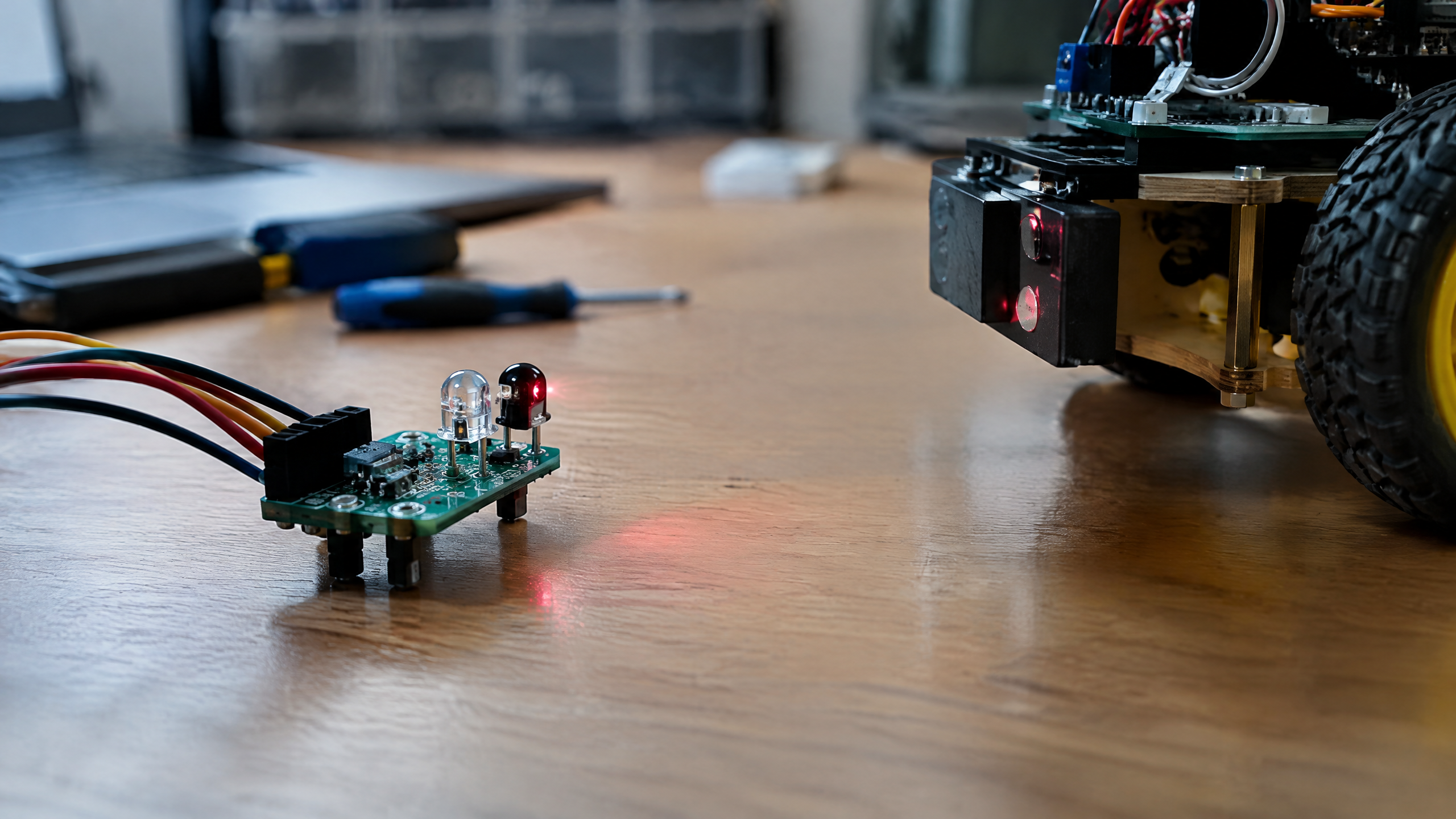
A common educational IR sensor module is an active sensor. It usually has:
an IR LED transmitter (emitter), which sends infrared light toward a target area;
a light-sensitive receiver, often a photodiode, that receives some reflected light; and
electronics that turn the received signal into an output a microcontroller can read.
When an object is positioned so that enough emitted IR is reflected back, the receiver responds. A photodiode converts received optical energy into electrical current; subsequent circuitry can compare that signal with a threshold or report a digital measurement. [3] [4]
Many basic modules provide a digital high/low or 0/1-style result: “reflection crossed the chosen threshold” rather than “the object is exactly this far away.” Some integrated proximity sensors process their readings internally and communicate digital values over an interface such as I²C. Outputs and meanings depend on the particular board or component. [3] [4]
A wavelength around 940 nm is a common example in remote-control and proximity designs, including one Vishay proximity device, but it is not a specification for every IR sensor. [1] [4]
### Passive sensing: detecting emitted infrared
A passive IR sensor does not need to shine light onto the target. Instead, it responds to infrared naturally emitted by objects. A PIR motion sensor, for example, is designed to notice changes in the infrared pattern in its field of view; it is not the same as a reflective obstacle sensor. Educational guidance distinguishes passive IR detection from active IR devices that emit and measure reflected light. [2]
This distinction prevents a common beginner mistake: an IR module in a line-following robot does not automatically measure human motion or surface temperature, and a PIR unit does not automatically tell a robot how close a wall is.
Main IR sensor types
### 1. Reflective IR proximity sensors
These active sensors emit IR and detect reflection. They are common in classroom robotics, line-following experiments, simple object-presence checks and some device proximity functions. On a module, a small adjustment control may set the detection threshold. It is best treated as a setup adjustment for that specific surface and environment, not as a precise calibration scale. [3]
### 2. Through-beam and break-beam IR sensors
In these arrangements, the emitter and receiver face each other across a gap. An object is detected when it blocks the IR path. This approach avoids relying on the object’s reflected light, but it needs emitter/receiver alignment and a clear optical path.
### 3. IR remote-control receivers
A remote control transmits encoded IR pulses; the receiver is designed to recognise that signal. The important task here is receiving a patterned communication signal, not estimating an object’s proximity.
### 4. Passive infrared (PIR) motion sensors
PIR sensors respond to changes in infrared energy from their view, which can be useful for occupancy or motion-triggered systems. They sense change, so their result should not be interpreted as a direct measurement of a person’s identity, exact location or body temperature. [2]
### 5. Thermal IR and imaging sensors
Thermal systems use infrared information associated with the temperature of objects or scenes. Their design, wavelength range, optics, calibration and interpretation are different from a low-cost reflective module. Infrared detector calibration is a specialised measurement task involving detector responsivity and wavelength-dependent performance. [5]
Where are IR sensors used?
IR sensors appear in many ordinary technologies, but the function varies by sensor type:
Robotics and maker learning: reflective modules can support line following, object detection and simple obstacle experiments in school labs or Arduino projects.
Phones and consumer electronics: an IR proximity function may help a device know that something is close to its front surface; the exact implementation differs by model.
Remote controls: an IR transmitter and receiver can carry command signals between a handset and a compatible device.
Security and automation: PIR sensors can help trigger a light, alert or recording workflow when an infrared pattern changes.
Industrial automation: through-beam or reflective arrangements can support object counting, position checks or presence detection when the installation suits the task.
Thermal observation: specialised IR systems can help visualise temperature-related patterns in equipment, buildings or scientific work.
For projects in Indian classrooms, hobby groups and embedded-systems labs, the most useful habit is to define the decision first: Do I need to detect a line, a nearby object, a broken beam, movement, or a thermal pattern? That decision points to a sensor category more reliably than the label “IR sensor” alone.
IR sensor vs ultrasonic sensor
Both IR and ultrasonic sensors can be used in a robot, but they sense different physical signals. A concise comparison helps when choosing what to test in a prototype.
| Consideration | IR reflective sensor | Ultrasonic sensor |
|---|---|---|
| Signal used | Emitted and reflected infrared light | Emitted sound pulses above human hearing, then returning echoes |
| Typical beginner output | Thresholded object/line detection; some devices provide digital proximity data | Time-of-flight-based distance estimate on supported modules |
| Strong influences | Surface colour/material, reflectivity, angle, ambient light and optics | Target shape/angle, echo path and environmental conditions |
| Best takeaway | Useful for short-range reflective tasks when tested on real targets | Useful when an echo-based distance approach fits the installation |
Neither column promises a universal range or accuracy. Test the exact module and target in the intended placement, particularly if the result will control equipment or an automated action.
Limits, accuracy and calibration: why an IR reading can change
An IR sensor does not simply “see an object” under all conditions. In a reflective setup, a dark, angled, shiny, transparent or irregular surface may return a different amount of light than a light-coloured, flat surface at the same position. Sunlight and some indoor light sources can also add infrared or visible-light interference.
Practical designs can reduce interference by pulsing the IR emitter and rejecting the steady (DC) component of ambient light. Vishay describes this type of ambient-light rejection for an integrated proximity design, but the capability and performance must be confirmed for the component being used. [4]
For a basic module, set its threshold only after mounting it in the real project enclosure and testing the actual surface, angle and lighting. Recheck after relocating the device, changing its window or cover, or switching the target material. A potentiometer may alter when the module changes state; it does not establish a universally accurate distance. [3]
For thermal or measurement-grade IR work, calibration needs are more demanding. Detector response can vary with wavelength, optics, electronics and the measurement setup. NIST’s work on infrared calibrations illustrates that calibrated infrared measurement is a specialised process, not an assumption that applies to every sensor board. [5]
A practical checklist before using an IR sensor
Identify the sensing mode. Is it reflective, break-beam, remote-control, PIR or thermal?
Read the module documentation. Confirm supply voltage, output logic, interface and any stated operating constraints.
Test the real target. Try the relevant colours, materials, angles and distances rather than only a white sheet or a hand.
Test under real lighting. Check performance near windows, outdoors and under the lights expected during use.
Mount it consistently. Keep the emitter/receiver orientation and any optical window clean and stable.
Use a safe fallback for consequential actions. Do not rely on a simple IR detection alone where a missed or false detection could create an unsafe condition.
FAQs
What is an IR sensor?
An IR sensor detects infrared radiation. Depending on its design, it can detect reflected IR from an emitter, receive encoded remote-control IR, respond to changes in emitted infrared, or contribute to thermal sensing. [1] [2]
How does an IR sensor work?
In a common active module, an IR LED sends invisible light and a receiver such as a photodiode detects some of the light reflected by a target. Electronics then convert the received signal into a usable output. [3] [4]
What is the IR sensor working principle in Hindi?
A simple Hindi-friendly summary is: IR LED invisible light bhejta hai, receiver reflected light ko detect karta hai, aur circuit output change karta hai. This describes an active reflective module. A PIR or thermal sensor follows a different principle because it detects emitted IR rather than sending out a reflective beam.
What are the main IR sensor types?
Useful categories include reflective proximity sensors, through-beam sensors, remote-control receivers, PIR motion sensors and thermal IR/imaging sensors. Their outputs and suitable applications differ.
Can I use an IR sensor with Arduino?
Many beginner IR modules can be read by an Arduino-compatible board, often through a digital input, while some integrated devices use I²C. Check the documentation for voltage levels, wiring and the meaning of the output; test the module with the surfaces and light conditions used in your project. [3] [4]
Is an IR sensor module the same as a distance sensor?
Not necessarily. A simple reflective IR module often indicates that reflected light is above or below a threshold. Reflection depends on the target and environment, so it should not be assumed to provide a precise distance without an appropriate sensor design, documentation and validation.
IR sensor vs ultrasonic sensor: which is better?
Neither is universally better. An IR reflective sensor can suit line or short-range reflection tasks, while an ultrasonic design uses sound echoes for an echo-based distance approach. Choose after testing the actual target, placement and environment rather than relying on a generic comparison.
Related reading
/article/proximity-sensor-types-working
/article/pir-motion-sensor-working-principle
/article/ultrasonic-sensor-working-uses
/article/light-sensor-working-principle-types
Source notes
Reporting record
techduopulse stores source destinations privately. Public notes remain non-clickable so every visitor journey stays on this website.
https://support.google.com/trends/answer/4355212?hl=en
Primary source · Research source 6https://science.nasa.gov/ems/07_infraredwaves/
Primary source · Research source 1https://www.teachengineering.org/lessons/mis_sensor_lesson01
Primary source · Research source 2https://ai.thestempedia.com/docs/evive/evive-tutorials/what-is-an-ir-sensor/
Primary source · Research source 3https://www.vishay.com/docs/84307/designingvcnl4040.pdf
Primary source · Research source 4https://www.nist.gov/news-events/news/2015/10/new-world-class-facility-infrared-calibrations
Primary source · Research source 5New India-focused sensor explainer covering IR sensor, working principles, uses and limitations.