
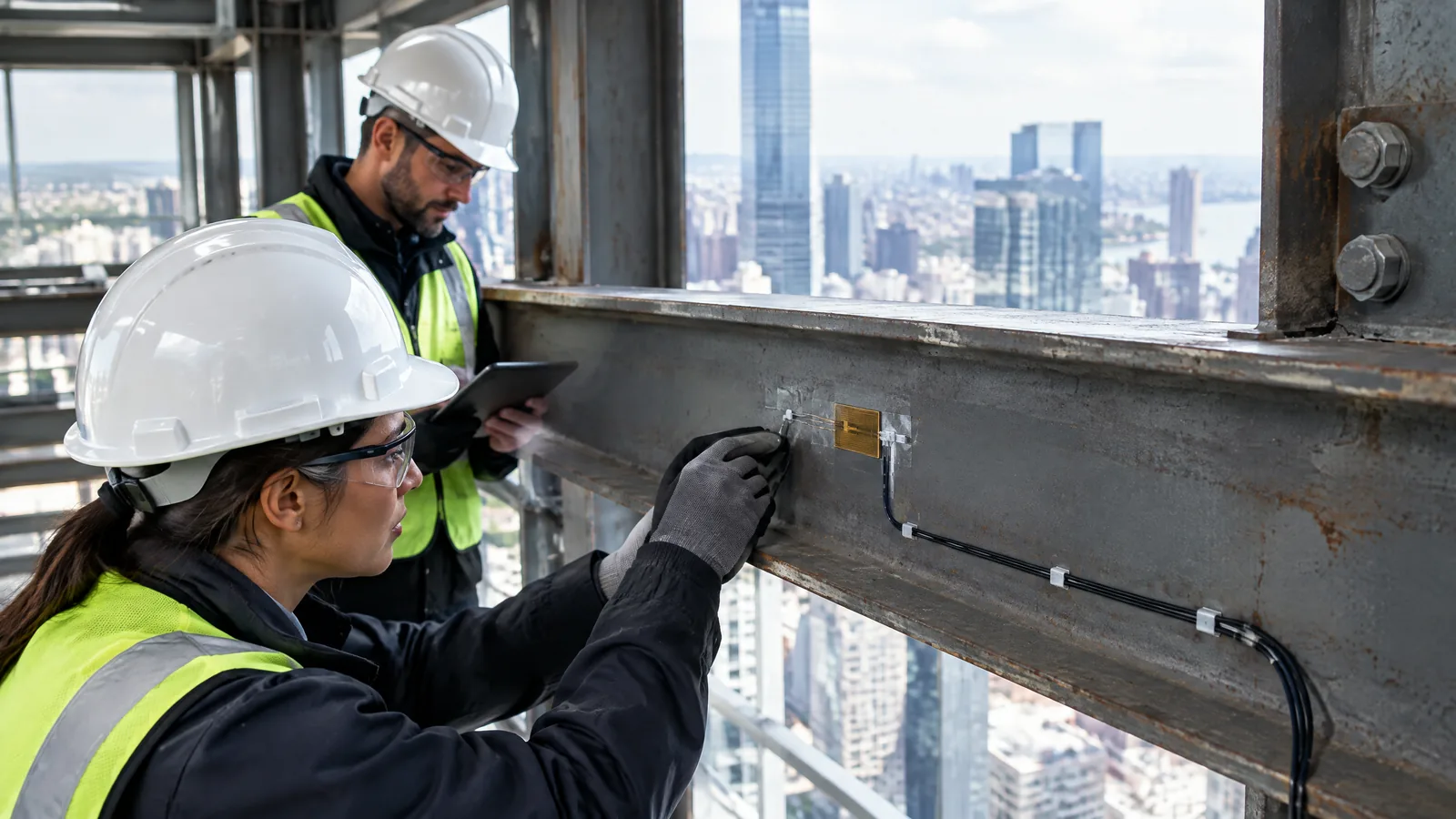
A crack, unusual vibration or a change noticed during a building inspection can leave an owner asking whether the structure is carrying load differently than before. A structural strain gauge measures very small deformation at a selected point or gauge length, giving engineers evidence about change over time—not a standalone safety verdict.
This article is part of the computer hardware technology guide library.
Key takeaways
A structural strain gauge observes local strain: the small change in length or deformation of a material or attached reference points under load or other influences.
In a building monitoring programme, the useful result is usually a time series compared with a baseline, not one isolated number.
A complete structural-health-monitoring system may add temperature, humidity, tilt, vibration, displacement or crack instruments, plus data collection and analysis.
Placement, orientation, mounting, temperature effects and interpretation matter. A gauge alone cannot declare a building safe, unsafe or fit for occupation.
What does a structural strain gauge measure?
A structural strain gauge measures deformation at a defined location. When a beam, column, connection or other member stretches or compresses slightly, the sensing element responds to that change. Depending on the design, the output may be an electrical resistance change, a distance change between reference points or another signal that must be conditioned and interpreted.
The word structural is important. This is not the same as a force sensor placed on a weighing platform. A building gauge is selected for a particular material, surface, direction and measurement question. It may be used to observe how a member responds to service loads, temperature variation, vibration or a suspected change in condition.
NIST describes mechanical gauges as surface-mounted instruments that measure surface strain and can monitor crack-width growth. Its description also notes a simple physical principle: the distance between two reference points changes over time. That is useful evidence, but it describes the measured deformation at that location rather than the full condition of a building.
How strain monitoring fits into a building
The practical question is rarely just “What is the strain right now?” Engineers usually want to compare observations with an initial baseline and with the building’s expected behaviour. A gradual change, a repeatable response to temperature, or a change after an unusual event can each mean something different. The surrounding context determines which interpretation is reasonable.
For a historic building, monitoring may help document movement or deterioration while limiting intrusive inspection. For a high-rise or other large asset, it may be one part of a programme that studies loads, vibration, tilt, settlement or fatigue. Resensys describes structural-health monitoring applications for historic buildings and high-rise buildings and lists strain alongside tilt, vibration, displacement, humidity and temperature.
A sensor reading is therefore an observation in a measurement chain. The chain includes the physical sensor, its attachment, wiring or radio link, power, data logger, timestamping, calibration and analysis. Removing any of those from the discussion can make a precise-looking number misleading.
What a complete structural-health-monitoring system may include
A structural strain gauge is one instrument, not the whole monitoring system. The final arrangement depends on the structure and the question being investigated. An engineer may specify several sensor types so that local strain can be considered alongside movement and environmental conditions.
Optional or model-specific components can include temperature and humidity sensors for environmental context, accelerometers for vibration, tilt sensors for rotation or inclination, displacement or crack gauges for movement across a joint, and a gateway or data logger for collecting readings. Software may graph trends and issue alerts against project-defined thresholds. These are external system components; they are not automatically built into the physical strain gauge.
FHWA research on wireless structural monitoring describes field instruments measuring acceleration, strain, displacement and tilt, with observations compared with baseline conditions. It also reports that installation time, cabling, cost and the number of sensors needed for useful spatial coverage are practical constraints. A wireless installation may reduce cabling, but it does not remove the need for engineering design, suitable placement or data review.
- Physical sensor: measures local deformation or another selected parameter.
- Mounting and force path: transfers the relevant structural movement to the instrument without unintended looseness or bending.
- Readout and communications: excites, conditions, records and transfers the small signal.
- Context sensors: optional instruments such as temperature, humidity, tilt, vibration or displacement devices.
- Engineering interpretation: relates the time series to drawings, loads, history, inspections and the question being assessed.
Why placement and baseline matter
A strain value only makes sense when its location and direction are known. A gauge placed along one axis does not automatically describe deformation in another direction. Surface condition, adhesive or fixture quality, gauge length, local geometry and the way load reaches the member can all affect the result.
Baseline data gives the team something to compare against. FHWA describes sensors used at the beginning of a structure’s life cycle and later on a regular or event-driven basis to document changes from initial conditions. In a building, the baseline may need to account for ordinary temperature cycles, occupancy or other repeatable influences before a change is treated as unusual.
Thresholds should not be copied from a generic internet tutorial. They are tied to the structure, instrument, installation, uncertainty and engineering assessment. A dashboard alert can prompt review; it does not replace inspection or a qualified decision about what action is appropriate.
Limitations: what the gauge cannot tell you by itself
One gauge samples one location and one measurement direction. It cannot see every member, connection, foundation condition or hidden defect. A stable reading at one point is not proof that every part of a building is unchanged, and a changing reading is not proof of a particular failure mechanism.
Some instruments have specific operating limits. NIST notes that mechanical gauges can be bulky or dislodged. It also describes piezoelectric strain gauges as potentially temperature-dependent and unsuitable for steady-state or low-frequency signals. A piezoelectric gauge is an alternative instrument class, not a universal replacement for a bonded metal-foil gauge.
Noise, drift, temperature, calibration, mounting changes, accidental contact and communication gaps can affect a time series. If the data looks surprising, the safe response is to preserve the record and involve the responsible structural engineer or inspection team. Do not loosen, relocate or add a sensor on a load-bearing element as a DIY experiment, and do not use an online reading to make an occupancy or repair decision.
Frequently asked questions
These answers describe the measurement role of a structural strain gauge. They do not certify a particular building or installation.
Is a structural strain gauge the same as a load cell?
No. Both can use strain-sensitive materials, but a load cell is designed as a force or weight transducer with a defined load path. A structural strain gauge is installed to observe local deformation in a member or surface as part of a building or infrastructure monitoring programme.
Can a strain gauge detect a building crack?
It can provide evidence of deformation at its installed location, and some mechanical gauges are used to monitor crack-width growth. It cannot automatically find every crack or identify the cause of one. Crack interpretation requires the gauge location, baseline, environmental context and engineering inspection.
Can one strain sensor tell whether a building is safe?
No. One sensor measures a limited part of the structure. Safety decisions require an appropriately designed assessment that can combine drawings, inspection, loads, material information, multiple measurements and qualified structural-engineering judgement.
What other sensors may be used with a building strain gauge?
Depending on the question, a programme may add temperature or humidity sensors, tilt sensors, accelerometers, displacement or crack gauges, and data-logging and communications equipment. These are optional system components, not guaranteed features of every strain gauge.
Are structural strain gauges suitable for a DIY building project?
They are specialist instruments rather than a DIY safety device. Placement, attachment, calibration, thresholds and interpretation should be specified or reviewed by appropriately qualified structural professionals, especially for occupied, historic, high-rise or otherwise high-consequence assets.
About the image
AI-generated editorial illustration; not an actual product or mission photograph.
Source notes
Reporting record
techduopulse stores source destinations privately. Public notes remain non-clickable so every visitor journey stays on this website.
Source note: Resensys Structural Health Monitoring application overview
Primary source · SHM parameters, building applications, system components and alertsSource note: FHWA structural-health monitoring research fact sheet
Primary source · Baseline comparison, strain/displacement/tilt/acceleration monitoring, field-test and deployment constraintsSource note: NIST structural-health-monitoring sensor technology report
Primary source · Mechanical gauge principle, surface strain and crack-width monitoring, limitations, piezoelectric sensor constraintsNew India-facing Buildings application explainer. Separates a structural strain gauge from a load cell and from a complete structural-health-monitoring system; explains baseline comparison, optional instruments, mounting and interpretation limits; and avoids safety verdicts, DIY installation instructions and unsupported product claims.


