SEO Title: Force Sensor: Working Principle, Types and Uses Meta Description: Learn what a force sensor is, how strain gauges and load cells measure force, key sensor types, calibration basics and practical uses in India.
This article is part of the software engineering technologies guide library.
What is a force sensor?
A force sensor, also called a force transducer, converts applied mechanical force into a measurable electrical output. Force is expressed in newtons (N). In a basic physics relationship, force is written as F = m × a: mass multiplied by acceleration. [3]
In everyday weighing, gravity creates a force on the sensing element. A scale may ultimately show a mass value, but the sensing element first responds to the load force. In other uses, the force may be a compression from a button press, a pull in a test fixture, or the grip of a robot.
“Force sensor” is a broad category. A load cell is one type of force sensor, and many common load cells use strain gauges. The terms overlap in everyday conversation, but they are not perfect synonyms because force can be sensed through more than one physical mechanism. [2] [6]
How does a force sensor work?
The force sensor working principle is easiest to understand as a measurement chain:
Force is applied. The push, pull, or load travels through the sensor’s intended force path.
A sensing element changes slightly. In a strain-gauge load cell, the metal sensing body deforms by a very small amount while operating in its intended elastic range.
That change becomes electrical. A strain gauge’s electrical resistance changes with strain. A Wheatstone bridge arrangement helps make this tiny resistance change measurable. [3]
Electronics condition the signal. The bridge output is small, so a suitable readout, instrumentation amplifier, or analogue-to-digital converter (ADC) is normally used before a controller can work with it. [2]
Calibration turns output into a usable value. Known applied forces are compared with sensor output so that a reading can be related to force instead of being treated as an unexplained voltage. [3]
This sequence is why a sensor’s data alone is not the whole answer. The sensor element, mounting, wiring, signal conditioning, software, and calibration together form the measurement system.
Main force sensor types
Two useful families to distinguish are strain-gauge load cells and flexible force-sensitive resistors. They can both respond to contact or load, but they suit different measurement goals.
### Strain-gauge load cells
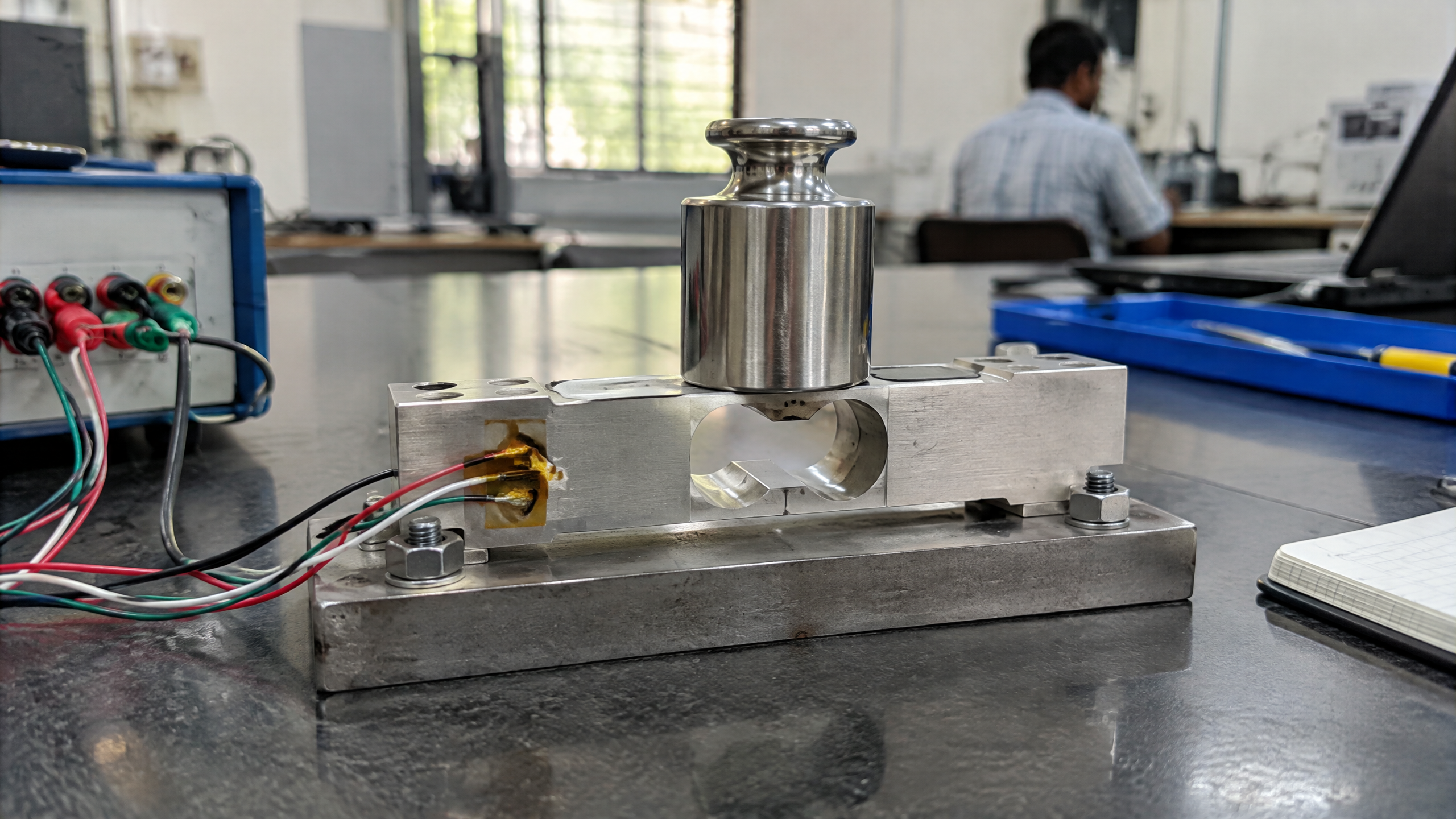
A strain gauge load cell uses gauges bonded to a sensing body. Tension or compression produces a small elastic strain, changing the gauges’ resistance. A Wheatstone bridge reads that change as a small ratiometric output, often specified in millivolts per volt (mV/V) by manufacturers. The exact output and capability depend on the individual device and its documentation. [3]
This architecture is appropriate when a system needs a calibrated force or weight measurement and is designed with correct loading, readout, and calibration in mind. It is common to encounter it in weighing and measurement setups.
### Piezoresistive or flexible force-sensitive resistors
A piezoresistive force sensor or flexible force-sensitive resistor changes electrical behaviour when contact compresses its sensing material. Its thin, flexible form can be useful for embedded contact sensing or for detecting relative changes in force. However, such sensors are generally less accurate than a typical strain-gauge load cell, so a changing reading should not automatically be interpreted as a precise, calibrated force value. [6]
### Load cell vs force sensor: a quick comparison
| Aspect | Strain-gauge load cell | Flexible force-sensitive resistor |
|---|---|---|
| Place in the category | One commonly used type of force sensor | Another force-sensing approach |
| Sensing response | Elastic strain changes resistance in a bridge | Contact compression changes electrical behaviour |
| Typical measurement role | Calibrated force or weight measurement when the system is set up correctly | Relative/contact or embedded sensing |
| Key caution | Mounting, overload, temperature, readout, and calibration affect results | Generally less accurate than a typical strain-gauge load cell |
The comparison is a guide to the measurement task, not a universal rating of every product. Always use the device documentation and test the finished system in its real mounting arrangement. [3] [6]
Where are force sensors used?
Force sensors appear wherever a system needs to turn mechanical interaction into data or a control signal. Examples include:
Weighing and measurement: Load cells can form the sensing part of scales and other systems that translate load into a reading.
Industrial test rigs: A controlled push or pull can be monitored while a component is tested.
Robotics: A gripper can use force feedback to recognise contact or manage how firmly it acts on an object.
Embedded contact sensing: Thin force-sensitive resistors can fit where a system needs to notice touch, pressure distribution, or relative contact change rather than make a laboratory-style load measurement. [6]
Learning and prototyping: In an Arduino-based project, a load cell and an appropriate readout module are a practical way to learn about bridge signals, ADCs, and calibration. [2]
India-specific use does not change the underlying physics. Whether the context is an engineering lab, a maker club, a manufacturing line, or a student project, the meaningful question is: What force must be measured, how will it reach the sensor, and how reliable must the final decision be?
Accuracy, installation, and calibration: why readings differ
A force sensor does not measure in isolation. Its accuracy in a completed system can be affected by the way force reaches it and by how the signal is interpreted.
### Keep the force path intentional
The sensing element should sit in the intended force path. Centered loading and a sufficiently rigid contact surface help the sensor respond as designed. Off-centre loading, unintended bending, poor mounting, or overload can change the reading or harm the sensor. [2] [3]
For a scale-like setup, for example, placing a load at a different point on a platform can create different mechanical conditions from the ones assumed during design. Do not use a sensor outside its documented loading arrangement or capacity.
### Treat the electrical signal as the start, not the answer
The raw signal from a full bridge load cell is small. Noise, readout resolution, wiring, and signal conditioning can influence what a controller sees. An Arduino does not remove these measurement issues: it needs an appropriate interface and a calibration process just like any other readout system. [2]
### Calibrate with known applied forces
Force sensor calibration maps known forces to corresponding outputs. NIST describes force-transducer calibration in tension and compression using known forces, with traceability to the SI system. [3]
For an educational setup, calibration means using suitable known loads or forces and recording the response under the actual mounting conditions. It does not mean assuming that a displayed voltage is already a valid force value. For formal, safety-critical, regulated, or high-consequence measurement, use the relevant procedures, qualified equipment, and professional requirements rather than relying on a hobby calibration.
### Expect real-world influences
Temperature, hysteresis, mounting conditions, sensor geometry, bending, and overload can affect results. A reading may also be repeatable in one setup but less representative after the fixture, contact surface, or force direction changes. These are reasons to define the required measurement range and uncertainty before treating the output as a decision-ready number. [2] [3]
A practical way to choose the right approach
Start with the result you need rather than with a sensor name:
Need to measure a defined load or force? A properly selected, installed, conditioned, and calibrated strain-gauge load cell is the more relevant starting point.
Need to detect that something is being pressed or compare relative contact? A flexible force-sensitive resistor may be more suitable, with appropriate caution about accuracy. [6]
Building a learning project? Plan for the entire chain: mechanics, excitation/readout, code, and calibration—not just the sensor element. [2]
Before connecting hardware, check the sensor’s documentation for its intended loading direction, capacity, environmental limits, electrical requirements, and mounting guidance. No general explainer can certify a component or design for a particular use.
Frequently asked questions
Force sensor kya hai?
A force sensor is a device that converts a push, pull, squeeze, or other applied mechanical force into a measurable electrical output. In a strain-gauge design, tiny elastic deformation changes resistance; the electronics then read that change. [3]
Load cell kya hai?
A load cell is a type of force sensor. Many load cells use strain gauges and a Wheatstone bridge to turn load-related strain into a small electrical signal. It is often used where a system is designed to measure force or weight after suitable signal conditioning and calibration. [2]
Force sensor kaise kaam karta hai?
A force sensor works by letting an applied force change a sensing element. With a strain-gauge sensor, elastic strain changes resistance; a Wheatstone bridge and readout electronics convert that small change into a signal. Calibration then relates the output to known force values. [1] [3]
What is a force sensor working principle in India?
The working principle is the same in India and elsewhere: mechanical force is converted into an electrical output through a sensing mechanism and readout electronics. Local projects may use different fixtures, power arrangements, or modules, but correct mounting and calibration remain essential. [2] [3]
Can I use a force sensor with Arduino in India?
Yes, an Arduino-based learning project can use a force sensor, but the sensor type matters. A bridge-based load cell normally needs suitable signal conditioning or an ADC/readout because its raw output is small. Calibrate the assembled setup with known applied loads instead of assuming a direct reading is accurate. [2] [3]
What does load cell HX711 Arduino mean?
This wording usually refers to an Arduino learning setup that combines a load cell with an HX711-style readout module. The important concept is that a load cell’s small bridge signal needs a suitable interface before a controller can read it. The finished reading still depends on installation and calibration, not on the module name alone. [2]
Is a force sensor in Hindi different from a load cell?
Language does not change the device. “Force sensor” is the wider term, while “load cell” is one kind of force sensor, often based on strain gauges. When reading a Hindi or English tutorial, check whether it is describing precise force measurement with a load cell or relative contact sensing with a flexible force-sensitive resistor. [2] [6]
Related reading
/article/pressure-sensor-working-principle-types
/article/touch-sensor-working-types
/article/accelerometer-explained
---
Source notes
Reporting record
techduopulse stores source destinations privately. Public notes remain non-clickable so every visitor journey stays on this website.
https://support.google.com/trends/answer/4365533?hl=en
Primary source · Research source 4https://developers.google.com/search/docs/monitor-debug/trends-start
Primary source · Research source 5https://www.nist.gov/programs-projects/calibration-force-transducers
Primary source · Research source 1https://edg.uchicago.edu/tutorials/load_cell/
Primary source · Research source 2https://www.baumer.com/us/en/service-support/function-principle/functionality-of-force-sensors/a/Know-how_function_force_sensor
Primary source · Research source 3https://www.tekscan.com/resources/whitepaper/load-cell-vs-force-sensor
Primary source · Research source 6New India-focused sensor explainer covering force sensor, working principles, uses and limitations.