
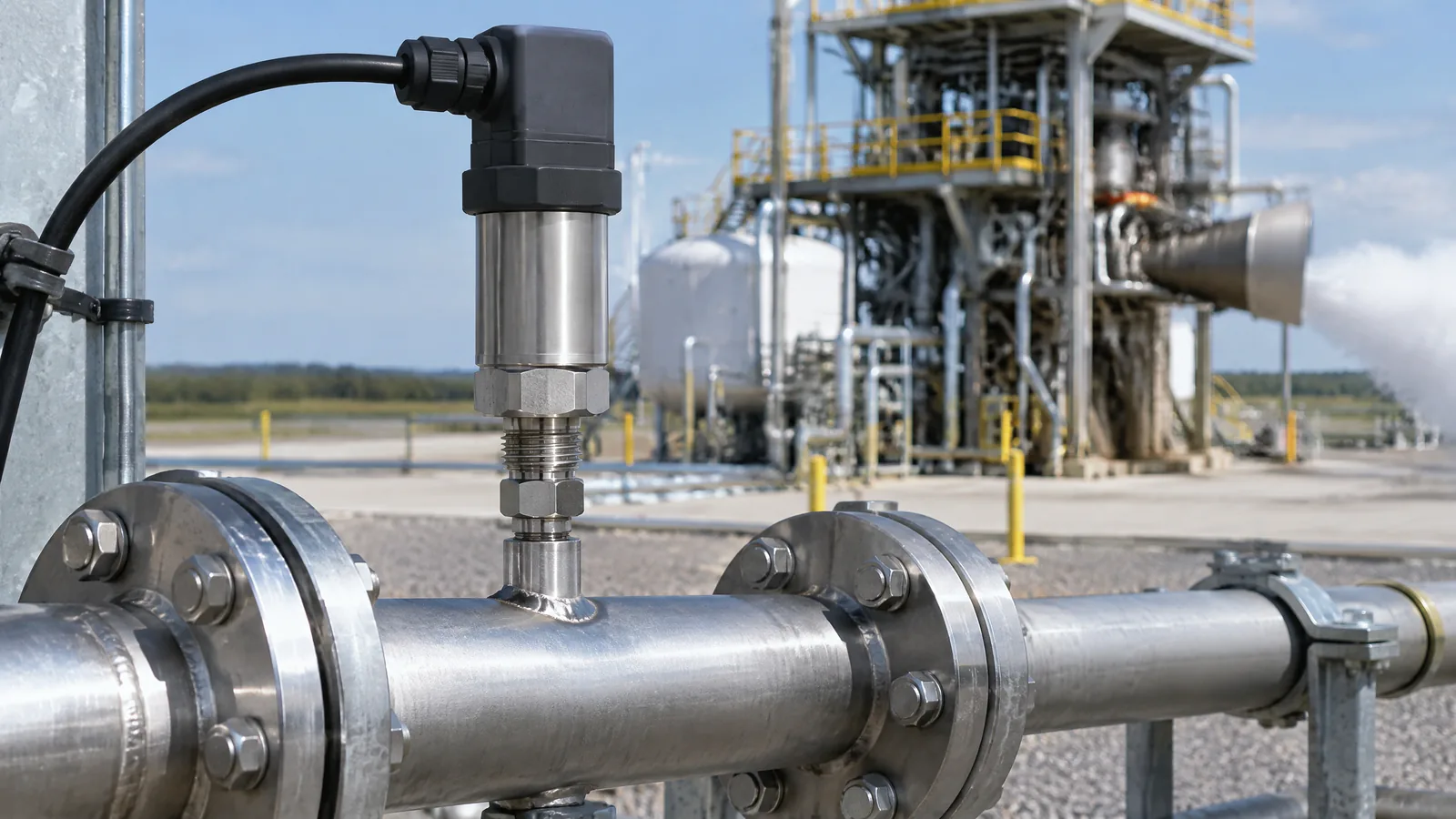
When a rocket test team sees an unexpected pressure reading, the first question is not “is the number high or low?” but “where was it measured, and what is it referenced to?” A static pressure transducer for propellant systems is a piezoresistive or strain-gauge fluid-pressure sensor that measures pressure in a tank, feed system or combustion measurement point and sends a signal to test instrumentation; it is one measurement channel, not a complete control or safety system.
This article is part of the computer hardware technology guide library.
Key takeaways
A static pressure transducer measures pressure that changes slowly enough to be tracked over time, such as a tank or test-stand pressure.
The sensing element is only part of the chain: signal conditioning, calibration data and data acquisition turn its electrical response into a usable engineering value.
Absolute, gauge and differential pressure answer different questions, so the reference must be named before two readings are compared.
Rocket applications may involve optional external equipment such as sense lines, transmitters, temperature compensation and specialized test-stand instrumentation; these are not universal parts of every vehicle.
What does a rocket engine pressure sensor measure?
In a launch-vehicle or engine-test context, the sensor observes the pressure of a fluid or gas at a defined measurement point. That point may be associated with a propellant tank, a feed system or a combustion chamber measurement arrangement. A KELLER Pressure case study on the TU Vienna Space Team’s Lamarr liquid rocket describes pressure sensors used in pressurisation and fuel tanks and in the engine combustion chamber. [2]
The term “sensor” can hide several separate components. The pressure transducer is the pressure-sensitive instrument. A sense line or process connection, where used, carries the pressure to a remotely mounted instrument. Signal-conditioning hardware supplies excitation or interprets the electrical output, while a data-acquisition system time-stamps and records the result. NASA Stennis describes this chain for its test-facility pressure transducers rather than presenting it as a universal rocket design. [1]
Why piezoresistive transducers suit static pressure measurement
A piezoresistive or strain-gauge transducer uses pressure-driven deformation of a sensing structure to change electrical resistance. Bridge circuitry detects that small change, and downstream electronics convert it into a pressure value. This is different from the question of whether the measured pressure is static or dynamic: the sensing mechanism and the measurement job are related, but they are not the same classification.
Kistler separates long-term static pressure measurement, for which it describes piezoresistive sensors, from dynamic pressure measurement using piezoelectric technology. Its rocket-engine testing guidance also says that static monitoring can include propellant-flow monitoring and combustion-chamber pressure measurement on a test bench. [3]
For a reader, the practical lesson is to start with the time behaviour of the measurement. A slowly changing tank condition and a fast combustion event may need different sensor technologies, mounting arrangements, signal conditioning and sampling plans. One transducer type should not be assumed to cover both tasks simply because both are called pressure.
Absolute, gauge and differential pressure are not interchangeable
The reference tells you what the pressure value is compared with. Absolute pressure is referenced to a vacuum. Gauge pressure is referenced to the surrounding atmosphere. Differential pressure is the difference between two pressure points. The same physical system can use more than one reference, but the readings answer different questions.
For example, a tank measurement may be reported as absolute pressure when the external atmospheric condition matters. A test instrument may instead report gauge pressure relative to ambient. A differential transducer can compare the pressure on two sides of a component or across a measurement path. The label must be retained with the number; a bare value is incomplete.
KELLER’s rocket case study identifies pressure transmitters used across pressurisation, fuel-tank and combustion-chamber contexts, while NASA’s test-facility presentation separately lists pressure and differential-pressure measurements. Those examples show why “rocket pressure sensor” is an application family, not one universal wiring or reference scheme. [1] [2]
How the reading reaches a test record
A useful mental model is: pressure at the measurement point → diaphragm strain → resistance change → bridge or transmitter output → signal conditioning → calibrated engineering value → recorded data. The pressure transducer does not by itself know the final unit, reference or meaning of the signal. Those depend on the calibration record and the instrumentation configuration.
NASA Stennis describes pressure transducers with a Wheatstone bridge, facility excitation and millivolt readings that are scaled to engineering units using the sensor calibration report. It describes pressure transmitters separately, with facility power and a 4–20 mA output that a PLC scales. [1] These are examples of instrumentation architectures, not instructions to reproduce a rocket test system.
That distinction matters when comparing a physical sensor with an instrument listing. A pressure transmitter may package sensing and signal conversion together, while a transducer in a test setup may feed separate conditioning and acquisition hardware. Read the complete measurement chain before assuming two labels describe the same device.
Limits and selection questions
A pressure reading can be misleading if the reference, location, temperature, vibration, fluid compatibility or calibration status is unclear. Rocket-test environments can add cryogenic temperatures, hot combustion surroundings, fast pressure changes and demanding electrical or environmental requirements. Kistler explicitly describes separate static, dynamic, cryogenic and high-temperature measurement contexts. [3]
Before interpreting a published specification, ask: Is the measurement static or dynamic? Is the reference absolute, gauge or differential? Is the sensor exposed directly to the medium or connected through an external sense arrangement? What equipment provides excitation, conditioning and logging? Which calibration record converts the output into engineering units?
These are engineering review questions, not a build or test procedure. Propellant systems and rocket engines are hazardous, and pressure instrumentation should be selected, installed, calibrated and operated by qualified teams under the applicable facility and safety procedures. Do not use this explainer to improvise fittings, pressure tests or flight decisions.
Is a rocket engine pressure sensor the same as a normal pressure sensor?
The measurement principle can be similar, but the application environment is different. Rocket test and flight instrumentation may require application-specific choices for static or dynamic pressure, temperature, fluid compatibility, calibration and data acquisition. The name alone does not establish suitability.
What is a static pressure transducer used for in rocket work?
It can provide a recorded pressure measurement for a slowly changing condition such as a propellant-tank, feed-system or test-stand combustion-chamber measurement. Kistler distinguishes this static role from dynamic pressure measurement, which may require another sensor technology.
What is the difference between absolute and gauge pressure in a rocket system?
Absolute pressure is referenced to a vacuum, while gauge pressure is referenced to surrounding atmospheric pressure. They are not interchangeable unless the reference and atmospheric condition are known.
Does the sensor control the rocket engine?
Not by itself. A transducer produces a measurement signal. Separate conditioning, acquisition, software and control or monitoring systems may use that data, but this article does not prescribe flight actions or control logic.
About the image
AI-generated editorial illustration; not an actual product or mission photograph.
Source notes
Reporting record
techduopulse stores source destinations privately. Public notes remain non-clickable so every visitor journey stays on this website.
Source note: NASA Stennis Space Center rocket-engine hot-fire sensor presentation
Primary source · Pressure transducer bridge output, sense-line mounting, calibration scaling, pressure/differential-pressure acquisition, and transmitter distinctionSource note: KELLER Pressure liquid-propellant rocket case study
Primary source · Lamarr rocket pressure measurements in pressurisation/fuel tanks and combustion chamber; piezoresistive transmitter applicationSource note: Kistler rocket-engine testing measurement guidance
Primary source · Static versus dynamic pressure measurement, combustion-chamber/test-bench monitoring, and environmental constraintsNew application explainer for rocket engine pressure sensors. Uses NASA Stennis, KELLER and Kistler evidence to distinguish static piezoresistive pressure transducers from dynamic pressure instruments, transmitters, signal conditioning and acquisition equipment; explains absolute, gauge and differential references; and excludes ranges, fittings, thresholds, flight actions and DIY propulsion guidance.


