
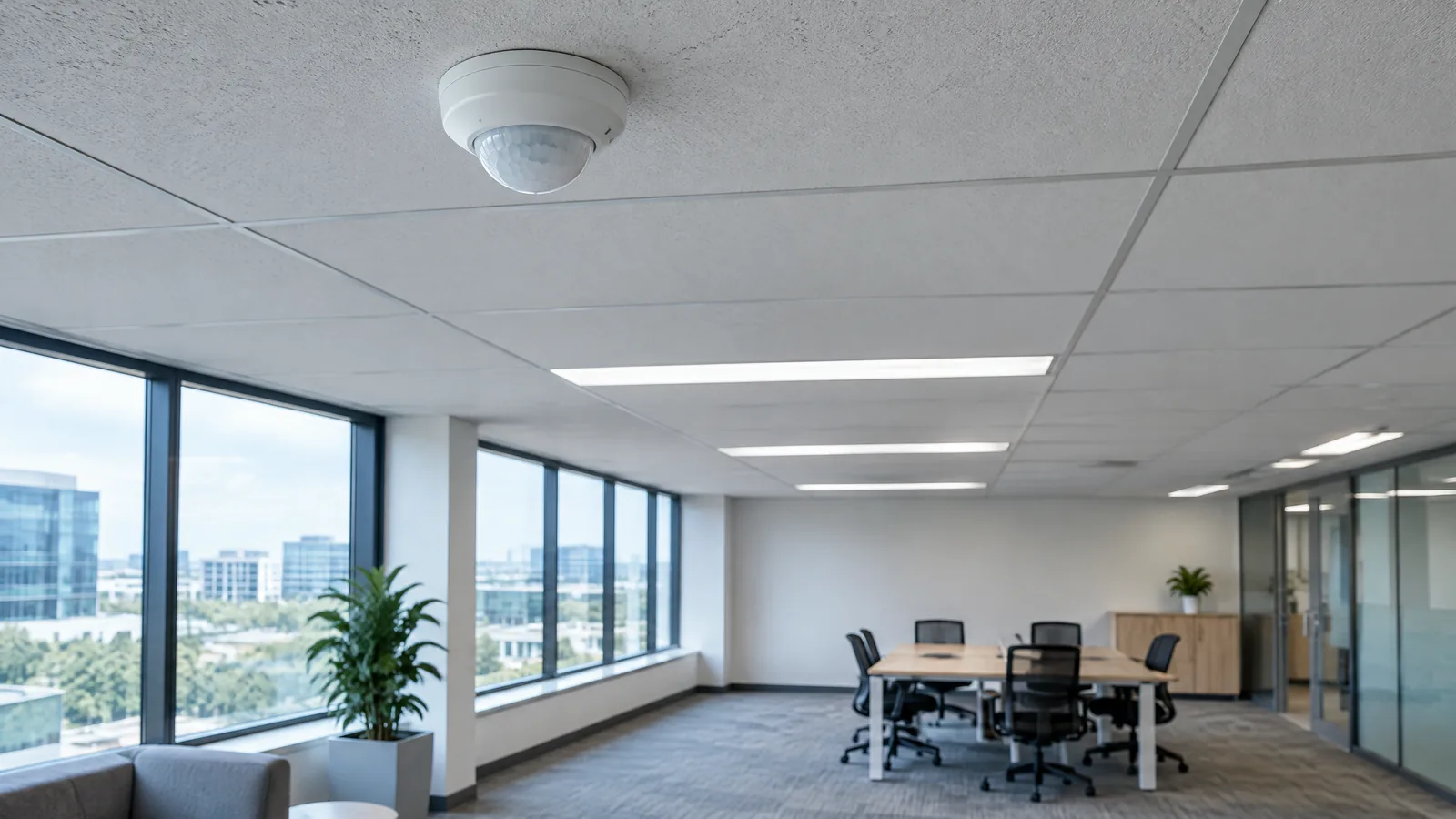
A classroom light that stays on after everyone leaves, or an office fan that never notices an empty room, points to a control problem: the building needs a useful occupancy signal. A PIR occupancy sensor for lighting and HVAC detects changes in infrared energy caused by motion, so it can support an occupancy response, but it cannot reliably count people or prove that a still person remains in the room.
This article is part of the computer hardware technology guide library.
What a PIR occupancy sensor actually tells a building system
A PIR sensor is best treated as a motion-event input. Passive infrared devices receive infrared energy already present in the scene; they do not emit a ranging beam. Common designs use offset sensing elements and compare changes as a warmer object moves through different fields of view. That output can tell a controller that motion was detected recently, not that a named person is present or that a precise number of occupants is in the room.
This distinction matters in building automation. If someone walks into a meeting room, a PIR event can help switch lights on or move an HVAC control toward an occupied mode. If that person sits still for a long time, a basic PIR may not create a new event. A room can therefore be occupied even when the last motion event is old. The controller needs a timeout, a conservative fallback, or another input rather than treating silence as proof of vacancy.
The sensor, its lens and signal-conditioning electronics are only one part of the arrangement. A building may also use a controller or BMS input, a lighting relay or dimming interface, an HVAC command interface, door contacts, temperature sensors or another occupancy technology. Those optional components belong to the installation design; they are not automatically included in every PIR module.
How PIR can support lighting control
For lighting, PIR is useful when the desired action is simple: respond to movement in a defined area and keep the lights on for a documented period after the last event. A corridor, store room, washroom entrance or small office may suit this pattern when the sensor's coverage matches the walking path and the light-control equipment is installed correctly.
A practical control rule is more reliable than a direct on/off assumption. The system can turn lights on after a valid motion event, hold them while events continue, and start a vacancy timer after the last event. The timer should be chosen for the room's use rather than copied from a different module. In a study room, for example, a person working quietly may need a longer hold or a manual override. Daylight sensing can also be added so motion does not automatically request full electric lighting when adequate daylight is already available.
PIR should not be the sole basis for an important egress or emergency-lighting decision. Those functions have their own design and code requirements. A PIR-controlled convenience light is a different use from a safety system, and the article's sensor guidance does not replace qualified electrical or building-services design.
- Define the area that should respond, including doorways, desks and likely walking paths.
- Choose a hold and vacancy strategy that does not switch lights off just because a person is briefly still.
- Check whether daylight, a wall switch or a manual override should be part of the control logic.
- Have mains-voltage wiring and permanent installation handled through the appropriate qualified process.
Using PIR for basic occupancy-informed HVAC response
A PIR signal can help an HVAC controller distinguish likely activity from a scheduled but empty period. For example, a motion event might allow a room to leave an unoccupied setback state, while a longer period without events could permit a less aggressive standby setting. The sensor does not measure temperature, humidity, carbon dioxide or comfort, so it cannot decide the complete HVAC state on its own.
NIST's occupancy-detection publication describes a building approach that combines motion with temperature and other sensor data rather than trusting one input in isolation. That is a useful design lesson for homes, classrooms and small offices: use PIR as one piece of evidence, then let the control strategy account for the room's thermal behaviour, schedule and the consequences of a missed event.
Keep the response proportionate. A short motion event may be enough to delay an aggressive setback, but it should not automatically command unsafe equipment behaviour or override required ventilation and protection logic. HVAC equipment, actuators and the BMS interface are external system components. Their wiring, operating limits and fail-safe behaviour must follow the equipment documentation and the responsible building-services design.
| Building question | What a basic PIR can contribute | What it cannot prove alone |
|---|---|---|
| Has there been recent movement? | A motion event in the sensor's coverage area | Who moved, how many people, or whether the event was a person |
| Should lights respond? | A trigger for a timer, scene or manual-review rule | That the room is continuously occupied or that safety lighting may be changed |
| Should HVAC leave standby? | One input to an occupancy-informed control policy | Temperature, air quality, comfort, required ventilation or equipment safety |
Placement and false-event checks before relying on the signal
Placement determines what the detector can see. A person crossing the sensing zones can produce a stronger change than someone moving directly toward the unit or remaining seated. Furniture, partitions and the lens pattern can create blind areas. Mounting near a changing heat source or a path with unwanted movement can also produce events that do not represent the room state you want to control.
TI explains that distance reduces the signal and signal-to-noise ratio, while designs tuned to detect slower movement can become more exposed to environmental false triggers. ST's signal-conditioning note likewise describes the small, noisy sensor signal, the role of a Fresnel lens and the need for filtering and thresholding. These are reasons to verify the exact installed detector rather than assume that a quoted range or sensitivity setting applies to another model.
Record observations under ordinary conditions: doors opening, fans or ventilation running, sunlight changing, people walking across and toward the field, and a person sitting still. Do not turn a short bench check into a claim of accuracy. If missed occupancy would cause a material comfort, access or safety problem, add suitable sensing and professional system review instead of increasing PIR sensitivity without limit.
- Map the room and mark likely walking paths, quiet work areas and obstructions.
- Confirm the detector's documented field of view, warm-up behaviour, output timing and retriggering mode.
- Test both crossing motion and a stationary occupant, then note false events from the real environment.
- Set the controller's timeout and fallback behaviour around the observed limitations, not a generic internet example.
PIR occupancy sensor versus a fuller occupancy strategy
The choice is not simply PIR versus no sensor. A PIR provides a limited motion signal without creating an image or identifying a person. Other technologies and signals may be better when the requirement is continuous presence, people counting, air-quality-based ventilation or robust room-state estimation. A building can combine motion with door state, temperature, schedules or another non-intrusive sensor, as the NIST research example illustrates.
For a small room, begin by writing the decision in plain language: should the light react to recent movement, should HVAC avoid an empty-room setback, or must the system estimate occupancy continuously? The first question may suit PIR. The last two may need additional signals, longer validation and a controller designed for uncertain data. Keeping those questions separate prevents a motion detector from being sold as a complete occupancy system.
PIR occupancy sensor FAQs
These answers describe a general PIR building use. The documentation for the exact detector, controller and installed equipment takes priority.
Can a PIR occupancy sensor count people in a room?
No. A basic PIR detects changes in infrared energy associated with motion. Its output does not reliably identify a person, count occupants or prove that a still person remains in the room. People counting needs a different sensing and system approach.
Can a PIR sensor control HVAC?
It can provide one input to an occupancy-informed HVAC policy, such as delaying an unoccupied setback after motion. It does not measure temperature, air quality or comfort, and it should not replace required ventilation, equipment protection or qualified controls design.
Why does a PIR light switch off while someone is still in the room?
A stationary person may not create the changes a basic PIR needs, or the person may be outside the detector's effective field. A longer hold strategy, better placement, manual override or additional sensing may be appropriate after checking the exact installation.
Is a PIR occupancy sensor the same as a motion sensor?
PIR is one type of motion sensor. In a building, the label occupancy sensor often describes the intended control use, but a PIR alone still provides motion evidence rather than guaranteed continuous occupancy information.
Does every PIR module include the HVAC or lighting control hardware?
No. A sensing element or conditioned module may only provide an analogue or digital motion signal. Controllers, relays, dimmers, BMS interfaces, HVAC actuators and additional sensors are external components selected for the installation.
About the image
AI-generated editorial illustration; not an actual product or mission photograph.
Source notes
Reporting record
techduopulse stores source destinations privately. Public notes remain non-clickable so every visitor journey stays on this website.
Source note: NIST occupancy-detection research
Primary source · Multi-sensor occupancy detection, motion and temperature inputs, and limits of individual non-intrusive sensorsSource note: Texas Instruments PIR motion-detection design note
Primary source · Offset sensing elements, motion waveform, distance and speed effects, and sensitivity versus false-detection trade-offSource note: STMicroelectronics PIR signal-conditioning application note
Primary source · Differential PIR sensing, Fresnel lens, signal conditioning, filtering, comparator output and startup blank timeSource note: Adafruit PIR module integration guide
Secondary source · Digital high/low module output, controller input pattern and model-specific retriggering settingNew Buildings application page for PIR occupancy sensor use in lighting and basic HVAC response. It extends the supplied PIR working-principle guide without duplicating it, separates the physical sensor from optional controllers and actuators, uses NIST, TI, STMicroelectronics and Adafruit evidence, and qualifies motion, placement, startup and continuous-occupancy limits.


