
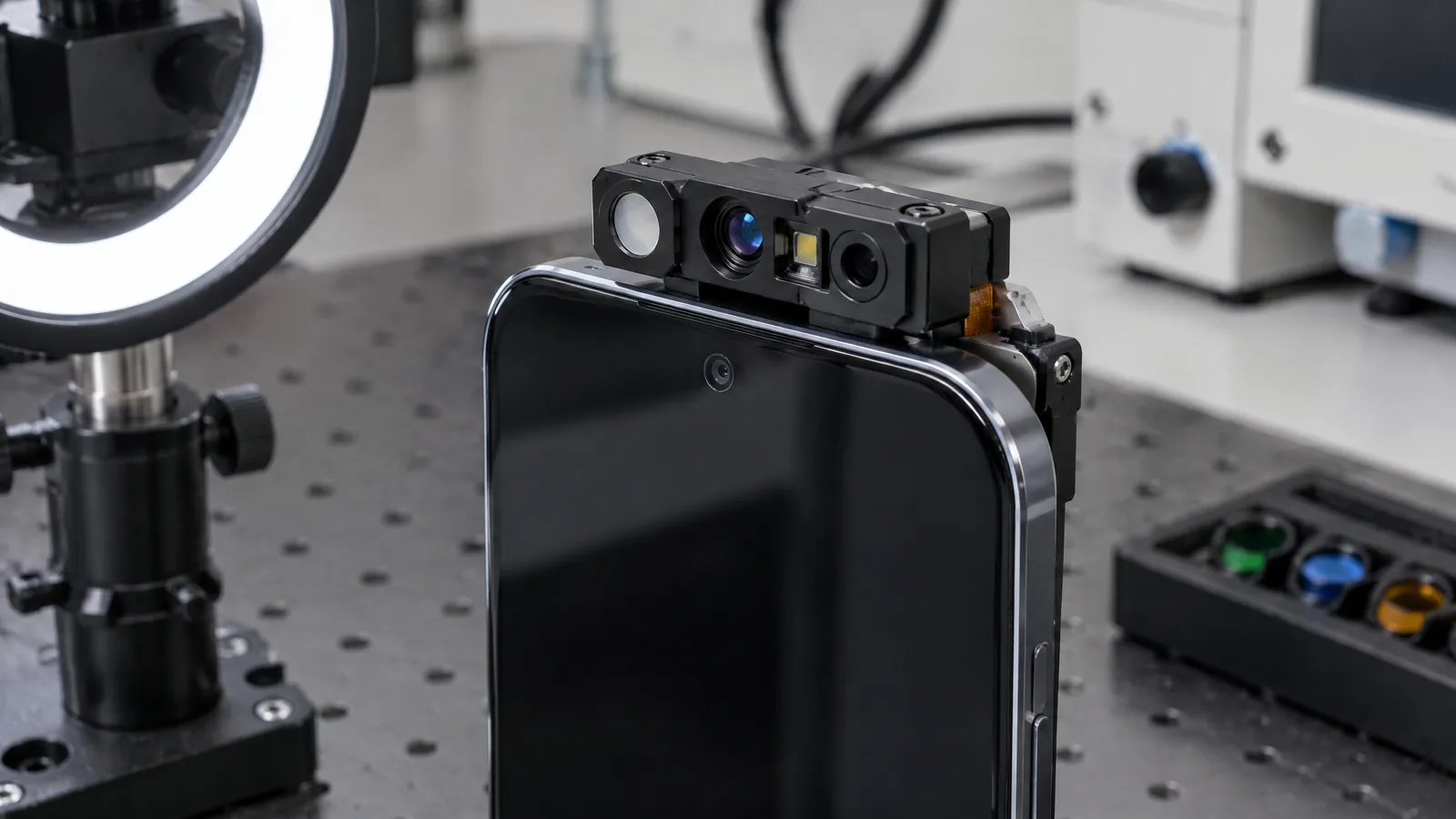
If your phone changes brightness under a shop LED or a camera preview shows bands under indoor lighting, the problem is not always the main camera sensor. A phone ambient color and flicker sensor is a separate, model-specific optical component that measures surrounding light across color channels and can detect repeating 50 or 60 Hz flicker for display or camera-related decisions.
This article is part of the computer hardware technology guide library.
Key takeaways
An ambient color and flicker sensor is a physical light-to-digital component, not a software-only estimate of orientation or rotation.
A documented example, the ams OSRAM TCS3408, uses Red, Green, Blue, Clear and Wideband channels and detects 50 Hz or 60 Hz ambient-light flicker in parallel.
The phone may use the readings to support automatic display appearance, color handling or camera processing, but the exact behavior depends on the device maker's optical design and software.
It is not present in every phone, and its output is not automatically a universal lux or camera-quality score.
- Physical optical sensor, with integrated conversion and a digital interface
- Useful for ambient color, illuminance-related calculations and periodic light changes
- Model-specific and strongly affected by placement, cover materials and calibration
What does a phone ambient color and flicker sensor measure?
The sensor looks at light reaching a small optical package near the phone's display or camera-related hardware. Instead of producing a finished photograph, it samples the surrounding light and sends digital readings to the phone's electronics. Those readings can describe separate color responses, a broader light response and changes that repeat over time.
The term ambient color refers to the color content of the light around the phone. A multi-channel device can compare red, green and blue responses with clear or wideband reference channels. From those measurements, the system can calculate values such as illuminance, chromaticity or correlated color temperature. These are sensing outputs used by a product's control software; they do not mean that the sensor sees color exactly as a person does in every scene.
Flicker detection is a different part of the job. Some lamps and displays vary their light output periodically even when they look steady to the eye. A suitable sensor can identify a 50 Hz or 60 Hz component and provide a flag, interrupt or buffered data for the phone to use.
How the physical sensor works
A useful example is the ams OSRAM TCS3408. Its five concurrent ambient-light channels are Red, Green, Blue, Clear and Wideband. The RGB and Clear channels use a UV/IR-blocking filter in the documented design, while the wideband channel provides a broader reference response. Internal analogue-to-digital conversion and a digital core turn the optical response into data that the phone can read over an I²C interface.
The same component has a separate flicker path that operates alongside color and ambient-light sensing. The datasheet lists independent timing and gain settings, 50 Hz and 60 Hz detection flags, and an interrupt for detected flicker. It can also buffer flicker data so a system can calculate other frequencies externally. This is why calling it only an RGB sensor would miss an important part of its design.
The physical package can be very small. The TCS3408 datasheet lists a 2.5 mm by 2.0 mm by 0.5 mm QFN package, a 1.8 V supply and I²C clock and data pins. Those figures describe the example component, not a specification that every phone follows. A complete phone still needs an optical opening or suitable cover, board layout, power, firmware and calibration.
Why a phone might use color and flicker readings
One use is display management. Ambient light information can help a phone choose a display brightness or adjust how the interface appears in different surroundings. Color information can give the software more context than a single brightness-only reading, especially when the light source changes from daylight to an indoor LED.
A second use is camera-related processing. Flicker from an indoor light source can interact with a camera's exposure and readout timing, producing visible bands, uneven brightness or color changes in a recording. A flicker-aware sensor can supply an additional environmental signal to camera software. It does not replace the image sensor, and its presence does not guarantee that every video under every lamp will be flicker-free.
The TCS3408 datasheet lists display brightness management, display color management, camera image processing and flicker-immune camera operation as applications. These are supported application targets for the component family. They should not be read as proof that a particular phone implements all four features or uses this exact part.
- Display brightness or appearance decisions
- Ambient color context for display or image handling
- A signal that camera software can use when 50/60 Hz lighting is present
- An input to product-specific calibration and control logic
Sensor, software and camera: what is actually doing the work?
It helps to separate three layers. The physical sensor detects incoming light. Its integrated converter and interface produce digital channel readings. The phone's firmware, display controller or camera software then decides how to respond. A change in screen brightness is therefore not the sensor acting alone; it is a system decision based on sensor data and other product rules.
The component is also different from the main camera image sensor. The image sensor records the scene used to make a photo or video. An ambient color and flicker sensor is a small environmental monitor that can observe light conditions without being the main image-forming device. Some phones may omit it and use another sensor, camera frames or software estimation instead. The public product specification for a phone is the only safe way to confirm the hardware arrangement.
Important limitations: why readings vary between phones
Optical placement matters. A sensor under a dark cover, behind an inked window or close to a camera, display or infrared emitter can receive a different mixture of direct light, reflections and stray light than a component on an evaluation board. The TCS3408 product material specifically discusses operation behind inked materials and suppression of cross-coupling from nearby 940 nm infrared sources, but those are design capabilities rather than a promise about every handset.
The light source matters too. A lux or color estimate depends on spectral response, geometry and the conditions used to calibrate the system. The datasheet's example optical characteristics are tied to stated test LEDs and integration settings. A reading under a warm LED, cool LED, sunlight or a phone display should not be treated as interchangeable without checking how the complete device was designed.
Finally, this sensor is optional and model-specific. Do not assume that every phone with auto-brightness, a camera flicker setting or a color-adaptive display contains a separate ambient color and flicker package. Manufacturers can combine functions, use a different component or implement some behavior in software.
| Part or layer | What it does | What it does not prove |
|---|---|---|
| Ambient color and flicker sensor | Samples ambient optical channels and periodic light changes | It is not the main camera and does not guarantee perfect video under every lamp |
| Phone firmware and control software | Interprets readings and chooses display or camera behavior | A software response does not identify the exact sensor model |
| Main camera image sensor | Captures image frames for photos and video | Its image alone is not the same as a dedicated flicker-sensor reading |
Frequently asked questions
These answers describe the sensor class and the documented TCS3408 example. Phone makers may use different parts or software paths.
Is an ambient color and flicker sensor present in every phone?
No. It is a model- and design-specific physical optical component. A phone can offer automatic brightness or camera processing without using this exact sensor, so check the device's service documentation or specification before assuming it is present.
Is this the same as the phone's camera sensor?
No. A dedicated ambient color and flicker sensor monitors surrounding light with optical channels and flicker detection. The main camera image sensor records image frames. They can support related software decisions, but they are different components.
What does 50/60 Hz flicker mean?
It refers to periodic changes in light output associated with some powered light sources. A compatible sensor can detect 50 Hz or 60 Hz components and report them to the device. The result can help camera or display software, but it does not promise that every recording will be free of bands or brightness changes.
Can this sensor measure accurate lux?
It can support illuminance estimation when the complete optical system is designed and calibrated for that purpose. A component datasheet's test result is not a universal lux guarantee for every phone, cover material, light source or viewing angle.
Is the TCS3408 used in every smartphone with flicker control?
No. TCS3408 is a documented example of a color and flicker sensing component with mobile and display applications. A phone manufacturer may use another component, another sensor arrangement or software estimation.
About the image
AI-generated editorial illustration; not an actual product or mission photograph.
Source notes
Reporting record
techduopulse stores source destinations privately. Public notes remain non-clickable so every visitor journey stays on this website.
Source note: ams OSRAM TCS3408 color and flicker sensor product brief
Primary source · Five ambient-light channels, filters, illuminance/chromaticity/color-temperature calculations, parallel 50/60 Hz flicker detection, mobile/display applications and…Source note: ams OSRAM TCS3408 ALS/color/flicker datasheet
Primary source · Application list, channel architecture, I²C/interrupt interface, operating conditions, optical test limits and calibration caveatsRelated reading: techduopulse light-sensor explainer
Context source · Existing broad guide reviewed for overlap; supports distinction between general light sensors and this mobile color/flicker applicationRelated reading: techduopulse smartphone camera hardware explainer
Context source · Existing camera guide reviewed for overlap; supports distinction between the main image sensor and a separate ambient optical sensorNew India-facing hardware explainer for a distinct phone application. It separates the optional physical ambient color/flicker component from the main camera sensor and from software decisions, uses the ams OSRAM TCS3408 as a documented example rather than a universal phone claim, and includes placement, calibration and light-source limitations.


