SEO title: Light Sensor: Types, Working Principle and Uses Meta description: Learn what a light sensor is, how LDRs and photodiodes turn light into electrical signals, and where light sensors are used in phones and automation.
This article is part of the software engineering technologies guide library.
Introduction
How does a phone know when to dim its display, or an automatic lamp know that a corridor has become dark? In both cases, a light sensor turns received light into a signal that electronics can interpret. It may simply detect a bright/dark change, help estimate illuminance, or support a more specialised optical system.
For students, makers and curious readers in India, the topic often appears as an LDR sensor, a photodiode, or an Arduino light-sensor project. Those labels are related, but they do not describe one interchangeable part. An LDR is useful for a simple changing-light or threshold experiment; a photodiode can respond much faster; and an integrated ambient-light sensor can deliver processed digital data to a phone or embedded device. Knowing the difference helps you interpret a reading rather than treating every changing voltage as a precise brightness measurement.
What is a light sensor?
A light sensor—also called a photosensor or photodetector—is a broad family of devices that responds to light. Depending on its design, it can detect whether light is present, follow changes in received light, measure illuminance, or convert light into electrical energy. [1] [3]
“Light sensor” therefore describes a job, not a single component. A garden-light circuit that decides between day and night does not need the same response speed, spectral behaviour or measurement quality as a phone adjusting its display. Before choosing or wiring a sensor, it is useful to ask a practical question: Do I need a bright/dark decision, a changing analogue signal, or a calibrated light measurement?
Light sensor working principle: from photons to a usable signal
At a high level, light falls on a light-sensitive material and changes an electrical property. A circuit then turns that change into an output that a controller, display or switch can use.
The path differs by sensor family:
Photodiode: Light reaching its p–n junction creates electron–hole pairs, producing a light-dependent photocurrent. Over a useful operating range, that photocurrent can be approximately related to incident light, though sensitivity depends on wavelength and the device material. [1] [2]
Photoresistor or LDR: More illumination generally makes the sensing material more conductive, so its resistance falls. The LDR is commonly placed in a biased circuit or voltage divider; the resulting changing voltage is what an analogue input reads. [1] [2]
Phototransistor: Light influences transistor action, producing an output suited to optical detection. It belongs to the same broad photosensor family but does not behave exactly like an LDR or photodiode. [1]
Photovoltaic sensor: The device converts light into electrical energy rather than merely supplying a sensing signal. [1]
For a photodiode, the circuit can use photovoltaic or photoconductive operation. Biasing, amplifier design, capacitance, dark current and noise can all influence the final result, so a photodiode circuit should not be treated as a drop-in replacement for an LDR divider. [2]
Main types of light sensors
The comparison below is a starting point, not a universal ranking. The appropriate type depends on the lighting source, the speed of change, the required output and whether the result must be calibrated.
| Type | Electrical response to light | Where it is useful | Important interpretation point |
|---|---|---|---|
| LDR / photoresistor | Resistance generally decreases as illumination rises | Basic bright/dark detection and classroom circuits | Nonlinear response; a divider voltage is not automatically lux |
| Photodiode | Generates light-dependent photocurrent | Faster optical detection and measurement-oriented circuits | Wavelength response, bias and signal conditioning matter |
| Phototransistor | Light controls transistor output | Optical detection applications | Output behaviour differs from both LDRs and photodiodes |
| Integrated ambient-light sensor | Processed analogue or digital light data | Displays, mobile devices, automotive and industrial systems | Filters, spectral matching and conversion settings affect the reading |
| Photovoltaic sensor | Converts light to electrical energy | Light-to-energy conversion applications | It is designed around energy conversion, not necessarily a calibrated light reading |
### LDR sensor (photoresistor)
An LDR sensor, also called a photoresistor, is often the easiest family to meet in a beginner electronics project. Its resistance usually decreases as light increases. Put it in a voltage divider, and the divider output changes with the light falling on the LDR. A microcontroller can read that changing voltage and trigger an action at a chosen threshold. [1] [2]
This convenience has limits. An LDR’s response is nonlinear, and temperature, wavelength, dark resistance and previous illumination can affect its behaviour. [1] [2] [6] Two LDR circuits that look similar can therefore produce different values in the same room. Treat the reading as an application-specific signal unless the full system has been calibrated for the intended conditions.
### Photodiode light sensor
A photodiode light sensor uses a p–n junction rather than a variable resistance. Incident light creates charge carriers and a photocurrent. That physical mechanism supports a different set of design choices: the circuit may use the photodiode without bias in photovoltaic mode, or with bias in photoconductive mode. [2]
Photodiodes are useful when response speed and a well-managed signal path matter. But a good result still depends on more than the sensor package: wavelength sensitivity, capacitance, amplifier design, dark current and noise affect the circuit output. [2] Check the relevant device documentation and circuit conditions rather than assuming that any photodiode gives the same result under every LED, daylight source or enclosure.
### Ambient light sensor
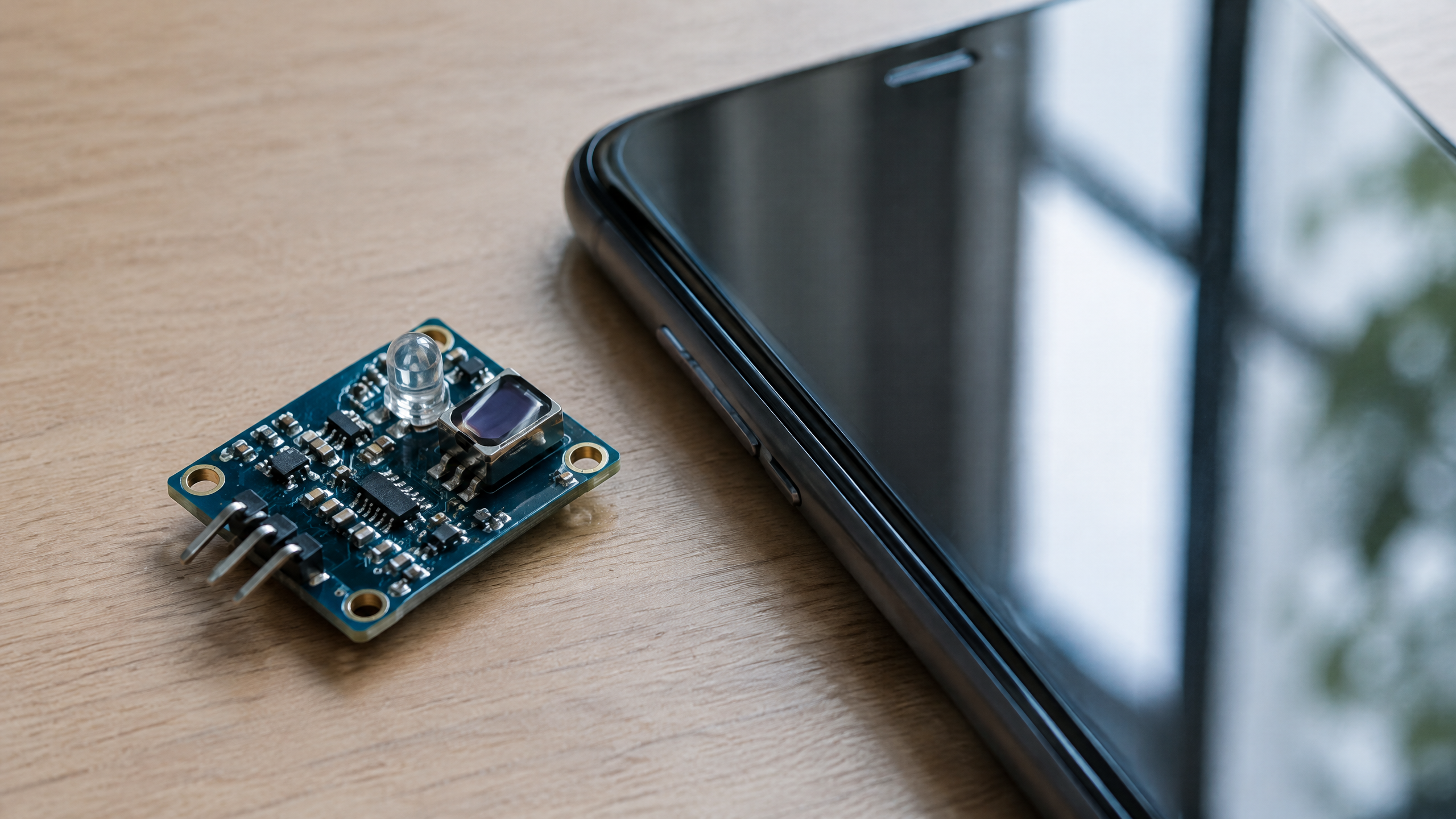
An ambient light sensor is commonly an integrated sensor intended to describe surrounding light for an electronic system. It may include optical filters, spectral matching, configurable conversion and a digital output. Such sensors are used for automatic display brightness and LED/display adjustment, including in mobile devices, as well as automotive and industrial sensing. [1] [3]
This is the kind of sensing behind the familiar “auto brightness” experience. It is not necessarily trying to reproduce what every human observer sees in every situation; placement, filtering and the product’s software policy all shape the final brightness decision.
Where light sensors are used
Light sensor applications begin with a simple decision—bright or dark—but extend well beyond automatic lamps:
Phones, tablets and displays: ambient-light sensing can help an interface adjust display or LED brightness. [3]
Home, school and building automation: an LDR-based circuit can act as a learning-friendly day/night input for a non-critical lighting project.
Robotics and embedded learning: an Arduino light sensor setup can let students read a changing divider voltage, record a trend or test a threshold in a controlled activity.
Automotive and industrial equipment: integrated light-sensing approaches can support lighting and display-related decisions. [3]
Optical systems: photodiodes and phototransistors can detect changes in received light where a faster response is relevant. [1] [2]
For India-aware projects, it helps to test where the circuit will actually be used: bright outdoor daylight, a shaded classroom, indoor LED lighting and reflected light can all present different conditions. The aim is not to find one magic threshold, but to design and verify a threshold for the real setting.
Accuracy, limitations and calibration
A light sensor output is only part of a measurement system. It can be very useful for a bright/dark decision yet unsuitable as a precision illuminance meter without appropriate design and calibration.
Lux is the usual unit for illuminance, but the relationship between a sensor output and lux is not universal. Spectral response and geometry matter: changing the light source, its angle, the distance, a window or an enclosure can change the result. [3] A lower LDR resistance or higher analogue-to-digital converter (ADC) count is therefore not, by itself, a universal lux value.
Use these practical checks when interpreting a result:
Define the task. Decide whether the system needs a threshold, a trend or a measurement in lux. Do not require measurement-grade meaning from a basic threshold circuit.
Consider the light source. A sensor’s wavelength sensitivity can make its response to different LEDs or daylight differ. [1] [2]
Control placement. Keep the sensor position and orientation consistent. Avoid unintentionally measuring reflections, shadows or light leaking from the device itself.
Allow for device and circuit effects. LDR temperature and illumination history can matter; photodiode bias, amplifier design, dark current, capacitance and noise can matter. [2] [6]
Calibrate when precision matters. Compare the completed setup against a known reference under conditions relevant to the application, and document the procedure. Calibration applies to the whole arrangement—not only the sensor component. [3]
For lighting that affects safety, access or other consequential operations, do not rely on an untested hobby threshold alone. The sensing, power, control and failure behaviour need application-appropriate engineering and verification.
Light sensor FAQs
What is a light sensor?
A light sensor is a photosensor or photodetector that responds to light. It may detect its presence, follow changes in light, estimate illuminance or convert light into electrical energy, depending on the sensor family. [1] [3]
What is the light sensor working principle?
Light changes an electrical property in a light-sensitive device. A photodiode creates a light-dependent photocurrent, while an LDR generally becomes less resistive as illumination rises. Electronics then convert that response into a voltage, current or digital value. [1] [2]
What are the main types of light sensors?
Common types include photoresistors (LDRs), photodiodes, phototransistors, photovoltaic sensors and integrated ambient-light sensors. They differ in output behaviour, speed, linearity and spectral response. [1]
What is an LDR sensor?
An LDR sensor is a light-dependent resistor, also called a photoresistor. Its resistance generally decreases as light increases. It is commonly used in a voltage-divider circuit for simple light-change or threshold detection, but the divider reading is not automatically a calibrated lux measurement. [1] [2]
What is the difference between a photodiode and an LDR?
A photodiode is a p–n-junction device that produces light-dependent photocurrent. An LDR is a light-controlled resistor. They have different response behaviour and circuit requirements: photodiode designs depend on factors such as bias and signal conditioning, while LDRs are nonlinear and can be affected by temperature, wavelength and illumination history. [1] [2] [6]
How does a light sensor with Arduino work?
In a typical learning setup, an LDR in a voltage divider produces a changing analogue voltage that an Arduino-compatible controller can read. Your program can compare that value with a locally tested threshold to indicate a light change or control a demonstration output. The threshold must be set and checked in the intended environment; it does not create a universal lux reading. [2]
What is an ambient light sensor used for?
An ambient light sensor is used to sense surrounding light for electronic systems. Integrated versions can support automatic display brightness and LED/display adjustment in mobile, automotive and industrial applications. [1] [3]
Related reading
/article/proximity-sensor-types-working
/article/ir-sensor-working-types-uses
/article/temperature-sensor-types-working-principle
/article/humidity-sensor-types-working
Source notes
Reporting record
techduopulse stores source destinations privately. Public notes remain non-clickable so every visitor journey stays on this website.
https://support.google.com/trends/answer/4365533?hl=en
Primary source · Research source 4https://developers.google.com/search/docs/monitor-debug/trends-start
Primary source · Research source 5https://www.analog.com/en/resources/glossary/light-sensor.html
Primary source · Research source 1https://wiki.analog.com/university/courses/electronics/text/light-sensors-photodiodes
Primary source · Research source 2https://www.ti.com/product-category/sensors/optical-sensors/light/overview.html
Primary source · Research source 3https://pmc.ncbi.nlm.nih.gov/articles/PMC7146615/
Primary source · Research source 6New India-focused sensor explainer covering light sensor, working principles, uses and limitations.