
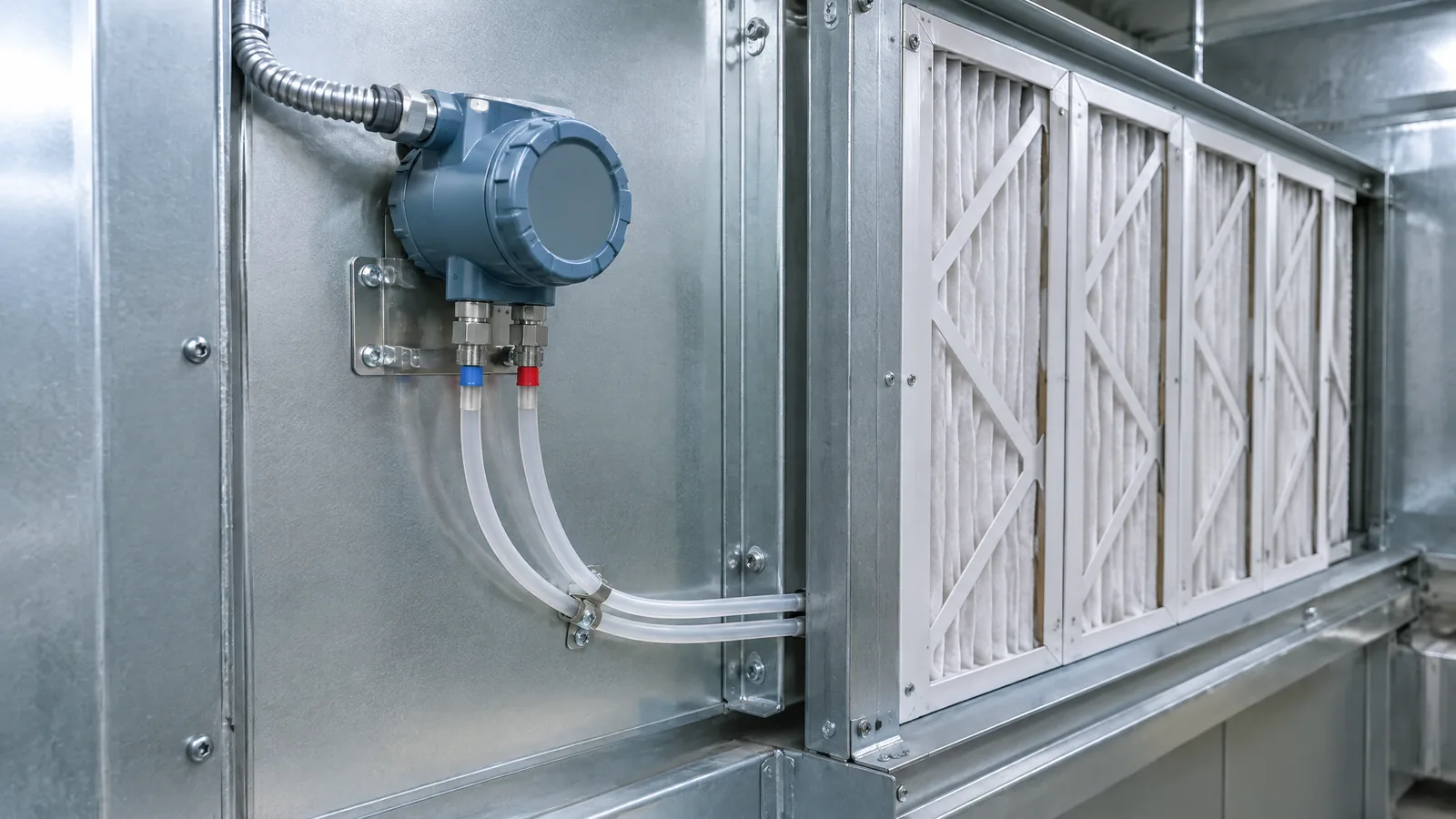
A building operator sees the pressure drop across an air filter climbing and needs to know whether it is time to investigate the system. An HVAC differential-pressure transmitter measures the pressure difference between two points—often the inlet and discharge sides of a filter—so the trend can support filter-status and airflow monitoring without pretending to measure dirt or indoor-air quality directly.
This article is part of the computer hardware technology guide library.
Key takeaways
An HVAC differential-pressure sensor is a pressure instrument, not a dust or indoor-air-quality sensor. It compares two pressure ports and reports their difference.
A rising filter pressure drop can be consistent with increasing airflow resistance, but the reading also depends on fan state, airflow, tubing, ports, installation and the rest of the system.
Use the installed filter and system documentation for initial and final pressure-drop guidance. A universal replacement number would be misleading.
A transmitter can support monitoring and control, but it does not by itself diagnose a blocked filter, fan fault or unsafe building condition.
- Measures pressure difference, not filter dirt or IAQ directly.
- Trend the value with operating context rather than reacting to one unexplained number.
- Treat unusual readings as an investigation cue and follow qualified HVAC procedures.
What does an HVAC differential-pressure transmitter measure?
Pressure is force per unit area. Differential pressure uses another point in the system as its reference, rather than using a vacuum or the surrounding atmosphere. In an air-handling unit, the transmitter receives pressure through two small connections and calculates the difference between them.
For a filter check, the high-pressure port is normally connected to the air side before the filter and the low-pressure port to the air side after it. The exact connection, tubing route and allowable range belong to the transmitter and HVAC system documentation; a reversed or leaking connection can make a believable number misleading.
The broad pressure-sensor guide explains the general principle and types of pressure measurement. This page extends that explanation to a specific building-maintenance use case: [read the pressure sensor working-principle guide](https://techduopulse.com/article/pressure-sensor-working-principle-types).
How filter pressure drop changes as the system operates
A filter creates some resistance even when it is newly installed. As particles and contaminants collect, the pressure difference between the inlet and discharge sides can increase. A transmitter turns that difference into a signal that a display, logger or building-automation system can trend.
That trend is useful because it gives a maintenance team an operating clue without requiring the filter to be judged by appearance alone. However, a high differential-pressure reading is not proof that the filter is dirty. A changed fan condition, restricted duct, disconnected tube, blocked sensing port, air leak or wrong installation can also alter the result.
Setra’s HVAC application guidance distinguishes an initial pressure-drop rating for a clean filter from a final pressure-drop rating associated with the manufacturer’s tested change-out condition. Those values are not universal: filter construction, airflow and system design differ. Use the filter manufacturer’s and system designer’s guidance before setting an alarm or replacement workflow.
Using the reading to support airflow monitoring
Differential pressure can also support airflow measurement in an air-handling system or air-flow station. The useful point is not that pressure difference equals airflow in every installation. The relationship depends on the measurement arrangement and operating conditions, so the system must be designed and interpreted as a whole.
In practice, record the pressure trend alongside fan status, commanded or measured airflow where available, damper position and the time of the reading. A value taken during start-up, a low-speed period and normal occupied operation may not be comparable. National Instruments notes that flow, fluid compressibility and external forces can affect pressure readings, and that static and changing conditions can differ.
The transmitter may provide an analogue or digital output, and some models include signal conditioning. Others need suitable excitation, amplification, filtering or input hardware. Check the instrument datasheet before assuming that a small pressure module can connect directly to a controller.
What the sensor cannot tell you on its own
A differential-pressure transmitter does not count airborne particles, identify a contaminant, measure carbon dioxide or certify indoor-air quality. It also cannot determine the cause of a high reading without system context. It is better described as a pressure-difference instrument that supplies evidence for a maintenance decision.
A high value may justify checking the filter condition, port orientation, tubing, fan operation and other approved maintenance points. A low or unexpectedly flat value does not automatically mean the filter is healthy; a disconnected tube or blocked port could hide the pressure difference. Do not convert one reading into an automatic diagnosis.
Building systems can be consequential and may affect comfort, ventilation and equipment operation. Do not open pressurised equipment, alter controls or bypass safety functions based on this explainer. Use the site procedure and qualified personnel for inspection, calibration and corrective work.
A practical interpretation checklist
Before acting on a trend, check the measurement setup and the operating state. This simple record helps separate a genuine change across the filter from a measurement or system change.
- Confirm what the two ports are connected to and that high and low sides match the approved installation drawing.
- Record the filter model or rating, its installation date and the manufacturer’s initial and final pressure-drop guidance.
- Note fan speed, airflow or operating mode, damper position and any recent maintenance when recording a reading.
- Check the transmitter’s units, range, output type and calibration or verification status; do not assume Pa, inH2O or another unit from the display alone.
- If the trend changes sharply or conflicts with the rest of the system, pause automatic conclusions and escalate through the site’s qualified HVAC maintenance process.
Common questions about HVAC differential-pressure sensors
These answers keep the measurement useful without assigning a universal threshold or diagnosis.
Is an HVAC differential-pressure sensor the same as a dirty-filter sensor?
No. It measures the pressure difference between two points. A rising difference across a filter can be consistent with increasing restriction, but it does not directly measure dirt and cannot identify the cause by itself.
Which side of an HVAC filter uses the high port?
For the filter-status arrangement described by Setra, the high port measures the inlet side and the low port measures the discharge side. Follow the transmitter and system installation documentation for the actual equipment.
What pressure-drop value means that a filter must be replaced?
There is no safe universal value for every filter and system. Use the filter manufacturer’s initial and final pressure-drop guidance together with the system designer’s or qualified HVAC professional’s procedure.
Can this sensor measure airflow directly?
It can support airflow measurement when installed in a suitable flow-measurement arrangement. The relationship depends on the system and operating conditions, so a filter pressure-drop reading should not be treated as a direct airflow value.
Why might the reading look wrong after maintenance?
Check the documented port orientation, tubing, leaks, blocked connections, sensor range, units and operating state. If the result remains unexplained, use the approved inspection or calibration process rather than adjusting controls from a single reading.
About the image
AI-generated editorial illustration; not an actual product or mission photograph.
Source notes
Reporting record
techduopulse stores source destinations privately. Public notes remain non-clickable so every visitor journey stays on this website.
Source note: Setra HVAC filter status and airflow application guidance
Primary source · Filter pressure-drop trend, high/low port orientation, initial/final pressure-drop guidance and airflow monitoringSource note: NI pressure measurement and sensor fundamentals
Primary source · Differential-pressure definition, diaphragm-to-signal principle, operating-condition effects and signal conditioningSource note: NIST pressure and vacuum calibration information
Primary source · Differential-pressure instrument calibration and measurement-reference contextSource note: peer-reviewed pressure-sensor mechanisms review
Secondary source · Piezoresistive, bridge-based and capacitive sensing mechanisms and compensation considerationsNew India-facing application explainer distinct from the existing broad pressure-sensor guide. Grounds filter pressure-drop and airflow-monitoring claims in Setra, NI, NIST and a peer-reviewed review; distinguishes pressure difference from dirt and IAQ; avoids universal thresholds, unsafe DIY instructions, made-up testing and automatic diagnosis.


