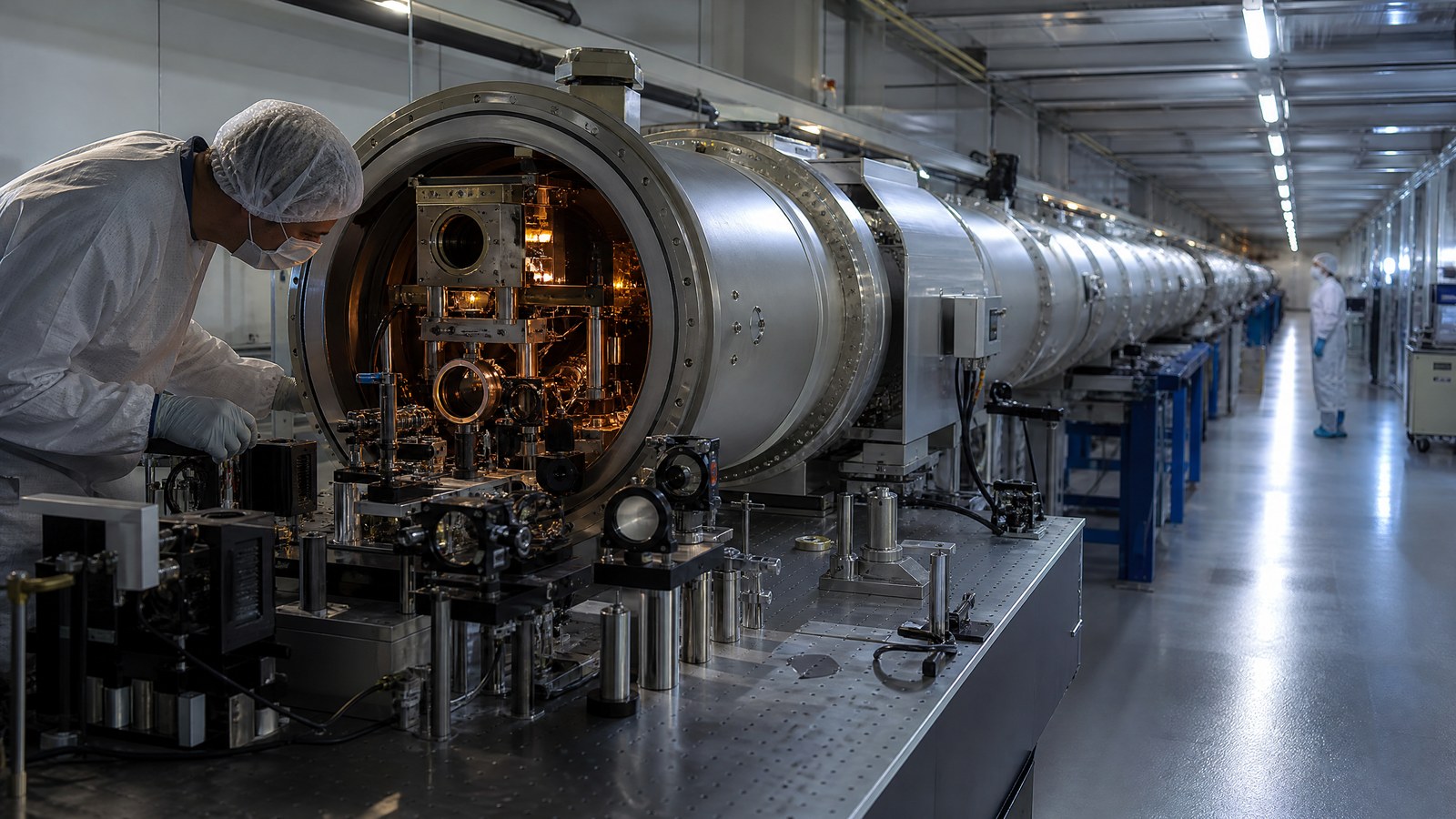
{"intro":["A gravitational-wave detector does not take a picture of a distant collision. It measures a changing difference between two paths traveled by laser light. A passing gravitational wave stretches space in one direction while compressing it in a perpendicular direction, producing an extremely small differential change in the instrument’s arms. The signal is tiny compared with everyday vibration, so the achievement is not a single clever sensor but a carefully engineered measurement system.","Laser interferometry supplies the basic method. One laser beam is split, sent down two perpendicular arms, reflected, and recombined. If the paths are exactly balanced, the returning light can cancel in a designed pattern. A differential change shifts the relationship between the waves, altering the light at the detector. Extracting meaning from that shift requires long baselines, optical amplification, vibration isolation, calibration, and checks against non-astronomical noise."],"sections":[{"heading":"The instrument measures a difference, not absolute distance","paragraphs":["An interferometer compares waves. In a Michelson-style layout, a beam splitter sends light along two perpendicular arms, end mirrors return the beams, and the beams are recombined. Their relative phase, meaning where the crests and troughs line up, determines the resulting light pattern. Equal travel distances can produce destructive interference; a change in one path shifts the phase and changes the light reaching a photodetector.","For gravitational-wave work, the quantity of interest is differential arm motion: the arms change oppositely as a wave passes. This is important because many environmental disturbances move both paths in similar ways, while the detector is designed to be especially responsive to their difference. The output is a time-varying measurement, not a direct image. Scientists compare its shape with physical models and with extensive information about the instrument’s condition."]},{"heading":"Light converts path changes into an observable signal","paragraphs":["Laser light behaves as a wave, so a small path-length change alters the timing, or phase, of the returning wave. When the two returning beams are superimposed, their phase difference changes the measured brightness. This is the central conversion: a geometric change becomes an optical signal. The detector does not need a ruler placed along each arm; it uses the laser wave relationship as the sensitive reference for comparing the two round trips.","The concept is elegant, but the operating point must be controlled precisely. Mirror positions, laser frequency, alignment, and optical cavity conditions can all affect the output. Feedback systems keep the instrument near its intended configuration, and calibration relates the recorded signal to the inferred differential motion. The presence of a faint optical change alone is not enough; investigators need to establish that it has the expected behavior and is not explained by known instrumental effects."]},{"heading":"Long arms and optical cavities increase sensitivity","paragraphs":["Longer interferometer arms make a given fractional stretch produce a larger absolute path change. LIGO’s arms are four kilometers long, already far beyond a tabletop instrument. Yet the optical path is effectively extended further by Fabry–Pérot cavities, in which light reflects repeatedly between mirrors in each arm. Repeated travel lets more light sample the arm length and increases sensitivity without building an impractically longer straight facility.","The same design uses optical recycling to build up useful circulating light and to shape the response to signals. More stored light can sharpen the interference measurement, though it brings engineering challenges involving optical losses, stability, and quantum noise. These features are not decorative complexity; they are part of the reasoning chain that makes a minuscule differential effect measurable. Instrument geometry and optical design work together rather than independently."]},{"heading":"Noise control is as important as the laser","paragraphs":["Earth is noisy at the scale relevant to these measurements. Seismic motion, acoustic disturbance, thermal motion, electrical effects, scattered light, and fluctuations in the optical system can all influence a detector. LIGO uses isolation and suspension systems to reduce unwanted motion, but no system removes every disturbance. The practical goal is to understand, monitor, and limit noise well enough that a candidate signal can be distinguished from instrumental behavior.","This is why gravitational-wave data analysis includes environmental sensors, instrument diagnostics, data-quality studies, and calibration work. A simple comparison to the size of an atomic nucleus describes the extraordinary scale of the effect, not a claim that a detector literally resolves a solid object of that size. The measurement is an inferred differential displacement derived from interference, with uncertainty and noise characterization forming part of the result."]},{"heading":"The detector records a waveform, not a cosmic photograph","paragraphs":["A gravitational wave changes the detector output over time, creating a waveform whose frequency and amplitude evolution can carry information about its source. Scientists use general-relativity-based models, signal processing, and parameter estimation to relate measured data to possible astrophysical systems. That process does not turn the instrument into a camera. It is closer to identifying a faint, patterned sound in a carefully characterized recording than to viewing a scene through a telescope.","Interpretation has limits. Different source parameters can produce partially similar signals, detector sensitivity varies with frequency and orientation, and models have assumptions. Reports therefore use statistical methods and uncertainty estimates rather than asserting that every source property was observed directly. This measured-versus-inferred distinction is useful well beyond gravitational-wave science: a sophisticated instrument can provide powerful evidence while still requiring transparent reasoning from signal to conclusion."]},{"heading":"Independent observatories make the evidence stronger","paragraphs":["Separated detectors help assess whether a candidate is astrophysical rather than local. A disturbance at one site may arise from conditions unique to that instrument, whereas a gravitational wave should produce a consistent pattern across widely separated observatories after accounting for travel time and detector orientation. Multiple instruments also improve the ability to constrain where a signal came from and how it was polarized, although sensitivity and geometry affect what each contributes.","Independent confirmation does not eliminate the need for calibration or noise studies; it complements them. The strongest analyses combine detector characterization, coincidence checks, model comparison, and transparent estimates of significance. For a same-site next read, look for Science coverage that explains how researchers separate a precise measurement from the broader interpretation built from it. That habit makes spectacular measurements easier to understand without overstating what they alone prove."]}]}
This article is part of the emerging technology science guide library.
Source notes
Reporting record
techduopulse stores source destinations privately. Public notes remain non-clickable so every visitor journey stays on this website.
LIGO technical overview
Primary source · Long arms and optical cavities increase sensitivityLIGO explainer
Primary source · The instrument measures a difference, not absolute distanceInitial reviewed edition explains interferometric measurement, optical sensitivity, noise control, and independent confirmation without treating a waveform as a photograph.