You may hear a Geiger counter click near ordinary background radiation and wonder whether each click is a dose reading. A Geiger–Müller (GM) counter detects ionising-radiation events in a gas-filled tube and reports counts, but the tube and its pulse electronics do not automatically identify the radiation, measure its energy or prove that a situation is safe.
This article is part of the emerging technology science guide library.
What does a Geiger–Müller counter actually measure?
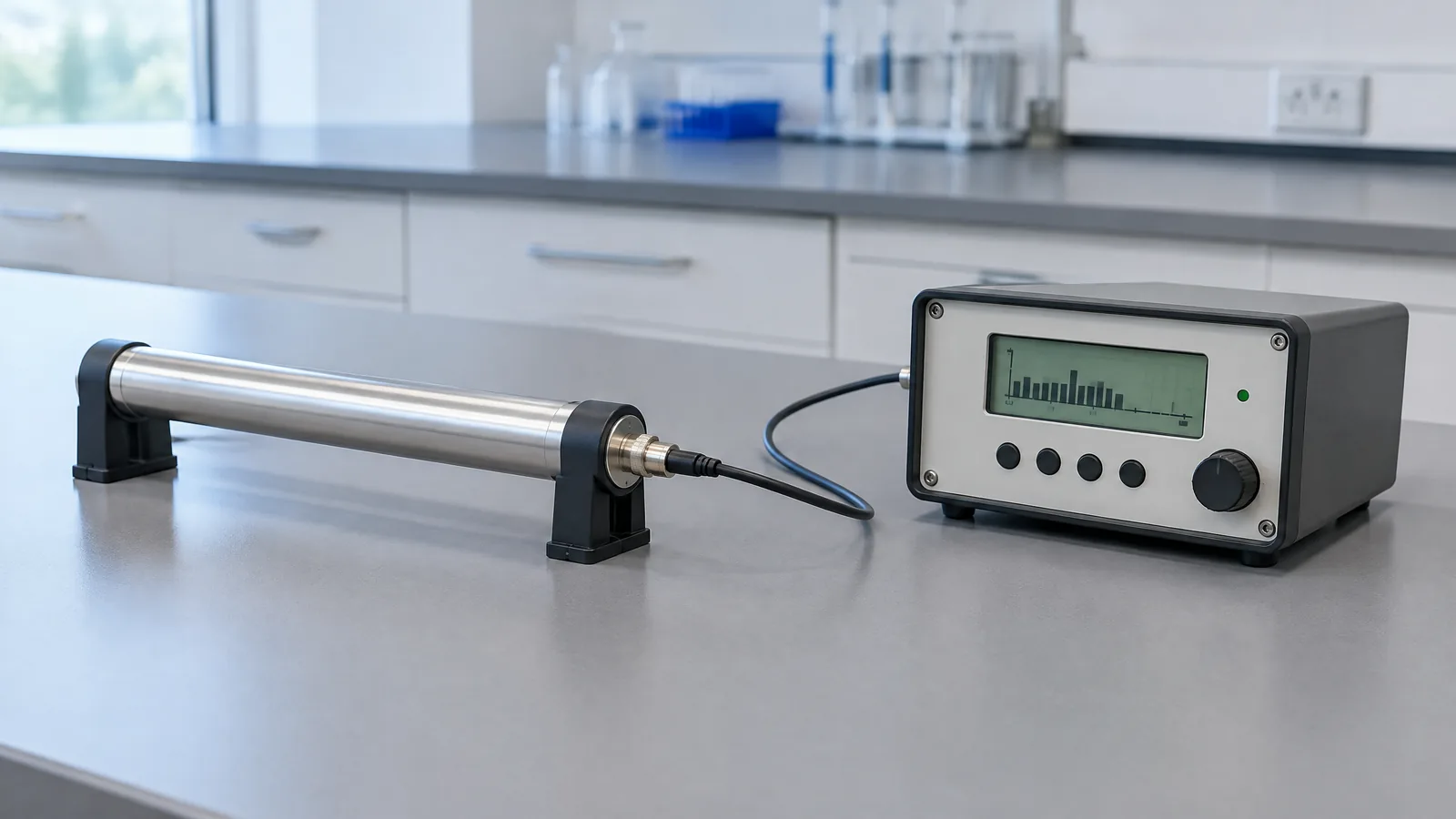
The physical sensor is the GM tube. It contains gas, electrodes and a high-voltage electric field. When ionising radiation enters the sensitive volume, it can create ion pairs. The resulting gas discharge becomes a short electrical pulse that connected electronics can turn into a click, a counter increment or a rate display.
A basic instrument commonly reports counts per minute (CPM): registered pulses during a one-minute interval. Background pulses are normal and vary with location, altitude, weather, ventilation and detector construction. A changing display is not automatically evidence of a dangerous source.
The tube does not identify the source, radiation type or particle energy. An end-window design may be sensitive to alpha, beta and gamma in suitable conditions; a side-wall design may mainly respond to beta and gamma. The exact window, housing and tube model matter.
- Physical sensor: the sealed GM tube.
- Support electronics: high-voltage bias and pulse handling matched to the tube.
- Optional electronics: scaler, buzzer, display, data logger or Arduino.
- Not automatically included: dose calibration, energy identification or safety certification.
How a GM tube pulse becomes a reading
A pulse-counting system has separate jobs. The tube creates a discharge; an interface shapes the signal; a counter records events over a chosen window; and software may calculate a rate. An Arduino, when used in supervised education, is the recorder or interface—not the radiation sensor.
Short windows react faster but fluctuate more. Longer windows smooth random variation but delay the result. A careful project labels its time window and retains raw counts. Never infer dose from a homemade conversion factor unless the complete instrument has been calibrated for the relevant radiation and energy.
A click is not a unit of dose. CPM is detector response under a particular geometry and setup. Dose rate is a different quantity that depends on radiation type, energy and calibration.
- Record raw pulses and the interval used.
- Keep position, orientation and surroundings consistent for comparisons.
- Treat any CPM-to-dose conversion as model- and calibration-specific.
Why dead time changes high-count readings
Dead time is the short interval after an event when the tube and electronics cannot register another event normally. If an event arrives during that interval it may be missed. As the true rate rises, a simple counter can under-report rather than increase linearly.
The IAEA gives about 300 microseconds as an illustrative GM dead-time value and warns that correction may be needed. NRC training likewise explains that a detector processing one event can be unable to detect subsequent events. Use the exact detector specification; do not copy one number into every Arduino sketch.
At sufficiently high fields a GM instrument can saturate. IAEA also lists energy dependence, no energy discrimination and poor suitability for pulsed accelerator radiation. A hobby pulse logger is not a substitute for a selected and calibrated professional instrument.
- Dead time can make high rates look lower than the true rate.
- Correction depends on detector and electronics, not only software.
- Saturation and pulsed-field limits are stop signs, not bugs to bypass casually.
Calibration: what turns counts into a qualified measurement
Calibration compares an instrument indication with a known value of the quantity it is intended to measure under controlled conditions. For a GM system, response, linearity, energy dependence and direction can matter. A tube can be functioning yet unsuitable for a claimed dose-rate measurement if its response does not match the field or energy.
IAEA recommends checking calibration validity and performing functional checks before practical monitoring. For learners, use manufacturer documentation and supervised laboratory procedures rather than source-based home testing. Do not obtain, open or handle radioactive materials to test a project. Background observation can demonstrate counting behaviour, but it does not calibrate an instrument.
Calibration has scope: a result may apply only to a defined detector, energy range, geometry and measurement quantity. If those conditions are missing, describe the result as an educational count rather than a dose assessment.
- A function check is not calibration.
- Calibration for one energy or radiation type does not cover all others.
- An uncalibrated counter should not guide compliance, health or emergency decisions.
What a beginner project can and cannot claim
A bounded electronics project can show how pulses are counted, how a time window changes variability, and how a display or logger handles events. It can compare background observations without introducing a radioactive source. State the tube model, interface assumptions, interval and whether the result is raw CPM or a derived rate.
It should not claim to identify a radionuclide, measure a person’s exposure, certify a workplace, locate a source safely or convert arbitrary CPM into universal dose rate. If a display suddenly rises, move away and follow local radiation-safety or emergency guidance instead of experimenting with the detector.
Is a GM tube the same as a Geiger counter?
The GM tube is the physical gas-filled detector. A Geiger counter combines it with high-voltage, pulse-processing, counting and display electronics.
Can an Arduino measure radiation directly?
An Arduino can count and log pulses from a compatible detector interface. It is not the radiation sensor and does not make the result calibrated or suitable for safety decisions.
Does higher CPM always mean higher dose?
No. CPM depends on detector design, geometry, radiation type and energy. A calibrated dose-rate instrument is needed for a qualified dose measurement.
Why does a GM counter miss events at high rates?
During dead time after one event, the tube and electronics may be unable to register another. At high rates this can cause under-counting and eventual saturation.
About the image
AI-generated editorial illustration; not an actual product or mission photograph.
Source notes
Reporting record
techduopulse stores source destinations privately. Public notes remain non-clickable so every visitor journey stays on this website.
Source note: IAEA radiation-monitoring lesson
Primary source · GM operation, dead time, saturation, energy response, calibration and practical limitsSource note: NRC Science 101 Geiger counter explainer
Primary source · Ionisation pulses, CPM, background variation and counts versus calibrated doseSource note: NRC instrumentation training
Primary source · Dead time at higher count rates and detector-specific specificationsNew educational explainer for the uncovered Geiger–Müller counter topic. Separates the physical GM tube from optional high-voltage, pulse-counting and Arduino logging electronics; explains CPM, dead time and calibration; and avoids radioactive-source handling, dose claims, unsafe testing and DIY safety advice.