
When two satellites are trying to detect tiny changes in Earth's gravity, air drag and sunlight can look like part of the signal. The GRACE-FO accelerometer measures those non-gravitational forces—not gravity itself—so scientists can separate them from the orbital changes used to study Earth's mass and moving water.
This article is part of the computer hardware technology guide library.
Key takeaways
- The GRACE-FO accelerometer is a specialised force sensor for a gravity-science mission.
- It measures non-gravitational acceleration, including effects from atmospheric drag and solar radiation pressure.
- Gravity is inferred from the combined evidence of satellite-to-satellite ranging, orbit information and force measurements.
- The resulting products can help study changes in groundwater, ice, soil moisture, lakes, rivers and sea level, but the accelerometer alone does not map any of them.
What does the GRACE-FO accelerometer measure?
The GRACE-FO accelerometer measures forces that act on a spacecraft for reasons other than Earth's gravity. Atmospheric drag can slow a satellite slightly, while solar radiation pressure can push on surfaces exposed to sunlight. Spacecraft operations can also introduce forces, such as those associated with attitude and orbit control.
NASA's Jet Propulsion Laboratory describes the instrument as a very sensitive accelerometer that measures forces besides gravity. In practical terms, its job is to provide the correction information needed when researchers interpret changes in the distance between GRACE-FO's two satellites.
That distinction matters. A precision accelerometer for gravity missions is not a direct gravity meter. It does not look down and identify an underground aquifer. It records the spacecraft's non-gravitational acceleration; the mission's science system then combines that record with other measurements to estimate changes in the gravity field.
Why a gravity mission needs this sensor
GRACE-FO flies two satellites one behind the other, separated by roughly 220 kilometres. They continuously measure their separation with a microwave ranging system. When the satellites pass over a region where Earth's mass distribution differs, the local gravity field changes their motion slightly. Those changes can alter the distance between the spacecraft.
The difficulty is that gravity is not the only influence on a satellite. Even a small push from the atmosphere or sunlight can change its motion. If that effect is left mixed into the ranging data, the inferred gravity field can be biased. The accelerometer supplies an estimate of the unwanted force so data processing can account for it.
This is a system-level measurement chain rather than a single-sensor reading. NASA describes the result as the combination of location, force and orbital-change measurements. The range instrument observes how the satellites move relative to one another; orbit and attitude systems provide additional context; the accelerometer helps identify the forces that should not be attributed to gravity.
| Mission element | What it contributes |
|---|---|
| Precision accelerometer | Measures non-gravitational forces acting on the spacecraft |
| Microwave ranging | Tracks changes in the distance between the two satellites |
| GPS and orbit determination | Supports precise spacecraft position and time information |
| Science data processing | Combines the measurements to estimate gravity-field and mass changes |
How the sensor fits inside GRACE-FO's instrument system
The GRACE Follow-On instrument-performance paper reports one precise accelerometer at the mass centre of each satellite. Its electrostatic sensing system observes displacement of a 72-gram proof mass along three linear and three angular directions, allowing the mission team to infer non-gravitational accelerations.
The same paper explains that GRACE-FO also uses GPS for precise orbit determination and time tagging, a dual-frequency K/Ka-band microwave instrument for intersatellite range variations, and a laser ranging interferometer operating in parallel as a technology demonstration. These are complementary instruments. The accelerometer is not a replacement for the ranging system, and the ranging system cannot by itself identify every non-gravitational push.
The mass-centre placement is also meaningful. It helps the instrument measure the spacecraft's translational and rotational responses in a controlled reference location. The published technical description reports both linear and angular sensing, so it is more specialised than the single-axis or three-axis MEMS accelerometer found in many consumer devices.
What GRACE-FO can learn from the combined measurements
After the force effects are accounted for, repeated measurements of the satellites' motion can be used to estimate changes in Earth's gravity field. Since gravity responds to the distribution of mass, those estimates reveal broad changes in water and ice that are difficult to observe from the ground alone.
NASA lists applications including changes in groundwater, soil moisture, water stored in large lakes and rivers, ice sheets, glaciers and the sea-level contribution from water added to the ocean. The GRACE applications overview also describes use in groundwater and drought-related workflows, and records GRACE-informed groundwater assessment as part of water planning and reporting in India.
These are derived Earth-observation products, not raw accelerometer outputs. They depend on the twin satellites, ranging, orbit information, calibration, models and processing over time. A reader should therefore avoid saying that the GRACE-FO accelerometer directly measures groundwater or drought. It helps make the broader gravity measurement usable.
Limitations and careful interpretation
A precision sensor does not remove every source of uncertainty. The technical performance paper reports that GRACE-FO accelerometer data require calibration, especially for the second spacecraft. Calibration and data-product adjustments were used to make the measurements useful, but this is a reminder that instrument output is part of a processing pipeline.
The mission also measures a large-scale gravity signal rather than taking a direct sample at one address. Spatial resolution, time averaging, orbit geometry and the models used to process the observations all affect what a final map means. A gravity-derived water-storage estimate should be read as an Earth-observation product with defined scale and uncertainty, not as a replacement for a local well measurement or a field survey.
Finally, the GRACE-FO accelerometer is not a suitable template for a hobby build or a phone-sensor experiment. Its electrostatic proof-mass design, spacecraft placement, calibration and supporting instruments are engineered for a specialised space mission. Consumer accelerometers can explain the general idea of measuring acceleration, but they do not reproduce GRACE-FO's gravity-science capability.
Frequently asked questions
Does the GRACE-FO accelerometer measure gravity directly?
No. It measures non-gravitational forces such as atmospheric drag and solar radiation pressure. Scientists combine that information with satellite ranging, orbit data and other processing to infer changes in Earth's gravity field.
Why do GRACE-FO satellites need two accelerometers?
Each of the two spacecraft carries its own precise accelerometer. The paired measurements help characterise non-gravitational forces on each satellite while the mission tracks their separation and relative motion.
Can GRACE-FO measure groundwater in India?
GRACE-informed products can support broad groundwater and water-storage assessment, and NASA's applications overview documents use of GRACE-informed groundwater assessments in Indian water planning and reporting. The accelerometer alone does not measure a local aquifer; the result comes from the complete mission and its data processing.
Is the GRACE-FO accelerometer like a phone accelerometer?
Both are acceleration sensors in a broad sense, but their designs and purposes differ greatly. GRACE-FO uses a specialised electrostatic proof-mass instrument at each spacecraft's mass centre to measure very small non-gravitational forces for orbital science.
What happens if drag is not corrected?
Drag changes the spacecraft's motion for a reason unrelated to the gravity signal being studied. If it is not estimated and accounted for, the resulting interpretation of intersatellite range changes can mix atmospheric effects with gravity-field changes.
About the image
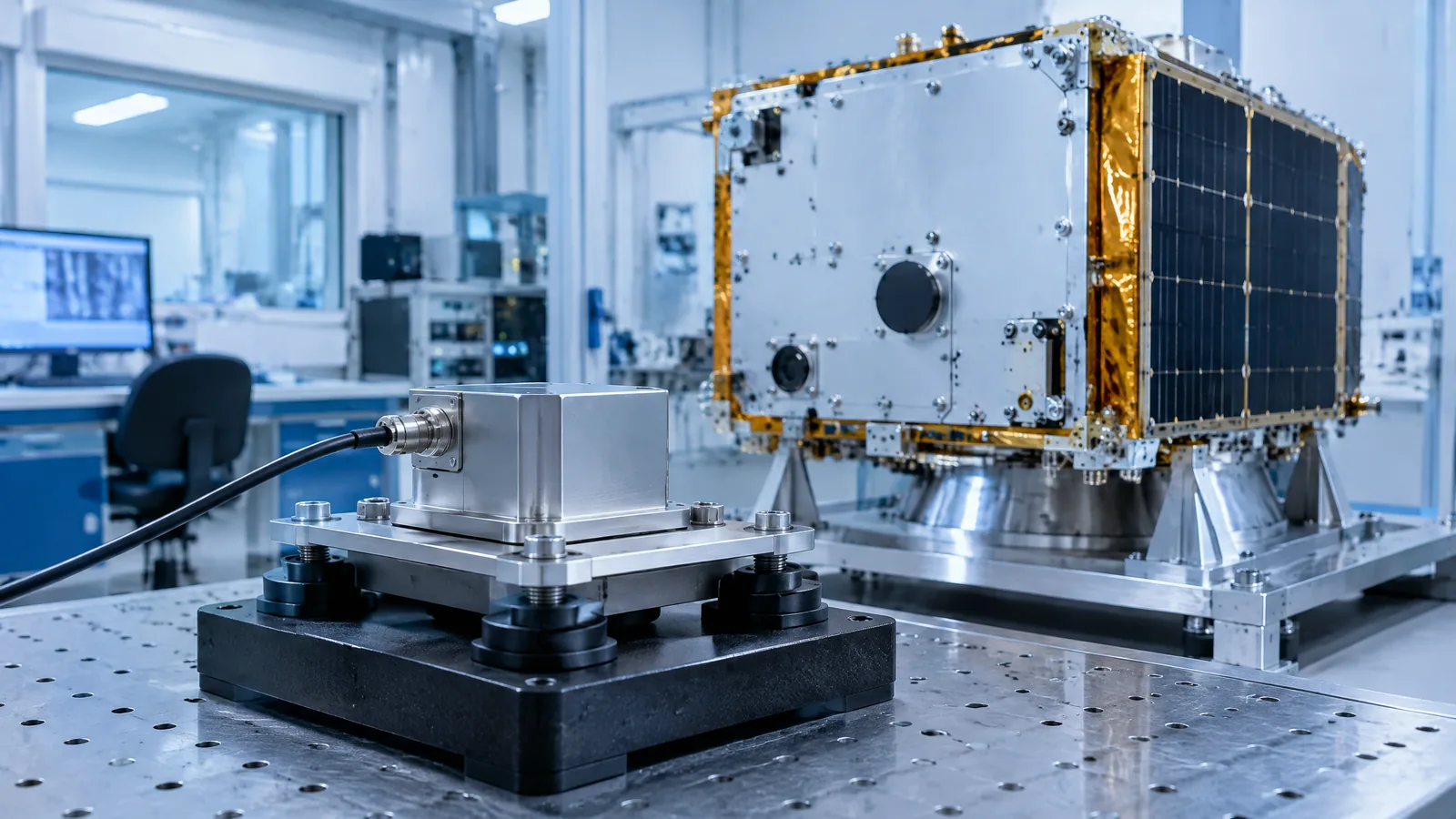
AI-generated editorial illustration; not an actual product or mission photograph.
Source notes
Reporting record
techduopulse stores source destinations privately. Public notes remain non-clickable so every visitor journey stays on this website.
Source note: NASA/JPL — GRACE-FO mission
Context source · Explains the twin-satellite ranging method, the accelerometer's measurement of forces besides gravity, correction for drag and solar pressure, and the mission's water and ice…Source note: American Geophysical Union / Geophysical Research Letters — Extending the global mass change data record: GRACE Follow-On instrument and science data performance (Landerer et al., 2020)
Context source · Details the accelerometer at each satellite's mass centre, electrostatic 72 g proof-mass sensing across linear and angular directions, non-gravitational-force correction,…Source note: NASA/JPL — Societal Benefits and National Interests / GRACE applications overview
Context source · Describes gravity-based water, ice and drought applications, operational data use, and NASA's record of GRACE-informed groundwater assessment in Indian water planning and…Created a distinct application article rather than duplicating the existing general accelerometer guide. Clarified that the GRACE-FO accelerometer measures non-gravitational forces and that gravity, groundwater and drought insights are derived from the complete mission measurement and processing system.


