
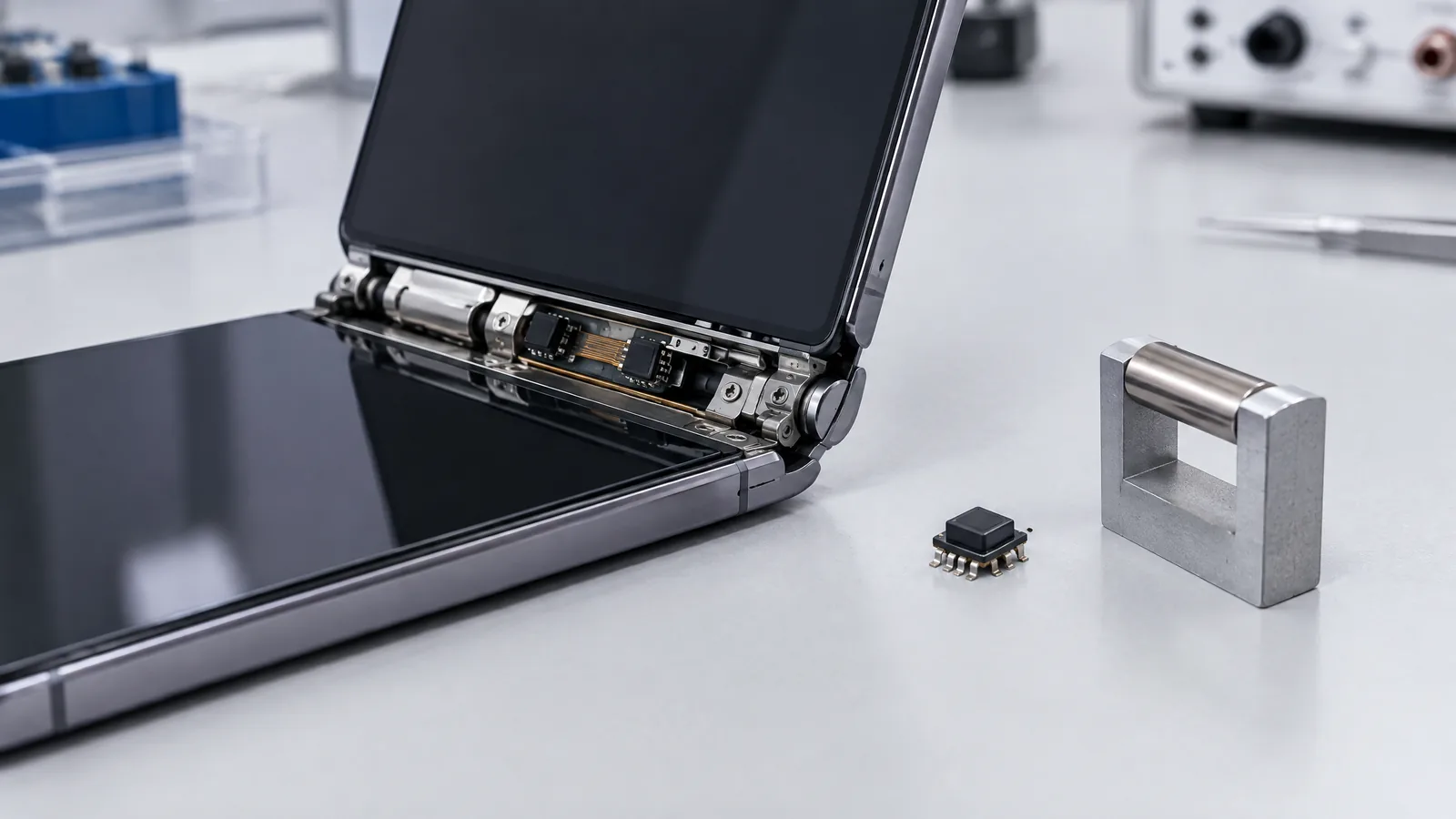
When a foldable phone wakes its inner screen as you open it, you may wonder how it knows the two halves have moved apart. A fold-state Hall-effect sensor measures a change in the local magnetic field from a nearby magnet, giving the phone an early signal that the device is opening or closing.
This article is part of the computer hardware technology guide library.
What a fold-state Hall-effect sensor measures
A fold-state Hall-effect sensor is a physical magnetic-field sensor used with a magnet. It does not measure the hinge angle directly. Instead, it detects how the magnetic field at its sensing area changes as the magnet moves closer or farther away during folding.
In one described clamshell arrangement, the magnet sits near one inner edge and the Hall sensor sits opposite it. When the phone opens, the field read by the Hall sensor declines; when the phone closes, the field increases. The exact direction depends on the magnet position, sensor orientation and the design's magnetic circuit. [1]
That distinction matters. The component reports a magnetic condition, while phone software and other electronics interpret that condition as a likely open or folded state. A Hall sensor is therefore one input in a state-detection system, not a universal hinge-angle instrument.
How the magnet and sensor work together
The magnet is not the sensor. It is an external magnetic component positioned so that folding changes the field reaching the Hall IC. The physical Hall sensor converts that field condition into an electrical signal, such as a change on a digital input. A nearby controller can then use the signal as an opening or closing trigger.
A simple design may use a threshold: one field condition means the halves are close, and another means they have moved apart. The useful threshold depends on the selected Hall part, magnet strength, distance, polarity and alignment. Two phones can use the same sensing principle but different placements and switching behaviour.
This arrangement can provide an early, low-power event. The technical disclosure describes an always-on chip receiving the Hall signal and waking a more power-hungry application processor when the device may have opened, or helping place it into a low-power state when it has folded. [1]
- Physical sensor: the Hall IC that responds to the magnetic field.
- Magnet: a separate magnetic component whose position changes with the fold.
- Electronics: the always-on controller, application processor and display logic that interpret the signal.
- Optional confirmation: a touch IC mutual scan or accelerometer may check the state in some designs.
Why a phone may use more than the Hall sensor
A Hall reading can be fast and power-efficient, but it can also be influenced by an outside magnetic field. The cited disclosure specifically notes susceptibility to external fields, including fields generated by wireless chargers. That is why a product may treat the Hall transition as an initial indication rather than final proof. [1]
One described approach triggers a mutual scan in the touch integrated circuit after the Hall sensor detects a possible opening or folding event. The scan checks whether two touchscreen regions are in the expected relationship, and the system can combine that result with the Hall signal before changing the inner display state. [1]
An accelerometer is another optional component. It can detect motion associated with opening, work alongside the Hall sensor for redundancy, or replace it in an alternative design. These parts are model-specific. A conventional slab phone does not need fold-state detection, and not every foldable uses the same sensor combination.
Samsung's published Galaxy Z TriFold specification lists a hall sensor among the phone's sensors, alongside an accelerometer, gyro, geomagnetic sensor, proximity sensor and light sensor. The specification confirms the listed component for that model; it does not disclose the exact magnet layout or the software sequence used for display switching. [2]
What happens when the foldable phone opens
A typical sequence can be understood without assuming one exact product implementation. First, the magnet moves relative to the Hall sensor as the hinge opens. The resulting field change crosses the sensor's configured detection condition. An always-on controller receives the event and can request a more complete state check or wake the main processor. Display software then decides whether the inner screen should become active.
Closing follows the reverse pattern in the described arrangement: the magnet comes nearer, the field rises, and the system receives a closing indication. The phone may then turn off, limit or change the inner display state. The result depends on firmware, power-management policy and the rest of the device design; the Hall transition alone does not guarantee a visible screen action. [1]
This layered design also explains why a small physical sensor can participate in a noticeable phone feature. The sensor is not rendering the display or controlling the hinge. It is supplying an early measurement to electronics that make the state decision.
- Magnet-to-sensor spacing changes as the fold moves.
- The Hall IC reports a field transition to control electronics.
- Optional touch or motion sensing can confirm the event.
- The phone's power and display logic applies the final state change.
Limitations and what the sensor cannot tell you
A fold-state Hall-effect sensor is not a universal measure of hinge angle. It is most useful when the phone's mechanical layout creates a repeatable magnetic change between the intended states. A sensor can indicate that a threshold was crossed without providing a precise angle in degrees.
External magnets and magnetic accessories may alter the field at the sensing area. Orientation, distance, polarity and the individual IC's thresholds also matter. A wireless charger or another magnetic object can therefore complicate detection in a particular arrangement, even when the phone is working as designed. [1]
The sensor is also optional at the product-category level. The brief's evidence supports Hall-based fold detection as a documented technique and confirms a Hall sensor in Samsung's Galaxy Z TriFold specification. It does not support saying that every foldable phone has one, that every Hall sensor is placed in the hinge, or that a user can diagnose a phone fault from the word “Hall” in a specification alone.
Key takeaways
The fold-state Hall-effect sensor measures a local magnetic-field change caused by a magnet moving as a foldable phone opens or closes. It helps electronics infer device state; it does not directly measure hinge angle.
Some designs use a Hall event as an early trigger and add a touch-IC scan, accelerometer or other controller for confirmation. These components are optional and model-specific.
External magnetic fields, magnet placement, polarity, distance and sensor thresholds can affect the reading, so the same principle does not imply identical behaviour across foldables.
Frequently asked questions
What does a fold-state Hall-effect sensor detect?
It detects a change in the local magnetic field from a nearby magnet as the foldable phone opens or closes. The phone's electronics interpret that change as evidence of a likely fold state.
Is a Hall sensor the same as a hinge-angle sensor?
No. A Hall sensor measures magnetic-field conditions. A design can use those conditions to distinguish broad states such as open and folded, but that does not make the sensor a direct, universal hinge-angle measurement device.
Do all foldable phones use a Hall sensor?
No such universal claim is supported. The evidence describes Hall-based fold detection as one technique, and Samsung lists a hall sensor for Galaxy Z TriFold. Other foldables may use different sensors, confirmation methods or layouts.
Can a magnet interfere with fold-state detection?
It can affect a Hall-based arrangement if it changes the field at the sensor. The technical disclosure notes susceptibility to external magnetic fields, including fields associated with wireless chargers. The practical effect depends on the phone's design and accessory.
Why might a foldable phone also use an accelerometer or touch sensor?
A second sensing method can help confirm a Hall-triggered event or provide redundancy. The cited design describes an accelerometer as an additional or alternative sensor and a touch-IC scan as a possible confirmation step.
About the image
AI-generated editorial illustration; not an actual product or mission photograph.
Source notes
Reporting record
techduopulse stores source destinations privately. Public notes remain non-clickable so every visitor journey stays on this website.
Source note: Technical Disclosure Commons Defensive Publications Series disclosure
Primary source · Magnet and Hall placement, field change during opening/closing, optional touch-IC and accelerometer confirmation, controller/display sequence, external magnetic-field limitationSource note: Samsung Newsroom Galaxy Z TriFold specification table
Primary source · Galaxy Z TriFold sensors list includes hall sensorNew application-focused explainer separating the physical Hall sensor and magnet from optional touch-IC, accelerometer, always-on controller and application processor. Uses the supplied Technical Disclosure Commons source for fold-state mechanism and limitations, and Samsung's specification page only for the model-specific sensor-list confirmation. Avoids claiming universal foldable-phone hardware or direct hinge-angle measurement.


