An engine knock sensor is a specialised vibration sensor that helps an engine-control system recognise a combustion event called knock. Its value is not that it can name every rattle under a bonnet, but that it supplies a carefully interpreted signal at the point where combustion, mechanical vibration and electronic control meet.
On this page 4 sections
Part of our computer hardware technology guide library
How an Engine Knock Sensor Turns Vibration Into Engine-Control Information
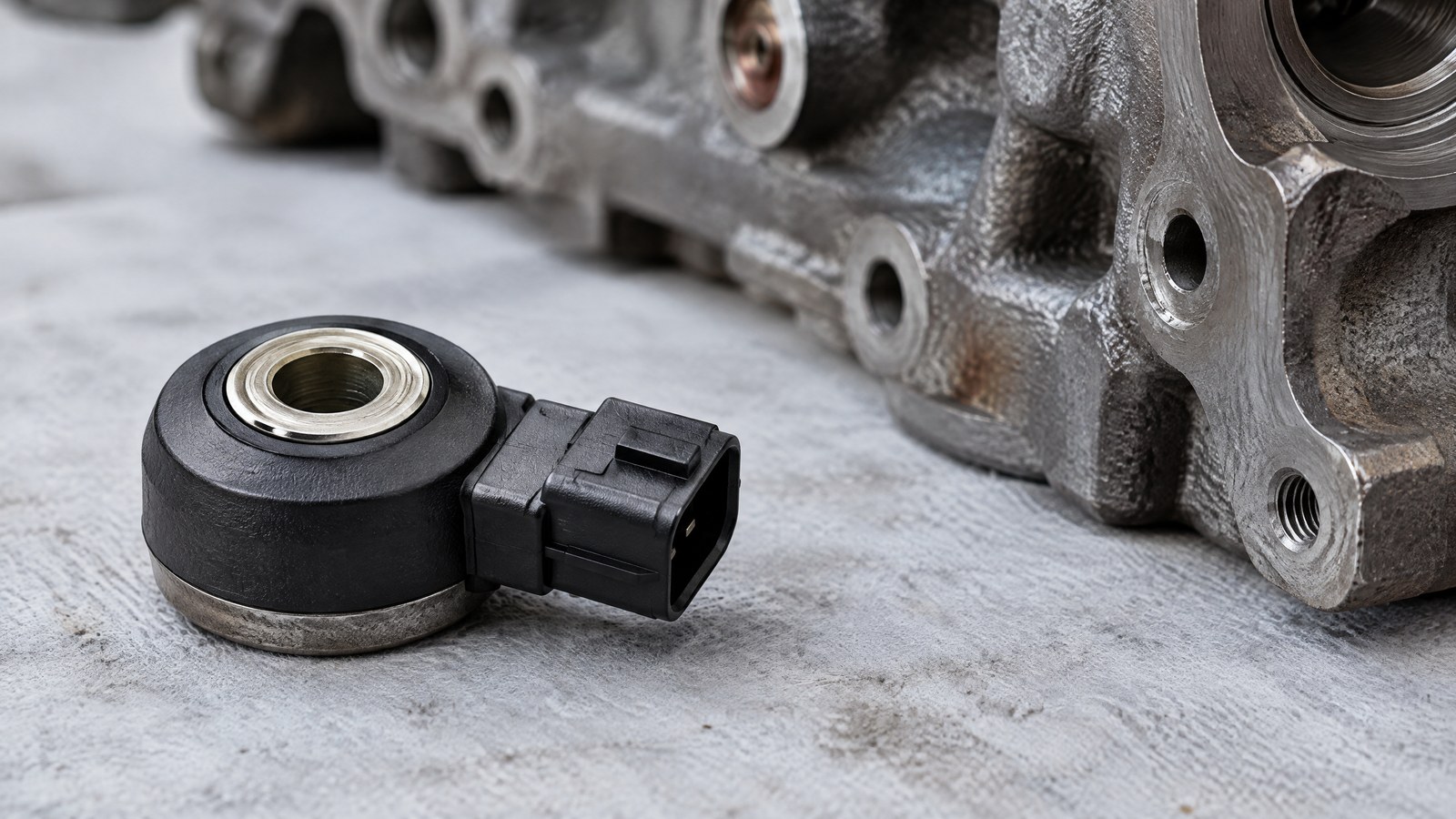
An engine knock sensor is attached directly to the engine structure, where it measures structure-borne vibration rather than exhaust sound or cabin noise. Bosch describes a crankcase-mounted example with a piezoelectric measuring element that identifies the higher-frequency vibration characteristic of knocking and sends a signal to the engine-control unit, or ECU; TI describes a typical sensor mounted on the engine block [1] [4].
AI-generated editorial illustration of generic engine knock-sensor hardware beside an engine block, not a photograph of a tested product or an actual field measurement.
The important word is “characteristic.” A running engine naturally produces many overlapping vibrations from combustion, valves, injectors, rotating parts and accessories. The sensor’s electrical output is therefore raw evidence, not a verdict. Electronics and software consider the part of the signal that is relevant to the engine and its operating moment before the ECU uses it as input to combustion control [2] [3].
Combustion knock is not a generic mechanical noise
Combustion knock, also called detonation in some technical material, is abnormal combustion inside a cylinder. Texas Instruments describes it as uncontrolled ignition of pockets of the air-fuel mixture in addition to the pocket initiated by the spark plug; it can raise cylinder pressure and may produce a pinging sound [4]. This is different in kind from simply hearing a click, tick, belt squeal or loose heat shield.
That distinction matters because people often use “engine knock” as a catch-all label. A noise heard by a driver can have several possible sources, while combustion knock is a pressure-and-vibration event associated with what is happening in a cylinder. The knock sensor is designed around the latter. It is not a universal acoustic diagnosis device, and a sound alone cannot establish that the sensor, fuel, ignition system or an internal mechanical part is responsible.
Piezoelectric material converts vibration into an electrical signal
The sensing element is commonly piezoelectric ceramic. When the engine structure vibrates, the sensor’s mechanical construction loads the ceramic and produces an electrical response. Bosch’s example identifies a seismic mass and ring-shaped piezo ceramic among the sensor’s components; Niterra likewise describes piezoelectric ceramics detecting knocking vibration [1] [2].
This arrangement explains why physical mounting and engine structure matter to the signal. The sensor is coupled to the engine’s vibration path, not placed as a free-standing microphone. A response that is useful on one engine is not automatically interpreted the same way on another, because engine geometry, sensor placement and ordinary background vibration differ.
The control system separates a relevant pattern from background vibration
A sensor alone does not make a knock decision. In one TI interface example, the electrical signal passes through amplification, filtering and integration. Its programmable band-pass filter is intended to extract the frequency component associated with the engine and transducer while reducing background combustion noise [3]. The controller can then interpret an output in relation to engine speed, load and a defined time in the combustion cycle.
A useful engineering detail is the knock window: TI describes systems that look for knock for a specified time after top dead centre, resetting the integrator at the start of that window [4]. This is why “it senses vibration” is true but incomplete. The system is selective in both frequency and time, which helps it avoid treating all normal engine vibration as evidence of knock.
Resonant and non-resonant sensors describe signal emphasis, not a universal diagnosis
Knock sensors may be discussed as resonant or non-resonant types. A resonant design emphasises a narrower vibration region, whereas a non-resonant design offers a broader response that the rest of the system can process selectively. TI notes that flat, non-resonant sensing elements have wider frequency bandwidth than resonant ones [3].
That label does not tell an owner which component fits a particular vehicle or prove that a sensor is faulty. It explains an engineering trade-off in how the vibration signal is presented to the control system. Vehicle-specific documentation and qualified diagnosis remain necessary whenever a part is being assessed or replaced.
Important Points / Key Information
The engine knock sensor is best understood as one input to a closed control loop. It detects a targeted kind of structure-borne vibration, signal-processing electronics isolate a relevant pattern, and the ECU uses that interpreted information to manage knock-related combustion control [1] [3].
Key Takeaways
- Knock refers to abnormal combustion, not every mechanical sound an engine can make.
- A piezoelectric knock sensor changes engine-block vibration into an electrical signal; it does not directly measure a driver’s audible impression.
- Filtering and a time window help the control system distinguish a knock-related pattern from normal background vibration.
- A sensor reading, unfamiliar noise or warning indication is evidence for qualified assessment, not a stand-alone repair conclusion.
What the signal cannot establish by itself
The sensor cannot, by itself, prove the root cause of a noise or declare an engine mechanically healthy. Its output can be influenced by the vibration path, background combustion, the specific sensing element and the control system’s interpretation. TI’s technical material shows why the processing stage exists: it uses filtering, gain and time integration rather than passing a bare vibration measurement straight to a conclusion [3] [4].
For a car owner, the safe takeaway is modest: persistent unfamiliar metallic sounds, a warning indication or a change in how the vehicle runs deserves vehicle-specific assessment by a qualified professional. Avoid treating an online description as a calibration instruction, a parts-selection rule or a reason to override a vehicle’s safety or emissions systems.
Examples / Supporting Information
The following examples show how the idea is used, not how to modify an engine-control system. They are included to separate an engineering signal from the broader, often ambiguous experience of hearing an engine noise.
A sourced signal-processing example
In its 2014 technical article, TI presents a knock-sensor signal-conditioning system in which a piezoelectric sensing element feeds a signal conditioner, which then sends an interpreted voltage signal to the engine control module. The illustrated sequence includes amplification, a band-pass filter, rectification and integration during a defined knock window; the processor uses the resulting data in spark-ignition timing control [4]. This is a concrete example of the sensor-plus-processing architecture, not a recommendation to reproduce those settings in a vehicle.
Niterra’s product description supplies a complementary manufacturer example. It identifies a non-resonant piezoelectric ceramic sensor used for detection of vibration caused by engine knocking and for ignition-timing control, while describing flat output over its stated knock-frequency band [2]. Manufacturer descriptions explain component intent, but they do not substitute for the exact design and diagnostic information of any specific vehicle.
Hypothetical India-focused ownership context
Hypothetical scenario: an owner in India notices an unfamiliar pinging or rattle during a normal commute and wonders whether it is “knock.” The useful first distinction is that the sound may be combustion knock, ordinary engine vibration or an unrelated mechanical issue; the ear cannot reliably sort those categories by itself. A technician with the correct vehicle information can interpret fault information and physical symptoms together rather than assuming that an engine knock sensor is the cause.
The broader lesson applies whether the vehicle is a car, two-wheeler, construction machine or stationary engine: sensor context matters. Niterra lists knock-sensor applications across several engine-powered machine types [2], but the meaning of a signal still depends on the engine and control system around it.
Conclusion
An engine knock sensor is a focused piezoelectric vibration sensor, not an all-purpose listener for anything that sounds wrong. By detecting knock-related structure-borne vibration and feeding a selectively processed signal to the ECU, it supports combustion control while leaving the interpretation of other noises to broader vehicle diagnosis [1] [3].
For nonexpert readers, the most useful distinction is simple: combustion knock is a specific event, whereas “knocking noise” is an everyday description that can cover many causes. Keeping those meanings separate makes the technology easier to understand and helps avoid unsafe conclusions from a sound, a code or a single sensor signal.
How we checked thisSources (4)
We keep source links private so your reading stays on techduopulse. Each note names the publisher and document we checked.
Bosch explanation of structure-borne knock sensing
Primary source · How an Engine Knock Sensor Turns Vibration Into Engine-Control InformationNiterra description of non-resonant piezoelectric knock sensing
Primary source · A sourced signal-processing exampleTexas Instruments knock-sensor interface data sheet
Primary source · The control system separates a relevant pattern from background vibrationTexas Instruments explanation of knock windows and signal conditioning
Primary source · A sourced signal-processing exampleOwner-approved educational sensor explainer; obsolete private-draft status removed without changing source-backed facts or professional safety boundaries. Original generic AI editorial illustration, not a product or field-test photograph.