
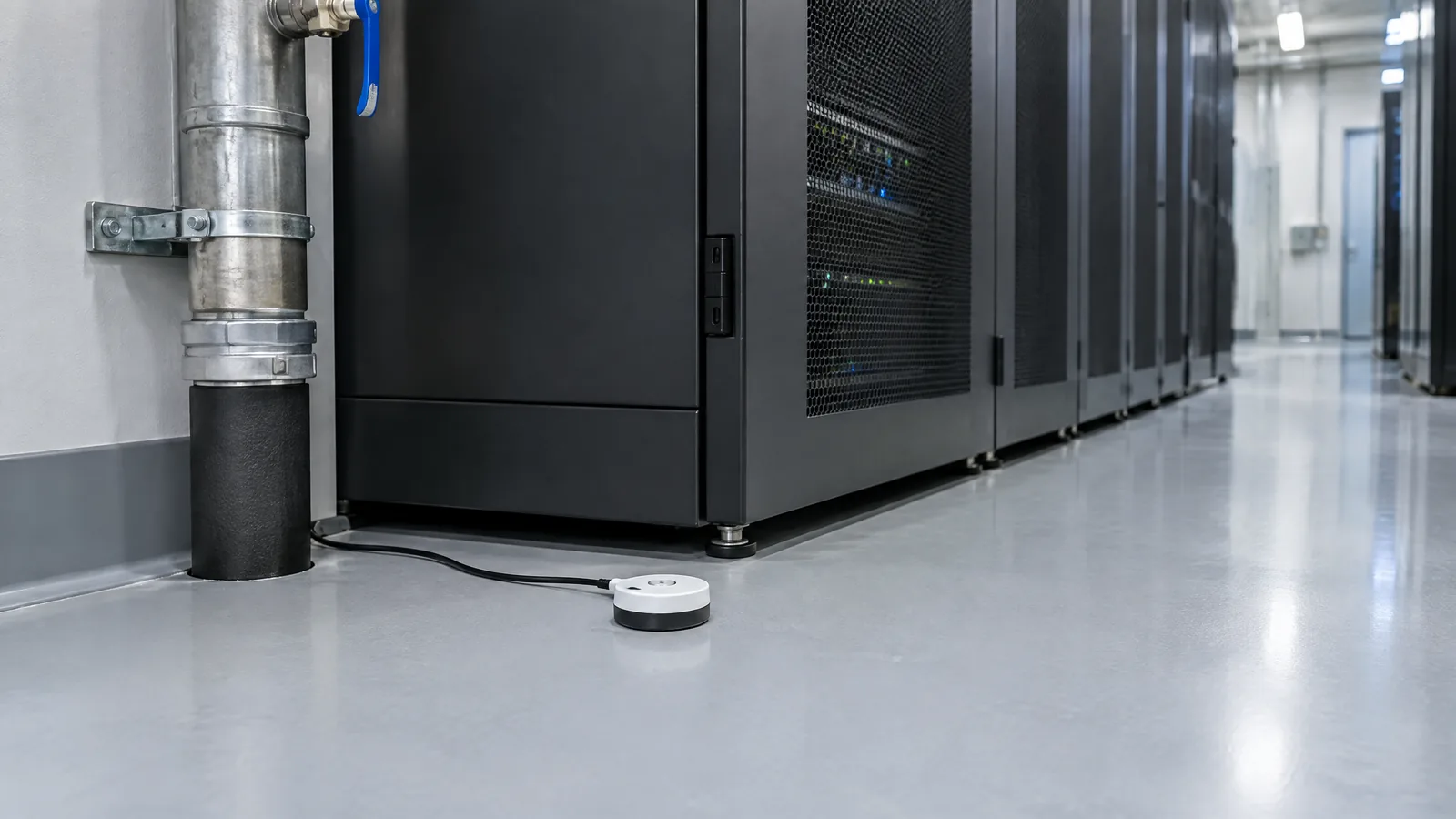
A small drip under a server-room pipe, chiller connection or elevator-pit fitting can go unnoticed until it reaches equipment or a hard-to-access area. A commercial building water leak sensor based on a conductive spot probe detects water at the selected point, giving the building team an early alert—but it does not map the whole building or locate leaks inside a buried pipe.
This article is part of the computer hardware technology guide library.
Key takeaways
A water-leak spot probe is a point detector: it responds when water bridges its sensing contacts at the installed location.
It can suit selected risk points such as below plumbing connections, near chilled-water equipment, inside server rooms or at elevator pits.
The probe is only one part of a system. An alarm, monitor, communications path and response plan may be separate components.
One probe cannot promise room-wide coverage, pipe-leak location or automatic shut-off unless the wider system has those capabilities and has been designed for them.
- Use a point probe for a defined local risk, not as a substitute for a building-wide survey.
- Choose a cable, tray or other zone arrangement when the risk area is wider than one spot.
- Treat shut-off valves, pumps, remote alerts and building controls as external or model-specific functions.
What does a water-leak spot probe measure?
A conductive water-leak spot probe detects the presence of conductive liquid at its sensing contacts. In simple terms, water reaches the probe, changes the electrical condition between the contacts and produces a signal for an alarm or monitoring device. It answers a narrow question: has liquid reached this chosen point?
That makes it different from a level sensor in a tank. A level sensor is normally arranged to detect or measure material height in a vessel. A spot probe is placed on a surface or in a small risk area to indicate local wetness. It does not measure the volume of water in a room, the flow rate in a pipe or the exact path that a leak took.
The word “conductive” also matters. The probe is intended for a liquid that can complete the sensing circuit. A dry surface, a poorly positioned probe or a liquid with different electrical properties may not produce the expected response. Follow the chosen device’s instructions instead of assuming every liquid behaves like clean water.
Where can a spot probe help in a building?
Place the probe at a known consequence point: under a valve or pipe joint, beside a chilled-water unit, near a server-room cooling route, or at a low point where water could collect. The aim is not to cover every square metre. It is to watch a location where even a small amount of water deserves attention and where staff can identify the related equipment quickly.
Commercial leak-detection guidance identifies server rooms, elevator pits, storage areas, unattended spaces, industrial facilities and chilled-water applications as distinct use contexts. Each context changes the mounting, access and response requirements. An elevator pit, for example, may need a solution that can be inspected safely without treating the probe as permission to enter a hazardous area during an incident.
Before choosing a position, consider how water will actually travel. A raised threshold, cable tray, floor slope, drain or equipment base can prevent water from reaching a probe placed only a few centimetres away. A probe should be accessible for inspection and protected from routine cleaning, splashes and accidental movement where the application requires it.
- Server or network room: watch a selected low point near water-bearing cooling or plumbing routes, while keeping the detection path separate from electrical hazards.
- Chilled-water equipment: monitor a connection or condensate-risk area identified by the facilities team; do not assume the probe covers the entire plant room.
- Elevator pit: use only as part of a site-approved detection and response arrangement, with access and electrical safety handled by qualified personnel.
- Unattended or storage area: pair a local detector with a remote alert when a nearby person may not hear an audible alarm.
A point probe is not a complete leak-location system
A spot probe gives local evidence, not a building-wide diagnosis. If the water flows around the probe, collects elsewhere first or comes from a concealed route, the alert may be delayed or absent. The installation therefore needs risk prioritisation: identify the assets and rooms where early warning matters, then decide how many sensing points are justified.
The U.S. Department of Energy’s facility guidance makes a similar distinction at a larger scale. Smart meters can help indicate that a leak exists but cannot locate it directly. Facility-level and distribution-level work may use different methods, including acoustic tools, thermal imaging, in-pipe sensors, fibre optics or other technologies. A conductive spot probe should not be presented as a replacement for those approaches.
For a wider area, an external sensing cable or a set of probes may create more coverage. Above-ceiling trays and specialised guards are another distinct arrangement. These are not simply “better probes”; they are different components with different installation and maintenance needs.
| Need | Possible arrangement | What it still cannot promise |
|---|---|---|
| One known wet-risk point | Conductive spot probe and local alarm | Coverage of the whole room or hidden pipework |
| A longer floor or equipment edge | Sensing cable or multiple point probes | Accurate source location unless the system is designed to report zones |
| Remote or unattended monitoring | Probe connected to a monitor or communications system | A response if the alert path, power or escalation plan fails |
| Suspected distribution-pipe leak | Site investigation using an appropriate facility or utility method | A conclusion from one surface probe alone |
Which components are optional, model-specific or external?
The physical probe is not the same thing as the complete alert system. A basic installation may use a sensing probe and a nearby audible alarm. A larger arrangement can add a monitor panel, several detectors, remote notifications, a sensing cable, a power supply or connections to building controls. The exact functions depend on the selected equipment and its installation.
A valve or pump interface is an external control function, not an automatic feature of every conductive probe. Some commercial systems are designed to control valves, pumps or other electrical equipment, but that capability must be specified, installed and tested as a system. It should not be improvised around a sensor output, especially where an incorrect action could interrupt critical building services.
The same separation applies to instruments. A multimeter used during troubleshooting, a building-management-system input and a leak-detection monitor are not interchangeable evidence. Use the device documentation and a qualified facilities or electrical professional for wiring, isolation, alarm testing and any connection to consequential equipment.
- Physical sensor: the conductive contacts that respond to liquid at the selected point.
- Alarm or monitor: local or remote equipment that interprets the sensor signal and notifies someone.
- Coverage accessory: cable, tray or additional probes for a larger area.
- External response equipment: valve, pump, building-control input or work-order system, where specifically supported.
- Human response plan: inspection, isolation, repair and escalation steps owned by the building team.
How to assess coverage before installation
Start with the consequence, not the product name. List rooms and equipment where water could damage electronics, interrupt operations or remain hidden. Mark likely leak paths, low points, drains and access restrictions. Then decide whether one point is enough to provide useful early warning or whether the area needs several points, a cable or a different detection method.
Confirm what the alarm means. A wet probe may indicate water at the sensor, but it does not identify the failed fitting or prove that no water exists elsewhere. Define who receives the alert, how quickly the location can be checked and what information should be recorded. For an unattended room, a local buzzer alone may not meet the response need.
Finally, plan routine inspection. Check that the probe has not moved, been covered by dust or cleaning residue, or become disconnected. Review nuisance alarms after cleaning or maintenance and change the placement only after considering the original risk path. The goal is a dependable detection arrangement, not the largest number of sensors.
Water-leak spot probe FAQs
What is a water-leak spot probe?
It is a conductive point sensor that detects liquid reaching its sensing contacts at a selected location. It normally provides a signal to an alarm or monitoring device; it does not measure room-wide water volume or automatically locate the source of a leak.
Where should a commercial building water leak sensor be placed?
Place it at a selected consequence point where water is likely to collect or where early warning matters, such as beneath a plumbing connection, near chilled-water equipment, in a server-room risk area or at a planned elevator-pit low point. The position must match actual water paths and access requirements.
Can one spot probe protect a whole server room?
Not reliably. One probe covers its installed point and may miss water that flows elsewhere or remains concealed. A risk assessment may justify multiple probes, a sensing cable, a tray arrangement or another detection method.
Does a leak sensor shut off a valve automatically?
Not by itself. Some complete monitoring systems can interface with valves, pumps or building controls, but those are model-specific external functions requiring suitable design, wiring and testing.
Is a water-leak spot probe the same as a water meter?
No. A spot probe detects liquid at a point. A meter measures water use or flow, and a meter may help indicate an unexplained loss without locating it directly. They answer different monitoring questions.
About the image
AI-generated editorial illustration; not an actual product or mission photograph.
Source notes
Reporting record
techduopulse stores source destinations privately. Public notes remain non-clickable so every visitor journey stays on this website.
Source note: Water Alert commercial-building leak-detection application guidance
Primary source · Commercial locations, point detectors, active monitors, remote alarms, sensing cables and specialised coverage componentsSource note: U.S. DOE FEMP distribution-system leak-detection guidance
Primary source · Meters cannot locate leaks directly; facility and distribution methods differ; combinations depend on site size and needInitial 15 October 2026 India-facing application explainer. Adds a distinct commercial-building use case for a conductive point probe, separates the physical sensor from alarms, monitors, cables, valves and response plans, and qualifies coverage and leak-location limits using Water Alert and U.S. DOE guidance without making product-wide or safety-critical claims.


