SEO Title: Level Sensor: Types, Working and Uses Meta Description: Learn what a level sensor is, how point and continuous measurement work, and when ultrasonic, radar, float and pressure methods fit.
This article is part of the software engineering technologies guide library.
What is a level sensor?
A level sensor detects or measures the level of a material in a vessel, tank or other container. The material may be a liquid, slurry, powder or another bulk material—not only water. A system may use the resulting signal to show a reading, raise an alarm, control a pump or support a process decision.
There are two broad jobs a level-measurement system can perform:
Point level detection answers a threshold question: has the material reached the high mark, fallen below the low mark, become full or become empty? A switch-based device can be used for alarms, pump control or overfill-related functions. [1] [2]
Continuous level measurement reports the current level over a range, rather than only one threshold. It is useful when a display, trend or ongoing control decision needs to reflect how the fill level changes. [1] [2]
For example, a simple water tank level sensor may switch a pump based on a low and a high point. A continuous system can instead report an approximate level across the whole tank height. Neither approach is automatically “better”; the useful choice depends on the question the system must answer.
How does a level sensor work?
The operating principle is usually one of two approaches: sense a physical change at the material, or measure the distance or pressure associated with the material level.
A float is a familiar direct approach. As a liquid rises or falls, the float moves; that movement can be converted into an indicated level or a switching action. [4] A probe-based method can interact electrically with the material. A pressure-based method is different: pressure at the bottom of a liquid tank increases with the liquid column above it. In a differential-pressure arrangement, the bottom pressure is compared with a lower reference pressure, commonly atmospheric pressure for the situation described in the NPTEL lesson. [4]
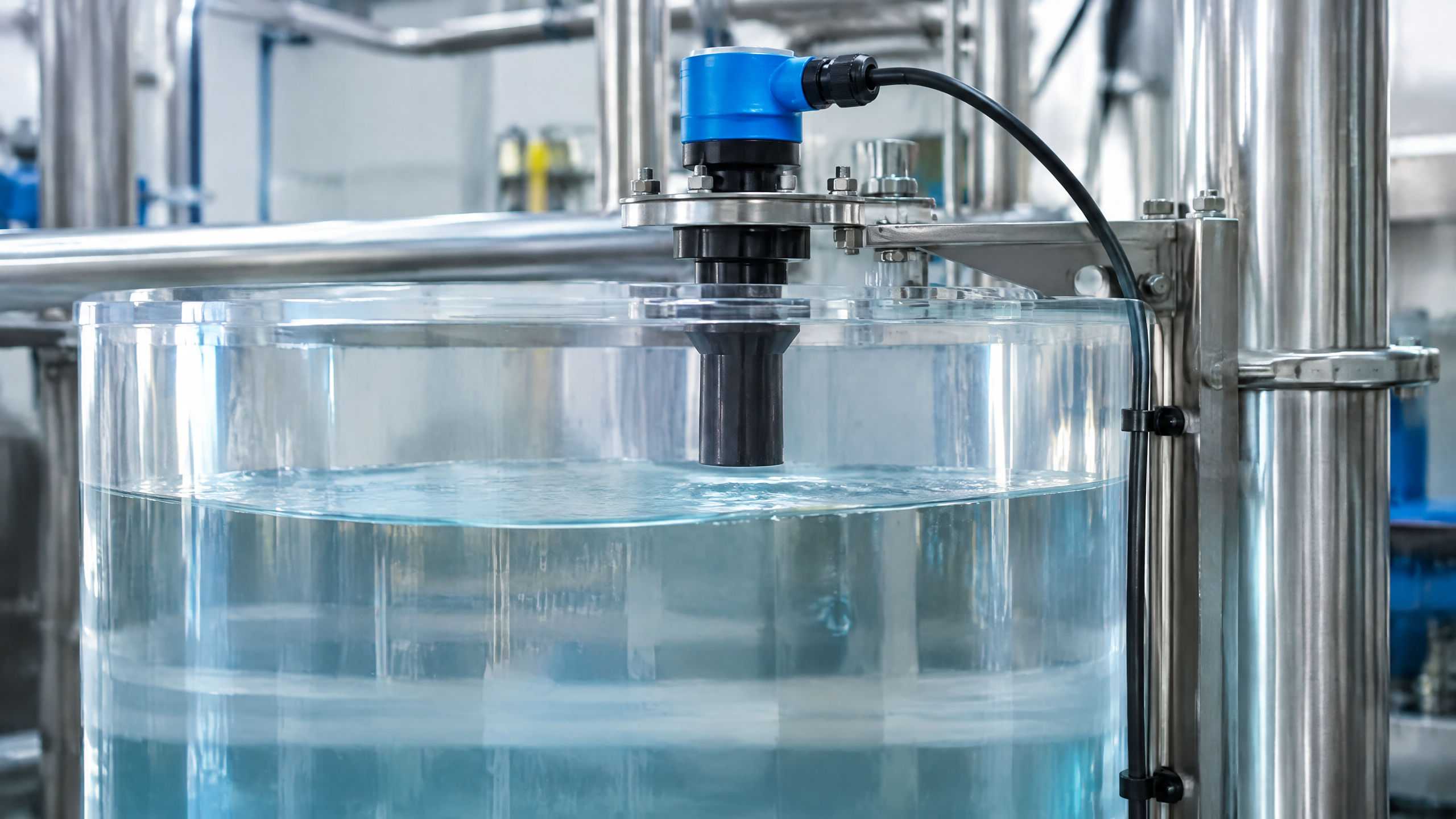
Non-contact methods often work from above the surface. An ultrasonic level sensor sends sound waves and measures a reflected signal. A radar level sensor uses reflected electromagnetic waves instead. Both can use a time-of-flight idea—measure the return time and infer the distance to the surface—but their implementation and environmental limitations are not the same. [2] The instrument then relates the measured distance, pressure or signal change to the tank’s level according to its configuration.
Main level sensor types
A practical way to group level sensor types is by whether the measurement element contacts or interacts directly with the medium.
### Float and switch devices
Float devices move with the liquid level and may provide a direct indication or a high/low switch. They are especially intuitive for a clear threshold task, such as signalling full or empty. Their suitability still depends on the liquid and the mechanical arrangement. [1] [4]
### Hydrostatic and differential-pressure devices
A hydrostatic level sensor infers level from liquid-column pressure. It can be relevant where pressure at the lower part of a tank or water body can be measured with an appropriate reference. Because this approach depends on the medium and reference conditions, density and installation context matter when interpreting the result. [2] [4]
### Ultrasonic devices
An ultrasonic device measures the reflected sound from the material surface and can work without direct contact with that surface. This makes it one option to assess where contact with the process material is undesirable, but foam, vapour, tank fittings and other site conditions must be considered during selection. [2]
### Radar and guided-wave radar devices
Radar measures reflected electromagnetic waves and may be used as a non-contact method. Guided-wave radar uses a probe and therefore interacts with the medium differently. These details matter when considering build-up, temperature, pressure, vapour and the tank arrangement; “radar” should not be treated as a single, universally identical solution. [1] [2]
### Capacitance probes and related contact methods
Capacitance probes are among the contact methods used for level measurement. Their application fit can depend on the material’s electrical properties and on whether coating or build-up is likely. Other contact approaches mentioned in engineering guidance include dipsticks and pressure-based devices. [1] [2]
Point detection versus continuous measurement at a glance
| Need | Point level detection | Continuous level measurement |
|---|---|---|
| Main answer | Whether a set high, low, full or empty point has been reached | The current level across a measurement range |
| Typical system role | Alarm, pump-control or threshold indication | Display, trend or ongoing process measurement |
| Example question | “Has the tank reached the high mark?” | “How full is the tank right now?” |
The table is a planning aid, not a specification. A final system also has to account for the medium, vessel and performance requirements. [1] [2]
Where level sensors are used
A water level sensor is commonly associated with home and building tanks, where the system may indicate a low or high condition or help automate a pump-control sequence. In an educational or Arduino water level sensor project, the important lesson is to define whether the goal is an alert at one point or a measurement across the tank height before choosing the sensing method.
The same engineering concepts appear beyond domestic tanks:
Groundwater monitoring: A pressure-based sensor can be tested and calibrated for water-level measurement. India’s Central Water & Power Research Station (CWPRS) publishes information about its National Hydrology Project groundwater level sensor calibration laboratory. [3]
Industrial vessels: Liquids, slurries, powders and bulk materials may require a method that considers corrosion, temperature, pressure, dust or material build-up. [1] [2]
Water and process operations: A high-level alarm, low-level pump-control input and continuous vessel measurement are distinct jobs, even if they are all described casually as “level sensing.” [1] [2]
India-oriented searches often use phrases such as “water level sensor for tank”, “automatic water level indicator”, “Arduino water level sensor” and “groundwater level sensor India”. Those phrases are useful for explaining reader contexts, not evidence that any one query is the most popular or most suitable. Google notes that Trends data is sampled and normalized, and that Autocomplete should not be read as a popularity ranking. [5]
Accuracy, calibration and safety: what a reading can—and cannot—tell you
A number on a display is only as useful as the sensing method, installation and calibration behind it. Factors that can affect the choice or the reading include:
the material’s density, conductivity, viscosity and corrosiveness;
foam, vapour, dust, coating and build-up;
tank geometry, internal fittings and mounting position;
process pressure and temperature; and
the accuracy and response time needed for the actual task. [2]
For pressure-based groundwater instruments, calibration is a real measurement activity rather than a label on a device. CWPRS states that its published facility tests pressure-based groundwater level sensors over a 100 mbar to 10 bar range, with a stated ±0.1% full-scale accuracy and environmental testing from 0°C to 65°C; it also states ISO 17025 compliance for the facility. These are the laboratory’s published facility and test parameters, not universal accuracy or environmental specifications for every groundwater or hydrostatic sensor. [3]
A classroom indicator, a home-tank display, an industrial transmitter, an alarm switch and a calibrated hydrology instrument have different responsibilities. Do not assume a sensor reading by itself is a certified safety function or that it will prevent overflow, dry running or another hazardous condition. For a consequential pump, process or water-management setup, confirm the sensor’s application limits, calibration needs, installation instructions and control-system safeguards with a qualified professional.
FAQs
What is a level sensor?
A level sensor detects or measures the amount or height of a liquid, slurry, powder or other bulk material in a vessel. It may provide a single threshold signal or a continuous measurement. [1] [2]
Which water level sensor for a tank is appropriate?
Start with the job, not the device name. A simple full/empty or high/low indication calls for point level detection; knowing the changing level calls for continuous measurement. Then assess tank geometry, material conditions, mounting and the accuracy or response time required. [1] [2]
Is an automatic water level indicator the same as a level sensor?
An automatic water level indicator is a system application that may use one or more level sensors. It may only show or switch at selected levels, whereas a continuous level-measurement system reports level across a range.
What are level sensor types and working methods in simple terms?
Common approaches include floats, pressure-based methods, capacitance probes, ultrasonic measurement, radar and guided-wave radar. A float moves with the liquid, a pressure device uses liquid-column pressure, ultrasonic uses reflected sound, and radar uses reflected electromagnetic waves. [1] [2] [4]
Can I use an Arduino water level sensor for a student project?
Yes, as a learning context, provided the project clearly separates a threshold indicator from a continuous measurement task. Treat the result as a project measurement whose reliability depends on the sensor method, mounting and conditions; it is not automatically suitable for safety-critical pump control.
How is a groundwater level sensor used in India?
Groundwater level can be monitored with pressure-based instrumentation. CWPRS documents a National Hydrology Project calibration laboratory for groundwater level sensors, illustrating why test conditions and calibration are important alongside the sensor itself. [3]
Related reading
/article/pressure-sensor-working-principle-types
/article/flow-sensor-working-principle
/article/soil-moisture-sensor-working-india
Source notes
Reporting record
techduopulse stores source destinations privately. Public notes remain non-clickable so every visitor journey stays on this website.
https://support.google.com/trends/answer/4365533?hl=en
Primary source · Research source 5https://www.emerson.com/is/content/emerson/en/measurement-instrumentation/marketing/products/level/documents/dl-rmt-00805-0100-1034.pdf
Primary source · Research source 1https://www.us.endress.com/en/field-instruments-overview/level-measurement
Primary source · Research source 2https://cwprs.gov.in/groundwater-levels-sensor
Primary source · Research source 3https://archive.nptel.ac.in/content/storage2/courses/103103037/module7/lec5/3.html
Primary source · Research source 4New India-focused sensor explainer covering level sensor, working principles, uses and limitations.