Cable ties, also called zip ties or tie wraps, organise cables with a locking loop, but their suitability depends on the exact product and job. [1] [2]
This guide explains types, sizing, force ratings and safe cable management without treating colour, a material name or a tensile figure as installation approval.
Show less
On this page 11 sections
- Key Takeaways
- What are cable ties, and how do they work?
- Cable tie types and typical uses
- How to read cable tie specifications
- UV, temperature and fire ratings mean different things
- How to choose and fit a cable tie
- Practical applications at home, in IT and in machinery
- Frequently asked questions
- Important Points / Key Information
- Examples / Supporting Information
- Conclusion
Part of our computer hardware technology guide library
Key Takeaways
- Choose the exact cable-tie part by bundle size, lock design, environment and intended function, not colour or a 'heavy duty' label. [1] [2]
- Minimum loop tensile strength is force, not a permanent suspended payload or hoisting rating. [1]
- Black T50R 111-05001 lists UV-Stabilised: No; black T18R 111-00405 lists Yes. The exact sheet matters. [3] [5]
- UV markings, temperature ranges, flammability and support approvals answer separate questions; UL/CSA designations do not establish Indian BIS approval. [1]
What are cable ties, and how do they work?
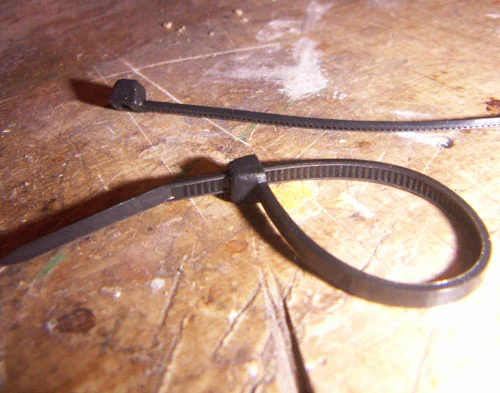
A cable tie is a strap with a locking head used to bundle or position wires and cables. In a conventional inside-serrated plastic tie, the tail passes through the head and a small tongue, called a pawl, engages the teeth. The loop tightens as the tail moves forward, while the pawl prevents it slipping backwards. [1] [2]
That mechanism is common, not universal. HellermannTyton also describes smooth-strap designs and stainless steel ball-lock ties. The lock design affects handling and removal, so a familiar appearance should not replace the instructions for the particular tie. [2]
Single-use and reusable designs
Choose a designed releasable tie or hook-and-loop strap when a bundle will need reopening. Manufacturer examples use lever releases, side locks, flexible rubber closures or wing releases. A non-releasable tie is not an adjustable strap: do not rely on tricks that lift or defeat its pawl. For maintenance, a suitable reusable design avoids repeatedly cutting fasteners beside cable insulation. [2]
Cable tie types and typical uses
Material, lock and mounting style describe different parts of the choice. A tie may be plastic, releasable and fitted with a mounting element at the same time. The table outlines useful categories; it does not give every product in a category the same strength or environmental rating. [2]
| Type or design | Typical purpose | What to check |
|---|---|---|
| Inside-serrated plastic tie | Routine cable bundling | Exact material grade, dimensions and loop tensile rating. [2] |
| Releasable tie | Temporary bundles and maintenance access | Release mechanism and manufacturer reuse instructions. [2] |
| Hook-and-loop strap | Adjustable office, network or fibre cable organisation | Cable suitability, strap sizing and gentle fastening. [2] |
| Tie with fixing element | Routing a harness to a panel, hole, stud or edge | Mount geometry, panel fit and separate fixing strength. [1] [2] |
| Stainless steel tie | Specified harsh-environment cable management | Steel grade, coating, compatibility and exact ratings. [2] |
| Specialist polymer tie | Specified heat, chemical or radiation exposure | Part-specific environmental data, not the polymer name alone. [2] [4] |
Nylon, specialist plastics and stainless steel
PA66 means polyamide 6.6, often called nylon 6/6. Additives and finished-product design affect its properties; saying only 'nylon' leaves important questions unanswered. Plastic ties are not all the same material, and a generic material chart is not a substitute for an exact product sheet. [2]
HellermannTyton describes stainless steel options in 304 and 316L, including corrosion-focused marine applications. Coatings or protective channels can reduce contact-corrosion risk against dissimilar metals and help protect sensitive bundles. These additions have their own limitations, so do not copy an uncoated steel tie's temperature rating onto a coated version. [2]
How to read cable tie specifications
Start with the full part number. Length and width describe the strap, while maximum bundle diameter describes the bundle it can accommodate. Use the manufacturer's recommended bundle diameter instead of guessing capacity from overall length. The head and usable tail also take space. [1]
Minimum loop tensile strength is a force characteristic of the locked loop, involving both the strap and locking mechanism. UL Solutions explicitly distinguishes it from material strength and long-term static load-bearing capability. A larger number is not permission to hang a heavier object from an ordinary tie. [1]
Three exact manufacturer parts compared
These HellermannTyton examples show why specifications must stay attached to a part number. They are manufacturer-listed values retrieved on 4 November 2026, not TechDuoPulse test results, recommendations or a universal width-to-strength chart. All three examples are non-releasable. [3] [4] [5]
| Exact part and material | Length × width; maximum bundle | Minimum loop tensile force | Operating temperature | Listed UV property |
|---|---|---|---|---|
| T18R-PA66-BK, 111-00405; black PA66 [5] | 100.0 × 2.5 mm; 22.0 mm [5] | 80 N [5] | −40°C to +85°C [5] | UV-Stabilised: Yes [5] |
| T50R-PA66-BK, 111-05001; black PA66 [3] | 200 × 4.6 mm; 50.0 mm [3] | 225 N [3] | −40°C to +85°C [3] | UV-Stabilised: No [3] |
| T50R-E/TFE-BU, 111-00732; blue ETFE [4] | 202 × 4.7 mm; 50 mm [4] | 222.3 N [4] | −80°C to +170°C [4] | UV resistant: Yes [4] |
Force ratings are not payloads in kilograms
The values 80 N, 225 N and 222.3 N are forces, not load masses in kilograms. The US ETFE sheet also lists 50 lb in its tensile field; read that in the force context, not as a permitted suspended payload. No conversion creates a safe hoisting rating. [1] [3] [4] [5]
The two T50R examples have similar dimensions and listed forces but different materials and operating ranges. A label such as 'heavy duty' cannot settle that comparison. Check the documented figure, environmental conditions and intended function rather than assuming width or a marketing class determines suitability. [3] [4]
UV, temperature and fire ratings mean different things
An outdoor marking, a temperature range and a flammability classification answer different questions. None should be used as shorthand for the others. Read the declared properties together with the application requirements. [1]
Black does not automatically mean UV-stabilised
The black T50R 111-05001 lists UV-Stabilised: No, while the black T18R 111-00405 lists Yes. That is a concrete reason to check the exact sheet and packaging rather than choose by colour. UL notes that UV stabilisers can be used in a range of colours. [1] [3] [5]
Likewise, blue is not proof of metal detectability. The blue ETFE example is a specialist polymer tie; a food-production tie needs an explicit detectable-material specification. Colour coding is useful for identification, but it does not certify a material property. [2] [4]
Operating temperature is not installation temperature
Operating temperature describes the rated environment in service; installation temperature concerns conditions while fitting the tie. UL treats these as separate selections and notes that nearby heat sources and conductor heating need consideration. The table's ranges belong only to the named parts and are not universal nylon or ETFE limits. [1] [3] [4] [5]
Flammability and support approvals are not fire-survival promises
The T50R PA66 example lists UL 94 V-2; the ETFE example lists V-0. These are flammability classifications, not proof that a complete cable-support installation will keep holding during a fire. A tie, its mount, the fasteners and the surrounding installation must be assessed as a system. [1] [3] [4]
UL's S-suffix types, 2S and 21S, concern primary support for cable, flexible conduit or flexible tubing under the respective electrical codes; rigid conduit is not covered. UL/CSA recognition or listing is not Indian BIS approval. For an Indian installation, the applicable local requirements and end-use acceptance still need checking. [1]
How to choose and fit a cable tie
For ordinary cable organisation, first decide whether the job is bundling, positioning or actual support. A tie around several leads does not establish that it can bear their entire suspended weight. Fixing-device strength is a separate characteristic, and the mounting method changes the connection to the surface. [1]
Measure the bundle and match the function
Measure the actual outer bundle diameter at its widest point, then check the manufacturer's recommended range and maximum diameter. Confirm the material, documented force rating, lock type and any mounting element. Choose an adjustable design where leads change regularly, rather than making future access depend on cutting a tight loop. [1] [2]
Avoid crushing cables, sharp tails and poor storage
Tighten only as appropriate for the cable and tie instructions; more tension is not automatically better. Sensitive insulation and fibre cables need particular care. Use a suitable tensioning or flush-cutting tool, keep the cutting edge clear of the cable and use appropriate eye protection. Metal ties also require suitable handling protection. [2]
Store nylon ties in their sealed packaging, away from direct sunlight and heat sources. HellermannTyton warns that ties which become brittle can fail during application. Good storage does not turn an indoor-rated product into an outdoor one. [2]
Do not use a tie to join conductors, insulate damaged wiring or replace a specified pressure-rated fuel-hose clamp. Mains, solar and industrial installations need trained workers and the relevant equipment instructions, not an improvised repair based on this general guide.
Practical applications at home, in IT and in machinery
Cable management should preserve access as well as keep a route orderly. The useful design depends on whether cables stay in place or need regular changes; maintenance needs are part of the selection. [2]
Desk leads and network racks
For desk leads, group cables without pulling on their plugs or trapping a lead that needs removal. An adjustable strap can make equipment changes easier. In a network rack, soft, reopenable fastening is worth considering for patch leads and sensitive cables, alongside the cable manufacturer's bend and routing instructions. A neat-looking bundle is not evidence that it has been tightened correctly. [2]
Vehicle harnesses and industrial routing
Manufacturer guidance includes fixing ties for holes, studs and panel edges in vehicles and machinery. Follow the vehicle or equipment maker's specified routing and fastening points; a loose replacement tie is not automatically equivalent to an integrated harness mount. Consider heat, movement, vibration and abrasion without inventing a universal temperature or strength requirement. [2]
Frequently asked questions
Can cable ties be reused?
Designed releasable ties and hook-and-loop straps can be reopened according to their instructions. The three product examples here are non-releasable; do not treat a forced-open locking head as a verified reusable fastener. [2] [3] [4] [5]
Which cable ties can be used outdoors?
Choose a product with documented UV or outdoor suitability and check the other exposure conditions. Black alone is insufficient: the two black PA66 examples in this guide have different listed UV properties. [1] [3] [5]
Does a 225 N rating tell me how much weight I can hang?
No. It is a loop tensile force characteristic, not a long-term static load or hoisting approval. Support needs the appropriate tie, fixing device, hardware and accepted installation design. [1] [3]
Does a UL mark establish approval for an Indian installation?
No. UL's guidance distinguishes North American listed products and recognised components. Those designations do not establish Indian BIS approval or acceptance for every local application; verify the requirements for the actual installation. [1]
Important Points / Key Information
Keep these distinctions clear when checking a packet or datasheet.
- Size: use the recommended bundle diameter, not length alone. [1]
- Strength: loop tensile force does not establish a permanent suspended payload. [1]
- Environment: verify UV, operating temperature and installation conditions separately. [1]
- Installation: the mount, hardware, cable and intended use matter alongside the tie. [1]
Examples / Supporting Information
Illustrative outdoor check: two packets contain black ties, but their exact sheets disagree on UV stabilisation. The user checks the part numbers and required exposure rating rather than choosing the longer tie by appearance. The T18R and T50R examples demonstrate that distinction, not interchangeability. [3] [5]
Illustrative maintenance check: a technician expects to replace network leads and chooses a suitable reopenable strap, leaving access to connectors. This is a selection scenario, not a TechDuoPulse trial or certification of a particular rack installation. [2]
Conclusion
Choose cable ties by the job and exact datasheet, not by colour, familiar dimensions or a 'heavy duty' label. Measure the bundle, decide whether reopening is needed and check the declared environmental properties. The manufacturer examples show how similar-looking ties can differ in important ways. [3] [4] [5]
Keep bundling separate from supporting weight. Appropriate tools, cable care and compatible mounts matter, while regulated or safety-critical work requires qualified assessment. A well-chosen tie helps organise a cable system; it does not certify the system or repair electrical damage. [1]
How we checked thisSources (5)
We keep source links private so your reading stays on techduopulse. Each note names the publisher and document we checked.
Cable Ties for Cable Management
Primary source · Source-backed article facts and limitationsCable ties for industry / Cable ties and fixings
Primary source · Source-backed article facts and limitationsT50R-PA66-BK — article 111-05001
Primary source · Source-backed article facts and limitationsT50R-E/TFE-BU — part 111-00732
Primary source · Source-backed article facts and limitationsT18R-PA66-BK — article 111-00405
Primary source · Source-backed article facts and limitationsInitial source-backed manual publication. Reviewed article facts preserved; licensed real photograph credited and labelled accurately. Full article remains in server-rendered HTML with a two-paragraph reading disclosure.