
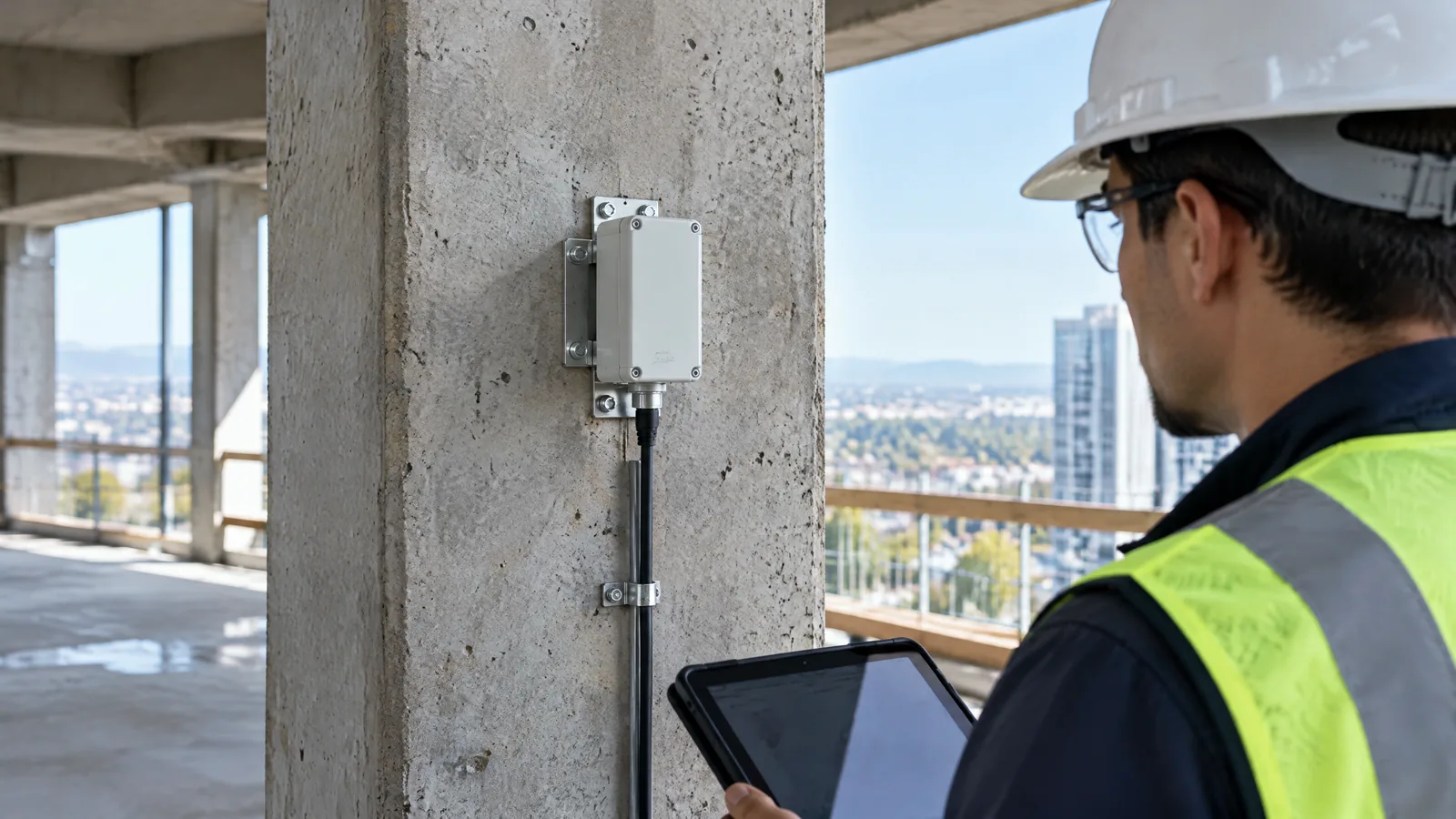
A crack, uneven floor or concern about movement near a building can make one question urgent: is the structure changing, and how can that change be measured? A structural tilt sensor, also called an inclinometer, measures angular change at a selected point; it provides evidence for qualified engineers to compare with a baseline and other observations, not a standalone safety verdict.
This article is part of the computer hardware technology guide library.
Key takeaways
A building tilt sensor measures a change in inclination or rotation at its mounting point. It does not directly measure every crack, load, settlement value or form of damage.
Inclinometers are one part of a structural health monitoring system. A project may also use accelerometers, displacement sensors, strain gauges, temperature sensors, survey equipment or other instruments, depending on the question.
Placement, alignment, temperature, mounting quality and the starting baseline affect interpretation. A trend across time and locations is more useful than an isolated number.
A sensor can flag a change for review, but it cannot clear a building as safe or diagnose the cause without engineering assessment and supporting evidence.
What does a structural tilt sensor measure?
A structural tilt sensor measures angular change relative to gravity or a defined reference direction. In simple terms, it records whether the surface or structural member carrying the instrument has rotated, and by how much according to that instrument's axes and specification. An inclinometer is therefore different from a tape measure for a crack or a survey instrument that directly establishes a point's position.
The word tilt does not automatically mean that a building is leaning dangerously. A reading may reflect genuine structural movement, foundation settlement, thermal effects, installation change, vibration or sensor noise. The useful question is usually whether a repeatable change remains after the monitoring team accounts for the environment and the measurement setup.
Tilt can be relevant to several investigations. Engineers may observe foundation or differential settlement, deformation near an excavation, movement of a retaining element, or sway and rotation during wind or seismic events. The sensor reports a physical quantity; it does not identify the cause on its own.
How an inclinometer fits into building monitoring
A complete monitoring arrangement normally has more than the small sensing unit attached to a wall, column or other selected point. The wider system can include a data reader or logger, a communications link, software for storing and visualising readings, and alert rules. Wireless communication and remote dashboards are optional system components, not part of the physical tilt measurement itself.
The monitoring objective determines the design. A team investigating a suspected settlement pattern may select several points on foundations or structural members and compare their changes. A high-rise study of wind or earthquake response may distribute instruments at multiple levels and combine tilt data with acceleration or other measurements. USGS examples show why building instrumentation can use sensors from the basement through the roof to understand input motion and the response of a structure.
Other instruments answer different questions. An accelerometer measures linear acceleration and vibration. A displacement or crack gauge can track a change across a defined gap. A strain gauge measures deformation in a material or member. Temperature and humidity sensors can help explain environmental influences. These instruments may complement an inclinometer, but they are not interchangeable.
- Physical inclinometer: measures angular change at its installed location.
- Optional logger or gateway: reads, stores or transmits the sensor output.
- Optional dashboard and alerting: displays trends and can notify the monitoring team when project thresholds are crossed.
- Supporting instruments: selected when vibration, displacement, strain, temperature, humidity or ground movement also matters.
Where building tilt monitoring can help
For foundation and settlement investigations, a series of tilt measurements can help show whether selected walls, columns or other points are rotating over time. The pattern matters: readings at one point cannot describe the whole building, and a change in angle does not by itself establish how much vertical settlement occurred or where it originated.
During nearby excavation, tunnelling, dewatering or construction, monitoring may be used to watch an existing structure for movement while work proceeds. The monitoring plan should define the locations, measurement frequency, baseline, review process and response thresholds before a worrying trend appears.
For taller buildings, tilt data can help characterise sway or slow changes under wind, temperature and other loads. For earthquake studies, tilt is only one possible measurement. USGS building instrumentation uses triaxial seismic sensors to record motion in three orthogonal directions, illustrating why structural response is normally studied with an instrumented system rather than one sensor type.
| Monitoring question | Possible useful measurement | Important caution |
|---|---|---|
| Is a selected point rotating over time? | Inclinometer trend at a stable, documented mounting point | The trend needs a baseline and environmental context |
| How did a building respond to shaking? | Accelerometers, possibly with tilt and other measurements | A tilt sensor is not a complete seismic record |
| Is a crack opening or closing? | A suitable crack or displacement gauge | Tilt does not directly measure crack width |
| Could temperature be affecting the reading? | Temperature data alongside the sensor record | A temporary thermal effect should not be called structural damage |
Installation, baseline and reading interpretation
Good monitoring starts with a defined question and a location that represents the behaviour being studied. The installation surface should be stable for the purpose, the sensor should be securely fixed and aligned, and the team should record its orientation and mounting details. A device placed wherever it is convenient may produce a precise-looking number that is not useful for the structural question.
After installation, the team establishes a baseline under documented conditions. Temperature changes can temporarily affect tilt readings, so the monitoring plan should account for thermal behaviour rather than treating every short-term variation as settlement. The exact stabilisation period, sampling interval and alert threshold are system- and project-specific; they should come from the instrument specification and qualified monitoring design, not from a generic internet number.
Interpretation normally looks at a time series and compares related locations. Reviewers may ask whether the change is persistent, whether several sensors show a consistent pattern, whether a construction or weather event coincided with it, and whether other observations support the same explanation. FHWA describes monitoring systems as a measuring device, a way to read it and a way to store measurements, while also noting that different systems have different capabilities and limitations.
- Define the movement or response the project needs to observe.
- Document the selected location, axes, mounting condition and installation time.
- Check the output for unusual offsets, noise and communication problems before relying on the trend.
- Record environmental and site events that could affect the reading.
- Have a qualified structural or geotechnical professional set review rules and interpret changes.
Limits and safety boundaries
A structural tilt sensor is an observation tool, not a building-safety certificate. It cannot prove that an unmonitored part of a building is sound, identify every hidden defect, or replace an inspection after an earthquake, impact, fire, flood or other event. It also cannot establish causation from one number.
Model-specific claims need care. Resolution, accuracy, range, sampling, battery life, wireless distance and alert behaviour belong to a particular sensor and system under stated conditions. They should not be presented as universal inclinometer properties. External gateways, data platforms and SMS or email alerts may be useful, but they are optional components with their own power, network and maintenance requirements.
If a building shows visible damage, unusual movement or a safety concern, do not attach a consumer module and use its output as permission to enter or occupy the structure. Follow local emergency guidance and seek an appropriately qualified professional. Monitoring can support a decision process; it should not replace one.
Frequently asked questions
These answers describe the measurement concept in general. The specification and monitoring plan for a particular installation take priority.
Is a building tilt sensor the same as an inclinometer?
In structural monitoring, the terms are often used for instruments that measure inclination or angular change. The exact sensing technology, axes, range and output depend on the model and system.
Can an inclinometer measure building settlement directly?
It measures angular change, not settlement in metres directly. A qualified team may use tilt patterns with geometry, surveys and other evidence to investigate whether settlement or differential movement is involved.
Where should a tilt sensor be installed on a building?
The location should represent the structural behaviour being investigated and have a suitable, stable mounting condition. Engineers decide placement from the monitoring objective; there is no universal best wall, floor or height.
Can one tilt reading tell me whether a building is safe?
No. One reading cannot assess an entire structure or diagnose a cause. Safety decisions require appropriate inspection, context, baseline data and qualified engineering judgement.
Does a building monitoring system need wireless connectivity?
No. Wireless gateways and remote dashboards are optional ways to collect and view readings. A system can use wired or manual data collection, depending on the site and monitoring requirements.
About the image
AI-generated editorial illustration; not an actual product or mission photograph.
Source notes
Reporting record
techduopulse stores source destinations privately. Public notes remain non-clickable so every visitor journey stays on this website.
Source note: Resensys Structural Health Monitoring application overview
Primary source · SHM parameters, high-rise tilt/settlement/vibration applications, system components and alertsSource note: Resensys inclinometer installation and applications reference
Primary source · Definition, uses, placement, baseline, thermal effects and optional system architectureSource note: USGS National Strong Motion Project building instrumentation overview
Primary source · Instrumented buildings, sensor distribution, triaxial input-motion measurement and engineering use of recordingsSource note: FHWA structural health monitoring technical report
Primary source · Monitoring-system components and capabilities, sampling/storage choices, and technology limitationsNew India-facing hardware explainer created because the supplied accelerometer guide is related but does not answer the distinct building tilt-sensor query. Separates angular measurement from acceleration, distinguishes physical sensors from optional logging, wireless and alert components, explains baseline and thermal context, and avoids safety-clearance or model-universal claims.


