Apple announced its first touchscreen MacBook Pro on 28 October 2026, combining a tandem OLED display with M5 Pro and M5 Max chips. For Indian readers, the key details are a starting price of ₹3,49,900 and availability listed from 9 November—not the US launch date of 6 November [1] [5] [6].
On this page 9 sections
- What Apple actually announced
- How touch changes the way you use a Mac
- PROLED XDR: what the display numbers mean
- M5 Pro, M5 Max and the limits behind the headline specs
- Touchscreen MacBook Pro price in India
- Which differences matter for your work?
- Important Points / Key Information
- Examples / Supporting Information
- Conclusion
Part of our consumer technology guide library
What Apple actually announced
The official name is MacBook Pro with PROLED XDR Display . Apple offers it in 14-inch and 16-inch versions with M5 Pro or M5 Max, in Space Black or Silver. This is an announced product, so “expected launch” is no longer the right description. [1]
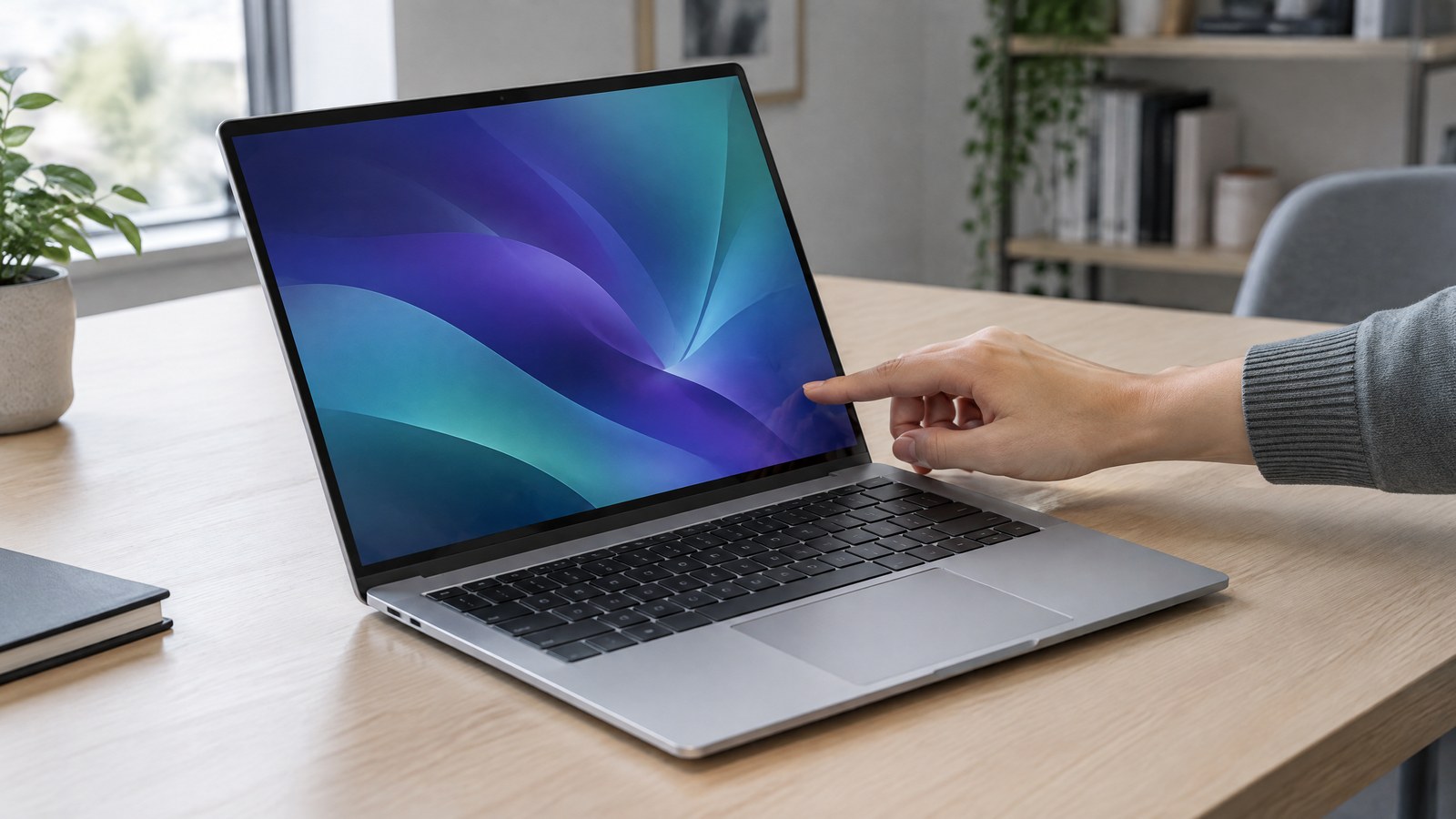
The screen is the main change. You can touch it directly, but you still get the familiar keyboard and Force Touch trackpad. Apple also lists a redesigned hinge, lighter bodies, a new thermal system and Dynamic Island on the display. [1] [2] [3]
India and US launch dates are different
Apple's US release says availability begins on 6 November 2026 . Its India product page and India Store list 9 November , after pre-orders opened on 28 October. A listed availability date is not a delivery promise for every address or configuration. [1] [5] [6] [7]
There is an inconsistency worth explaining: the opening of Apple's India press release mentions 6 November, but its own pricing section says 9 November. The dedicated India product and Store pages agree on 9 November, which is the date used here. [5] [6] [7]
How touch changes the way you use a Mac
Touch is an extra input method, not a replacement for the pointer. Swipe through a document, pinch a photo to zoom, or move an object directly on the screen. Then return to keyboard shortcuts when they are quicker. [1] [2]
Apple says the touch sensor is integrated into the display panel rather than added as a separate layer. Its redesigned hinge is intended to keep the display stable during interaction. Video stabilization is also intended to reduce movement in your camera feed when you touch the screen during a call. These are Apple's design claims, not observations from our own testing. [1] [2]
For background on touch detection, see our capacitive touchscreen explanation . It explains the underlying principle without assuming that Apple's implementation is identical to a phone's.
Where direct touch could help
A musician adjusting software faders or playing an onscreen instrument has a clear reason to try touch. So does a designer rotating a 3D object or annotating an image. A writer editing several pages may prefer the keyboard and trackpad for most of the session. [2]
The useful question is not whether touch looks impressive in a demonstration. It is whether reaching toward the display makes a repeated task easier. The examples above illustrate possible workflows; they do not establish a measured productivity gain.
App support needs a separate check
Basic screen interaction and an app's dedicated touch features are not the same thing. Apple's announcement discusses updates for its creative apps and third-party software, but its footnotes say the named third-party apps will be available later in the year. Do not assume every demonstrated feature arrives with the hardware. [1]
For an essential work app, check its actual version and supported gestures before changing your workflow. The announcement alone cannot answer whether a specific plug-in, shortcut or specialist control will behave the way you expect.
PROLED XDR: what the display numbers mean
Tandem OLED uses two self-illuminating pixel layers. Unlike a mini-LED-backlit LCD, OLED pixels produce their own light and can switch off in dark areas. Apple says its display engine also adjusts colour and brightness while monitoring pixel use over time. [2]
The important comparison is like for like. Both MacBook Pro display families are listed with up to 1,000 nits sustained full-screen brightness under Apple's stated conditions. The new OLED model has a higher advertised peak HDR figure, but that does not mean the whole screen stays at 2,000 nits throughout a workday. [3] [4]
Source: Apple's product, technical-specification and MacBook Pro overview pages, checked 31 October 2026. These are manufacturer figures, not independent measurements; Apple's sustained-brightness condition includes temperatures below 25°C. [2] [3] [4]
| Display feature | PROLED XDR MacBook Pro | Liquid Retina XDR MacBook Pro |
|---|---|---|
| Display technology | Tandem OLED | Mini-LED |
| Direct screen touch | Yes | No |
| Sustained full-screen brightness | Up to 1,000 nits | Up to 1,000 nits |
| Peak HDR brightness | Up to 2,000 nits | Up to 1,600 nits |
| Published contrast ratio | 10,000,000:1 | 1,000,000:1 |
| Listed wide colour gamuts | P3 and Adobe RGB | P3 |
Peak brightness, colour and refresh rate
The technical specifications qualify 2,000-nit peak brightness for HDR content and peak SDR brightness outdoors. They also list adaptive ProMotion refresh rates from 10Hz to 120Hz. Refresh rate describes screen updates, not a guarantee that games run at the same frame rate. [3]
Adobe RGB support is relevant to print-oriented photography and design, while P3 remains useful for video and other colour workflows. A wider gamut still needs appropriate software settings and a colour-managed workflow; it does not automatically make every image more accurate. [2]
Screen size and the lighter design
The advertised screen diagonals are 14.2 inches and 16.3 inches, measured as rectangular shapes; the usable area is smaller because of rounded corners. Apple's retrieved 14-inch specification lists a native resolution of 3024 × 1986. That figure should not be applied to the 16-inch version. [1] [3]
Weight also varies. Apple lists the 14-inch M5 Pro at 1.38kg and the M5 Max at 1.40kg, rather than one identical weight for all 14-inch configurations. Its launch material describes the 16-inch design as starting around four pounds, with a configuration caveat. [1] [3]
M5 Pro, M5 Max and the limits behind the headline specs
The touchscreen model comes with M5 Pro or M5 Max , not M6. Apple's current MacBook Pro overview also lists a separate non-touch Liquid Retina XDR family with M6, M5 Pro or M5 Max options. A newer chip name and a newer display design are therefore different choices. [3] [4]
Memory and storage are configuration-specific
“Up to 128GB memory and 16TB storage” describes the range's upper options, not the starting model. Apple's specifications tie 128GB unified memory to the listed M5 Max configuration with a 40-core GPU. The retrieved M5 Pro configurations list storage up to 4TB, while the listed M5 Max options extend to 16TB. [3]
Choose capacity around your real projects. Editing large media files, running local models and opening unusually heavy workloads are different demands from ordinary browsing or document work. A maximum-spec configuration is not necessary simply because it exists.
AI and battery claims need context
Apple describes Neural Accelerators in the GPU cores and positions the machine for demanding AI work. That does not give us a verified speed for every model, prompt or application. Model format, memory use and the software running it still matter. [1] [3]
The family's “up to 24 hours” battery claim is not a promise for every variant or workload. The 14-inch specifications list up to 22 hours of video streaming for M5 Pro and up to 20 for M5 Max, with lower figures for wireless browsing. Apple's family-level test details refer to a particular 16-inch M5 Pro configuration. [3] [4]
Our laptop battery-health guide explains why current battery capacity and a launch-time runtime claim answer different questions.
There is a familiar set of ports: three Thunderbolt 5 connections, HDMI, SDXC, MagSafe 3 and a headphone jack, alongside Wi-Fi 7 and Bluetooth 6. Practical speed still depends on the connected equipment and network. [2] [3]
Touchscreen MacBook Pro price in India
Apple's India launch release lists ₹3,49,900 as the starting price for the 14-inch M5 Pro version. Larger displays and M5 Max configurations start higher. [5]
Source: Apple's India and US launch releases dated 28 October 2026. Prices are published starting prices, not quotations for every memory, storage or glass option; US figures are not rupee conversions. [1] [5]
Apple's India press release separately states education-saving prices, starting at ₹3,31,900 for the 14-inch M5 Pro. The India Education Store confirms an education shopping route and the 9 November availability date, but its retrieved collection view did not independently show all four education prices. Check eligibility and the selected configuration rather than treating the education figure as a universal discount. [5] [8]
| Model | India starting price | US starting price |
|---|---|---|
| 14-inch, M5 Pro | ₹3,49,900 | US$2,899 |
| 16-inch, M5 Pro | ₹4,09,900 | US$3,399 |
| 14-inch, M5 Max | ₹5,49,900 | US$4,499 |
| 16-inch, M5 Max | ₹5,89,900 | US$4,799 |
Which differences matter for your work?
Touch, OLED and a lighter body may be valuable without making an existing laptop obsolete. Apple still presents both PROLED XDR and Liquid Retina XDR families on its current MacBook Pro overview. That is not confirmation of a future discontinuation plan. [4]
For visual work, investigate the interface
A photographer preparing print work may care about Adobe RGB. A music producer may care more about touch controls in their chosen software. Try to identify the specific action you would change before treating either feature as a reason to upgrade.
For writing and coding, keep the basics in view
Keyboard comfort, screen space, memory requirements and application compatibility remain important. Touch cannot resolve every bottleneck. If your present machine already handles the workload, waiting for relevant independent reviews may be more useful than choosing from launch claims alone.
For the wider computing context, our Smartphone Technology Explained guide covers how processors, displays and software work together. The same habit helps here: assess the complete workflow, not a single headline specification.
Important Points / Key Information
- The product is officially announced; this is not a rumour roundup.
- India availability is listed from 9 November 2026 ; US availability begins on 6 November .
- Peak brightness is not sustained full-screen brightness.
- Memory, storage, weight and battery figures depend on the configuration.
- Touch-specific app updates may arrive after the hardware.
- Dynamic Island's Spotlight behaviour depends on Siri AI being available and enabled; Apple also lists software, language and region limits. [1]
Examples / Supporting Information
Does the touchscreen replace the trackpad?
No. Apple's specifications retain the Force Touch trackpad and Magic Keyboard. Touch adds another way to scroll, zoom and manipulate content. [2] [3]
Is the touchscreen MacBook Pro available in India on 6 November?
Apple's dedicated India product and Store pages list 9 November. The local press release contains conflicting introductory wording, so 6 November should not be presented as the confirmed India availability date. [5] [6] [7]
Does every model have 128GB memory and 16TB storage?
No. Those are upper configuration options. The technical specifications separate M5 Pro and M5 Max choices, with different memory and storage limits. [3]
Has this article tested the laptop?
No. This is source-backed launch analysis based on Apple's announcement, specifications and India pages checked on 31 October 2026. Workflow examples are illustrations, not hands-on findings or benchmark results.
Conclusion
Apple's first touchscreen MacBook Pro adds direct interaction and a tandem OLED display to its professional laptop line. The practical benefit depends on your apps and the work you do—not simply on having another input method.
For India, remember the verified essentials: ₹3,49,900 starting pricing, pre-orders from 28 October and availability listed from 9 November. Compare the exact configuration, keep battery and brightness claims in context, and look for evidence from the workloads that matter to you before deciding whether the change is worthwhile. [5] [6]
How we checked thisSources (8)
We keep source links private so your reading stays on techduopulse. Each note names the publisher and document we checked.
Apple unveils groundbreaking MacBook Pro with PROLED XDR Display and Touch for the first time on Mac
Primary source · Supporting informationMacBook Pro with PROLED XDR Display — product overview
Primary source · Supporting informationMacBook Pro with PROLED XDR Display Technical Specifications
Primary source · Supporting informationMacBook Pro — display-family overview and battery-test footnotes
Primary source · Supporting informationApple unveils groundbreaking MacBook Pro with PROLED XDR Display and Touch for the first time on Mac
Primary source · Supporting informationMacBook Pro with PROLED XDR Display
Primary source · Supporting informationPre-order MacBook Pro with PROLED XDR Display
Primary source · Supporting informationPre-order MacBook Pro with PROLED XDR Display
Primary source · Supporting informationSource-backed owner-approved initial news-analysis edition. Generic AI touchscreen-laptop illustration; no hands-on test claimed.