
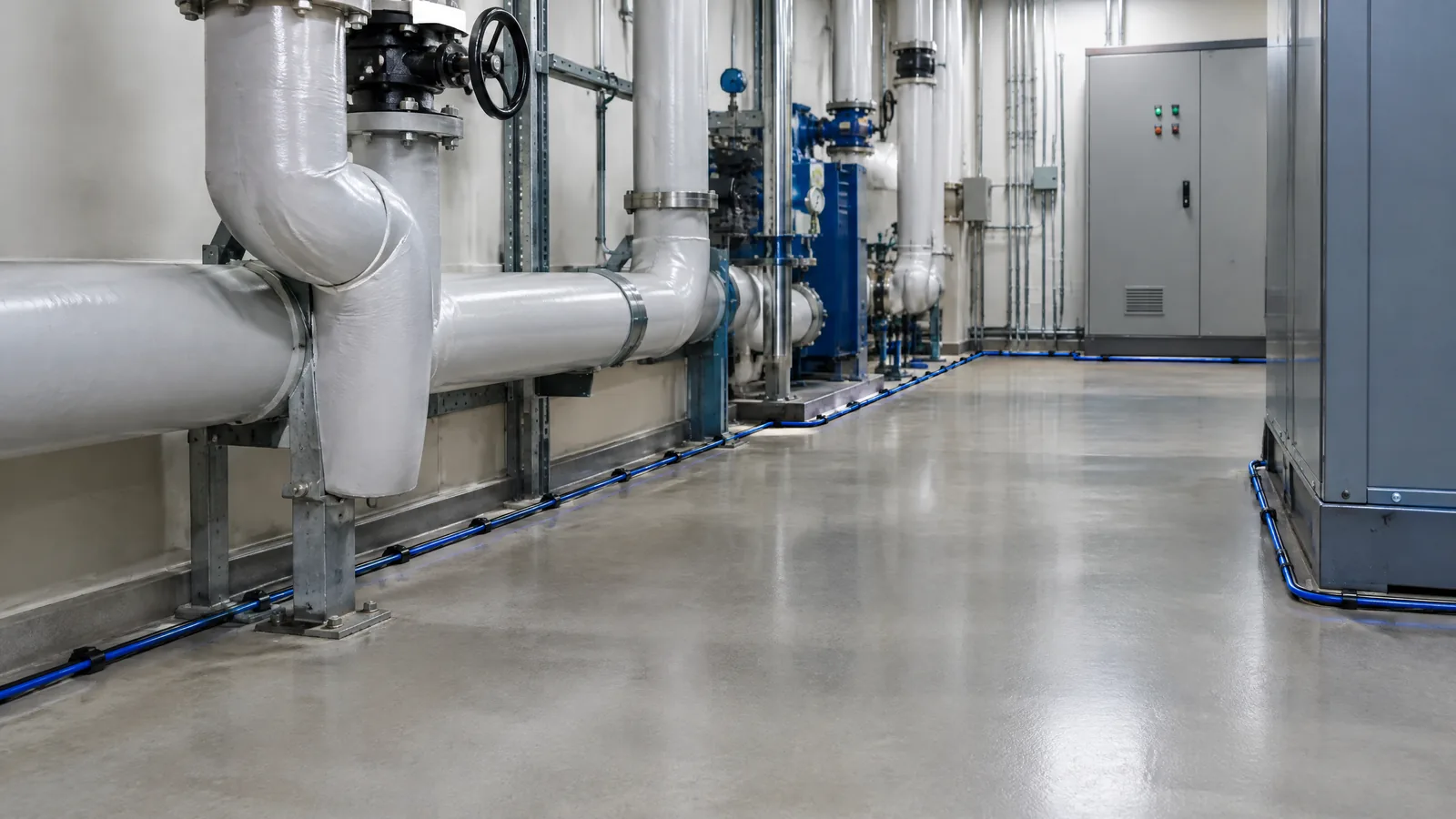
A single spot leak sensor can miss water that travels along a pipe, under equipment or across a long plant-room edge before reaching the probe. A water-sensing cable detects liquid at multiple sensing points along a routed cable, but it normally works as a peripheral connected to a compatible detector or controller rather than as a complete alarm or shut-off system.
This article is part of the computer hardware technology guide library.
Key takeaways
The short version: use a compatible cable and controller to extend detection along a real leak path, then document the limits and response workflow.
- Water-sensing cable extends detection along a route or perimeter where one spot probe leaves gaps.
- The cable is only one part of a system: a compatible detector or controller interprets the contact and may provide local or remote notification.
- Spacing, cable length, liquid type, mounting and the leak path are model- and site-dependent. A cable cannot guarantee that every leak will reach a sensing point.
- Choose the layout after mapping vulnerable equipment and likely water paths, not by cable length alone.
What does a water-sensing cable measure?
A water-sensing cable measures the presence of a conductive liquid at sensing contacts distributed along its length. In a typical design, liquid bridges two contacts and changes the electrical condition seen by a connected detector. The detector then decides whether to raise an alarm according to its configuration.
This is different from a cable that continuously measures water depth, flow rate or humidity. Unless the product documentation says otherwise, the useful output is a leak or liquid-presence event at the cable, not a detailed map of volume or pressure.
The exact sensing geometry varies. One Water Alert product, for example, describes gold-plated sensors embedded every 3 feet and says its adjustable contacts can respond from contact with the floor to a stated 1/8-inch height. Those figures belong to that product and should not be treated as an industry-wide standard.
- Measured condition: liquid reaching the cable's sensing contacts.
- Normal output: a detector or controller receives an electrical leak condition.
- Not automatically measured: water volume, source location, pressure or total damage.
Why use cable instead of one spot leak sensor?
A spot probe is useful when the likely leak point is known and water will collect there. A cable is more useful when the vulnerable path is long, irregular or spread around several pieces of equipment. It can be routed along a chilled-water line, around a server-room perimeter, beneath a row of cabinets or near a basement edge, subject to the manufacturer's installation rules.
Commercial-building guidance commonly separates simple local detectors from active systems that monitor multiple detectors and notify a responsible person. Water Alert describes cables as an option for larger areas or perimeter monitoring, while also listing spot detectors and ceiling protection for other locations. The practical lesson is to match the sensing form to the way water is expected to move.
Cable does not automatically mean wider protection. A poorly routed cable can sit outside the leak path, be blocked by a raised surface or be installed where cleaning water creates nuisance alarms. Coverage should be judged by the route and the expected path of liquid, not by the headline length of the cable.
The parts of a building leak-detection setup
The cable is a sensor peripheral. It usually needs a compatible detector, monitor or controller to provide power, interpret the sensing condition and activate an alert. A controller may offer a local sounder, relay output, building-management connection or remote notification, but those functions depend on the selected system.
Some installations add spot probes, ceiling trays, end-of-line test hardware, remote communications or outputs for valves and pumps. These are not automatically included with every water-sensing cable. Water Alert's commercial-building page gives a product-specific example of monitor panels that can monitor multiple detectors and control valves or pumps; that capability must be confirmed for the actual controller rather than assumed from the cable alone.
Compatibility deserves particular attention. The cited Water Alert cable page says one or two cables connect to its Standard Series detector and explicitly excludes its VR Series. Connector type, maximum cable count, zone design, liquid compatibility and cable length all need to come from the chosen product documentation.
| Component | What it does | What to verify |
|---|---|---|
| Water-sensing cable | Presents sensing contacts along a route | Contact spacing, length, liquid scope and mounting rules |
| Detector or controller | Supplies/interprets the sensing circuit and raises an event | Cable compatibility, zones, alarm outputs and power |
| Notification or integration | Sends the event to staff or another building system | Relay, network, BMS or remote-alert support |
| Optional response equipment | May operate a valve, pump or other equipment | Whether the controller supports it and who owns the response |
Where a water-sensing cable can help
Long equipment rows and service corridors are natural candidates because a single probe may not cover the full edge. The cable can also be considered around areas where a leak could spread before pooling, such as underfloor routes, plant rooms, storage edges and equipment perimeters. The choice should follow a site walk that identifies water sources, low points, drains and assets that need early warning.
In a server room or communications room, the cable may be placed near cooling-water risks or along a vulnerable perimeter. In a basement or utility area, it may follow a pipe route or a boundary where seepage is expected. Above a suspended ceiling, a dedicated tray or another approved sensor may be a better fit than laying a floor cable; the manufacturer's application guidance should decide.
Treat the cable as part of an alert workflow. Someone must receive the alarm, know which zone it refers to and have a safe, documented response. Detection does not remove the need for inspection, isolation by authorised personnel or repairs.
Limitations and checks before choosing one
A water-sensing cable cannot detect liquid that never reaches its contacts. It may miss a leak that runs in another direction, remains inside a wall or arrives between sensing points. Dust, construction residue, cleaning chemicals, condensation and physical damage can also affect a real installation, so the maintenance instructions matter.
Do not assume that every cable detects every liquid. The cited Water Alert product specifically mentions water and some water-and-ethylene-glycol solutions, but that is a product statement. If the site risk includes another chemical or conductive liquid, confirm compatibility with the manufacturer before relying on the alarm.
Ask for a zone drawing, a cable and controller compatibility statement, an alarm-routing plan and a maintenance procedure. Confirm how the system is tested, how a damaged cable is reported and what happens during power or communications failure. Do not call an installation complete merely because the cable is physically laid out.
- Map the likely leak path and the equipment that needs early warning.
- Confirm cable type, sensor spacing, maximum run and controller compatibility.
- Check whether cleaning liquids, condensation or other site fluids could create nuisance or missed alarms.
- Document alarm recipients, zone labels, testing and maintenance responsibility.
- Treat valve, pump and building-management control as separate, model-specific functions.
Frequently asked questions
These answers describe the general role of a cable and qualify features that depend on a particular product or controller.
Is a water-sensing cable a complete leak alarm?
Usually no. It is normally a sensing peripheral that needs a compatible detector, monitor or controller to interpret liquid contact and provide an alarm or notification. Some systems can add remote alerts or control outputs, but those are controller-specific.
How is a cable different from a spot water sensor?
A spot sensor watches one location, while a cable places sensing contacts along a route or perimeter. Cable is useful when the likely leak path is longer or less predictable, but it still detects only where liquid reaches its sensing points.
Can a leak-detection cable identify the exact source of a leak?
Not automatically. A basic cable reports a liquid condition to its detector. Exact location or zone-level reporting depends on the cable design, controller and how the installation is divided into zones.
Can the cable shut off building water?
The cable itself cannot. A compatible controller may have relay or control functions for a valve or pump, but that is an optional, model-specific part of the wider system and should be designed and authorised separately.
Does a longer cable always provide better coverage?
No. Coverage depends on route, sensing-point spacing, mounting, liquid behaviour and controller limits. A shorter cable placed across the real leak path can be more useful than a longer cable routed away from it.
About the image
AI-generated editorial illustration; not an actual product or mission photograph.
Source notes
Reporting record
techduopulse stores source destinations privately. Public notes remain non-clickable so every visitor journey stays on this website.
Source note: Water Alert commercial-building leak-detection application guidance
Primary source · Distinction between passive detectors, active monitored systems, cable sensing and commercial-building applicationsSource note: Water Alert leak-detection cable product documentation
Primary source · Cable sensing principle, model-specific spacing/lengths, liquid scope and detector compatibilitySource note: RLE Technologies facility leak-monitoring checklist
Primary source · Site-specific threat mapping and monitoring-planning contextInitial 15 October 2026 India-facing explainer for a distinct Buildings application page. Defines water-sensing cable as a distributed sensor peripheral, separates cable, controller and optional response equipment, uses model-specific claims only where attributed, and states practical coverage and liquid-compatibility limitations without safety guarantees or invented performance data.


