
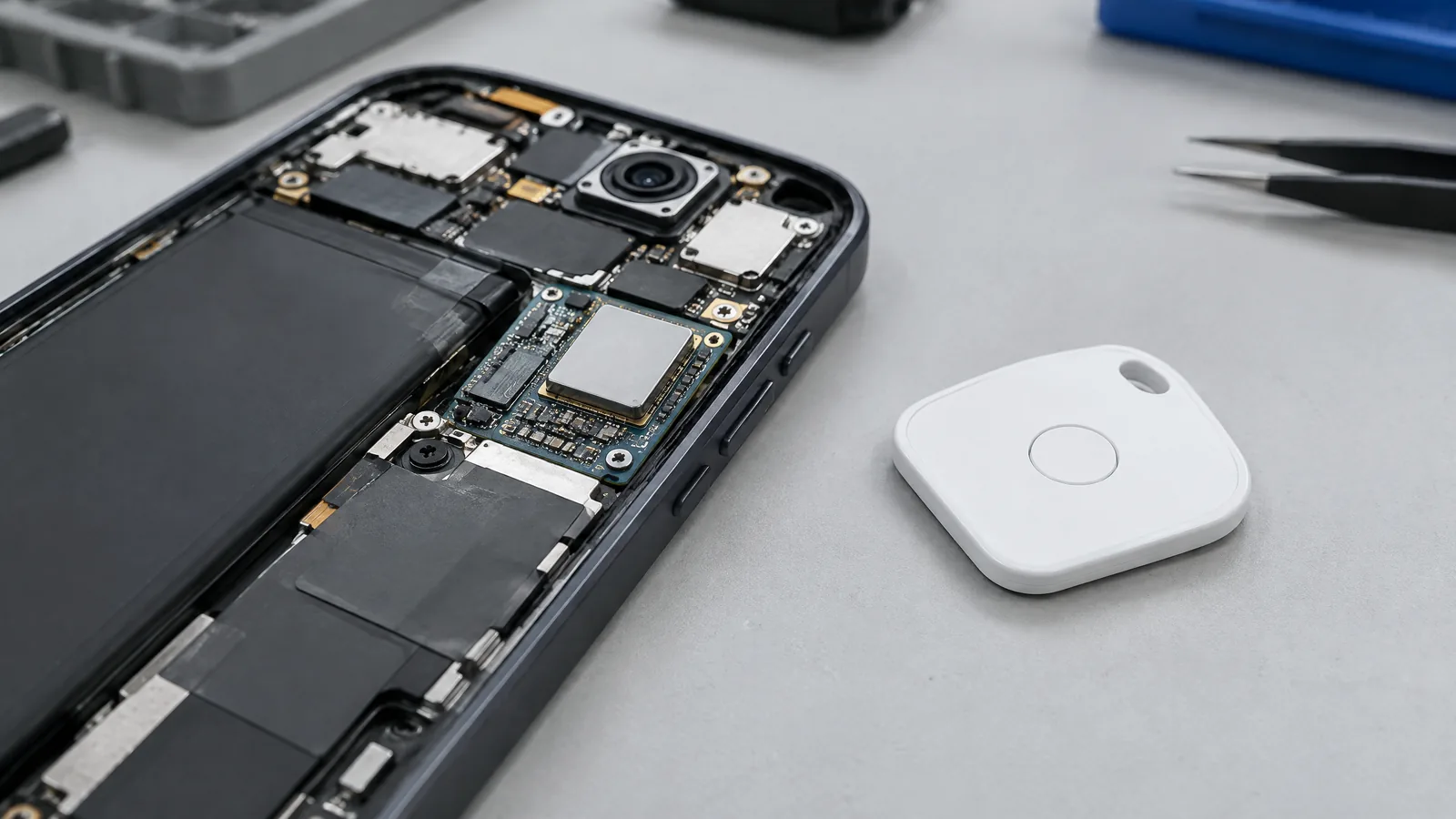
You may see Ultra-wideband (UWB) in a phone's specifications and wonder whether it is another way to get a stronger GPS signal. Ultra-wideband (UWB) ranging hardware measures the distance and relative position between compatible nearby devices, so it can help find an accessory or understand which direction a peer is in, but it does not calculate a worldwide location on its own.
This article is part of the computer hardware technology guide library.
Key takeaways
- UWB is optional short-range radio ranging hardware, not a camera, temperature sensor or standalone GPS receiver.
- The phone and the other device or infrastructure need compatible UWB hardware and a supported software path; Android 12 or later alone is not enough.
- UWB can improve nearby finding, indoor positioning and some access experiences because it measures relative distance and position.
- Bluetooth may help discover a peer and exchange setup information, but Bluetooth by itself does not turn a phone into a UWB ranging device.
- Performance and availability vary by phone, accessory, region, application and surrounding radio environment.
What does UWB measure in a phone?
UWB measures a relationship between participating devices. Android describes the technology as radio communication focused on precise ranging between devices, while the FiRa Consortium describes it as fine ranging and relative positioning. In everyday terms, the phone can help determine how far away a compatible peer is and, when the complete system supports it, where that peer is relative to the phone.
That makes UWB hardware different from the physical sensors that measure light, acceleration, rotation or pressure. It is also different from GPS. A UWB radio exchanges carefully timed signals with a nearby UWB peer; it does not listen for satellite signals and produce a global coordinate by itself.
The documented Android model has a Controller, also called the initiator, and a Controlee, also called the responder. The two devices need to identify each other and agree on ranging parameters before a session starts. Android notes that Bluetooth Low Energy can be used as an out-of-band method for discovery and for exchanging those parameters.
How phone UWB ranging works in practice
A normal use case has several parts rather than one magic sensor reading. First, an app or system feature discovers a nearby compatible device. Next, the peers exchange the information needed for a ranging session. The UWB radios then take part in the ranging exchange, and software turns the results into a distance or relative-position experience.
This is why a phone can contain UWB hardware yet offer no useful result with an ordinary Bluetooth earbud, a non-UWB tracker or an unsupported accessory. Bluetooth can provide the initial discovery path, but the peer and the application still need the required UWB capabilities and compatible protocol behaviour.
Android's documentation also separates the hardware capability from the app's operating conditions. A new ranging session generally needs a foreground app or service unless the device and implementation support background ranging. If the app moves to the background, the session can remain maintained at lower layers while ranging reports stop until the app returns to the foreground.
Where UWB in phones is useful
The clearest consumer example is nearby finding. A compatible phone and accessory can use relative ranging to make a lost item easier to locate than a rough signal-strength estimate alone. The exact interface depends on the phone maker, operating system and accessory ecosystem, so the presence of a UWB chip is not a guarantee that every finding feature is available.
UWB can also support device-to-device experiences. FiRa describes use cases in which people or devices locate one another, while Android's sample documentation mentions device control and media sharing. These experiences still depend on both endpoints, the application and the permissions or account setup required by the product.
Indoor positioning is another possible application. GPS is designed for satellite-based positioning and can be difficult to use reliably inside large buildings. UWB can provide local, relative positioning when compatible anchors, tags or other peers are installed. That can be useful in places such as a multi-level parking area, warehouse or airport, but it is local infrastructure-assisted positioning rather than a phone-wide replacement for maps and cellular location.
Access systems are a further example. A compatible phone, reader and credential system may use fine ranging to judge whether a person is approaching an authorised door or vehicle. This is a complete security product, not a reason to treat a phone's UWB chip as a universal key. The lock, identity checks, relay protection, operating system and vendor implementation all matter.
UWB phone versus GPS: the simple difference
The two technologies can complement each other. A phone might use GPS for the broad outdoor position and UWB for a final local interaction with a nearby tag, vehicle or building system. Neither technology guarantees perfect results in every environment, and an app may combine several signals before showing a user-facing estimate.
| Question | UWB in a phone | GPS or GNSS |
|---|---|---|
| What it measures | Relative distance and position to compatible nearby peers | Position derived from satellite signals |
| Typical setting | Nearby devices and local indoor systems | Outdoor or open-sky navigation and location |
| What it needs | UWB-capable endpoints plus compatible software and setup | A GNSS receiver, satellite visibility and location software |
| Does it work alone? | No; it needs a participating peer or local system | It can calculate a position from received satellite signals, subject to coverage and conditions |
| Best mental model | A precise local measuring link | A global satellite-based positioning system |
What a phone needs before UWB can work
Android's documented requirements start with Android 12 or later and a device that advertises the `android.hardware.uwb` feature. That is a capability check, not a promise that every Android 12 phone contains the necessary radio. The phone must also expose a supported UWB implementation, and the other endpoint must be compatible with the intended use case.
For IoT devices, Android's guide calls out FiRa MAC 1.3 compliance. In practical terms, look for compatibility information for the exact phone, tag, car, lock or reader rather than relying on the words 'Android', 'Bluetooth' or 'premium phone'. Manufacturer software, country rules and an app's support list can change what is actually available.
Android provides a Core UWB Jetpack library for implementing UWB on supported devices. That library is an app-development interface; installing or updating it cannot add a missing UWB radio to a phone. A phone without the physical hardware cannot be upgraded into a UWB phone by changing a setting.
Limitations and sensible checks
Do not assume a quoted accuracy applies equally to every handset, accessory or room. Android describes precise ranging and gives a 10 cm accuracy figure in its UWB communication documentation, but actual results depend on the hardware, calibration, supported configuration, obstructions, reflections, peer orientation and the product's software. Treat it as a documented capability context, not a universal guarantee.
Availability is another limit. UWB remains an optional component and is not present on most phones. Even among supported models, a feature may require a particular accessory, app version, account, regional setting or operating-system release. Check the exact model's specifications and the feature maker's compatibility list.
Finally, UWB is not an automatic security decision. Android documents secured ranging configurations, including provisioned Scrambled Timestamp Sequence support on UWB-enabled devices running Android 14 or higher. That can help address particular radio threats, but a secure product still needs sound credentials, software, permissions and system design.
Frequently asked questions
UWB is easiest to understand when you separate the physical radio from the app or product built around it. These answers apply to the documented Android model and do not replace the exact support information for a particular phone or accessory.
Is UWB the same as GPS in a phone?
No. UWB measures relative distance and position between compatible nearby devices or local infrastructure. GPS or GNSS uses satellite signals to estimate a global position. A phone can use both for different parts of an experience.
Does every Android 12 phone have UWB?
No. Android 12 or later is part of the documented requirement, but the phone must also contain and expose compatible UWB hardware. Android identifies the `android.hardware.uwb` feature for capability checks, and UWB remains optional.
Can UWB find any Bluetooth tracker?
No. Bluetooth can help discover a peer or exchange setup information, but precise UWB ranging requires compatible UWB hardware and software on the participating devices. A Bluetooth-only tracker cannot provide UWB ranging.
Can I add UWB to a phone with an app?
No. An app or AndroidX library can use UWB on supported hardware, but software cannot add the missing radio, antenna design or device calibration to a phone that was not built with UWB.
Does UWB work through walls or in every room?
UWB can support local positioning in difficult indoor environments, but results vary with walls, metal, reflections, device orientation and the complete system. Do not treat a general ecosystem description as a guarantee for a specific room or product.
About the image
AI-generated editorial illustration; not an actual product or mission photograph.
Source notes
Reporting record
techduopulse stores source destinations privately. Public notes remain non-clickable so every visitor journey stays on this website.
Source note: Android Developers UWB communication guide
Primary source · Peer ranging definition; Android 12 and hardware-feature requirement; Controller/Controlee roles; BLE discovery; background limits; STS; FiRa IoT compatibilitySource note: FiRa Consortium UWB technology overview
Primary source · Relative peer positioning, fine ranging, indoor/challenging-environment context and interoperability framingSource note: FiRa Consortium UWB use-case overview
Primary source · Device-to-device finding, indoor location services, GPS contrast and hands-free access examplesSource note: AndroidX Core UWB release documentation
Primary source · AndroidX implementation library and distinction between software API support and physical device supportInitial 15 October 2026 India-facing explainer. Defines Ultra-wideband (UWB) ranging hardware as optional peer-to-peer radio hardware, distinguishes it from GPS and physical/environment sensors, explains Android 12 and compatible-hardware requirements, separates Bluetooth discovery from UWB ranging, and qualifies accuracy, indoor positioning, access and compatibility claims without promising universal phone support.


