SEO title: Ultrasonic Sensor: Working, Uses and Limits in India Meta description: Learn how an ultrasonic sensor measures distance with sound, where it is used in India, and how temperature, surfaces and range affect accuracy.
This article is part of the software engineering technologies guide library.
What is an ultrasonic sensor?
An ultrasonic sensor is a device that emits sound above the human-audible range and detects sound that returns from a target. Depending on its design, it can help measure distance, detect presence, monitor level, or support flow-related measurements. Ultrasonic sensing covers a wide set of applications and frequencies; IEEE describes the broader field as extending from about 20 kHz to 10 MHz, so that context should not be mistaken for the specification of every air-distance module. [1]
In the common air-distance arrangement, the sensor contains or works with a transducer. A piezoelectric transducer changes an electrical excitation into mechanical vibration that launches sound. When an echo returns, the process works in reverse: acoustic pressure becomes an electrical signal for the electronics to time and interpret. [1] [3]
How does an ultrasonic sensor work?
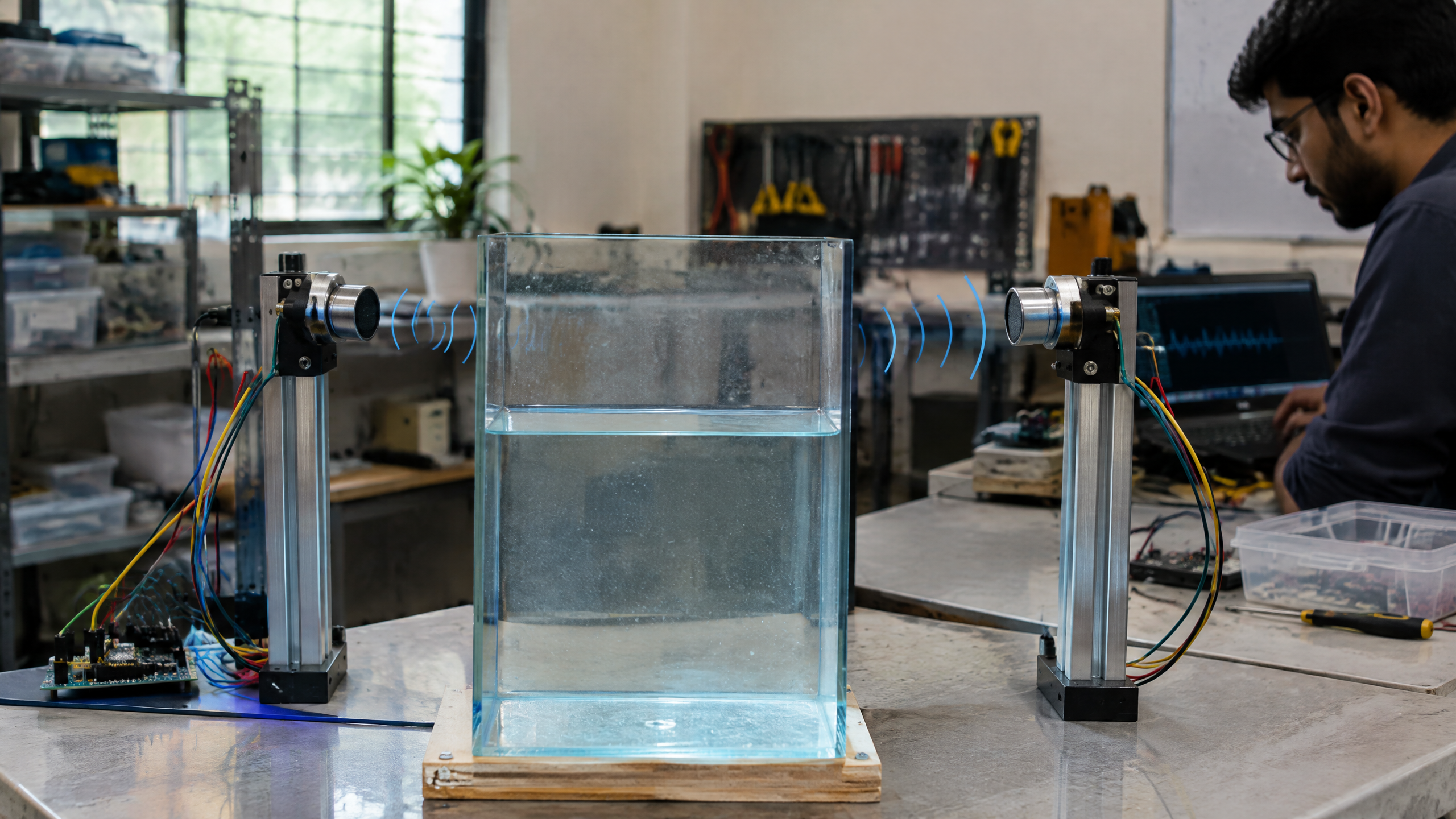
The ultrasonic sensor working principle is usually pulse-echo time of flight:
The electronics trigger a short ultrasonic pulse.
The pulse travels through a medium such as air towards an object or surface.
Some sound reflects back as an echo.
The receiver detects that echo and measures the round-trip time, T.
The controller estimates the one-way distance using:
text
Distance (L) = (T × C) / 2
Here, C is the speed of sound in the relevant medium. The division by two matters because the measured pulse has travelled from the sensor to the target and back. [2]
A controller can repeat this process to refresh a distance reading. In an HC-SR04-style Arduino exercise, for example, the program can time an echo pulse; Arduino’s pulseIn() measures the duration of a HIGH or LOW pulse in microseconds and returns 0 when a complete pulse does not arrive before its timeout. That is useful project behaviour to understand, not a universal ultrasonic-sensor standard. [4]
Simple Hindi wording: Ultrasonic sensor kaise kaam karta hai? It sends a sound pulse, waits for its echo, and uses the echo time to estimate distance.
Main ultrasonic sensor types
A practical distinction is whether transmission and reception share one transducer or use two. Air-coupled designs also involve a frequency trade-off: TI documents transducers in roughly the 30–500 kHz range, where lower frequencies generally support longer range, while higher frequencies can improve resolution and directivity but face more attenuation and therefore less range. The right choice depends on the application rather than a single “best” frequency. [3]
| Type / arrangement | How it is arranged | What to keep in mind |
|---|---|---|
| Monostatic pulse-echo | One transducer sends the pulse and receives the echo. | After transmitting, the transducer can keep ringing briefly. Near echoes may be obscured, creating a blind zone or minimum measurable distance. [3] |
| Bistatic pulse-echo | Separate transmit and receive elements are used. | It can help reduce the near-range problem, but adds hardware and calibration complexity. [3] |
| Air-coupled distance sensor | Sound travels through air to an object or surface. | Temperature, target shape and echo strength strongly affect the installed result. [2] [3] |
Where are ultrasonic sensors used?
Ultrasonic sensor applications range from classroom demonstrations to industrial automation. The same echo principle can be applied differently depending on the transducer, medium, housing and processing.
Robotics and education: An Arduino-based robot can use an ultrasonic sensor to estimate the distance to a large nearby obstacle. It is a good way to learn timing, units and signal limits without treating the sensor as a safety system.
Non-contact level checks: With suitable engineering and installation, an echo can be used to estimate the distance to a liquid or bulk-material surface. The reading represents distance to the reflecting surface, so vessel geometry, turbulence, foam and mounting matter.
Object presence and spacing: Machinery and automation can use ultrasonic sensing where a non-contact indication of an object or gap is useful.
Process and specialised measurement: Ultrasonic techniques can also support level, flow and other measurements, but an air-distance hobby module should not be assumed to have the performance, calibration or suitability of an industrial instrument. [1]
India-specific examples are often familiar: an engineering lab activity, a maker project, a tank-level prototype or an automation concept. Conditions such as heat, dust, monsoon-season humidity or an outdoor mounting may be relevant to the final design, but none automatically proves that a particular module will meet a required range or accuracy.
Accuracy, range and calibration: why an echo is not a guarantee
An ultrasonic sensor reports an estimate derived from time and sound speed, not a direct ruler measurement. A reliable installation starts by checking the assumptions behind that estimate.
### Target surface and angle
Echo strength depends on the target’s size, angle, shape, roughness and sound absorption. A large, flat target placed roughly square to the sensor may return a stronger echo than a small or angled one. Porous materials such as foam, cloth and wool can absorb sound and reduce the maximum usable sensing distance. [2]
### Temperature and the transmission medium
Sound speed changes with the medium and environmental conditions, including temperature. Therefore, a calculation that assumes one fixed speed of sound in air can gain error as conditions change. If a measurement matters, state the assumed conditions and assess the installed system rather than presenting one generic accuracy figure. [3]
### Blind zone and usable range
In a shared-transducer (monostatic) design, ringing immediately after transmission can conceal an echo from a very close target. This is why published modules often have a minimum-distance constraint. A listed maximum range is also conditional: the target and its placement may yield a weaker echo long before that nominal limit is helpful in a real setup. [3]
### Practical calibration and checking
For a learner project, compare readings with known distances across the range and target types you actually expect. Check that the sensor is securely mounted, point it at representative surfaces, allow for missed echoes or timeouts, and document temperature assumptions. For an application with material consequences, use an appropriate calibrated instrument and validation process; a simple Arduino prototype is not a substitute for system-level testing.
Advantages and limitations of ultrasonic sensors
Useful strengths include non-contact operation and the ability to sense many targets without relying on their colour or ambient lighting. The technique is intuitive to demonstrate because the return time has a direct role in the distance calculation.
Important limitations are just as practical: it needs a detectable echo, targets can redirect or absorb sound, near targets can fall in a blind zone, and temperature or a changed medium can affect the calculation. The sensor also needs time to listen after each pulse, so it is not automatically suitable for every fast-moving target. Treat the result as one input in a designed system, not as an unconditional decision-maker.
Frequently asked questions
What is an ultrasonic sensor in Hindi?
An ultrasonic sensor can be described as a sensor that uses sound above the human hearing range to detect an echo. In simple Hindi: yeh ultrasonic dhwani bhejta hai aur wapas aane wali echo ka samay maapkar distance ka andaza lagata hai.
Ultrasonic sensor kaise kaam karta hai?
It emits a sound pulse and measures how long the reflected pulse takes to return. For a pulse-echo distance estimate, multiply the round-trip time by the sound speed in the medium and divide by two. [2]
What is the ultrasonic sensor working principle in Hindi?
Its working principle is time of flight: sound pulse bheji jaati hai, echo wapas aati hai, aur time se distance nikala jaata hai. The result depends on the speed of sound and on receiving a usable echo.
How is an HC-SR04 ultrasonic sensor used with Arduino?
In a typical learning project, Arduino triggers the sensor and times the echo output pulse. A function such as pulseIn() can measure that pulse duration in microseconds, after which the sketch applies a stated sound-speed assumption to estimate distance. Handle a timeout or missing echo instead of treating every reading as valid. [4]
How does ultrasonic sensor distance measurement become inaccurate?
A soft, porous, small or angled target may send back a weak or misdirected echo. Sound speed can also change with temperature and medium, while a target inside a monostatic sensor’s blind zone may be difficult to measure. [2] [3]
What is the ultrasonic sensor HC-SR04 range?
There is no single range that applies to all ultrasonic sensors or all installed setups. For any specific HC-SR04-style module, use that module’s documentation and test with the real target, orientation and environmental conditions. Do not assume a nominal range is a universal accuracy or performance guarantee.
Related reading
[Proximity sensor](/article/proximity-sensor-types-working)
[Infrared (IR) sensor](/article/ir-sensor-working-types-uses)
[Level sensor](/article/level-sensor-types-working-uses)
[Flow sensor](/article/flow-sensor-working-principle)
---
Source notes
Reporting record
techduopulse stores source destinations privately. Public notes remain non-clickable so every visitor journey stays on this website.
https://support.google.com/trends/answer/4365533?hl=en
Primary source · Research source 5https://technav.ieee.org/topic/ultrasonic-sensors/
Primary source · Research source 1https://www.baumer.com/us/en/service-support/function-principle/ultrasonic-sensors---function/a/Know-how_Function_Ultrasonic-sensors
Primary source · Research source 2https://www.ti.com/lit/pdf/slaa907
Primary source · Research source 3https://docs.arduino.cc/language-reference/en/functions/advanced-io/pulseIn/
Primary source · Research source 4New India-focused sensor explainer covering ultrasonic sensor, working principles, uses and limitations.