
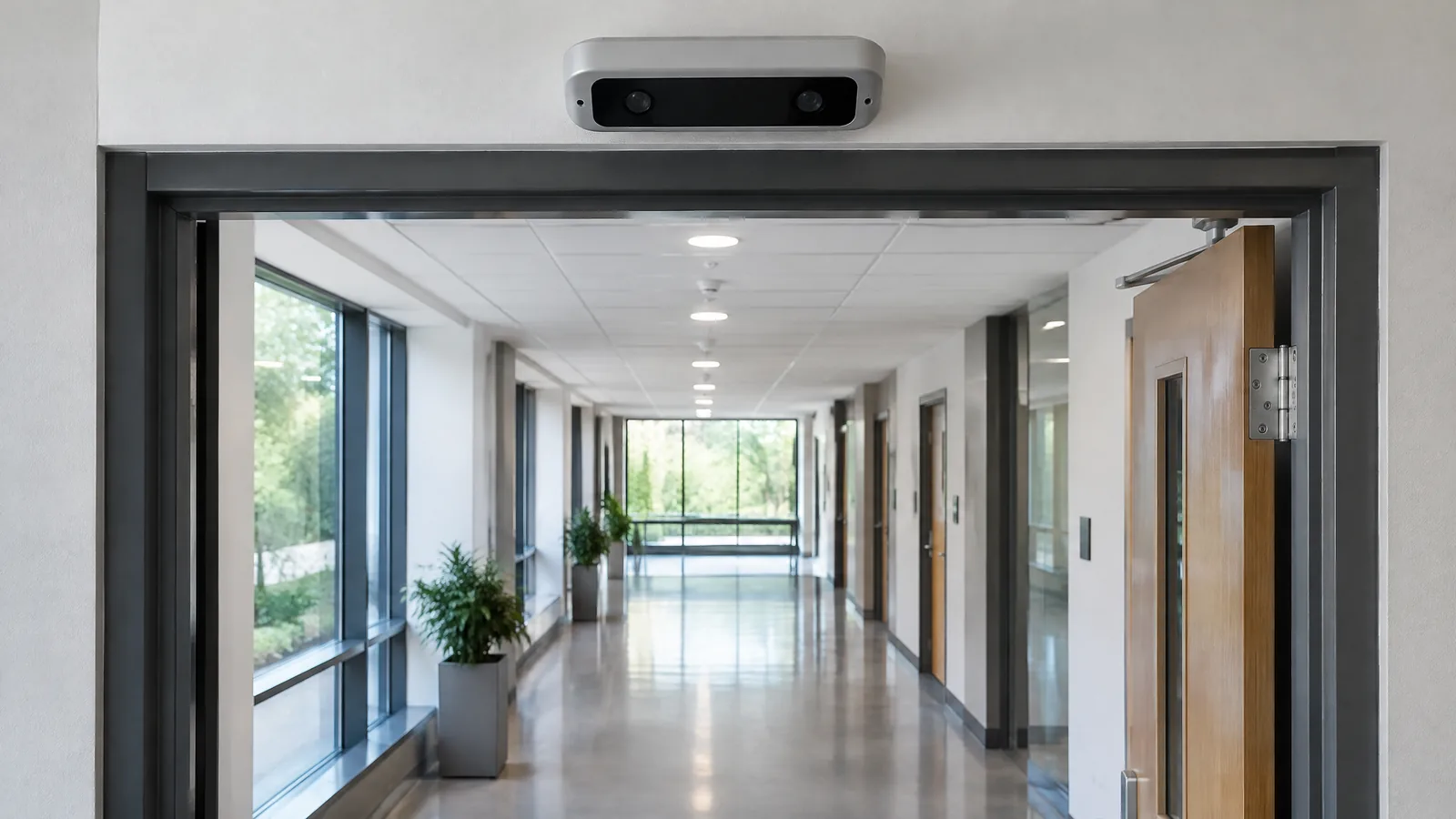
A building team may know that a lobby feels crowded but still lack a reliable count of people entering, leaving or using a shared space. A Time-of-flight (ToF) people-counting sensor measures distance and depth from reflected light, then uses those changes to estimate anonymous footfall or occupancy without needing a conventional video stream.
This article is part of the computer hardware technology guide library.
Key takeaways
A ToF people counter measures the return time of emitted light to estimate distance. Software can turn changing depth patterns into entry, exit or count events.
It is not the same as PIR, radar or camera analytics. The installed system may include an optical module, processing hardware, firmware and a building-management connection.
Camera-free hardware can reduce image-capture concerns, but privacy is still a system and governance question. Placement, light, reflectance, traffic patterns and counting logic affect results.
What does a time-of-flight people-counting sensor measure?
At its core, ToF measures the time between sending light toward a target and receiving the reflection. Because the light makes a round trip, the delay can be converted into distance. A multi-zone device can collect several distance measurements across a field of view, producing depth information rather than a normal colour image.
When a person crosses a defined doorway or corridor zone, their changing distances form a pattern. Software can use that pattern to estimate whether movement was inward or outward and, in a configured system, whether one or more people crossed. The result is a count event or occupancy signal, not a name or a statement about a person’s identity.
The word sensor can hide several parts. A building product may package an emitter, receiver and processor together. Another design can add an external microcontroller, an embedded classification model, network connectivity or a link to a building-management system. Those optional components are not properties of every ToF module.
How a building uses ToF for footfall and occupancy
The useful unit is a monitored zone, not the whole building. A sensor might watch a doorway, a narrow corridor, an entrance to a meeting area or a shared facility. The system then applies direction and zone rules to turn detections into an estimate of people entering, leaving or present.
STMicroelectronics documents one demonstration using a VL53L5CX on a gantry above a door and pointed at the ground. That project used a height threshold, a short sequence of readings and an embedded classifier for one- and two-person entry and exit classes. Its mounting height, distance threshold, sample rate and model are demonstration choices, not a universal installation recipe.
The building connection is a separate design decision. A counter may send events to access control, a building-management system or an analytics platform. Some commercial products offer wireless links such as LoRaWAN, while other installations use wired networking or a local controller. Confirm the actual interface, power method, retention period and failure behaviour for the selected system.
ToF versus cameras, PIR and other sensors
A camera-based counter analyses captured images or video. A ToF counter can instead work from depth measurements, and a camera-free design does not need to retain a visual record. That can be useful where a facility wants footfall data but does not need facial, clothing or appearance information.
PIR detects changes in infrared radiation associated with motion. It is useful for presence or motion triggers, but it does not inherently provide the same distance map or directional multi-person count. Radar uses radio waves and has different interference, mounting and signal-processing considerations. A single-point ranging sensor measures distance to a target; it is not automatically a people counter.
These categories can also be combined. A system might fuse ToF with another sensor or run a classifier on the depth time series. In that case, privacy, accuracy and maintenance depend on the complete design rather than the ToF component alone.
Limitations building teams should plan for
ToF is not magic occupancy knowledge. A crowded doorway, two people walking side by side, bags, pets, partial occlusion or unusual traffic can make the depth pattern harder to classify. A system tuned for a narrow door may not transfer to a wide lobby without new zones or logic.
Optical conditions matter too. Technical documentation notes that target reflectance, target speed, fog and strong sunlight can affect measurements. Low-light performance can be an advantage over ordinary visible-light video, but it does not remove every environmental or installation constraint.
Treat vendor accuracy numbers as context-specific unless the test conditions match your site. The ST demonstration reports 98.14% for a particular model, dataset and class setup; that number is not a promise for every door or building. A responsible procurement process should ask how the device handles missed detections, duplicate counts, outages, recalibration and changes in furniture or traffic flow.
Privacy and governance are still required
A camera-free ToF design may avoid collecting images, faces or clothing descriptions. That is a meaningful architectural distinction, but it does not automatically make a deployment compliant or risk-free. Count events can still be sensitive when combined with access logs, timestamps, location data or other systems.
Before installation, define the purpose, the smallest data set needed, who can access it, how long it is retained and whether raw depth data leaves the device. Tell building users what is being measured in clear language. Keep people-counting data separate from identity systems unless there is a documented, justified reason to connect them.
Also decide what the sensor is not allowed to do. It should not be presented as facial recognition, a safety-critical people guarantee or a way to identify individuals. A privacy-respecting design is helped by technical limits, but governance must cover the whole data path.
Frequently asked questions
These answers describe the sensing category rather than one specific product. Exact range, zones, interfaces and environmental limits are model-specific.
Is a ToF people-counting sensor a camera?
Not necessarily. A camera-free ToF counter uses emitted and reflected light to estimate depth and can produce count events without a conventional video stream. Some systems may combine ToF with other imaging or analytics, so check the complete product design.
Can ToF count people entering and leaving?
Yes, when the installation and software are designed for direction. A documented ST demonstration used a sequence of depth readings and classification to distinguish entry and exit classes. Results depend on placement, traffic and model logic.
Is a ToF occupancy sensor automatically anonymous?
No. A camera-free design can avoid images and appearance data, but the full system may still connect events with access records, timestamps or locations. Data minimisation, notice, access control and retention rules remain necessary.
Is ToF the same as PIR motion sensing?
No. PIR detects changes in infrared radiation, while ToF estimates distance from the travel time of light. ToF can provide depth patterns for counting, but it needs suitable placement and processing.
Does every ToF sensor work in the same way?
No. Devices differ by direct or indirect measurement approach, single-zone or multi-zone field of view, range, update rate, processing and communications. Use the exact model documentation for installation decisions.
About the image
AI-generated editorial illustration; not an actual product or mission photograph.
Source notes
Reporting record
techduopulse stores source destinations privately. Public notes remain non-clickable so every visitor journey stays on this website.
Source note: STMicroelectronics Time-of-Flight sensors overview
Primary source · Direct-ToF integration, single/multi-zone scope, smart-building applications and portfolio caveatsSource note: Terabee — Time-of-Flight technology for People Counting: ensuring privacy and anonymity
Context source · ToF depth sensing, camera-free counting claims, building integration and privacy caveatsSource note: Analog Devices, Time of Flight System for Distance Measurement and Object Detection
Primary source · Round-trip light timing, pulsed/CW distinction, components and environmental limitationsSource note: STMicroelectronics, People counting with a ranging sensor
Primary source · Documented door-counting setup, model-specific parameters and demonstration resultNew Buildings application explainer grounded in four technical sources. Separates ToF depth sensing from PIR, radar and cameras; distinguishes packaged sensors from optional processing, networking and building-system integrations; qualifies privacy, accuracy and environmental claims without generalising a model-specific demonstration.


