A steering-angle sensor quietly turns a steering-wheel movement into data that a vehicle’s safety systems can interpret. It does not steer the car by itself; it helps the vehicle compare where the driver intends to go with how the vehicle is actually moving.
On this page 4 sections
Part of our computer hardware technology guide library
What a Steering-Angle Sensor Measures
A steering-angle sensor is a position sensor associated with the steering shaft or column. Its core job is to report the steering wheel’s angular position, direction of movement and, in many designs, how quickly the driver is turning it. That makes it an input about driver intent: a request to travel in a particular direction, not a direct measurement of whether the vehicle has followed that request. Bosch describes steering-angle and steering-angle velocity as outputs of this type of sensor. [1]
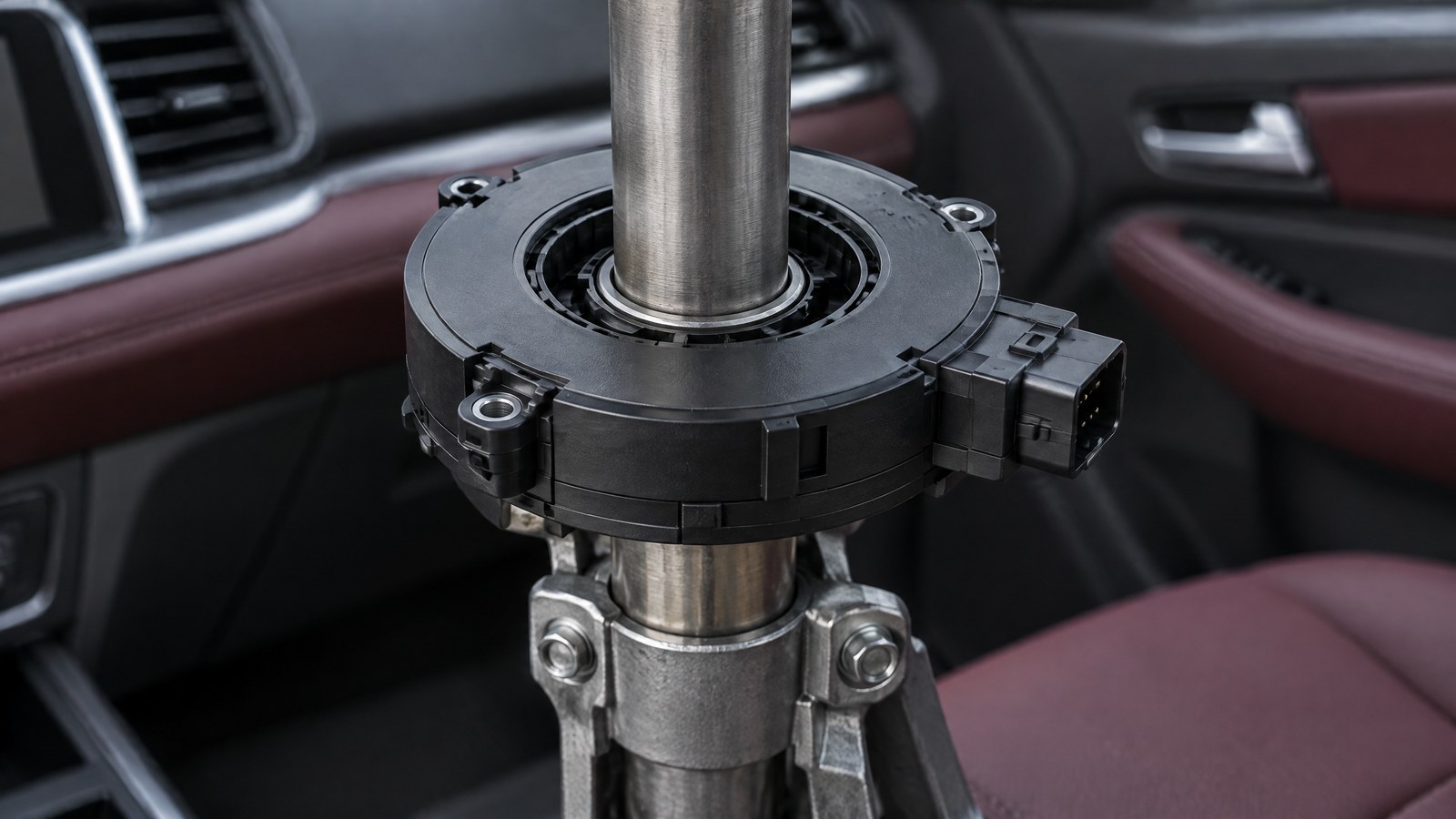
AI-generated editorial illustration of generic steering-column sensing hardware in a car cabin, not a photograph of a tested product or an actual field measurement.
The term can sound more definite than the measurement really is. A sensor value is useful only when the vehicle’s electronic control systems interpret it alongside other signals and the configuration intended for that particular vehicle. It is therefore better understood as one part of a vehicle-dynamics conversation than as a stand-alone verdict about handling or safety.
Steering-wheel angle is not road-wheel angle
Steering-wheel angle is the rotation of the wheel in the driver’s hands. Road-wheel angle is the direction of the tyres that meet the road. They are related through the steering mechanism, but they are not the same signal. The relationship may vary with steering ratio, vehicle design and operating conditions, so a steering-angle sensor should not be described as if it directly watches the front tyres.
This distinction also prevents a common mix-up: a steering-angle sensor does not measure where the vehicle is pointing or sliding. It records an input at the steering side of the system. The rest of the vehicle may respond differently when tyre grip, surface condition or vehicle motion changes.
Angle and steering rate answer different questions
The angle answers, “How far has the driver turned the steering wheel from its reference position?” The steering rate answers, “How quickly is that input changing?” Together they give the control system more context than either value alone. A small, steady correction and a rapid turn can produce different patterns even when the steering wheel briefly passes through a similar angle.
How a component obtains those values varies by design. Bosch’s published example uses magnetic sensing with two gear positions that change at different rates, allowing the component to derive an absolute value across several steering-wheel turns and perform plausibility checks. That is a useful example of a multi-turn sensor design, not a claim that every vehicle uses the same hardware or algorithm. [1]
Steering input becomes a desired-path estimate
Electronic stability control, often shortened to ESC, uses the steering input to estimate the direction the driver is asking the vehicle to take. Bosch’s system description pairs that input with wheel-speed, yaw-rate and lateral-acceleration information to compare a desired direction with the vehicle’s actual movement. [2] The steering-angle sensor therefore contributes to an estimate; it does not independently decide that a vehicle is skidding.
The U.S. NHTSA description of ESC draws the same conceptual boundary. It treats monitoring driver steering input and determining yaw rate as separate capabilities. In that document, yaw rate means the rate at which the vehicle’s heading changes about a vertical axis through its centre of gravity. [3] A steering-wheel rotation is not yaw rate, and yaw rate is not a road-wheel angle.
Why ESC needs more than one sensor
A stability-control system needs to compare intent with response. Wheel-speed sensors provide information about wheel rotation, while a yaw-rate sensor reports vehicle rotation and a lateral-acceleration sensor reports side-to-side acceleration. The software combines these signals using vehicle-specific logic. That division of roles is why a steering-angle sensor is neither a replacement for a wheel-speed sensor nor an alternative name for a yaw sensor. [2] [3]
The comparison is also bounded by physics. NHTSA notes that, as a vehicle approaches the lateral force available from the tyre and road surface, a steering-angle change produces less turning response than it does in ordinary driving. [3] This is a useful reason not to read a steering-angle value as a promise that the vehicle can follow any requested path.
Component design, reference and interpretation limits
Placement and architecture differ. A supplier educational resource describes steering-angle sensing within the steering column and notes that multiple sensing elements may be packaged together for redundancy, accuracy and diagnostics. [4] Other vehicle designs can integrate functions differently, so a generic illustration or description cannot identify the exact component layout in a specific car.
Equally, a dashboard warning, an off-centre steering wheel, a change in steering feel or a stability-control message does not establish a steering-angle sensor fault by itself. Those observations can arise from more than one mechanical, electrical or software-related condition. This explainer intentionally gives no calibration, reset, wiring, replacement or disabling instructions. A safety-related concern should be assessed by a qualified service professional using the vehicle maker’s current information and suitable equipment.
Important Points / Key Information
A steering-angle sensor is best understood as the vehicle’s record of steering input. It matters because ESC and some driver-assistance features need a defensible estimate of what the driver is asking for before they compare it with the vehicle’s measured motion.
- A steering-angle sensor measures steering-wheel input, commonly including angle and turning rate; it does not directly measure tyre direction, vehicle yaw or road grip.
- ESC uses steering input with other measurements, such as wheel speed, yaw rate and lateral acceleration, rather than relying on one sensor alone. [2] [3]
- The difference between the intended path and actual motion is meaningful only in a vehicle-specific system context and within the grip available from the tyres and surface.
- There are no safe universal fault thresholds, reset sequences or replacement instructions for this component. Safety warnings and changes in vehicle behaviour require qualified assessment.
- This article is educational information.
Examples / Supporting Information
The following examples show why the sensor is useful without turning the article into a diagnosis or a driving instruction.
A manufacturer’s stability-control model
In Bosch’s published electronic-stability-program explanation, steering angle supplies the desired direction of travel. Wheel-speed sensors, yaw-rate sensing and lateral-acceleration sensing contribute to the description of actual movement. [2] This is a supporting system example: it shows the division between intent and response, but it is not a test result, a description of every manufacturer’s implementation or a prediction of how a particular car will react.
An institutional definition that separates the signals
NHTSA’s ESC material is helpful because it keeps driver steering input and yaw-rate measurement distinct. [3] For a reader, the practical lesson is simple: turning the steering wheel is an instruction from the driver; yaw is rotation of the vehicle itself. A system that compares the two still needs other information and vehicle-specific interpretation. The U.S. document is used here for technical context only, not as a statement about requirements in India.
Hypothetical monsoon-road context in India
Hypothetical example: on a rain-slick urban curve, a driver turns the steering wheel to follow the bend. The steering-angle sensor records that requested direction and how quickly the wheel moved. If the vehicle’s wheel-speed, yaw-rate and lateral-acceleration signals do not describe the expected response, the stability-control system can evaluate that mismatch using its own design logic. This is not a claim that a system prevents every loss of control, and it does not make an unsafe speed or manoeuvre safe.
The relevant takeaway is not to watch the sensor. It is to understand why a modern vehicle needs separate signals for request, wheel rotation and body motion when road grip may change quickly.
Conclusion
A steering-angle sensor converts the driver’s steering-wheel movement into an angle-and-rate input that safety systems can use. Its most important role is not to report where the car is, but to help establish where the driver intends to go before that request is compared with wheel-speed and vehicle-motion measurements. [1] [2] [3]
Keeping steering-wheel angle, road-wheel angle and yaw rate separate makes the technology easier to understand and avoids overstating what one component can prove. Because this topic touches active safety systems, any vehicle-specific warning, repair decision or configuration question belongs with qualified human review and the relevant manufacturer information.
How we checked thisSources (4)
We keep source links private so your reading stays on techduopulse. Each note names the publisher and document we checked.
Bosch Mobility: steering-angle sensor measuring principle
Primary source · What a Steering-Angle Sensor MeasuresBosch Mobility: electronic stability program operation principle
Primary source · Steering input in a stability-control systemNHTSA: ESC definition and yaw-rate context
Primary source · Steering-wheel angle versus actual vehicle motionDelphi: steering-angle sensing in an ESC input set
Primary source · Component design and limitsOwner-approved educational sensor explainer; obsolete private-draft status removed without changing source-backed facts or professional safety boundaries. Original generic AI editorial illustration, not a product or field-test photograph.