
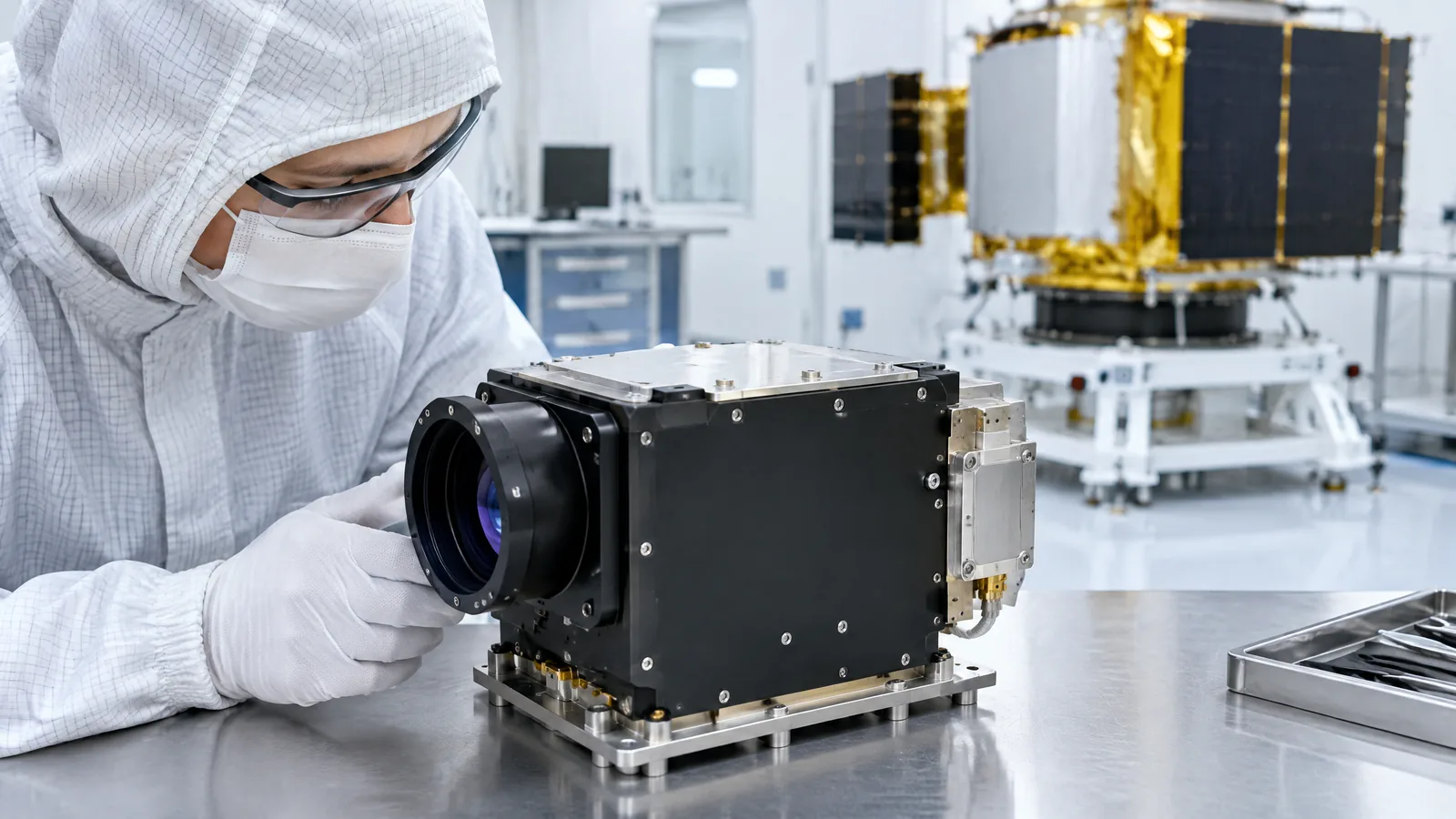
When a satellite must point an antenna, instrument or laser link in the right direction, knowing its own orientation is as important as knowing where it is. A star tracker satellite sensor photographs the surrounding star field and compares that pattern with a stored catalogue to estimate the spacecraft’s attitude, or orientation in space.
This article is part of the computer hardware technology guide library.
Key takeaways
A star tracker is an onboard optical attitude sensor: it looks outward at stars to help determine how the spacecraft is rotated, not downward to make Earth images.
Its camera and processing electronics recognise star positions and match them with known references. The result is attitude information for the spacecraft’s guidance and control software.
A star tracker does not work alone. Spacecraft can combine it with gyros, Earth and Sun sensors, magnetometers, GPS and actuators, depending on the mission.
The exact number of tracker heads, detector design, star catalogue and operating modes are mission-specific. Not every satellite needs or carries one.
- A star tracker measures orientation from stars.
- It is different from an Earth-observation camera.
- Other sensors and actuators fill gaps, provide backup or help during different mission modes.
- Performance and hardware details vary between spacecraft.
What does a star tracker measure?
A star tracker measures the spacecraft’s attitude: its rotation relative to an inertial reference frame. In simple terms, it helps answer whether the satellite is pointing in the intended direction and how its three axes are oriented.
The physical sensor is an optical head containing a lens, a light-sensitive detector and supporting electronics. It captures a small view of the sky. Software then identifies stars in that image and compares their relative arrangement with known star data. Because the pattern is used as a reference, the output is an orientation solution rather than a conventional photograph for a human viewer.
This distinction matters. A star tracker satellite sensor is not an Earth-imaging payload, and its image is not primarily used to identify coastlines, clouds or land cover. Its job is to provide the spacecraft with a reference for pointing.
How a satellite star tracker finds attitude from stars
The process begins with light from stars entering the optical head. The detector records bright points and their positions on the sensor. The tracker’s algorithms reject unsuitable points where possible, form a pattern from the remaining stars and search for a match in its onboard catalogue.
Once a match is found, the known star directions can be compared with the directions measured by the tracker. That comparison produces the spacecraft’s attitude estimate. The estimate can then be passed to the attitude and orbit control system, which decides how to maintain or change the spacecraft’s pointing using the mission’s approved actuators.
ESA’s Alphasat example describes this as analysing the placement of surrounding stars relative to the payload. Its technology-demonstration tracker was designed for accurate, autonomous attitude acquisition and included a catalogue of more than 3,000 stars. That catalogue size belongs to the Alphasat implementation; it is not a universal specification for every tracker.
- Capture a star field through the tracker’s optical head.
- Detect star-like points and determine their relative positions.
- Compare the observed pattern with stored star references.
- Calculate an attitude estimate for the spacecraft system.
- Send attitude data to the relevant guidance, navigation and control software.
Where the star tracker fits in spacecraft control
A star tracker is one part of a larger system, not a complete spacecraft-control solution. NASA’s description of the GRACE-FO attitude and orbit control system lists sensors, actuators and software working together. The system provides three-axis-stabilised Earth-pointing control during mission modes and measures spacecraft rates and orbital position.
On GRACE-FO, the Star Tracker Assembly supports fine attitude and orbit control and helps transform science data into inertial references. The same system also includes GPS receivers, gyros, coarse Earth and Sun sensors, a fluxgate magnetometer and an inertial measurement unit. Magnetic torquers and a cold-gas propulsion system are listed as actuators or control elements in that mission architecture. These components have different jobs and should not be described as parts of the optical sensor itself.
A gyro can provide angular-rate information, including during emergency modes. An Earth or Sun sensor can provide coarse pointing information, while a magnetometer can use Earth’s magnetic field as another coarse reference. The exact combination depends on the spacecraft’s orbit, mission modes, pointing needs and fault-tolerance design.
Why missions may use more than one tracker head
A tracker needs a suitable view of the sky and must continue to provide useful data through the spacecraft’s operating conditions. Missions can therefore use multiple heads for redundancy, wider operational coverage or improved availability. This is not a rule that every satellite follows.
NASA/JPL reports that GRACE-FO has three redundant star-tracker heads, while the earlier GRACE mission used two camera heads. Redundancy can help the system continue when a head is unavailable or its view is unsuitable, but the article’s mission example should not be treated as a standard commercial configuration.
ESA’s Alphasat tracker shows another design emphasis: a compact, lightweight, low-power, single-box unit intended to limit interference with a hosted payload’s main mission. This illustrates how packaging and resource limits shape hardware choices.
Limitations and design boundaries
A star tracker needs a usable view of stars. Bright stray light, an obstructed field of view, an unsuitable spacecraft attitude or other environmental conditions can affect when its measurements are available. Spacecraft designers use other sensors and operating modes so that attitude knowledge does not depend on one optical head at every moment.
The tracker also reports an estimate with a defined accuracy and update behaviour, not an infallible answer. A mission’s algorithms must consider validity checks, sensor faults and agreement with other measurements. Public mission pages often describe the role of the sensor without publishing every implementation detail, so specifications such as accuracy, detector type, thermal range and update rate should only be attached to a named model or mission when documented.
Hardware names can also be misleading if they are generalised. ESA identifies an active-pixel detector called ASTRO APS in the Alphasat technology-demonstration payload. That detector is a model-specific feature, not a universal requirement for all star trackers.
Star tracker versus other satellite sensors
The easiest way to understand a star tracker is to compare the reference it uses. A star tracker uses the apparent arrangement of stars. A Sun sensor looks for the Sun to provide a coarse directional reference. An Earth sensor uses the Earth’s sensed signature in designs that support that method. A magnetometer measures the local magnetic field, and a gyro measures changes in angular rate.
These are not interchangeable labels. A star tracker can support fine attitude knowledge, while coarse sensors or gyros can help with acquisition, safe modes or periods when the star tracker’s view is not usable. GPS primarily provides position information in the GRACE-FO description, although its data can be part of a wider navigation and control solution.
| Component | Primary reference or measurement | Typical role in the wider system |
|---|---|---|
| Star tracker | Relative positions of stars | Fine attitude reference |
| Gyro | Spacecraft angular rate | Rate data and support during selected modes |
| Sun or Earth sensor | Direction or signature of the Sun or Earth | Coarse attitude information |
| Magnetometer | Local magnetic field | Coarse attitude reference with a field model |
| GPS receiver | Signals from navigation satellites | Position and navigation reference |
Star tracker satellite FAQs
These answers describe the documented mission examples and the general role of an optical attitude sensor. A spacecraft’s own mission documentation takes priority for exact hardware details.
Is a star tracker an Earth-imaging camera?
No. A star tracker photographs stars so the spacecraft can estimate its orientation. An Earth-imaging camera is designed to collect information about the Earth; the two instruments can use optical detectors but serve different purposes.
Does a star tracker control a satellite by itself?
No. It supplies attitude information to a wider system of sensors, software and actuators. NASA/JPL’s GRACE-FO description lists star trackers alongside gyros, Earth and Sun sensors, a magnetometer, GPS, magnetic torquers and other system elements.
Why does a star tracker need a star catalogue?
The catalogue provides known star references. By comparing the observed pattern and relative positions with those references, the tracker can calculate which way the spacecraft is oriented. The catalogue size and matching design vary by implementation.
Does every satellite have a star tracker?
No. The need depends on the mission’s pointing accuracy, orbit, operating modes, available resources and fault-tolerance design. Some spacecraft use other sensors or a combination of sensors instead.
About the image
AI-generated editorial illustration; not an actual product or mission photograph.
Source notes
Reporting record
techduopulse stores source destinations privately. Public notes remain non-clickable so every visitor journey stays on this website.
Source note: ESA Advanced Star Tracker, Alphasat technology-demonstration payload
Primary source · Star trackers as attitude sensors; autonomous attitude acquisition; star-pattern analysis; Alphasat catalogue and model-specific ASTRO APS detailsSource note: NASA/JPL GRACE-FO Attitude and Orbit Control System
Primary source · Star Tracker Assembly role; three redundant heads; wider sensor, software and actuator system; separate gyro, Earth/Sun sensor, magnetometer and GPS rolesInitial 15 October 2026 India-facing satellite hardware explainer. Treats the star tracker as an onboard optical attitude sensor, separates it from Earth imaging and from other spacecraft sensors, and uses only the supplied ESA Alphasat and NASA/JPL GRACE-FO mission evidence. Model-specific detector, catalogue, redundancy and integration details are explicitly qualified.


