SEO title: Smoke Sensor: Types, Working and Uses Meta description: Learn how smoke sensors work, compare photoelectric and ionization types, and see why MQ-2 project modules are not the same as certified alarms.
This article is part of the software engineering technologies guide library.
What is a smoke sensor?
A smoke sensor is a device that responds to particles suspended in air. It does not detect “fire” directly; it monitors a physical change caused by particles and triggers when its configured threshold is reached. [1]
In everyday speech, people often call any such device a smoke detector or smoke alarm. The distinction matters in a building system:
A smoke detector is a sensing device connected to a fire-alarm system.
A smoke alarm combines sensing with an audible notification function for occupants. [2]
So, a detector can be one input in a wider smoke detection system, while an alarm may include the sounder intended to alert people. The exact arrangement varies by building and product design.
Smoke sensor working principle: from particles to a signal
Whatever the technology, the basic signal path is similar: particles enter or influence a sensing chamber; the chamber’s electrical or optical condition changes; electronics compare that change with a threshold; and the device sends or activates an alarm signal. [1]
Two common approaches are photoelectric and ionization detection.
### Photoelectric smoke sensor
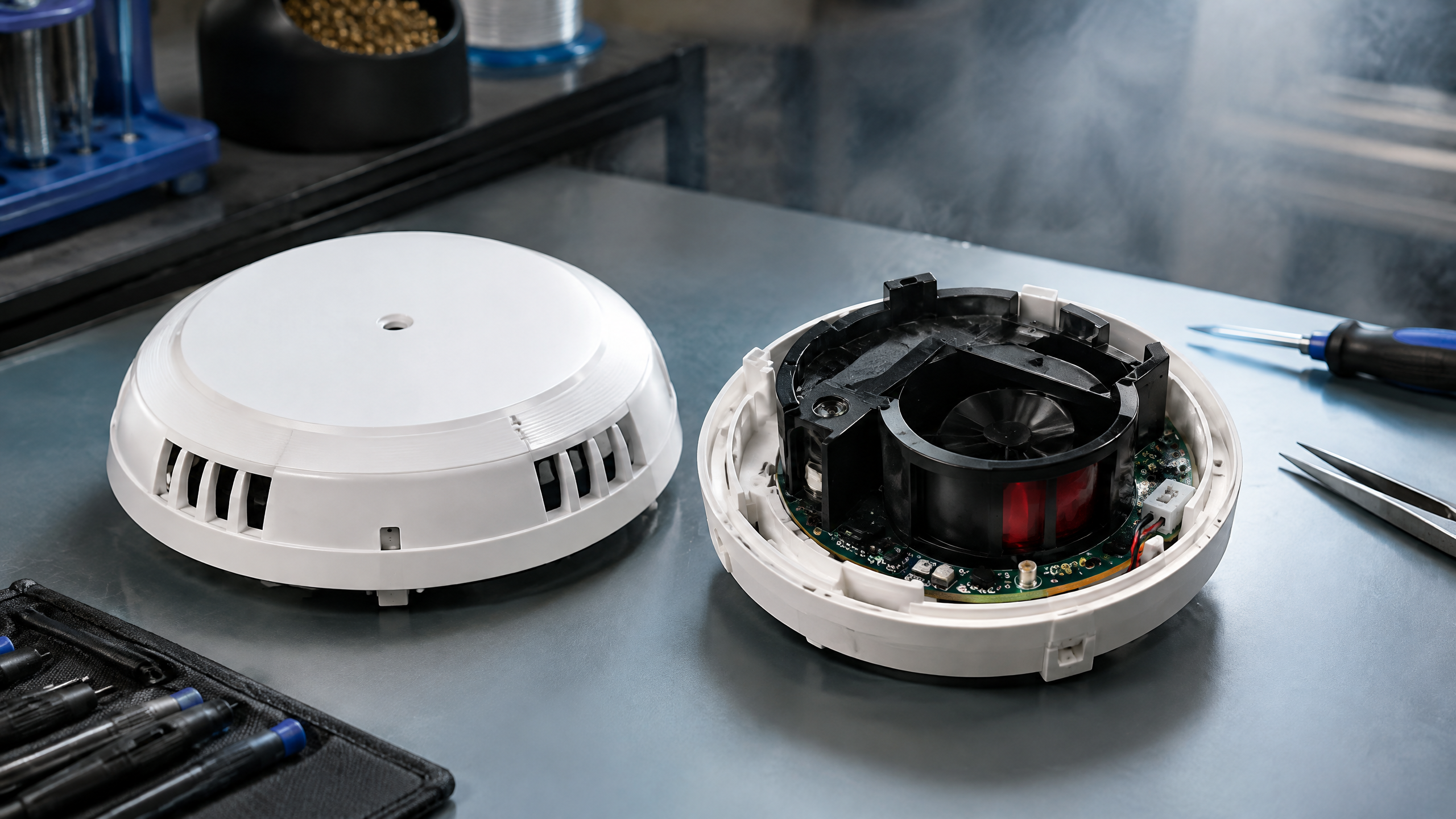
A photoelectric smoke sensor contains a light source and a light-sensitive detector inside a chamber. Under normal conditions, the photodetector is positioned so it receives little or no direct light from the source. When smoke particles enter, they scatter the light. Some scattered light reaches the photodetector, and the electronics can trigger once the detected signal crosses its threshold. [1]
A useful mental picture is a beam of sunlight becoming visible in a dusty room: particles change where the light travels. That is the principle, although an actual detector’s chamber and electronics are designed and tested far more carefully than this analogy suggests.
### Ionization smoke detector
An ionization smoke detector uses a small, shielded radioactive source to ionize air between plates in a sensing chamber. This enables a small electrical current. When smoke particles enter, they interfere with the ions and reduce that current. The electronics sense the change and may initiate an alarm at a defined threshold. [1]
This is not a DIY mechanism to open or modify. The detection chamber is part of a complete, manufactured device; safe handling, servicing and end-of-life directions must come from the manufacturer and applicable local arrangements.
Main smoke sensor types
| Type | What changes in the sensor | Typical sensitivity pattern | Reader takeaway |
|---|---|---|---|
| Photoelectric | Smoke scatters light towards a photodetector | Often more responsive to the larger particles associated with smouldering fires | Optical sensing is central to its operation. [1] [2] |
| Ionization | Smoke reduces ion current in an ionized chamber | Often responds faster to particles from many fast-flaming fires | It measures a current change, not flame itself. [1] [2] |
These patterns are tendencies, not guarantees that one technology will always warn first in every fire scenario. NIST and NFPA describe different sensitivity characteristics for the technologies, while real-world performance also depends on the fire, airflow, device design, placement, maintenance and test conditions. [1] [2]
Some products and systems use more than one sensing approach or add other inputs. That does not make every device equally suitable for every room or building. Treat a detector as part of a tested system, rather than just a sensor connected to a buzzer. [5]
The MQ-2 smoke sensor in Arduino projects
The MQ-2 smoke sensor is common in classroom and maker projects because it produces an electrical response to flammable gases and can also respond to smoke. Its sensing material is tin dioxide (SnO₂), a semiconductor material. Under the manufacturer’s stated standard test conditions, the sensor is specified for a 300–10,000 ppm flammable-gas range, uses a 5 V heater, and has a stated preheat requirement of more than 48 hours. [4]
Those details point to an important limitation: an MQ-2 board is not automatically a certified smoke alarm simply because it can respond to smoke. Its response may be influenced by the target gas, heater conditions, warm-up, the module’s circuitry, threshold setting and its environment. A flashing LED or buzzer in an Arduino demonstration is useful for learning about sensing; it is not evidence that the project is a life-safety installation.
For an India-specific standards context, the BIS product manual for IS 11360:1985 covers ionization and optical/photoelectric smoke detectors for use in automatic electrical fire-alarm systems. Its scope includes tests relating to sensitivity, stability, environmental conditions and fire performance. [3] A hobby board or unverified online module should therefore not be assumed equivalent to a detector that conforms to that specification. This is not a statement of legal approval or a substitute for advice from the relevant authority or qualified fire-safety professional.
Where smoke detection is used
Smoke sensing can appear in several settings, each with different requirements:
Homes and residential spaces: devices may provide local occupant notification or connect with a wider arrangement.
Apartments, offices, schools and public buildings: detectors can form inputs to a building fire-alarm system.
Electronics education: students can observe how an MQ-2 module’s output changes and how a microcontroller applies a chosen threshold.
Industrial and facility systems: smoke detection may sit alongside other detection, notification and control equipment.
The shared goal is early indication of airborne particles, but the consequence of an error is not the same in every use case. That is why a classroom experiment, a residential alarm and a building fire-alarm system need different levels of design, testing and maintenance.
Limitations, nuisance alarms and calibration considerations
A smoke sensor reading is not a universal verdict that a fire is present or absent. Cooking aerosols, steam-like airborne material, dust and other conditions can contribute to nuisance alarms or unsuitable readings. NFPA notes the relevance of keeping residential alarms away from kitchens and following the manufacturer’s instructions; this should not be read as a specific Indian placement rule. [2]
Keep these practical limitations in mind:
Placement changes what the device samples. Airflow, ventilation, doors, fans and the distance from a source can alter particle movement.
Dust and contamination matter. A sensing chamber is not isolated from its environment forever. Cleaning and inspection should follow the product documentation, not improvised disassembly.
Sensitivity is a trade-off. A lower threshold may increase response to small changes but can also increase unwanted activations. A higher threshold can miss smaller changes. Product testing addresses such trade-offs; it cannot be inferred from a generic module’s indicator light. [1] [3]
Calibration is not one universal adjustment. A project module’s threshold potentiometer is only a local setup control, not proof of traceable calibration or alarm-system suitability.
No sensor removes the need for a safety plan. Do not rely on an untested project, a single device or this article as a guarantee of detection, warning or protection. Follow the device instructions and the fire-safety procedures applicable to the premises.
Smoke detector vs smoke alarm: why the wording matters
When someone asks for a “smoke detector,” first consider what they mean. They may be asking about the sensing method, the sounder in a room, or a detector attached to a managed building system. NFPA separates the detector function from the residential alarm that includes audible notification. [2]
That distinction is especially useful in conversations with an electrician, building manager or installer. It helps avoid assuming that an Arduino sensor, a stand-alone alarm and an addressable building-system detector have the same role, approval status or maintenance needs.
Frequently asked questions
Smoke sensor kya hai?
A smoke sensor is a device that responds to airborne particles associated with smoke. It senses a change—such as scattered light or ion current—and can trigger when a threshold is reached; it does not directly sense “fire.” [1]
Smoke sensor kaise kaam karta hai?
The method depends on the type. A photoelectric sensor detects light scattered by particles, while an ionization detector senses a reduction in chamber current caused by particles. [1]
Smoke detector kaise kaam karta hai?
A smoke detector monitors its sensing chamber and sends a signal when its threshold is met. In a building fire-alarm system it can be one sensing component; a smoke alarm also includes audible notification for occupants. [2]
Smoke detector in Hindi ka kya matlab hai?
In Hindi, it is commonly understood as a device that detects dhuaan (smoke). For a technical explanation, it is more useful to ask whether the device is a sensor-only detector, a stand-alone alarm with a sounder, or part of a building fire-alarm system.
What is the smoke sensor working principle?
The general principle is particle detection followed by a threshold decision. In photoelectric designs, particles scatter light toward a photodetector. In ionization designs, particles reduce ion current in the chamber. [1]
Can an MQ-2 smoke sensor be used as a fire alarm?
An MQ-2 can be valuable for learning and gas/smoke-response experiments, but it should not automatically be treated as a certified life-safety fire alarm. Its manufacturer documents a semiconductor gas-sensing element, stated test conditions and warm-up requirements; a complete alarm needs appropriate design, testing, installation and maintenance. [4] [5]
Fire alarm aur smoke detector kaise kaam karte hain?
A smoke detector senses particles and sends a signal when its threshold is met. A fire-alarm system can use that signal for notification and other designed system responses. The details depend on the particular system, so do not assume that every detector includes a siren or that every smoke event will produce the same response. [2]
Related reading
/article/gas-sensor-working-principle-types
/article/temperature-sensor-types-working-principle
/article/humidity-sensor-types-working
/article/ir-sensor-working-types-uses
---
Source notes
Reporting record
techduopulse stores source destinations privately. Public notes remain non-clickable so every visitor journey stays on this website.
https://www.nist.gov/how-do-you-measure-it/how-do-smoke-detectors-work
Primary source · Research source 1https://www.nfpa.org/education-and-research/home-fire-safety/smoke-alarms
Primary source · Research source 2https://www.bis.gov.in/wp-content/uploads/2023/11/PM_-IS-11360_Nov-2023.pdf
Primary source · Research source 3https://www.winsen-sensor.com/d/files/PDF/Semiconductor%20Gas%20Sensor/MQ-2%20(Ver1.4
Primary source · Research source 4https://www.ti.com/solution/smoke-heat-detector
Primary source · Research source 5New India-focused sensor explainer covering smoke sensor, working principles, uses and limitations.