
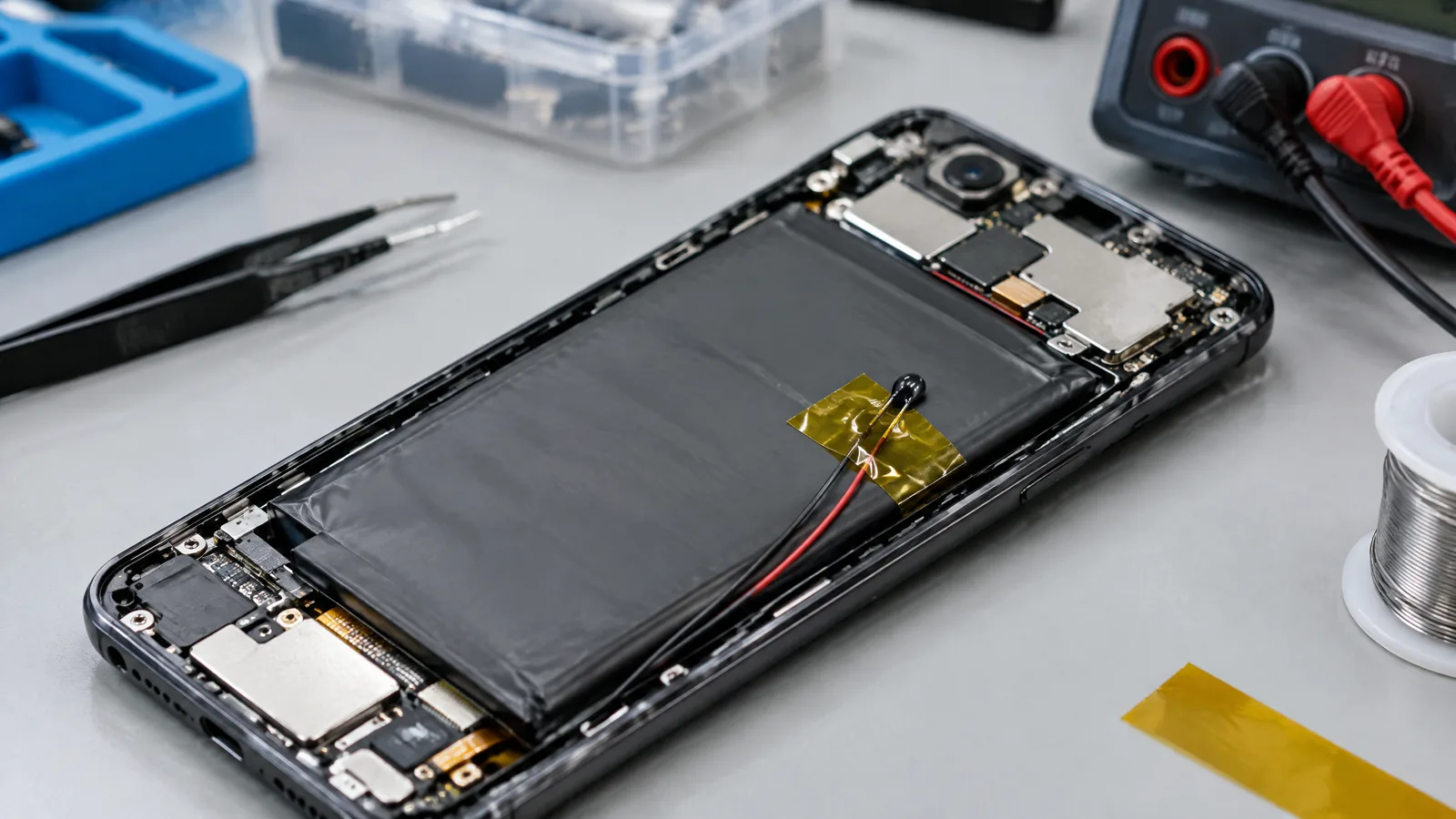
If your phone feels warmer while charging or working hard, the battery-management system needs a local temperature signal before it decides whether charging or discharge current should continue normally. A phone battery NTC thermistor is the physical sensor that measures the battery pack’s nearby temperature by changing resistance, while separate electronics interpret that change and can limit current when conditions are high.
This article is part of the computer hardware technology guide library.
Key takeaways
A battery-pack NTC thermistor is a small physical resistance-based temperature sensor, not a general room thermometer. Its resistance normally falls as its temperature rises. A measurement circuit reads that resistance and battery-management hardware can use the resulting estimate to reduce current when the battery is too warm. Exact placement, thresholds and architecture vary by phone model.
- The NTC element senses temperature close to the battery pack.
- A warmer NTC generally has lower resistance, so electronics need a conversion curve rather than a simple switch.
- The thermistor, measurement circuit and charging/discharge controller are separate parts of the system.
- A battery thermistor reading is not proof of the phone’s external surface temperature or room temperature.
What is a phone battery NTC thermistor sensor?
An NTC thermistor is a temperature-dependent resistor made from semiconductor material. NTC means negative temperature coefficient: as the thermistor becomes warmer, its electrical resistance generally decreases. Measuring that resistance gives the phone an indirect way to estimate the temperature at the point where the element is installed. [1] [2]
In a smartphone battery pack, the NTC is a physical sensor element. It is not the charging IC, battery-management controller, processor or temperature app. Those other parts may supply a small measurement current, convert resistance into a temperature estimate, compare it with operating rules and alter charging or discharge behaviour. [2] [3]
Some models may not document this component publicly. A temperature value shown in an app or settings screen also does not reveal the exact sensor location or circuit used by every phone.
How does the battery NTC measure temperature?
The process is a short signal chain. Heat from the battery pack reaches the thermistor through its mounting and nearby materials. The element’s resistance changes. A circuit measures that resistance, often through a voltage relationship, and software or dedicated power-management electronics convert it using the thermistor’s specified resistance-temperature curve. [1] [2]
The result estimates the local temperature where the thermistor is attached or positioned. It is not an instant, direct reading of every cell surface. Thermal contact, packaging, response time, electrical tolerances and the conversion curve affect how closely the estimate follows a changing battery condition. NI notes that thermistors are nonlinear and highly susceptible to self-heating, so measurement current and circuit design matter. [2]
The useful model is: physical NTC element → resistance-measurement circuit → temperature estimate → battery-management decision. Only the first item is the sensor; the others are supporting electronics and control functions.
What does the phone do when the battery is hot?
Panasonic’s smartphone example describes an NTC detecting battery temperature and the system limiting current when the battery temperature is high, which suppresses additional heat generation. [1] In practical terms, power-management hardware can use the estimate as one input to change charging or discharge behaviour. The exact response depends on the model and operating state; the source does not establish one universal threshold for every phone.
This is a control application, not just a display feature. The NTC itself does not decide to slow charging, shut down a device or protect a battery. The measurement and power-management system performs those functions.
A loose connection, damaged part, unsuitable replacement or poor thermal coupling could make the measured value differ from the battery condition. That is why a phone battery sensor should not be bypassed or replaced with an arbitrary resistor.
Battery NTC thermistor versus other phone temperature readings
A smartphone can contain more than one temperature-related sensing path. A battery-pack NTC is intended to represent the local battery area. A processor or power-management IC may report its own local junction temperature, while another sensor or an inferred software value may describe a different part of the device.
An NTC thermistor is different from a semiconductor temperature-sensor IC. The NTC changes resistance and needs a suitable measurement and conversion path. An IC performs more sensing and signal conversion inside a chip and may provide an analogue or digital output. TI describes these as different approaches with different linearity, interfaces and operating constraints. [3]
Ask which physical location a displayed reading represents. A battery NTC can inform charging decisions while still failing to describe the warmest outer surface, processor, camera module or surrounding air.
Limitations and safe interpretation
An NTC thermistor is sensitive and compact, but it is nonlinear. The phone’s electronics must use the correct part characteristics and conversion method. NI identifies self-heating, mounting, response time, operating range and measurement hardware as important factors. [2] A reading can lag when heat moves quickly or represent a local spot rather than the entire pack.
Do not treat an app’s displayed temperature as a laboratory measurement or use it alone to diagnose a damaged battery. The value may be rounded, filtered, delayed or sourced from a different location. If a phone repeatedly becomes unusually hot, swells, smells abnormal or shows a manufacturer warning, follow the manufacturer’s instructions and seek qualified service rather than opening the battery pack or bypassing its sensing path.
This article explains the sensor’s role, not a repair procedure. Battery packs store substantial energy, and the correct thermistor type, placement and protection design are model-specific. Follow manufacturer documentation and qualified repair practice for any replacement.
Frequently asked questions
These answers describe the general component-level use supported by the cited technical sources; individual phone designs can differ.
What does an NTC thermistor do in a phone battery?
It senses local battery-pack temperature through a temperature-dependent resistance. Measurement and power-management electronics can use that estimate to limit charging or discharge current when the battery is too warm. [1]
Does a battery NTC thermistor measure room temperature?
No. It is positioned to sense the battery area, so its reading represents a local battery-related temperature rather than general room air or every point on the phone.
Why does NTC resistance fall when temperature rises?
NTC means negative temperature coefficient. In this thermistor family, material resistance generally decreases as temperature increases. The phone converts that change into an estimated temperature. [1] [2]
Is the NTC thermistor the same as the charging controller?
No. The NTC is the physical sensing element. Separate circuitry measures its resistance, and battery-management hardware and software use the estimate for charging or discharge decisions.
Can I replace a phone battery NTC with a random resistor?
That is not a safe general repair recommendation. A substitute may give the wrong temperature estimate or defeat a protection response. Use manufacturer or qualified-repair guidance for the exact model.
About the image
AI-generated editorial illustration; not an actual product or mission photograph.
Source notes
Reporting record
techduopulse stores source destinations privately. Public notes remain non-clickable so every visitor journey stays on this website.
Source note: Panasonic Industry NTC thermistor application guide
Primary source · NTC principle and smartphone battery current-limiting applicationSource note: National Instruments temperature measurement fundamentals
Primary source · NTC resistance behavior, nonlinearity, self-heating and measurement considerationsSource note: Texas Instruments temperature-sensing technical reference
Primary source · NTC material, characteristics and distinction from IC temperature sensorsNew 15 October 2026 India-facing hardware application explainer. Separates the physical battery-pack NTC from measurement electronics and battery-management control, explains the resistance-based signal path and heat-response use, and qualifies model-specific availability, local measurement, nonlinear conversion, self-heating and repair limits using Panasonic, NI and TI technical sources.


