
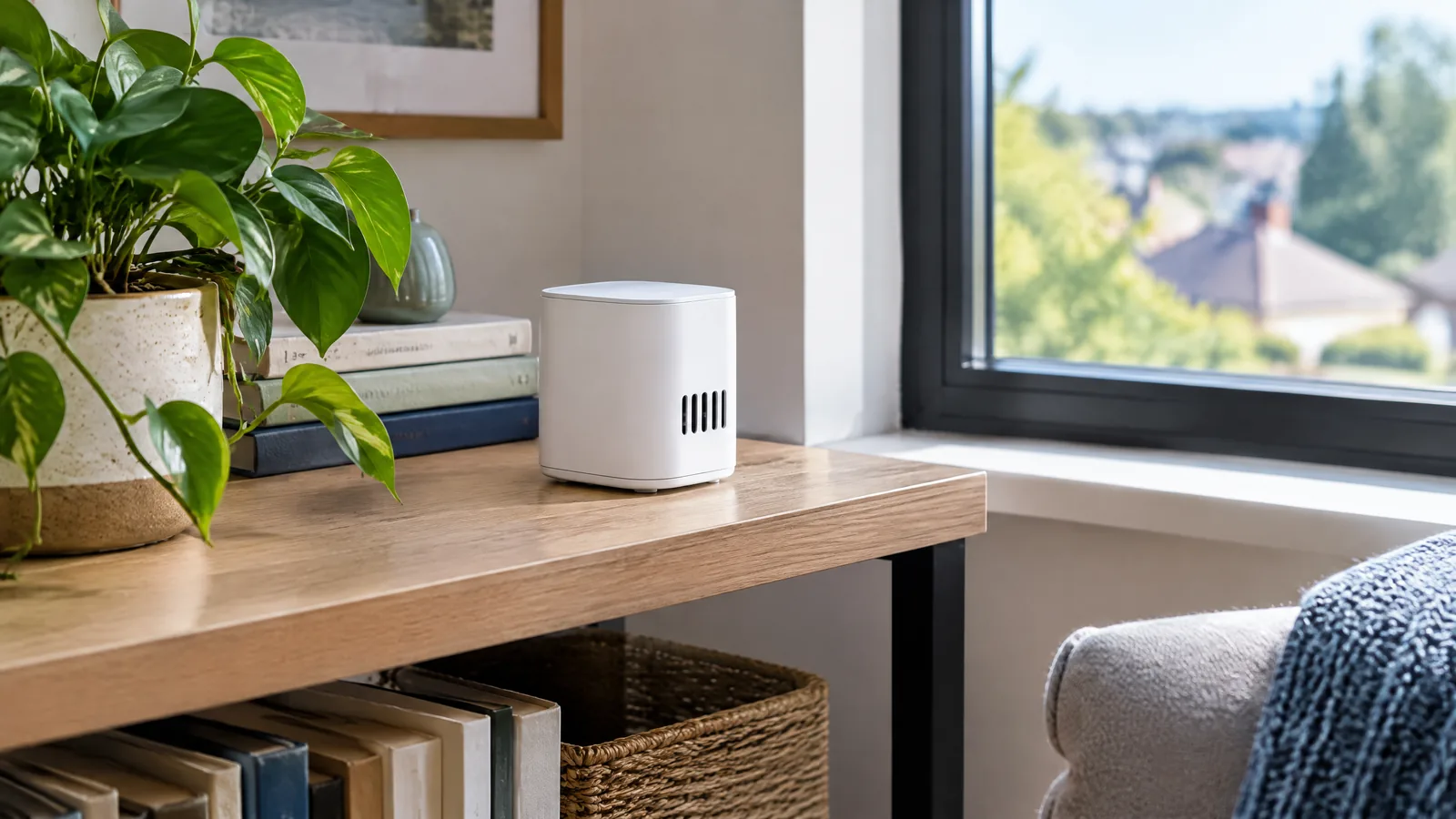
A room can look clean while cooking smoke, road dust or a closed-up bedroom still produces a changing particle reading. A particulate matter sensor measures airborne particles optically and reports estimated mass concentrations such as PM1, PM2.5 and PM10, making it useful for an indoor monitor, ventilation alert or compact IoT logger—but not a medical diagnosis or complete air-quality assessment.
This article is part of the computer hardware technology guide library.
Key takeaways
A particulate matter sensor is usually an optical particle counter: light scatters from particles, and electronics turn that signal into particle-count and estimated mass-concentration data.
PM1, PM2.5 and PM10 are size-fraction labels. They do not mean that a small module directly weighs every particle in the room.
An Arduino, display, Wi-Fi board, fan, filter, enclosure or HVAC actuator may be part of a finished project, but none is automatically part of the physical sensor.
Placement, airflow, contamination, aerosol type, averaging and calibration assumptions can change how a reading should be interpreted.
What does a particulate matter sensor measure?
Particulate matter, or PM, is a mixture of solid particles and liquid droplets suspended in air. The EPA describes PM10 as particles generally 10 micrometres and smaller, and PM2.5 as fine particles generally 2.5 micrometres and smaller. PM1 is commonly used for an even smaller fraction, but the exact output and calculation depend on the sensor design and its documentation. [1]
A PM reading is normally expressed as a mass concentration, often micrograms per cubic metre (µg/m³). That number should be read as an estimate produced by the instrument, not as a direct weighing of all dust in the room. A sensor may also expose particle-count data, size bins or an air-quality index calculated by the host software. Check what the particular model actually outputs before comparing two devices.
How an optical PM sensor works
In a typical optical particle counter, ambient air reaches a small measurement region containing a light source and photodetector. When particles pass through the light, they scatter some of it. The electronics analyse the signal and estimate particle count or size-related information. Sensirion describes this laser-scattering arrangement as the basis of its PM sensors, while Bosch describes a compact laser-and-photodiode design that can measure in free air without a conventional fan. [2] [3]
The conversion from optical response to mass concentration is where much of the interpretation sits. Optical properties such as particle shape and refractive index affect the signal. Review literature notes that common calculations assume particles are spherical and have uniform density; real indoor and urban aerosols do not always meet those assumptions. That is why two instruments can show different values for the same air, especially when the aerosol type differs from the calibration material. [4]
A fan is therefore model-specific, not a definition of a particulate matter sensor. Some modules use a blower to move a measured sample through a chamber. Others are designed for natural airflow. Do not add an external fan directly over a bare optical sensor unless the manufacturer’s mechanical guidance supports it; disturbed flow can make a useful-looking reading less representative.
PM1, PM2.5 and PM10: how to read the labels
PM10 is the broadest of these three common labels, PM2.5 is a finer subset, and PM1 is finer still. The labels help describe which particle-size fraction a value is intended to represent. They are not three different pollutants, and a PM2.5 value should not be treated as a measurement of every gas, odour or vapour in the room. [1]
Some compact sensors measure smaller particle ranges and estimate a larger fraction from the available data and a model of typical aerosols. Sensirion’s specification note explains that low-cost devices sample only a small fraction of the aerosol and may estimate PM10 from smaller-particle measurements because large particles are less frequently observed. This is a useful reason to read a datasheet’s definition of PM10 rather than assuming every PM10 field has the same meaning. [3]
| Label | Plain-English meaning | Question to ask of the sensor |
|---|---|---|
| PM1 | A fine particle-size fraction around 1 micrometre and below, where supported | Is it directly measured, binned, or estimated by the model? |
| PM2.5 | Fine inhalable particles generally 2.5 micrometres and smaller | What aerosol and reference method were used for calibration? |
| PM10 | Inhalable particles generally 10 micrometres and smaller | Does the device measure larger particles or infer this output? |
Using a PM sensor in an Arduino or IoT project
For a beginner project, the physical sensor provides the measurement signal and a host board reads it. An Arduino or another microcontroller can collect timestamped values, calculate a rolling average, show a trend on a display, or send readings to an IoT dashboard. A separate temperature or humidity sensor can add context, but it does not become part of the PM sensor. A relay, exhaust fan, air purifier, buzzer or HVAC control is an external actuator and should be treated as a separate design decision.
Start with the interface and electrical requirements in the exact datasheet: supply voltage, logic levels, communication bus, startup behaviour, measurement mode and update rate. Then give the optical opening a clear path to room air without placing it beside a dusty grille, a cooking plume or a strong outlet stream unless that is the condition you intend to observe. Log raw readings with time and location before building an automatic threshold response. A short spike and a sustained rise can mean different things for a ventilation experiment.
- Choose a documented PM module and confirm whether its output is PM1, PM2.5, PM10, particle count, or an estimate derived from other bins.
- Connect the module to the host board using its stated voltage and interface; do not assume an Arduino-compatible label means every board is electrically compatible.
- Keep the sensing opening unobstructed and protect it from direct dust loading, condensation and accidental contact.
- Record readings over time and describe the placement, averaging and operating mode alongside the numbers.
- Use an alert as an observation or building-automation feature, not as a certified emergency or medical warning.
Placement, maintenance and limitations
Placement can change the result before software does. A sensor behind a blocked grille, close to a sharp enclosure edge or in a stagnant pocket may sample air differently from the people or equipment you are trying to understand. Bosch advises keeping the optical sensing region open to surrounding air, avoiding permanent obstructions and protecting the lens with a suitable optical cover. It also identifies thermal integration as a product-design consideration for its example device. [2]
Contamination and ageing matter as well. Dust on an optical surface, condensation, unusual aerosol composition and long-term drift can alter the output. Sensirion distinguishes calibration precision from long-term drift and explains that reference instruments themselves require configuration and maintenance. A project should therefore avoid claiming laboratory accuracy just because the display shows a number. Compare devices only when their measurement conditions, averaging and calibration references are reasonably aligned. [3]
A PM sensor also does not measure every indoor-air concern. It does not, by itself, identify carbon monoxide, carbon dioxide, volatile organic compounds, humidity, temperature, biological material or a gas leak. Combining sensors can broaden an indoor monitor, but each signal still needs its own documented limits.
Frequently asked questions
These answers describe the general sensor class. The model datasheet takes priority for electrical connections, output definitions and installation details.
Can I use a particulate matter sensor with Arduino?
Often, yes, if the selected module supports the Arduino board’s voltage and communication interface. The Arduino reads and logs the module’s output; it does not automatically calibrate the sensor or turn the project into a certified air-quality instrument.
Does a PM2.5 sensor directly weigh dust?
Usually no. Optical sensors detect light scattered by particles and use an algorithm to estimate mass concentration. Particle shape, density, refractive index, calibration aerosol and sampling conditions can affect that estimate.
Is PM10 always measured directly by a small sensor?
No. Some low-cost designs estimate PM10 from smaller-particle measurements or typical aerosol profiles. Read the manufacturer’s output definition before treating PM10 as a direct count of every particle up to 10 micrometres.
Does a particulate matter sensor need a fan?
It depends on the model. Fan-assisted modules move a sample through a chamber, while some designs measure in natural airflow. An external fan can change sampling behaviour, so follow the specified mechanical arrangement.
Can this sensor prove that indoor air is safe?
No. It can provide useful particle trends or support a ventilation-monitoring project, but it is not a medical diagnosis, a complete air-quality assessment or a substitute for a certified safety system.
About the image
AI-generated editorial illustration; not an actual product or mission photograph.
Source notes
Reporting record
techduopulse stores source destinations privately. Public notes remain non-clickable so every visitor journey stays on this website.
Source note: EPA particulate-matter size definitions
Primary source · PM definition; PM10 and PM2.5 size descriptionsSource note: Bosch Sensortec BMV080 technical product information
Primary source · Laser/photodiode principle, fanless free-air measurement, integration and placement guidanceSource note: Sensirion particulate-matter sensor specification statement
Primary source · Laser scattering, mass-concentration estimation, PM10 extrapolation, calibration precision and driftSource note: peer-reviewed review of mobile optical PM sensors
Secondary source · Optical particle sizing, number-to-mass conversion and spherical-particle/uniform-density assumptionsInitial 15 October 2026 India-facing new application article. It distinguishes the physical optical PM sensor from optional Arduino, display, IoT, fan, filter and HVAC components; explains PM1/PM2.5/PM10 labels and optical mass estimation; and qualifies placement, calibration, contamination, drift and safety limits without medical or life-safety claims.


