
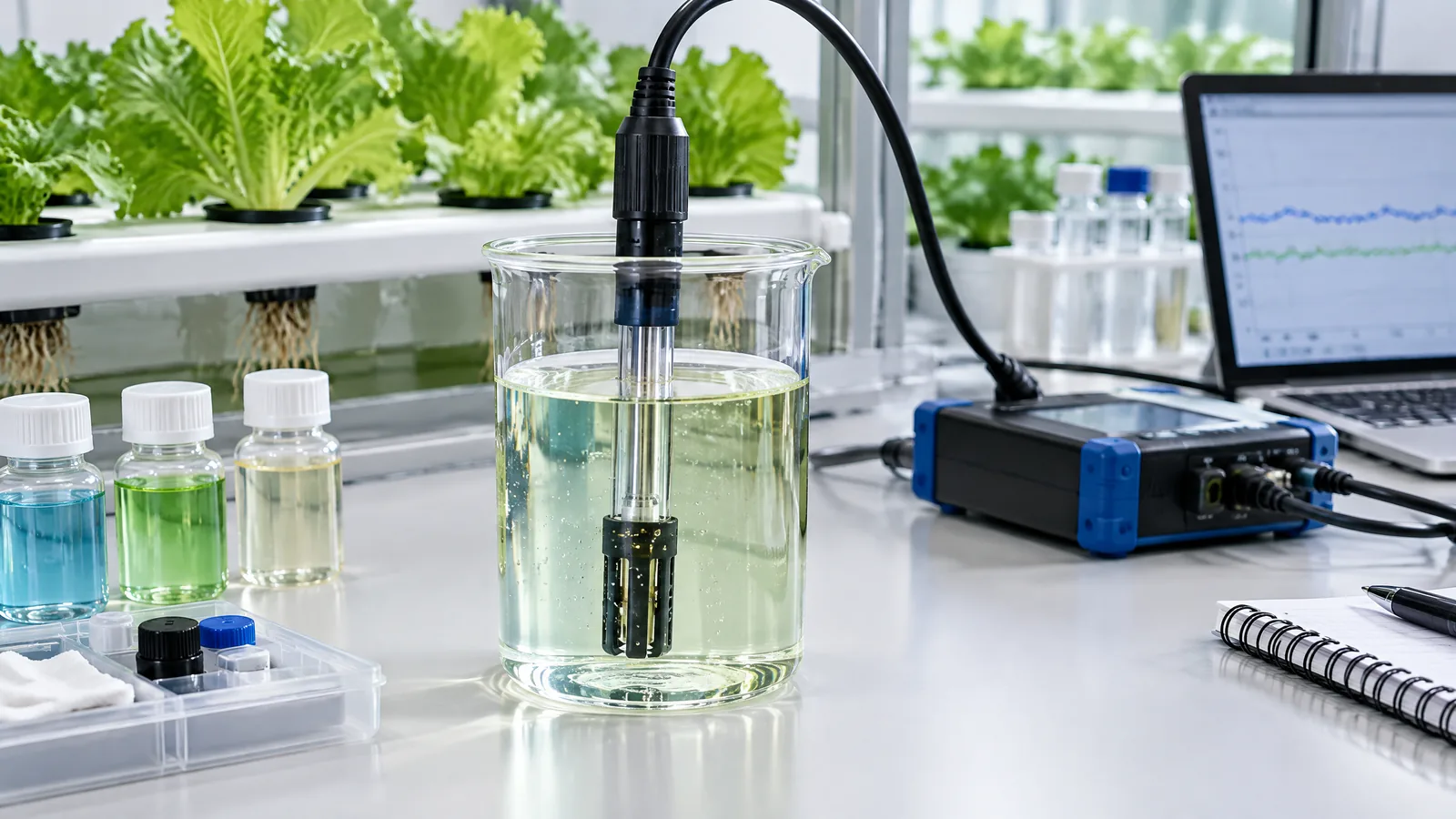
Your hydroponic reservoir can look clear while its electrical reading changes after water is added, nutrients are mixed or evaporation concentrates salts. An electrical-conductivity (EC) sensor measures how readily the solution conducts electricity through dissolved ions, giving a useful trend for water chemistry without identifying each nutrient or proving a TDS value.
This article is part of the computer hardware technology guide library.
Key takeaways
- An electrical-conductivity (EC) sensor measures conductance through ions in a liquid; it is an indirect indicator of total ionic content.
- The physical probe needs measurement electronics or a conditioning circuit, and an Arduino is an optional external logger or controller.
- Temperature, cell constant, calibration solution, bubbles, fouling and source-water chemistry can all change the reading.
- EC, salinity and TDS are related outputs in some instruments, but they are not interchangeable measurements.
- Use EC as a monitoring signal and check pH and other water-quality properties separately when the application requires them.
What does an electrical-conductivity (EC) sensor measure?
An electrical-conductivity (EC) sensor measures the conductance of a liquid between electrodes and converts that electrical behaviour into conductivity, commonly shown in µS/cm or mS/cm. Dissolved salts separate into positive and negative ions. Those ions carry charge, so a solution with more mobile ions will generally conduct more electricity. This makes EC useful for watching changes in a hydroponic reservoir.
The reading is not ion-selective. USP General Chapter 644 explains that conductivity responds to all ions and cannot, by itself, determine the precise concentration of a particular ionic species when the solution contains a mixture. In practical terms, an EC change can tell you that the solution’s overall ionic condition changed, but not whether nitrogen, potassium, calcium or another nutrient caused it.
This is why an EC sensor should support a monitoring workflow rather than replace water analysis or a complete nutrient-management plan. Source water already contributes ions, and evaporation, plant uptake and repeated top-ups can change the mixture even when the displayed EC looks familiar.
The probe is only one part of an EC sensor system
The wetted physical sensor is usually a conductivity cell with at least two conductors separated by an insulator. A measurement circuit applies an alternating electrical signal, measures the response and calculates resistance or conductance. Alternating current helps reduce polarisation effects that could distort a reading at the electrodes.
For a data logger, the complete system normally contains four distinct parts: the probe in the liquid, an EC conditioning or measurement circuit, a temperature measurement path, and a logger such as an Arduino, Raspberry Pi or industrial controller. The Arduino is not the physical sensor. It reads a conditioned interface over the interface supported by that particular circuit and then stores, displays or transmits the result.
Some commercial modules bundle the conditioning electronics and firmware. For example, Atlas Scientific’s EZO-EC documentation lists conductivity, salinity and TDS outputs, temperature compensation, calibration functions and UART/I2C communication. Those are specifications for that module and its compatible probes, not universal features of every low-cost EC probe. Check the chosen circuit’s voltage, interface, supported cell constants and isolation requirements before connecting it to a logger.
Why cell constant matters
The cell constant accounts for the geometry of the electrodes: their effective area and separation. The same measured conductance can represent different conductivity values when the cell geometry changes, so the conditioning circuit needs the correct cell constant for the probe. Sensor families use different cell constants for different conductivity ranges.
Metrohm’s measurement guidance recommends choosing a cell for the expected sample range and determining the effective cell constant with a suitable standard. A standard that is far outside the sample’s range can produce poor calibration. The nominal value printed for a probe is a starting point; the effective value and the manufacturer’s calibration procedure take priority.
In a small hydroponic logger, record the probe model, cell constant and calibration standard alongside the data. That simple record makes it easier to tell a real reservoir change from a probe replacement or a configuration mistake.
Temperature compensation is not an optional detail
Conductivity changes with temperature. A reservoir reading taken in the morning can differ from a reading taken later even if the ionic mixture has not changed in the same way. USP guidance describes temperature measurement as part of compensation and notes that conductivity is commonly referenced to 25°C. The compensation coefficient depends on the solution, so a default setting is an approximation rather than a universal truth.
An EC system may use an embedded temperature device in the probe, an external temperature sensor or a model-specific input. Do not assume that adding a separate temperature sensor automatically makes the result correct: the conditioning circuit must support it, the temperature value must be in the right place, and the compensation method must match the application.
For repeatable logging, keep the probe position consistent, allow the solution to mix and settle, and record both the compensated EC and temperature when the system makes those values available. Trends are easier to interpret when readings are collected under similar conditions.
EC is not the same as TDS or salinity
EC is the electrical measurement. TDS is an estimated mass concentration derived from conductivity using a conversion factor, while salinity is a different way of describing dissolved salts and may use a specific scale. The conversion depends on the solution composition and the instrument’s model. Two instruments can show different TDS values from the same EC if they use different factors.
Treat the label on the display as a unit choice, not proof that the sensor identified the dissolved material. If a project logs EC for hydroponics, store EC with its units and temperature reference. If it also stores a TDS estimate, label it as an estimate and preserve the conversion setting. This avoids presenting a calculated number as a direct chemical analysis.
A practical monitoring workflow
Start by characterising the water and the expected operating range. Oklahoma State University Extension advises testing source water and explains that salts already present in water affect EC and pH. Choose a probe and conditioning circuit that cover the intended range, then select a calibration solution suited to that range.
Before logging a reservoir, calibrate the probe according to its documentation. Rinse it, place it in the calibration solution, wait for a stable value and apply the required one-, two- or three-point procedure. Keep the solution and probe clean. The OSU guide also recommends stirring the nutrient solution and allowing the reading to stabilise before using it for management decisions.
For a simple Arduino data logger, save a timestamp, EC value, temperature, units, calibration state and any configuration such as cell constant or TDS factor. Use a stable sampling interval rather than reacting to one unexplained spike. A dashboard can flag a sustained change for inspection, but it should not silently dose chemicals or make safety-critical decisions from an unverified reading.
Inspect the probe when the data becomes noisy or drifts. Bubbles, particles, residue, poor placement near a tank wall and incompatible wetted materials can affect the measurement. USP guidance specifically calls for avoiding bubbles or particles between electrodes and checking material compatibility. Follow the probe maker’s cleaning and storage instructions rather than improvising a chemical treatment.
| Part or setting | What it does | What to verify |
|---|---|---|
| Conductivity probe or cell | Interacts with the liquid and provides the electrical path | Cell type, range, cell constant, wetted-material compatibility |
| EC conditioning circuit | Excites the cell and converts its response into a usable reading | Supply voltage, interface, calibration process and temperature input |
| Temperature sensor | Measures the temperature used for compensation | Placement, supported sensor type and compensation reference |
| Arduino or other logger | Stores, displays or transmits readings | Voltage levels, sampling interval, units and configuration records |
Limits to keep in view
An EC sensor cannot identify a nutrient, prove that a plant received the right ratio, or certify water as safe to drink. It also cannot make readings comparable when probes, units, temperature references or calibration procedures change without being recorded. A stable EC number can hide a changed ionic mixture, while a sudden number can be caused by temperature, mixing, fouling or a wiring problem.
For beginner projects, the safest design is observational: log the reading, compare it with the grower’s established operating guidance, and investigate persistent changes with appropriate measurements. Keep pH as a separate measurement, and use laboratory or professional testing when a regulated or high-consequence water-quality decision is involved.
Frequently asked questions
Can I connect an EC sensor directly to an Arduino analog pin?
Usually not without checking the sensor design. Many conductivity cells require an AC excitation and a dedicated conditioning circuit. Connect the Arduino to the interface specified by the conditioning module, such as a supported analog, UART or I2C output, and verify voltage levels first.
Does a higher EC always mean more useful nutrients?
No. Higher EC generally means more total ionic content, but EC responds to all ions. It cannot show whether the increase came from the desired nutrients, source-water salts or concentration caused by evaporation.
Why does my EC value change when the reservoir gets warmer?
Conductivity is temperature-dependent. Use a temperature sensor and a compensation method supported by the probe and conditioning circuit, and compare readings using the same temperature reference.
Is EC the same as TDS?
No. EC is the measured conductivity. TDS is an estimate derived from conductivity using a conversion factor, and that factor depends on the solution and instrument. Store the EC value and label any TDS result as an estimate.
How do I know whether an EC reading is trustworthy?
Check the cell constant, calibrate with a suitable standard, allow the solution to mix and stabilise, inspect the probe for bubbles or residue, and record temperature and units. If the result still conflicts with other observations, verify it with a separate meter or appropriate water analysis.
About the image
AI-generated editorial illustration; not an actual product or mission photograph.
Source notes
Reporting record
techduopulse stores source destinations privately. Public notes remain non-clickable so every visitor journey stays on this website.
Source note: Atlas Scientific EZO-EC technical documentation; conductivity, calibration, temperature compensation and interfaces
Primary source · Model-specific module capabilities and distinctions between EC, salinity and TDS outputsSource note: USP General Chapter 644; ion response, cell constant, AC measurement, temperature compensation and measurement limitations
Primary source · Definition, apparatus, cell constant, temperature dependence and avoiding bubbles or particlesSource note: Oklahoma State University Extension fact sheet HLA-6722; hydroponic EC meaning, calibration and stabilisation practice
Primary source · Dissolved ions, source-water effects, buffer calibration and hydroponic monitoring workflowSource note: Metrohm technical measurement guide; cell selection, standards, temperature dependency and stirring consistency
Primary source · Cell constant determination, suitable calibration range and temperature-compensation cautionsNew application article for hydroponic water-chemistry logging. Defines the physical EC probe separately from conditioning electronics and an optional Arduino logger; explains cell constant, temperature compensation, calibration and fouling; separates EC from TDS and salinity; and avoids regulated-water, medical, nutrient-identification and automated dosing claims.


